Metatron is the greatest of all the angels in Jewish mysticism: the supreme archangel, the “Prince of the Divine Presence,” the heavenly scribe who records the deeds of the world, and the angel who was once the mortal patriarch Enoch, taken up to heaven and transfigured into the mightiest of celestial beings. He stands closest of all to the divine Throne, an angel almost beyond the angels.
The Angel Who Was a Man
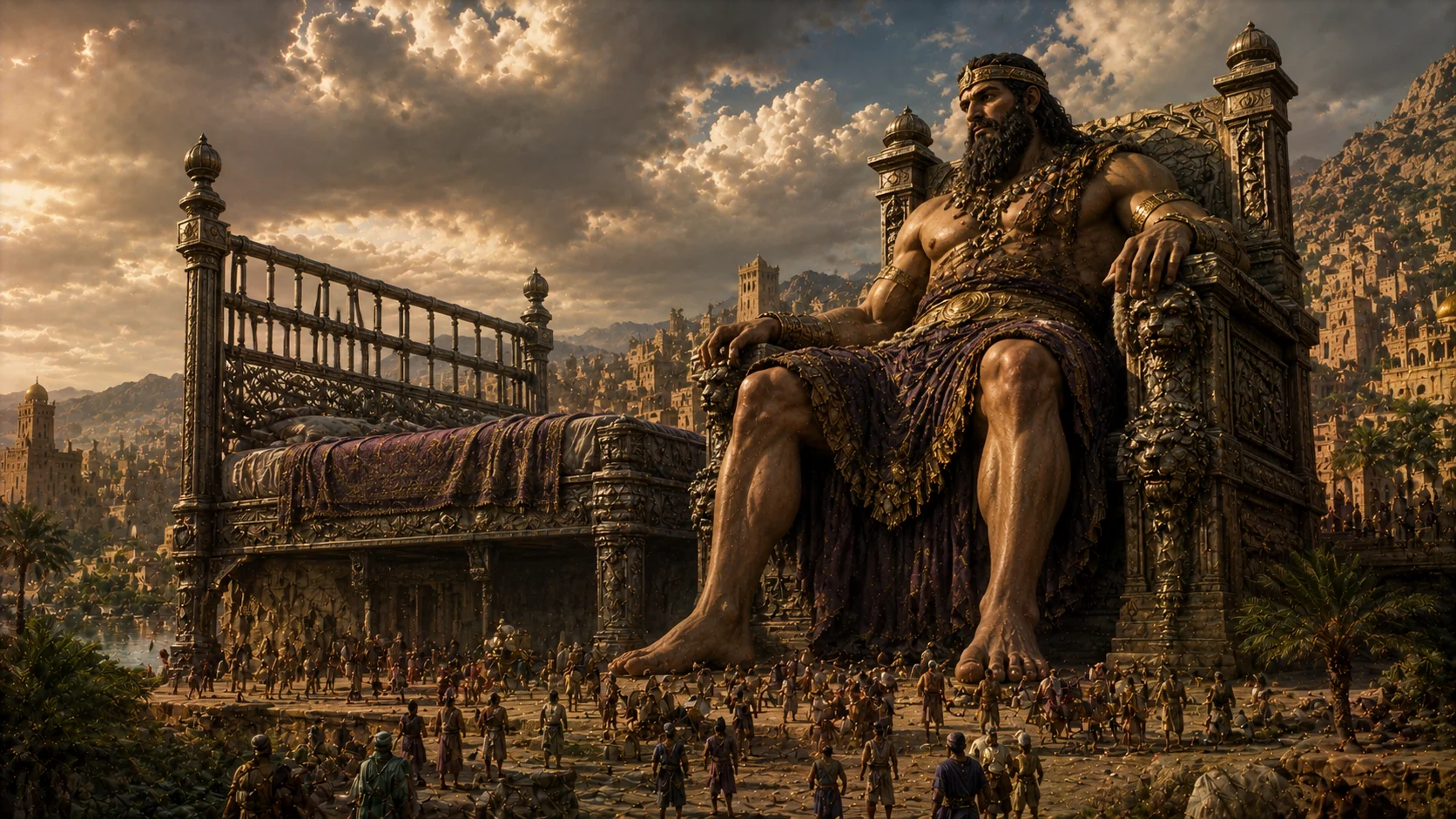
Metatron’s most extraordinary aspect is his origin. In the mystical tradition, he was once a human being — the patriarch Enoch, who “walked with God and was not, for God took him” (Genesis). Enoch, for his perfect righteousness, was taken up bodily into heaven and there transfigured, his flesh turned to flame, his body grown to cosmic size, and he was made into Metatron, the supreme angel — the one being who rose from humanity to become the greatest of the celestial host. (His celestial twin, the prophet Elijah transfigured, became the angel Sandalphon.)
The Lesser YHWH and the Scribe
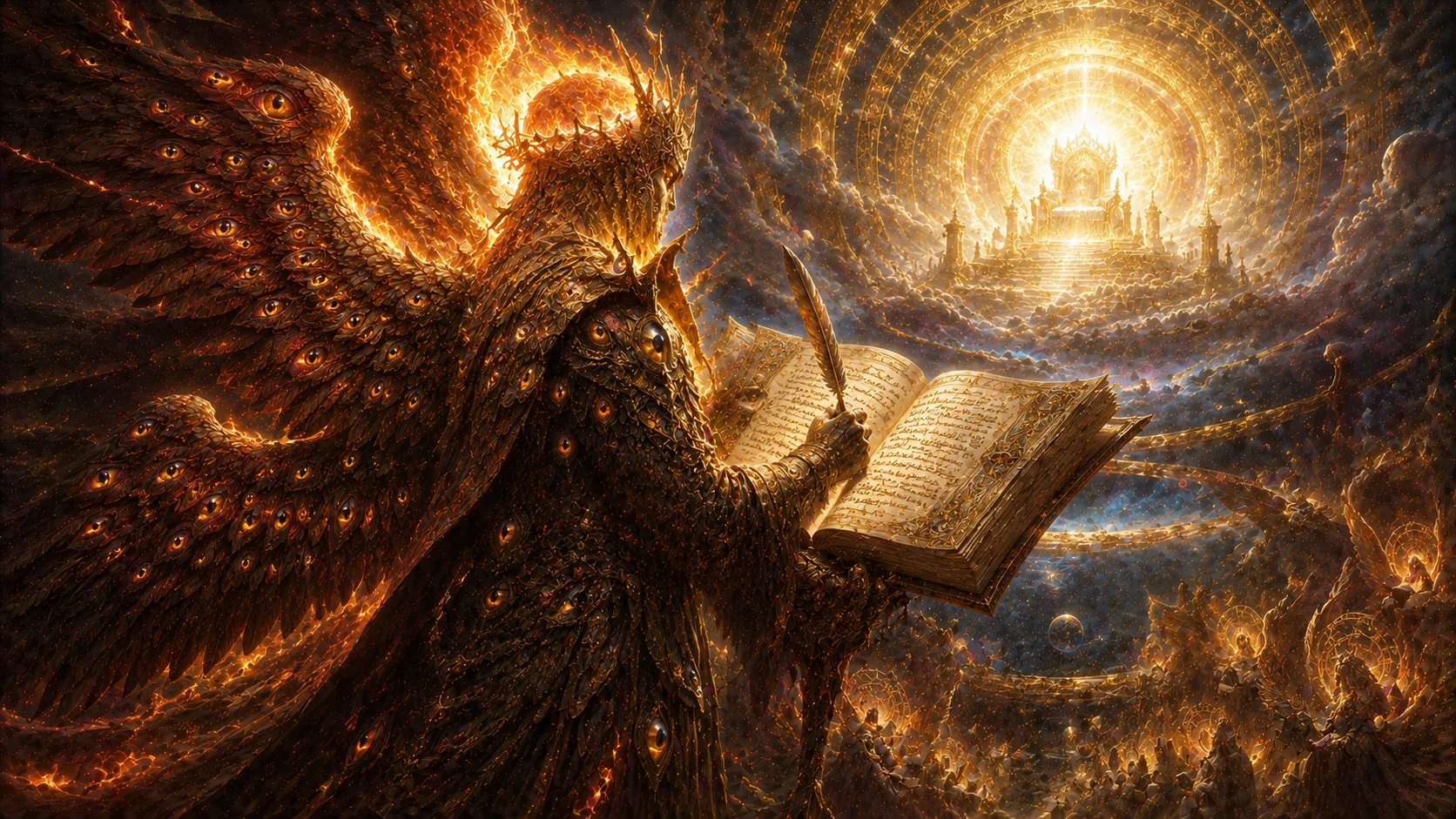
Metatron holds titles of staggering exaltation. He is called the “Prince of the Countenance” or “Prince of the Divine Presence” (Sar ha-Panim), the angel who stands before the very face of God; and, most strikingly, the “Lesser YHWH” — a title of such closeness to the divine that it caused theological controversy. He is the great heavenly scribe, who records all the deeds done in the world in the celestial books, and a teacher of the righteous dead in the heavenly academy. He governs the angelic hosts and the order of the heavens, second only to God.
The Prince of the Presence
In the Merkabah and Kabbalistic traditions, Metatron is a figure of immense importance — the link between the human and the divine, the angel who was a man, the scribe and the prince who stands at the summit of the created order before the Throne of Glory. His vast stature, his flaming form, his many eyes and wings, and his supreme rank made him the subject of profound mystical speculation. In Metatron, Jewish mysticism gave form to the highest of the angels and the hope of human transfiguration — the patriarch Enoch raised to become the supreme archangel, the heavenly scribe and Prince of the Divine Presence, the mightiest celestial being who stands closest of all to God.
The Name No One Can Explain
Every other archangel’s name is a small Hebrew sentence: Micha’el, “who is like God”; Gavri’el, “strength of God”; Rapha’el, “God heals.” Metatron’s name does none of this — it resolves into nothing in Hebrew at all, and the texts that first use it never pause to explain where it came from. That silence has kept commentators and scholars arguing for more than a thousand years. One old proposal reads it as a Greek compound, meta thronon, “beside the throne,” a fitting title for an angel whose entire office is standing nearest to God’s seat. Another points to the Latin metator, the officer sent ahead of an army to measure and mark out the next camp — a word already borrowed into rabbinic Hebrew, and one that chimes with the promise in Exodus of an angel sent before Israel to guard it on the way. A third and more provocative line hears an echo of Mithra, the Iranian god of covenant and light, re-clothed in Jewish dress during the centuries when Persian and Hellenistic ideas moved freely through the Near East. None of them settles the question, and the sources offer no help: some manuscripts spell the name with six Hebrew letters, others with seven, and the six-letter form carries the same numerical value, 314, as the divine name Shaddai — an arithmetic coincidence that Kabbalists, unsurprisingly, declined to treat as coincidence.
Two Powers in Heaven
The most dangerous idea in early Jewish mysticism began with a rabbi who looked up and saw an angel sitting down. The Babylonian Talmud, in tractate Chagigah, tells of four sages who entered the celestial orchard, the Pardes: Ben Azzai looked and died; Ben Zoma looked and lost his mind; Elisha ben Abuyah looked and became a heretic, remembered ever after only as Aher, “the Other”; and Rabbi Akiva alone entered in peace and departed in peace. What broke Aher was Metatron. There is no sitting on high — the celestial court knows only standing — yet Aher saw Metatron seated, permitted to sit while he wrote down the merits of Israel. From that single glimpse he drew a catastrophic conclusion: perhaps there are two powers in heaven. The response fell on the angel rather than the man. Metatron was brought out and struck with sixty lashes of fire, and asked why he had not risen when Aher appeared; he was then given leave to erase Aher’s merits from the record. Readers have been turning the scene over ever since, because the logic of the punishment is also its point: whatever else Metatron may be, he is a being who can be flogged, and a being who can be flogged is not a second god.
Seventy Names, and One That Makes No Sense
The Hekhalot text known as 3 Enoch, or Sefer Hekhalot, does something almost no other angel receives: it gives Metatron seventy names, an accumulation so vast that it reads less like a set of titles than an attempt to exhaust language in his praise. Among the strangest is one that appears, on its face, to contradict everything else said of him: Na’ar, “the Youth.” A being whose stature was enlarged to the height and breadth of the world, second only to God, is addressed as a boy. The text supplies its own explanation, and it is a good one — he is Enoch son of Jared, and among the angels he is young in days and months and years, junior to a host that existed before the world’s first morning, still new to an office he has held only as long as human history has run. Alongside it stands Sar ha-Olam, “Prince of the World,” the title under which Metatron governs the affairs of the lower creation on God’s behalf. A being with seventy names is a being the tradition could not stop describing — each new name a fresh attempt to say the same impossible thing.
The Prophet Raised to a High Station
Enoch’s ascent did not stay inside one tradition. The Qur’an names a prophet called Idris, “a man of truth, a prophet,” of whom it says that God “raised him to a high station” — language specific enough that Islamic tradition has long identified Idris with the Enoch of Genesis. In accounts of the Prophet Muhammad’s night journey, the Mi’raj, Idris is encountered in one of the heavens, already established there among the righteous. In Islam he remains a prophet and not an angel; the transfiguration into the supreme prince of the heavenly host belongs to the Jewish mystical tradition alone. But the shared root is unmistakable, and the shape of the memory is the same on both sides of it: a righteous man taken up alive, spared the ordinary human ending, and honoured ever after for having crossed a threshold nobody else returns from.
A Vessel for the Unbearable Light
By the time Metatron reaches the Zohar and the later currents of Kabbalah, he has become something more architectural than narrative — not simply a character in a story but a position on the map of creation. Kabbalists commonly describe him as the garment or vessel through which the divine light, too intense for any creature to receive directly, is stepped down and made bearable: the interface at which unlimited emanation meets a finite being that would otherwise be annihilated by it. He is set at the threshold between the world of the sefirot, the divine attributes, and the worlds of angels and matter beneath them — the last rung from which the descent into creation can still be called, in some sense, divine. It is a role that keeps faith with everything the earlier texts already say of him, while translating it into the abstract vocabulary Kabbalah uses for everything: he is not only the being who serves closest to God, he is the place where closeness to God stops being lethal and becomes something a creature can survive.
From the Hekhalot to the Multiplex
Metatron’s afterlife outside religious texts has been unusually vivid for an angel most people cannot name. Kevin Smith’s 1999 film Dogma put him in front of a mass audience in the form of Alan Rickman, announcing himself with weary precision as the voice of God — a herald who speaks in God’s place because no human could withstand the divine voice directly. The premise lightly distorts the tradition but keeps its essential shape: an intermediary exalted enough to stand in for the unbearable. The television series Supernatural later recast Metatron as the literal scribe of God, jealous of his archive and willing to rewrite heaven’s rules to seize power in the Almighty’s absence — a modern dramatisation of the exact anxiety the Talmud voiced more than a millennium earlier, that a being standing this close to the Throne might begin to think the Throne was his. Even the geometric figure sold today as “Metatron’s Cube,” drawn out of the Flower of Life pattern and said to encode the five Platonic solids, belongs to this afterlife rather than to the ancient sources: it is a modern esoteric emblem with no footing in the Hekhalot literature or in historical Kabbalah, borrowing the name for its authority. That an angel whose entire story grows out of one elliptical clause about a man who walked with God should end up lending that name to sacred geometry, network television and a Kevin Smith comedy says something about the durability of the underlying idea — a created being who stood so close to the infinite that the tradition could never quite decide where he ended and the divine began.
Sources & traditions
- EncyclopediaWikipedia — Metatron
- TraditionJewish/Kabbalistic texts, grimoires and later commentary
Myths change from area to area and from time to time. This chronicle follows the most widely told versions; tellings in other villages, regions and eras may differ.