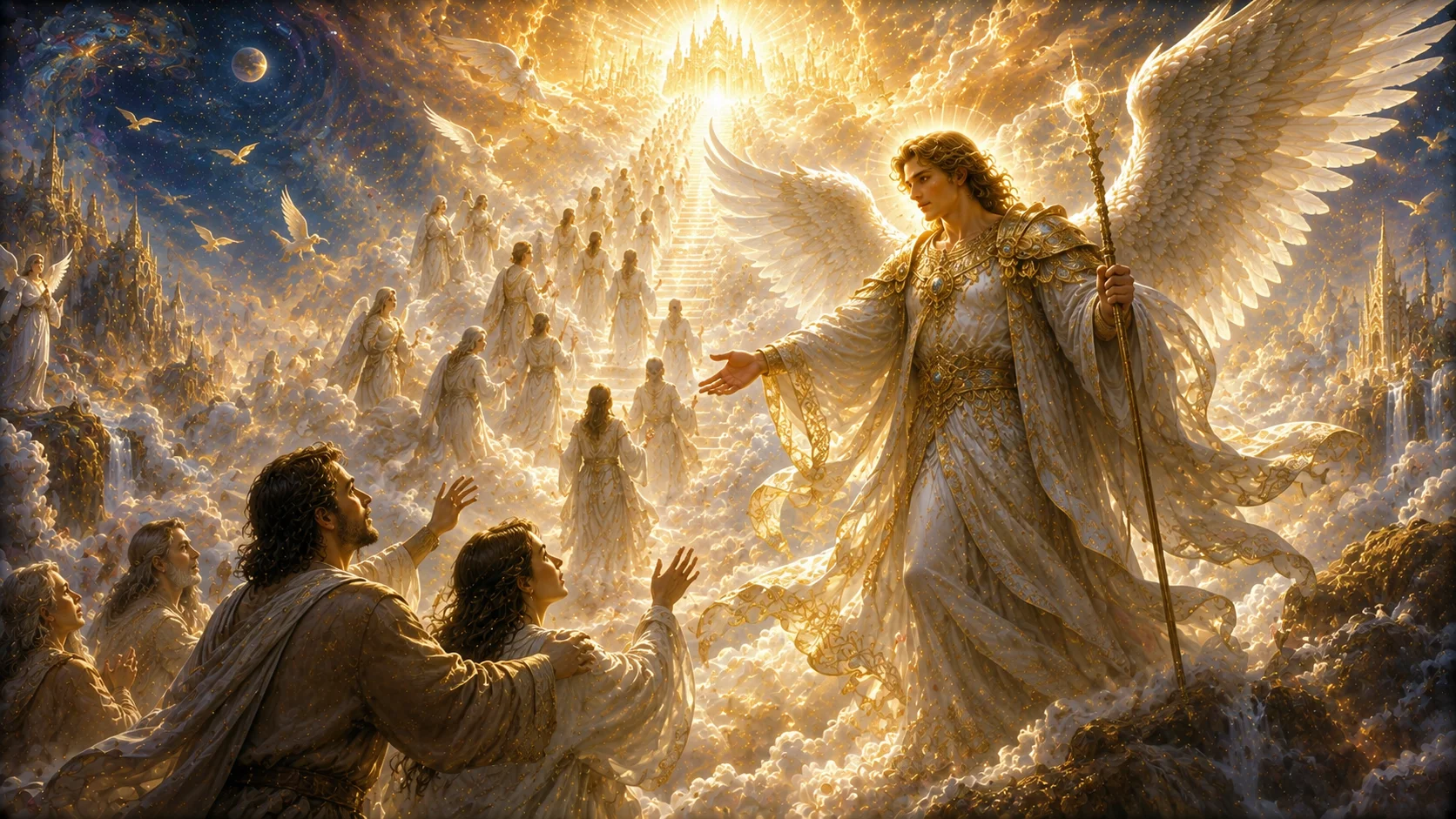
Remiel — “the Mercy (or Thunder) of God” — is the archangel of hope, divine visions, and the souls of the dead in Jewish tradition: the angel who guides the souls of the faithful to heaven, who grants true visions and hope, and who, in the apocalyptic writings, is one of the holy angels set over the resurrection and the destiny of souls. He is the hope and the guide of the dead.
The Mercy of God
Remiel (Ramiel, Jeremiel, “the mercy of God” or “thunder of God”) is named in the Book of Enoch as one of the seven holy archangels — “Remiel, whom God set over those who rise” — the angel set over the resurrection and the rising of souls. His office is bound to hope, to divine visions, and to the souls of the dead: he is the angel who guides the souls of the faithful on their journey to heaven, who grants prophetic and true visions, and who presides over the hope of resurrection and the destiny of the soul after death.
The Guide of Souls and Granter of Visions
Remiel is the angel of hope — the bringer of divine hope to the despairing, the comforter who turns the soul toward the light of God’s mercy. He is also a granter of true visions and prophetic dreams (in the apocryphal tradition, it is Remiel/Jeremiel who interprets visions and reveals what is to come), and a guide of souls, escorting the faithful dead to their heavenly reward and presiding over the resurrection at the end of days. He is associated with thunder (a sign of divine power and revelation) and with the merciful guidance of the soul.
The Hope of the Resurrection
Remiel is invoked for hope, for true visions and guidance, for comfort in despair, and for the safe passage of souls. As one of the seven archangels and the angel set over the rising of the dead, he holds an important place in the apocalyptic and angelic tradition, the angel of hope and the guide at the threshold of the world to come. In Remiel, Jewish tradition gave form to hope and the destiny of souls — the archangel of the mercy of God who grants true visions and divine hope, guides the souls of the faithful to heaven, and presides over the resurrection, the hope and the guide of the dead at the threshold of eternal life.
The Angel Who Refused to Be Worshipped
A seer falls on his face before a figure of enormous light, and the figure tells him to stop. It is one of the strangest moments in the whole literature of angels, and it belongs to Remiel.
In the Coptic text known as the Apocalypse of Zephaniah, the visionary is taken through the places of the dead and meets a being so vast and so luminous that he does exactly what any of us would do — he throws himself down to worship. The angel stops him: “Do not worship me. I am not the Lord Almighty, but I am the great angel Eremiel, who is over the abyss and Hades, the one in which all of the souls are imprisoned from the end of the Flood, which came upon the earth, until this day.” Eremiel is generally taken to be the same figure the other apocalypses call Remiel, Ramael or Jeremiel — the name wanders between languages the way all these names do.
Two things in that refusal are worth sitting with. The first is that his jurisdiction is not the pleasant one. He is not introduced as the escort of the blessed but as the keeper of the abyss, the warden of a prison that has been filling since the Flood. The second is the refusal itself. Here is a power great enough to be mistaken for God by a man who has spent his life thinking about God — and the entire content of his first speech is a correction of that mistake. In a tradition perpetually anxious about the worship of intermediaries, Remiel is the intermediary who polices the boundary himself.
The Name That Appears on Both Lists
Open the Book of the Watchers at its sixth chapter and you find a roll-call of the two hundred angels who came down on the summit of Mount Hermon, bound themselves by a mutual oath, took human wives and taught mankind the things it was not supposed to know. Among the chiefs of tens is a Ramiel. Turn fourteen chapters on, to the passage that lists the holy archangels and their offices, and there he is again — Remiel, one of the holy ones, set by God over those who rise.
Fallen and unfallen, in the same book, under what is very nearly the same name. Later readers have tried to resolve this in every possible direction: two different angels whose names collided in transmission; one angel remembered two ways; a scribe’s duplication in a list that is visibly corrupted — the sixth chapter contains several names that look like variants of one another, and a Rameel stands only four places from its Ramiel. The manuscripts do not help. The surviving Greek of the archangel list gives seven names with Remiel last; the Ethiopic gives six, and he is simply not there. He is the archangel most likely to go missing from his own roll-call.
This instability is not a defect of the tradition — it is the tradition. These lists were copied, translated, abridged and re-expanded across centuries and several languages before anyone thought to fix them. Remiel is what an archangel looks like when you can still see the seams.
Thunder, or Mercy
The disagreement over what his name means is older than any of the translations that carry it. Hebrew ra’am is thunder; the root raham gives compassion, the womb-deep pity of God. Read the name one way and he is the crash over the mountain; read it the other and he is the mercy that the crash turns out to be announcing.
The variant Jeremiel pulls toward a third form: the ordinary Hebrew name Jerahmeel, “God has compassion” — which in the Hebrew Bible belongs not to an angel at all but to a clan of Judah. The Jerahmeelites held grazing land in the southern desert, and their name surfaces in one of the less edifying scenes of the David story: sheltering among the Philistines and raiding elsewhere entirely, David tells his host he has been striking the Negeb of the Jerahmeelites. Before it was the name of a power over the dead, it was somebody’s great-grandfather. That is true of a great many angelic names, and it is worth remembering when the lists start to sound like a hierarchy designed from above rather than a vocabulary assembled from below.
The Angel Who Answers “How Long?”
The most human thing in Remiel’s dossier is a complaint.
In 4 Ezra — the apocalypse preserved in Latin as chapters three to fourteen of 2 Esdras, written in the shattered decades after the destruction of the Second Temple — the seer is told about the souls of the righteous waiting in their chambers, the storehouses where the dead are kept until the end. They are not serene. They ask: “How long are we to remain here? And when will the harvest of our reward come?” And it is Jeremiel the archangel who answers them: when the number of those like yourselves is complete.
Almost the same scene appears at almost the same moment in another apocalypse — the souls under the altar in the Revelation of John, crying “how long” and being told to rest a little longer until their number is filled. Two communities, writing in different languages out of the same catastrophe, imagined the dead asking the identical question. In one of them the question has an addressee, and his name is Jeremiel.
This is the office that makes him worth knowing. Remiel is not, in the end, the angel of death; death has plenty of angels. He is the angel of the interval — the one who stands in the long silence between a person dying and anything happening about it, and who is expected to explain the delay. Every tradition that promises a resurrection creates that silence, and the silence needs staffing.
Ramael and the Twelve Waters
In 2 Baruch, the Syriac apocalypse that is 4 Ezra’s closest sibling, he acquires a job title: Ramael — or Ramiel; the spelling wobbles here too — the angel who presides over true visions.
Baruch has seen a cloud rise from the sea and pour water over the earth, black and then bright and then black again, twelve times over, the last black water heavier and more terrible than all the others, and then a lightning-flash brighter than anything before it. The vision means nothing to him. Ramael comes to make it mean something: the waters are the ages of the world, dark reign following bright, ending in the worst of them and then in the lightning. The angel of true visions exists because a vision that no one interprets is indistinguishable from a bad dream. His gift is not the image; it is the reading of the image — and the guarantee, in a genre thick with false prophets, that this particular reading is not the dreamer’s own wishful thinking.
The same book hands him a harder assignment. Interpreting the eighth bright water as the reign of Hezekiah, Ramael describes what he himself did when the Assyrian army lay encamped against Jerusalem: the Mighty One commanded him, and he went out and destroyed their multitude, “the number of whose chiefs only was a hundred and eighty-five thousand.” It is a small masterpiece of escalation. The anonymous destroyer of the Book of Kings is finally given a name — and the famous figure from Kings, the whole slaughtered host, is demoted in passing to a count of the officers.
Why There Had to Be Seven
The number came first. The names were fitted to it afterwards.
In the Book of Tobit, Raphael identifies himself as one of the seven holy angels who carry the prayers of the saints into the presence of the Glory; the Revelation of John knows seven angels who stand before God. But when the Qumran community wrote its War Scroll and set archangel names on the shields of the towers, it inscribed four: Michael, Gabriel, Sariel, Raphael. Remiel is not among them. The seven-fold court and the four-fold guard coexisted for generations without anyone reconciling them.
What the twentieth chapter of 1 Enoch does — and this is why it matters out of all proportion to its length — is give the seven not just names but portfolios. Uriel is over the world and over Tartarus; Raphael over the spirits of men; Gabriel over Paradise and the serpents and the Cherubim; and Remiel, last in the surviving Greek, is “set over those who rise”. It is the shortest job description of the seven and the largest job. The Greek verb behind “those who rise” is the ordinary word for standing up — the same word the earliest Christian writers reach for when they mean rising from the dead. Remiel is posted at the moment when what was lying down stops lying down.
Where He Is Still Named
The Latin West eventually lost its nerve about angel names. Rome came to restrict liturgical honour to the three that appear in scripture, and the wider catalogue — the seven of Enoch, with their offices and their titles — drifted out of official worship and into private prayer, magical literature and the margins of manuscripts.
The Christian East never made that decision in the same way. In the Orthodox churches the archangels are commemorated together in the Synaxis of the Archangel Michael and the Other Bodiless Powers, kept on the eighth of November, and the company honoured there is larger than three: alongside Michael, Gabriel, Raphael, Uriel, Selaphiel, Jegudiel and Barachiel, some reckonings add an eighth, Jeremiel. In icons of the assembly each is known by what he carries — Michael his spear with its white banner, Selaphiel his hands folded at the breast in prayer, Barachiel a white rose — and Jeremiel holds a pair of balance-scales, the weighing of what a life turned out to contain.
The Ethiopian Orthodox Tewahedo Church went further than anyone with the source itself. There the Book of Enoch is not apocryphal; it is canonical scripture, copied and read in Ge’ez. The irony is exact, and worth stating plainly: the one church that kept the book inside its Bible reads it in precisely the manuscript tradition from which the archangel Remiel drops out. What that Bible holds securely is the other Ramiel — the chief of tens on the mountain, still standing in the sixth chapter where the trouble began.
The Afterlife of an Unassigned Name
Modern fiction has been drawn to Remiel for a reason that would have amused the copyists: he is the archangel nobody else has claimed. Michael comes freighted with a thousand years of armour, Gabriel with the Annunciation, Raphael with the fish and the healing. Ramiel arrives with authority and almost no baggage — a resonant name and a blank space where the iconography should be, which is precisely what an inventor of worlds wants.
So he becomes, in Neon Genesis Evangelion, a silent blue octahedron hanging over a city and burning through it with a light that does not look like violence until it is — an image with almost nothing to do with the ancient texts, which nonetheless keeps their essential note of a power too large and too indifferent to argue with. Elsewhere he becomes a prince of hell in American television horror, sliding back toward the fallen Ramiel of Enoch’s sixth chapter. Both readings were already in the manuscripts. The tradition handed the modern world a name that could go either way, and the modern world took both options.
Why the Angel of the Rising Persists
Most cultures appoint someone to walk the dead to wherever the dead go. What is unusual about Remiel is that his work does not end at the door. A ferryman’s task is finished when the passenger is across; Remiel’s task is the waiting on the other side, the enormous unmeasured pause between a burial and a promise, and the answering of a question that the promise itself creates.
That is the anxiety underneath him, and it is not an ancient one. Anybody who has stood at a graveside holding the belief that this is not the end has also, in the same breath, wanted to know when — and has felt how thin the space between those two thoughts is. The apocalyptic writers did something remarkable with that discomfort: instead of suppressing the impatience of the dead, they wrote it down, put it in the mouths of the righteous, and then invented someone to answer it. Remiel is the shape that hope takes when it is honest about how long it is being asked to wait.
Sources & traditions
- TraditionJewish/Kabbalistic texts, grimoires and later commentary
Myths change from area to area and from time to time. This chronicle follows the most widely told versions; tellings in other villages, regions and eras may differ.