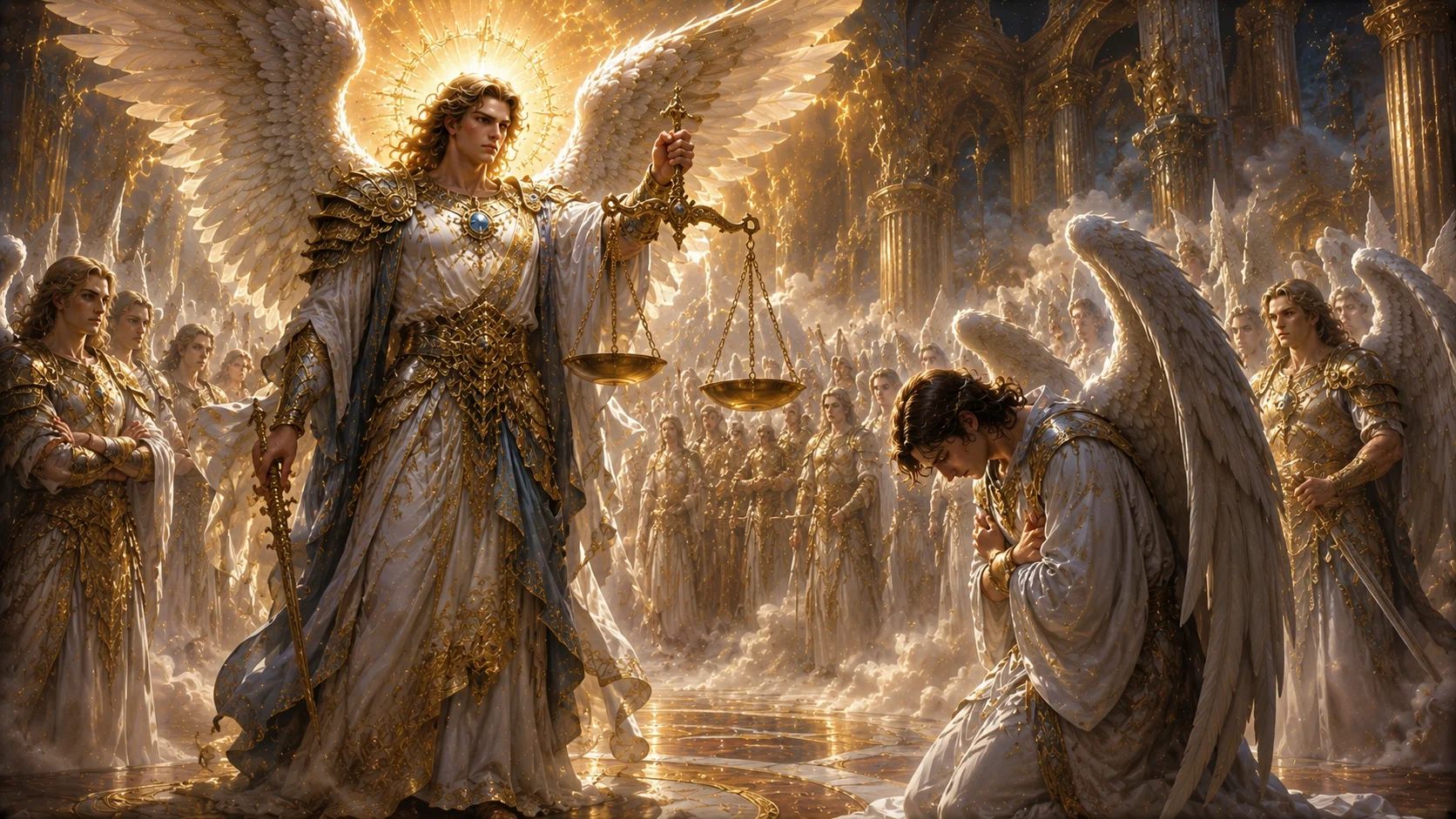
Raguel — “the Friend of God” — is the archangel of justice, harmony, and order among the angels in Jewish tradition: the angel who oversees the conduct of the other angels and ensures they act justly, the watcher who brings the wayward to account, the guardian of fairness and divine order in the heavens. He is the justice of heaven, even among the angels themselves.
The Friend of God
Raguel (Raguil, Reuel, “the friend of God”) is the archangel of justice, fairness, harmony, and order — named in the Book of Enoch as one of the holy angels, “who takes vengeance on the world of the luminaries” and watches over the conduct of the heavenly host. His distinctive office is the oversight of the other angels: Raguel is the angel who ensures that the angels themselves behave justly and in accordance with the divine order, who watches over their conduct and brings to account any who stray. He is, in a sense, the guardian of justice and harmony within heaven itself.
The Watcher of the Angels
Raguel’s role as the overseer of the angels makes him a unique and important figure — the angel of angels’ justice, the one who maintains order, fairness, and right conduct among the celestial host, and who, in the apocalyptic traditions, plays a part in the final judgment, bringing the fallen and the wayward (even fallen angels) to account. He is associated with harmony, balance, and the resolution of disputes, the angel who restores fairness and order where it has been broken.
The Justice of Heaven
Raguel is invoked for justice, fairness, harmony, balance, and the resolution of conflict — the angel who upholds what is right and brings the wayward to account. He is counted in some traditions among the seven archangels who stand before the Throne, his sphere being justice and the oversight of the heavenly order. As the “friend of God” who guards the justice of the angels, he holds an important place. In Raguel, Jewish tradition gave form to justice and harmony among the angels — the archangel who oversees the conduct of the heavenly host, ensures they act justly, brings the wayward to account, and upholds the fairness and order of heaven itself, the friend of God and the justice of the angels.
A Name Borrowed from a Mortal
Before it belonged to an archangel, the name belonged to a man. In the book of Exodus, Reuel is the priest of Midian who takes in a fugitive named Moses — gives him a home, a flock to tend, and eventually a daughter as a wife. The Greek and Latin Bibles render that same Hebrew name as Raguel, so a reader of the Septuagint or the Vulgate meets the archangel’s exact name attached to a Midianite herdsman. The man is a knot in his own right: Exodus calls him Reuel in one chapter and Jethro in the next, Numbers makes Hobab his son, and Judges calls Hobab the father-in-law instead — a tangle the text never quite unties. The Hebrew itself is plain and domestic, built on a root that carries both companionship and the pasturing of animals, and it has accordingly been read as “friend of God” and as “God shall pasture.” Either way it is a shepherd’s name, the kind a father actually gave a son. Whoever assembled the angelic rosters of the Enoch literature centuries later was not inventing a word out of nothing. He took one that already meant faithfulness in ordinary speech and pinned it to a being who stands in the sky.
The coincidence goes a layer deeper. In the Book of Tobit — the book that gave Raphael his fish and his walking staff — there is another Raguel: Sarah’s father at Ecbatana, who welcomes a travelling stranger, hands him his daughter, and draws up the marriage contract himself. Twice, in two separate scriptures, the name lands on a father-in-law, the man who takes an outsider in and makes him family. It is an odd pedigree for a being whose own office would turn out to be scrutiny rather than welcome.
Watcher Over the Sky Itself
Chapter 20 of 1 Enoch reads like a court roster, each of the seven holy angels handed a portfolio: Uriel over the world and Tartarus, Raphael over the spirits of men, Michael over the best part of mankind, Gabriel over paradise and the cherubim. Raguel’s charge is the one quoted above — vengeance upon “the world of the luminaries” — and it is worth pressing on what that phrase actually covers: the sun, the moon, the stars, and the fixed courses they are supposed to keep. The assignment only makes sense against the collection it sits in. A later section of the same book, the Astronomical Book, is preoccupied almost to the point of tedium with the correct workings of the heavens: a 364-day solar calendar, the gates through which sun and moon are said to rise and set, the exact count of days each season should hold. Whole chapters are given over to nothing but the mechanics of the sky — and to the warning that in the days of the sinners the seasons themselves will run wrong and the moon will alter her order. In that worldview, disorder overhead was not a metaphor. It belonged to the same category of crime as a corrupt judge or a broken oath, and someone had to be the angel who noticed when a star strayed from its lane. Raguel is that angel: justice extended past the conduct of men and angels into the physical architecture of the universe.
The shape of the idea has a history of its own. Named spirits with fixed departments — an angelic civil service rather than one undifferentiated host — becomes prominent in Jewish writing during the Second Temple period, after generations under Persian rule, and scholars have argued for well over a century about how much that owes to Zoroastrian religion, which ranked its own beings, the Amesha Spentas, each presiding over a named domain. The argument is not settled and may never be. But Raguel’s portfolio did not take shape in a vacuum.
Struck from the Register in Rome
The name travelled west with the Enoch tradition, and it surfaces in an awkward place: the prayers of a wandering Frankish cleric named Aldebert, who had gathered a following and was invoking eight angels by name at once. In 745 a council convened at Rome under Pope Zachary took up his case. The verdict was blunt. Scripture the Latin church accepted named only three angels — Michael, Gabriel and Raphael — and the rest of the names in Aldebert’s prayer, Raguel among them, were pronounced demons wearing angelic titles. The ruling did what rulings of that kind do. It did not erase belief outright; it starved it of the institutions that would otherwise have kept it alive. No feast was set for Raguel in the Latin calendar, and no attribute settled on him the way a sword settled on Michael. He passed out of Western devotion less because anyone refuted him than because after 745 no painter had a commission to depict him and no priest had a liturgy in which to say his name.
Kept Alive Where Rome’s Writ Did Not Run
A Roman council could bind only the church that answered to Rome. Ethiopia never did. The Ethiopian Orthodox Tewahedo Church assembled its Old Testament canon independently of the Latin and Byzantine worlds and kept 1 Enoch inside it as scripture proper rather than apocrypha — almost alone among the Christian traditions in doing so. For more than a thousand years the complete text survived nowhere else. European scholars knew the book only through a handful of Greek excerpts and secondhand quotations, until the Scottish traveller James Bruce brought three Ge’ez manuscripts out of Ethiopia to Europe in 1773 and the West recovered a scripture its own church had let go dark. That manuscript history is also Raguel’s survival story. Ethiopian tradition names its seven archangels as Michael, Gabriel, Raphael, Uriel, Raguel, Phanuel and Remiel, and it kept the sky-portfolio attached to him: he is remembered there as the archangel set over the lights, the sun and the moon and the stars. In that tradition he is not a curiosity recovered from an old book. He is scripture still read, still preached, and still prayed with.
An Archangel With No Face in the West
Walk into a European church old enough to have commissioned its own art and you can pick the archangels out by their gear: Michael by the raised sword and the scales, Gabriel by the lily or the scroll, Raphael by the fish and the walking staff that come straight out of Tobit. None of that ever accumulated around Raguel. Iconography builds the way any tradition builds — slowly, through generations of painters copying and slightly adjusting what came before — and in the Latin West he was struck from the register before that process had time to begin. He has no fixed colour there, no emblem, no gesture a viewer is trained to recognise. Ethiopian painters, working outside that ruling, gave their seven archangels faces; Rome’s never had reason to. So the nearest thing Western art holds of him is the idea itself: a judge who audits the other angels and the turning of the sky. Perhaps that suits him. An angel whose entire office is watching the watchers was never going to be the one painted holding a sword in triumph. His work was never to be seen finishing anything. It was to notice, quietly and permanently, whether everyone else was still keeping to their course.
Sources & traditions
- EncyclopediaWikipedia — Raguel (angel)
- TraditionJewish/Kabbalistic texts, grimoires and later commentary
Myths change from area to area and from time to time. This chronicle follows the most widely told versions; tellings in other villages, regions and eras may differ.