Barachiel — “the Blessing (or Lightning) of God” — is the archangel of blessings, good fortune, and lightning in Jewish and Christian tradition: the angel who showers the blessings of God upon the faithful, the chief of the guardian angels, and the patron of all who seek divine favour, abundance, and protection. He is the bestower of heaven’s blessings.
The Blessing of God
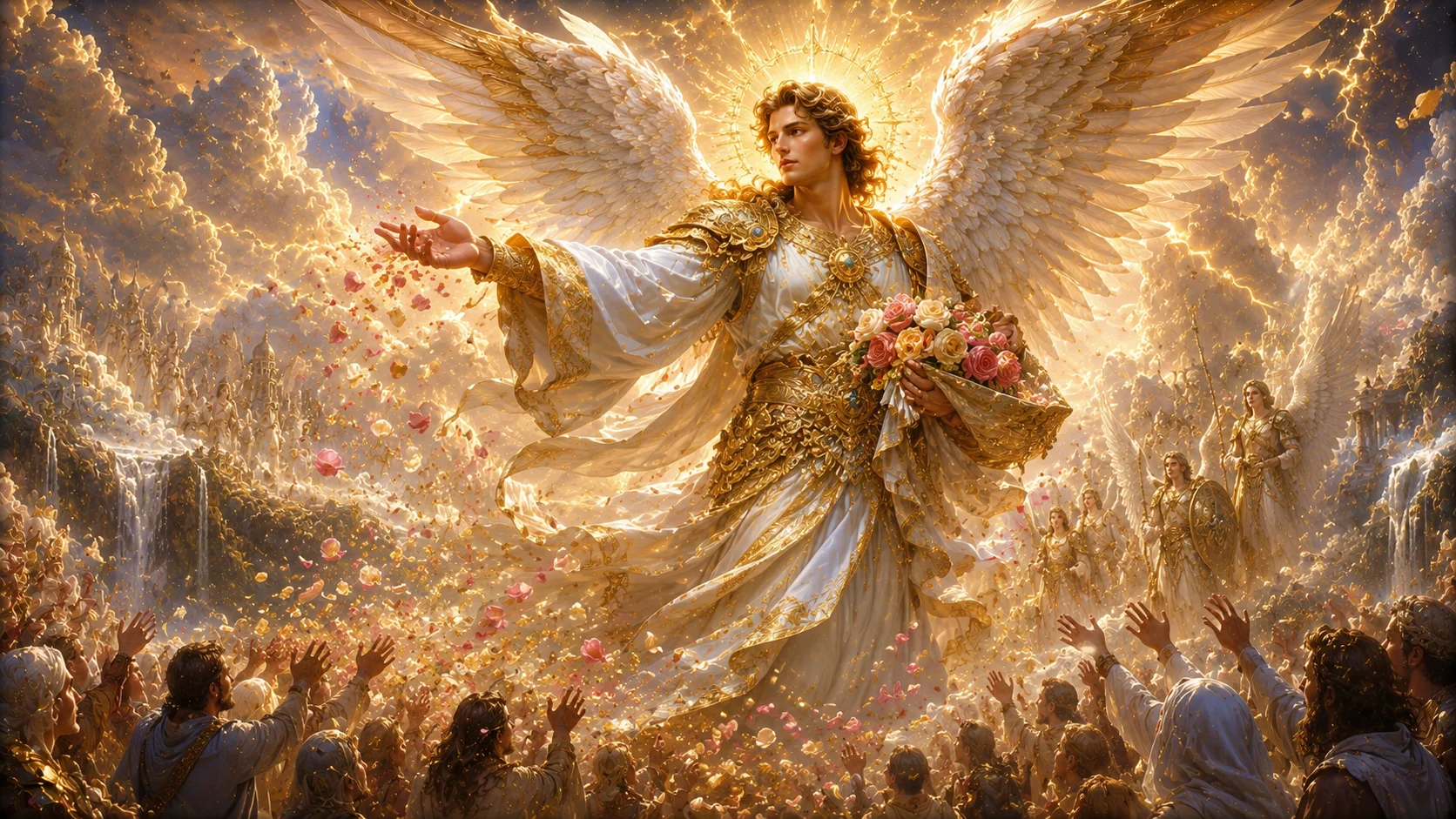
Barachiel (Barakiel, Baraqiel, “the blessing of God” or “lightning of God”) is the archangel of blessings, good fortune, and the bestowal of divine favour. He is the angel who distributes the blessings of God to humankind — the bounty, the good fortune, the protection, and the grace that descend from heaven — and he is invoked by those who seek blessing, abundance, success, and divine favour in their lives. He is often depicted scattering rose petals (a symbol of the blessings he bestows) from his robes, or holding a basket of bread or roses.
The Chief of the Guardian Angels
Barachiel is named in some traditions as the chief or leader of the guardian angels — the angel who oversees the host of guardian angels assigned to watch over and protect human beings, and thus the patron of divine protection and guardianship. He is counted among the seven archangels who stand before the Throne of God in the tradition of the seven (with Michael, Gabriel, Raphael, Uriel, and others), each governing a sphere of divine action — Barachiel’s being the bestowal of blessings and the oversight of the guardians.
The Bestower of Fortune
Barachiel is associated with lightning (a sign of divine power and favour descending from heaven), with good fortune and luck, and with the blessings of family, abundance, and protection. He is invoked for blessing, good luck, success in endeavours, and divine protection, the angel who opens the way for heaven’s bounty to descend. As an archangel of blessing and the chief of the guardians, he holds an important and beloved place. In Barachiel, Jewish and Christian tradition gave form to divine blessing and good fortune — the archangel who showers heaven’s blessings upon the faithful, the chief of the guardian angels, the bestower of fortune, abundance, and protection, the lightning and the grace of God descending upon humankind.
A Name With Two Faces
Before Barachiel scattered blessings from a robe full of roses, a name almost identical to his was already written down — attached to something forbidden. The Book of Enoch, one of the oldest surviving works of Jewish apocalyptic literature and still canonical scripture in the Ethiopian Orthodox Tewahedo Church, names the chieftains among the rebel Watchers who descended on Mount Hermon, took human wives against the order of heaven, and taught their descendants arts that were not theirs to give. Among them is Baraqijal — Baraqel, Baraqiel, depending on which Ethiopic manuscript or Aramaic fragment is consulted — and what he teaches is astrology, the reading of fates in the stars. His name means “lightning of God”; Barachiel’s is read as “blessing of God,” and sometimes as lightning too. The spellings sit so close that the angelological reference literature routinely files them as variants of one another. Nothing in the manuscript tradition establishes that they are one figure split by scribal drift and centuries of retelling — the resemblance may be no more than two names built from neighbouring roots. But it is worth naming, because it is the kind of collision this literature produces constantly: a single syllable arrives in one book as a gift and in another, written earlier, as a theft.
The Grammar Beneath the Blessing
Barachiel’s name is not one word doing one job — it is a pun that Hebrew allows and English cannot quite hold on to. Its root sits under barukh, “blessed,” the word that opens nearly every Jewish liturgical blessing (Barukh atah Adonai…, “Blessed are You, Lord…”), and under berakhah, the technical term for the blessing recited over bread, over wine, over a sight worth pausing for. A near neighbour, baraq, means lightning — the flash that splits the sky and, throughout the Hebrew Bible, keeps company with the voice and the appearing of God. The two roots are genuinely distinct, separated by their final consonant, but they sound close enough that an angel named for one could not help being heard as the other, and tradition kept both readings rather than force a choice. It is fitting, then, that Jewish practice preserves a blessing recited on witnessing lightning — oseh ma’aseh vereishit, “who makes the works of creation” — folding the storm itself back into the very vocabulary of blessing that gave Barachiel his name.
Seated Among the Seven
Walk into a church of the Eastern Orthodox or Byzantine Catholic tradition on the eighth of November, the Synaxis of the Archangels, and an icon there may show seven haloed figures standing shoulder to shoulder — the assembly that fixed Barachiel’s place in the heavenly administration for good. Michael carries a flaming sword; Raphael a vessel of healing medicines; Jegudiel holds a crown and a whip together, reward and correction in the same pair of hands; Selaphiel stands with his head bowed and his hands crossed on his breast, caught in perpetual prayer; Uriel bears a flame. Barachiel is the one shown mid-gesture rather than mid-office — not judging, not guarding, not healing, simply giving something away as he walks. It is a deliberately domestic role to set beside a swordsman and a physician, and it is exactly the role the feast day preserved: blessing needed its own seat at that table, distinct from protection, distinct from healing, distinct from revelation.
An Angel Assembled Out of Other Books
Barachiel never appears in the Hebrew Bible or the New Testament. Unlike Michael and Gabriel — named in the book of Daniel, and Gabriel again in the Gospel of Luke, and therefore anchored to a text every reader of those faiths already owns — Barachiel exists entirely in the overflow literature that grew up around scripture: later angel-lists, mystical and Kabbalistic tradition, and the liturgical calendars of Eastern Christianity. The most influential attempt to gather all of that scattered material onto one shelf, Gustav Davidson’s A Dictionary of Angels (1967), gave Barachiel an entry among the seven archangels, and in doing so put his name within easy reach of anyone outside theology who needed an angel and did not know where else to look. That is the peculiar afterlife of a minor archangel: with no single authoritative text to answer to, his name became freely borrowable, drifting into fantasy fiction and tabletop bestiaries as easily as into icon-painting, because no canon was ever positioned to say he could not go.
Why Blessing Needed a Face
Every culture that believes in an unseen order eventually asks the same question about good fortune: is it random, or does someone hand it out? The Greeks answered with Tyche and the Romans with Fortuna — goddesses of the wheel, indifferent to merit, as likely to ruin a household as to enrich it, their favour granted on no schedule and revoked without warning. A tradition built on covenant rather than caprice could not rest easy with a blessing that simply fell wherever a wheel happened to stop. It needed an intermediary who received good fortune from the Throne on purpose and delivered it on purpose — not a wheel, but a messenger running an errand. Barachiel is that answer, and the logic of the answer is why he is never the source of the blessing, only its courier: in this grammar an angel carries what it is given and originates nothing. He exists because a culture refused to let good fortune be meaningless — because something has to carry the blessing down, and someone has to be looking out for the household that gets the harvest, the sailor who survives the storm, the family that is, for no visible reason, simply lucky.
Sources & traditions
- EncyclopediaWikipedia — Barachiel
- TraditionJewish/Kabbalistic texts, grimoires and later commentary
Myths change from area to area and from time to time. This chronicle follows the most widely told versions; tellings in other villages, regions and eras may differ.