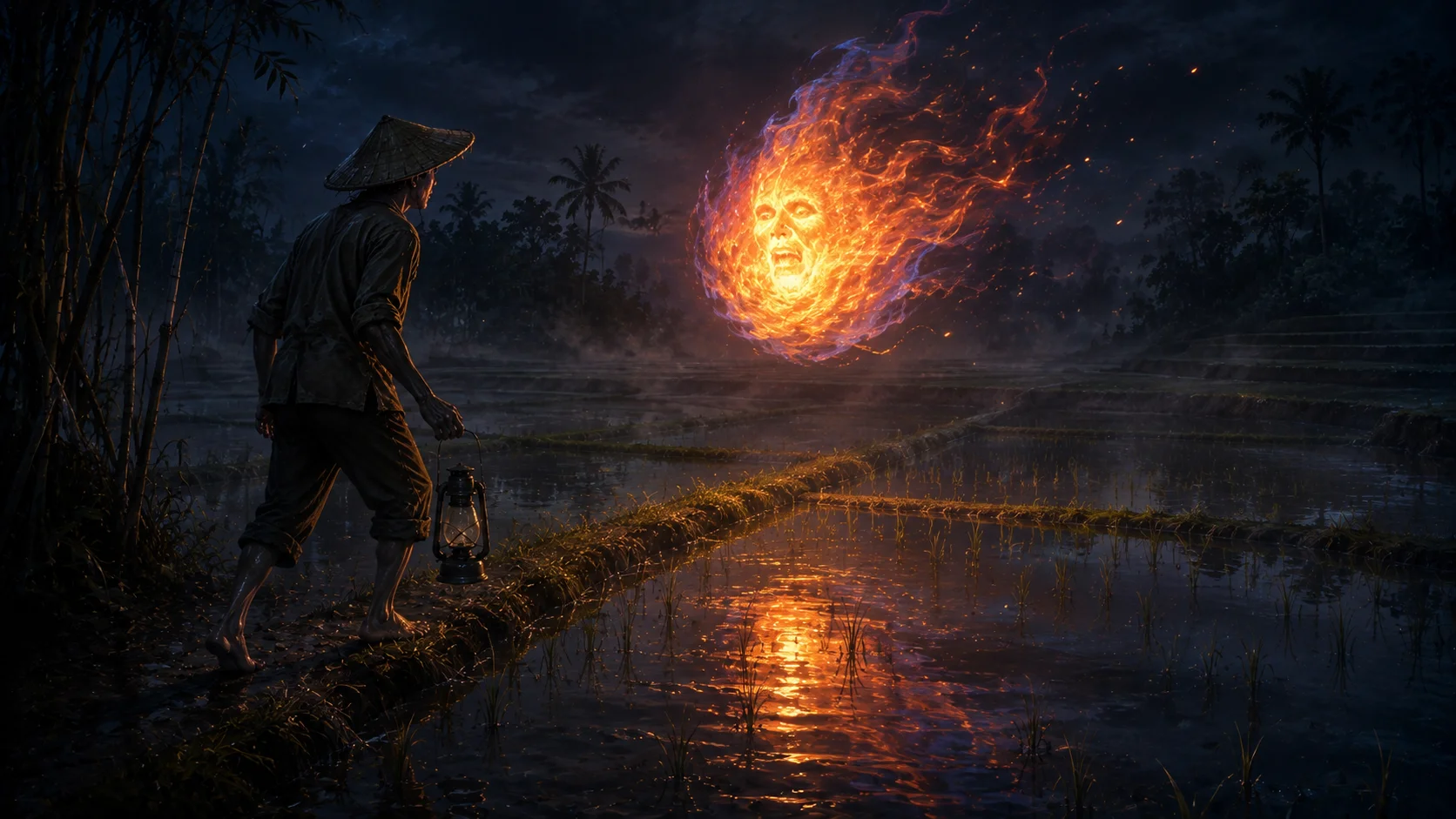
The Santelmo, also spelled santilmo, is the fireball-spirit of Philippine folklore: a glowing ball of fire that floats and dances through the night air over the rice-fields, marshes, rivers, and dark roads, luring, misleading, or simply terrifying those who behold it. Most documented among Tagalog and central Luzon communities, it survives today as one of the most frequently retold lights of the Filipino night.
A Name Carried Across the Sea
The Santelmo takes its name from Santo Elmo, or St. Elmo — the Spanish rendering of St. Erasmus of Formia, the patron saint European sailors invoked when a strange glow crept along a ship's mast in a storm. That glow, St. Elmo's fire, is a real electrical phenomenon, a corona discharge that gathers at the tip of a pointed object during charged weather. Spanish colonization carried the saint's name and the maritime story of his fire into the islands, where it was layered onto older native beliefs about wandering lights and fire-spirits. The result is a distinctly syncretic figure: not a purely pre-colonial being, but a Hispanic-era graft onto an indigenous root, its foreign name now so naturalized that few who fear it in the dark think of ships or saints at all.
The Ball of Fire
In its most consistent description, the Santelmo is a floating, glowing orb, sometimes small, sometimes said to swell as large as a person, that appears at night and drifts with a strange, deliberate, almost living motion. It glows blue, white, orange, or red, bobbing low over rice paddies, gliding above the black water of rivers and swamps, threading between the trees of a forest, or hovering at the bend of a lonely road. Unlike many of the storied beings of Philippine lower mythology, the Santelmo has no fixed humanoid or animal shape in most tellings. It is not a creature that merely carries fire, as some spirits are said to; it is the fire itself, mobile and unaccompanied by any other form. Folklorists have noted this as a structural distinction: where the tikbalang is horse-headed and the kapre is a giant crouched in a tree, the Santelmo is pure light, a phenomenon given a soul rather than a soul given a body.
The Restless Dead
The most widespread explanation for the Santelmo treats it as the wandering soul of a person who died a violent, sudden, or unbaptized death — the drowned, the murdered, the struck-by-lightning, those who died far from home and were never properly found, or those who passed without receiving the last rites. In this understanding, the soul cannot yet rest; it is condemned to roam as flame until the conditions that would release it are met, most often prayer, proper burial rites, or whatever closure the dead person was denied in life. This is a common account rather than a universally agreed one — other tellings describe the Santelmo instead as an elemental fire-spirit in its own right, or as a manifestation connected to the engkanto, the nature-spirits of Philippine belief. The figure's origin, in other words, is contested even within the tradition that produced it, and that ambiguity is part of what keeps it unsettling: no one telling can say for certain whose fire it is.
Marsh, River, and the Edge of the Living World
Santelmo is popularly associated above all with marshland and, in some tellings, with cemetery ground — the low, wet, uncertain edges of the landscape where the living rarely linger after dark. This placement echoes explanations found elsewhere in the world for will-o'-the-wisp phenomena, lights that gather where the ground itself seems unstable between worlds. But where the will-o'-the-wisp of other traditions is often treated as a passive curiosity, something merely strange to look at, the Santelmo within Philippine lore is treated as an actively malevolent or mischievous spirit. It does not simply glow and wait to be misinterpreted; it is understood to act, to notice, to choose.
What the Flame Does
Accounts describe the Santelmo as capable of leading travelers astray at night, drawing them off a safe path toward rivers, cliffs, or the deep wild under cover of darkness. In some tellings it chases those who flee from it; in others it flees from those bold enough to approach. Some regional accounts go further, describing the spirit as capable of chasing or attacking a person outright, or even entering a person's body and causing illness or death. This aggressive, possessing quality is documented but regionally variable — it is not a trait attached to every account of the Santelmo, and a traveler in one province's telling might face a light that only watches and misleads, while in another's the same light is spoken of as something to be genuinely feared for one's safety.
An Omen Over Water
In some Visayan and Bicol regional variants, the Santelmo appears specifically over bodies of water and is read as an omen of death or misfortune for whoever witnesses it. This tradition of the fire-as-warning sits alongside, rather than replacing, the fire-as-wandering-soul explanation; the same light can be understood simultaneously as the dead returning and as a sign of what is still to come for the living who see it. Such variants were noted in Philippine folklore compilations, including those of the scholar Maximo D. Ramos, whose work gathered regional tellings of Santelmo alongside those of many other beings of the islands' lower mythology.
Cataloguing the Fire-Spirit
Maximo D. Ramos stands as a foundational scholar of Philippine lower mythology, and his studies — among them The Creatures of Philippine Lower Mythology, published in 1971 — catalogued the Santelmo alongside beings such as the tikbalang and the kapre. Ramos treated it as its own distinct category: not a humanoid monster to be described by limb and face, but a phenomenon or spirit, classed by its behavior and its haunt rather than by any body it might wear. That scholarly framing matters, because it is precisely the Santelmo's bodilessness that separates it from the more anthropomorphic classes of spirit that share its folklore. Where other beings are named for what they look like, the Santelmo is named, ultimately, for what it once was seen to do on the deck of a ship an ocean away.
Turning Cloth Against the Light
Folk tradition offers several countermeasures against an encountered Santelmo. Reciting the Lord's Prayer or invoking the saints is described as a defense, calling on the same Christian framework that gave the spirit its name in the first place. Turning one's clothes inside out is another widespread method — not unique to the Santelmo, but shared with defenses against other wandering spirits such as the tikbalang, suggesting a broader Filipino folk logic in which disorienting one's own appearance can disorient or repel a spirit that depends on a traveler staying recognizably themselves. Others advise simply avoiding direct eye contact or refusing to pursue the light, on the understanding that curiosity, not the flame itself, is often what draws a person into danger.
A Family Without Kin
Because the Santelmo is a phenomenon or spirit rather than a named individual deity, it lacks the kind of relational network — spouses, offspring, rival deities — documented for figures such as Bathala or the diwata-type nature deities of Philippine belief. It has no genealogy to trace and no court of related beings to place it among. Instead, accounts relate it primarily to two things: the human dead whose souls it may represent, and place — the specific haunted swamp, the particular crossroads, the named riverside where sightings recur. This is itself a notable structural feature of the belief. Where other spirits are understood through who they are related to, the Santelmo is understood through where it is seen and whom it is imagined once to have been, a figure defined by geography and grief rather than by lineage.
The Gas Beneath the Glow
Santelmo sightings have long stood as a folk explanation for a real, physical phenomenon: marsh lights of the will-o'-the-wisp type, attributed by modern science to the combustion of methane or phosphine gases released by decomposing organic matter in wet, low-lying ground. The correspondence is close enough that the Santelmo represents a documented case of folklore providing a supernatural frame for an observable natural occurrence — the same wetlands that produce the gas are the same wetlands the stories place the spirit in. Rationalized, naturalistic explanations of this kind circulate in modern retellings alongside the soul-origin account, not as a replacement for it but as a second voice in the same conversation, one that has grown louder without ever fully silencing the other.
A Flame That Still Flickers on Screen
The Santelmo has not faded into a purely historical curiosity. In contemporary Filipino media, it appears as a recurring subject in horror anthology television, turning up in segments of the country's long-running horror anthology programs, and it continues to circulate in local ghost-story collections passed between communities and generations. This continued reception marks it as a popular urban and rural legend in its own right, distinct from the more elaborately storied figures of Philippine myth who carry names, families, and long narrative arcs. The Santelmo needs none of that scaffolding to unsettle a listener; a light with no face, seen once at the edge of a field at night, has proven durable enough on its own.
The Light That Refuses to Settle
What endures about the Santelmo is precisely its refusal to be pinned to a single explanation. It is a saint's name worn by a native fear, a soul's grief made visible, an omen read over dark water, and a pocket of marsh gas catching the night air, all at once, depending on who is telling the story and where the telling happens. It asks nothing of the traveler but distance, and offers nothing back but the light itself, drifting low over the fields, patient, unclaimed, and still seen.
Sources & traditions
- TraditionFilipino folk and village traditions (Philippines)
Myths change from area to area and from time to time. This chronicle follows the most widely told versions; tellings in other villages, regions and eras may differ.