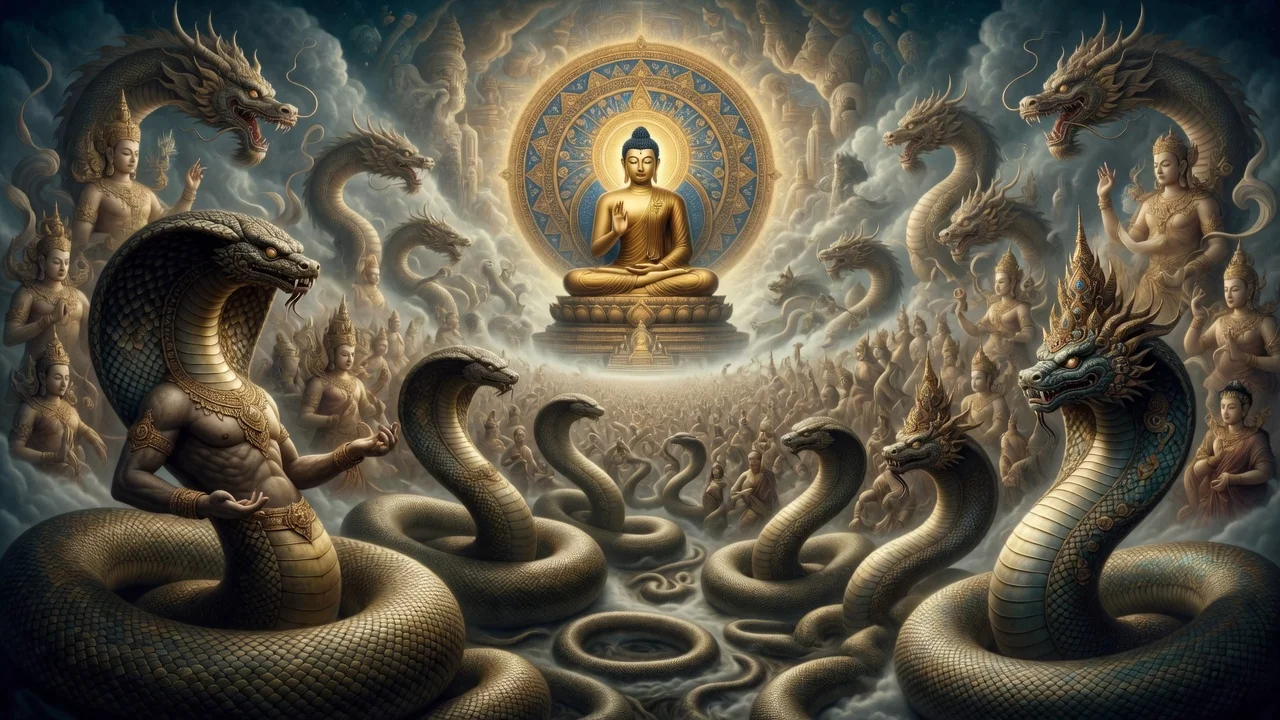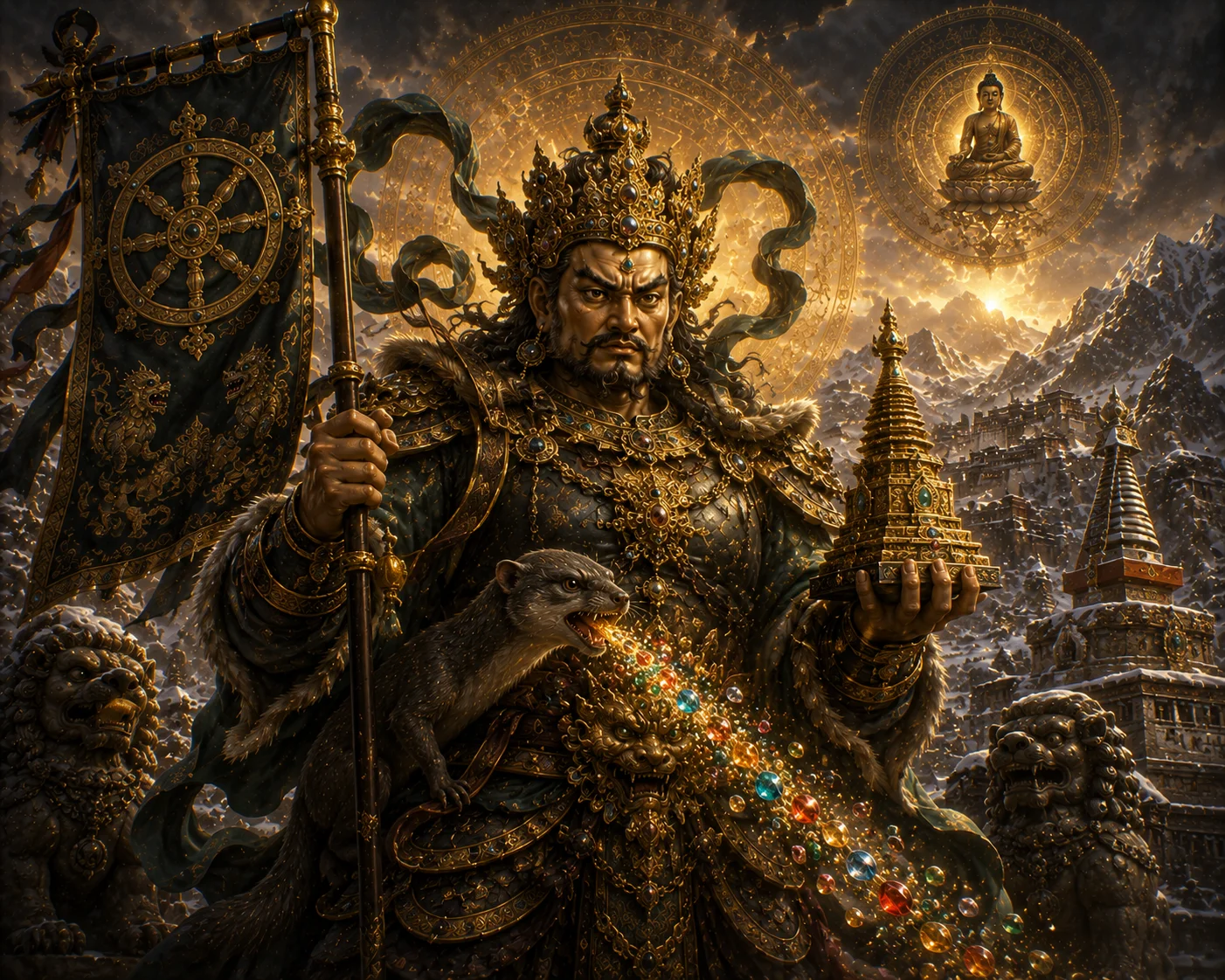
Ratnasambhava, the Jewel-Born, is one of the Five Wisdom Buddhas of Mahayana and Vajrayana Buddhism: the Lord Buddha of the South, the lord of generosity and the precious jewel, who transmutes the poison of pride and conceit into the wisdom of equality, the awareness that sees the fundamental sameness of all beings.
The Meaning of the Jewel-Born
The name Ratnasambhava is built from two Sanskrit roots: ratna, the jewel, and sambhava, arising or origin. Together they name him the Origin of Jewels, the one from whom preciousness itself arises. This is not a title of ownership over literal treasure but a description of an enlightened quality: the capacity to see worth, abundance, and value where the unawakened mind sees only scarcity, hierarchy, and want. Within the fivefold symbolic architecture of the Tathagatas, each Lord Buddha is given a name that names a transformation rather than a biography, and Ratnasambhava's name announces the transformation he presides over before a single attribute or gesture is described.
A Lord Buddha of Symbolic Rather Than Narrative Origin
Unlike the historical Lord Buddha Shakyamuni, whose life is told through birth, renunciation, awakening under the bodhi tree, and parinirvana, Ratnasambhava belongs to a different order of Buddhist thought entirely. He has no comparable origin episode, no recorded human lifetime, no named kingdom or family. He belongs instead to the symbolic and cosmological typology of the Five Tathagatas, also called the Five Jinas or Five Dhyani Buddhas, a system developed within Mahayana and elaborated in the tantric literature of Vajrayana Buddhism, including texts such as the Mahavairocana Tantra and the Tattvasamgraha or Vajrasekhara Tantra. To ask where Ratnasambhava was born or who his teacher was is to ask a question the tradition does not answer, because he is not a figure who lived and awakened in time. He is a facet of awakened mind itself, given form, colour, gesture, and direction so that practitioners have something concrete to contemplate.
Lord of the Southern Quarter
In the mandala of the Five Tathagatas, Vairocana sits at the centre and the four other Buddhas occupy the cardinal directions around him: Akshobhya in the east, Amitabha in the west, Amoghasiddhi in the north, and Ratnasambhava in the south. Each of the five is distinct, with his own colour, mudra, klesha to transform, and wisdom to embody, and the tradition is careful that none of these assignments overlap or blur into one another. Ratnasambhava's placement in the south is fixed across the major schema, and it is from this position that he is invoked in the ritual construction of mandalas, in thangka painting, and in the stupa niches of Nepalese, Tibetan, and wider Himalayan Vajrayana art, where he is regularly depicted as one of five directional Buddhas surrounding the central figure of Vairocana.
The Colour of Ripening Gold
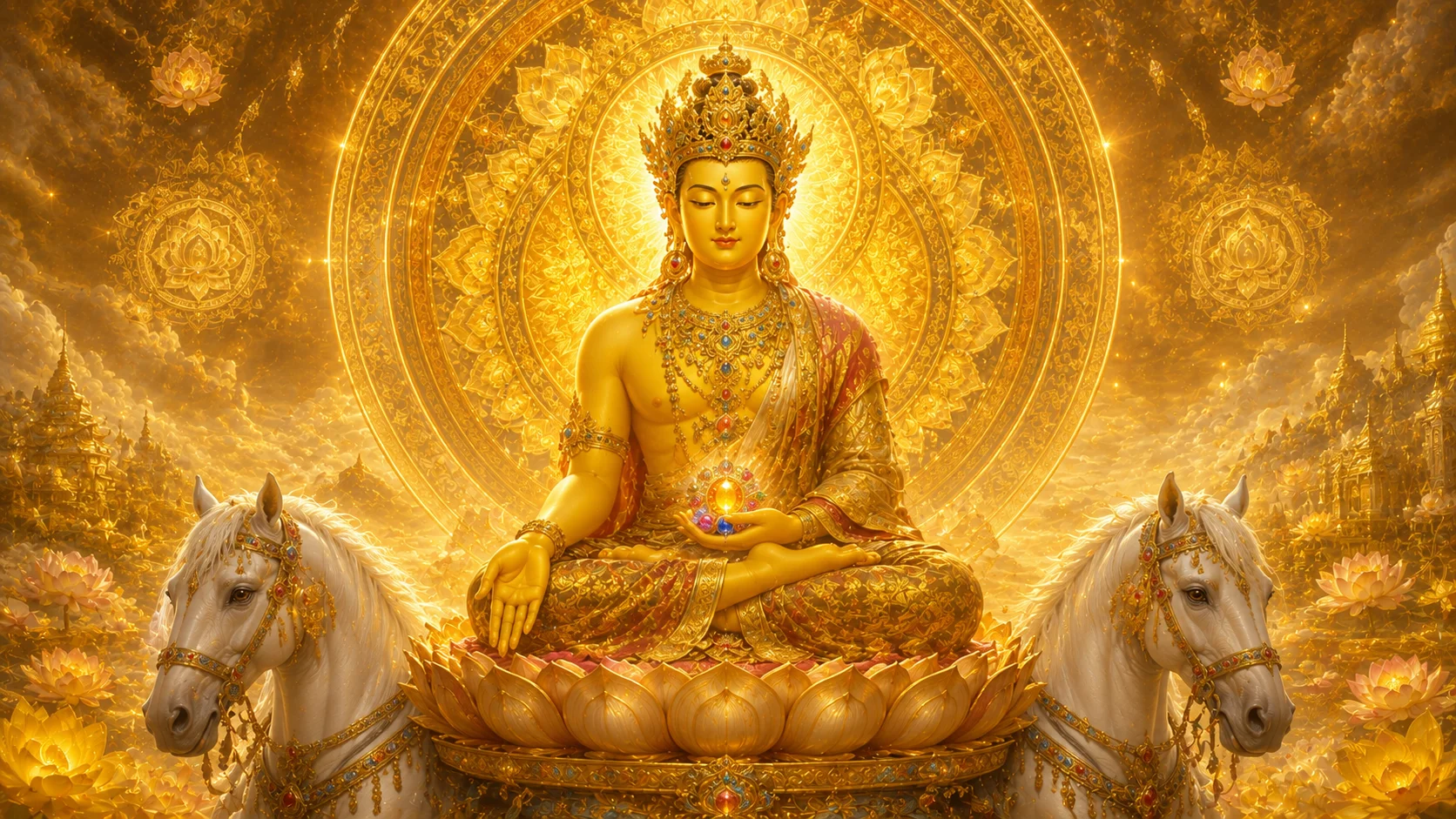
Ratnasambhava's iconographic colour is yellow or gold, the colour of ripened grain, of earth warmed by sun, and of the jewel itself catching light. Where Akshobhya's blue evokes the unshakeable clarity of a mirror and Amitabha's red evokes the fire of discernment, Ratnasambhava's gold evokes abundance, fertility, and the richness of a harvest freely given rather than hoarded. This colour is not decorative; in Vajrayana visualisation practice, colour is doctrine made visible, and to hold Ratnasambhava's golden form in the mind is already to begin turning the mind toward the quality he represents.
The Open Hand of Varada Mudra
Ratnasambhava is shown with his right hand lowered, palm outward and fingers extended downward, in the gesture known as varada mudra, the mudra of giving, of granting a boon. It is among the most immediately legible gestures in Buddhist iconography: an open hand, offered without concealment, asking nothing in return. Where other Buddhas fold their hands in meditation or raise them in teaching or reassurance, Ratnasambhava's hand reaches outward and down, toward the beings who stand in need of what it offers. The gesture is inseparable from the wisdom he embodies, because true equanimity does not withhold; it gives without calculating who is worthy.
The Wish-Fulfilling Jewel
His emblematic attribute is the cintamani, the wish-fulfilling jewel, sometimes shown singly and sometimes as a cluster of three jewels resting in his palm or on a lotus beside him. The cintamani is one of Buddhism's most evocative images: a jewel said to grant whatever is asked of it, symbolising not greed for possessions but the boundless generosity of an awakened mind, which meets every need precisely because it holds nothing back. This jewel gives Ratnasambhava's entire family of associations its name, the ratnakula or jewel family, one of the five Buddha-families into which the Vajrayana tradition organises the whole of enlightened activity.
Transmuting Pride Into the Wisdom of Equality
Each of the Five Tathagatas is understood, in the standard doctrine systematised in tantras such as the Guhyasamaja and carried forward through later Tibetan commentarial tradition, to preside over the transformation of one klesha, one root mental poison, into its corresponding wisdom. Ratnasambhava's poison is mana, pride or conceit, the habitual mind that ranks itself above or below others, that measures worth by comparison and status. The wisdom that arises when this poison is seen through and released is samatajnana, the wisdom of equality or sameness, the direct perception that all beings share the same fundamental nature beneath every surface difference of rank, wealth, or standing. Pride depends on distinction; the wisdom of equality dissolves the very ground pride stands on, not by denying difference but by seeing past it to what does not differ.
Governing the Skandha of Feeling
Vajrayana doctrine also maps each of the Five Tathagatas onto one of the five skandhas, the aggregates that Buddhist psychology holds together constitute the experience of a self. Ratnasambhava's family governs vedana, the skandha of feeling or sensation, the moment-to-moment tone of pleasant, unpleasant, or neutral that colours every experience before conscious judgement enters. It is precisely in the raw arising of feeling that pride and its opposite, insecurity, first take root, and it is this skandha that the ratnakula's practices are understood to transmute into clear, equalising wisdom rather than into the compulsive grasping and aversion that untransformed feeling produces.
Consort and Retinue, Where Traditions Diverge
In the mandala systems of Vajrayana Buddhism, each of the Five Tathagatas is frequently paired with a consort, and Ratnasambhava is conventionally paired with Mamaki, though some textual lineages instead associate him with Locana. This is a genuinely disputed point across the Garbhadhatu and Vajradhatu mandala traditions rather than a settled fact, and the variation should be understood as evidence of a living, textually diverse tradition rather than an error to be resolved. Likewise, his bodhisattva emanation is generally associated with Ratnapani, though some tantric systems instead connect the jewel family to Akashagarbha; here too the correspondence is not uniform across sources, and different lineages have preserved different answers.
The Horse of the Southern Lord Buddha
Ratnasambhava's vahana, the mount or throne support beneath his seat, is conventionally the horse, though some schema describe a pair of horses or, in certain textual traditions, lions in this role. As with the question of his consort, the sources vary, and the mount attribution is best treated as tradition-dependent rather than fixed to a single animal across every lineage. What remains constant beneath this variation is the throne itself as a marker of sovereignty, the seat from which the Lord of the South presides over his quarter of the mandala.
The Golden Light of the Third Bardo Day
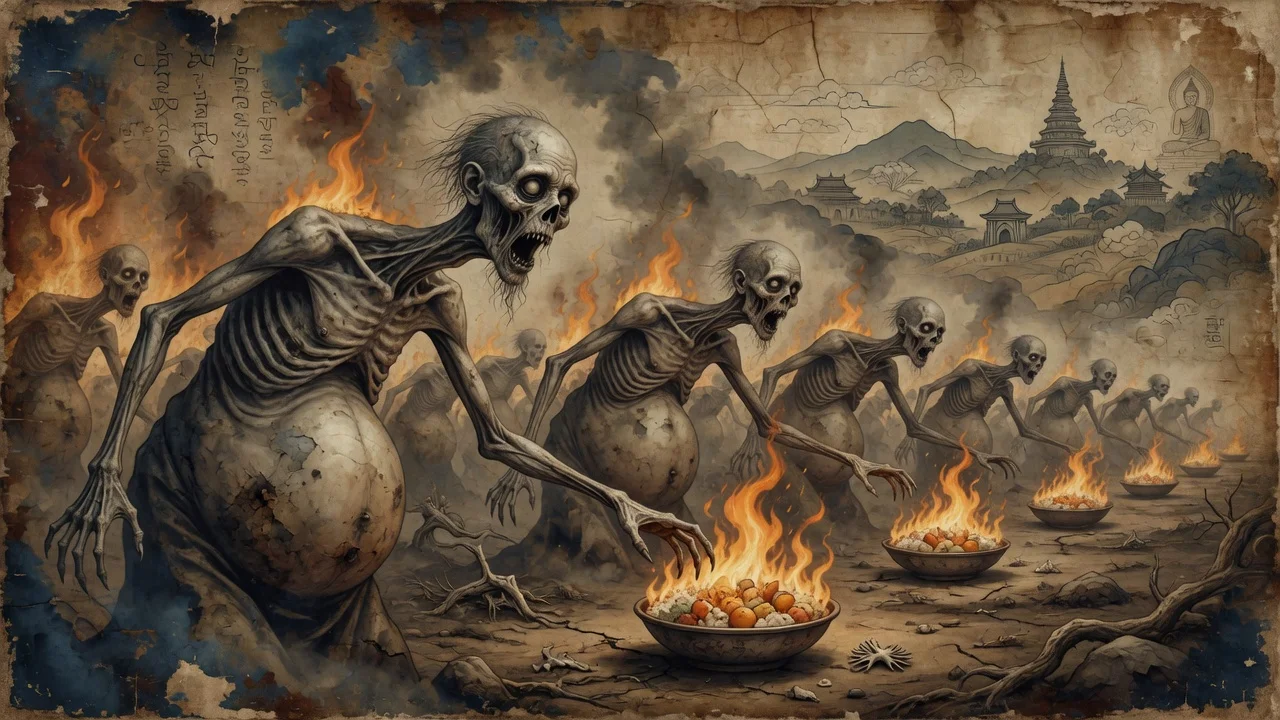
Ratnasambhava holds a vivid place in Tibetan Vajrayana funerary literature, above all in the Bardo Thodol, known in the West as the Tibetan Book of the Dead. In its account of the intermediate state between death and rebirth, the consciousness of the deceased is presented on the third day with a brilliant yellow light radiating from Ratnasambhava, an opportunity to recognise this light as one's own true nature and attain liberation on the spot. Set against it is the duller, more inviting light of the human and animal realms, a path shaped by the very habit of pride that Ratnasambhava's wisdom exists to dissolve. The teaching is precise and unsentimental: the consciousness is instructed to move toward the brilliant golden light and away from the comfortable, dimmer one, because the pull toward the dim light is the pull of an old, unexamined habit of mind reasserting itself even in death.
Invoked for Generosity and the Undoing of Arrogance
In later Tibetan Buddhist and Newar Buddhist ritual practice, Ratnasambhava continues to be invoked specifically for the cultivation of generosity and material and spiritual abundance, and for the overcoming of pride and arrogance in the practitioner's own mind. He is regularly included among the Five Buddhas invoked in Pancha Buddha empowerment, or abhisheka, ceremonies that are still performed today across the Himalayan Vajrayana world. To receive his empowerment is understood not as a request for wealth in a narrow sense but as an invitation to loosen the grip of comparison and self-inflation, and to discover in their place the plain, unranked sameness of all beings.
Distinct Among the Five, Never to Be Merged
Because the Five Tathagatas share a single symbolic system, it is worth stating plainly how sharply they are distinguished from one another: Vairocana at the centre, Akshobhya in the east, Amitabha in the west, Amoghasiddhi in the north, and Ratnasambhava alone in the south, each with his own colour, mudra, klesha, and wisdom that do not overlap with any of the others. Ratnasambhava is not a variant or aspect of these figures, and he is not to be confused with the historical Lord Buddha Shakyamuni, whose life belongs to an entirely different register of Buddhist memory. He stands as the Jewel-Born Lord of the South in his own right, gold in colour, hand open in varada mudra, cintamani resting in his palm, presiding over the slow, patient transformation of pride into the wisdom that finally sees every being as equal.
Sources & traditions
- EncyclopediaWikipedia — Ratnasambhava
- TraditionBuddhist texts, oral tradition and village tellings (South/Southeast Asia)
Myths change from area to area and from time to time. This chronicle follows the most widely told versions; tellings in other villages, regions and eras may differ.