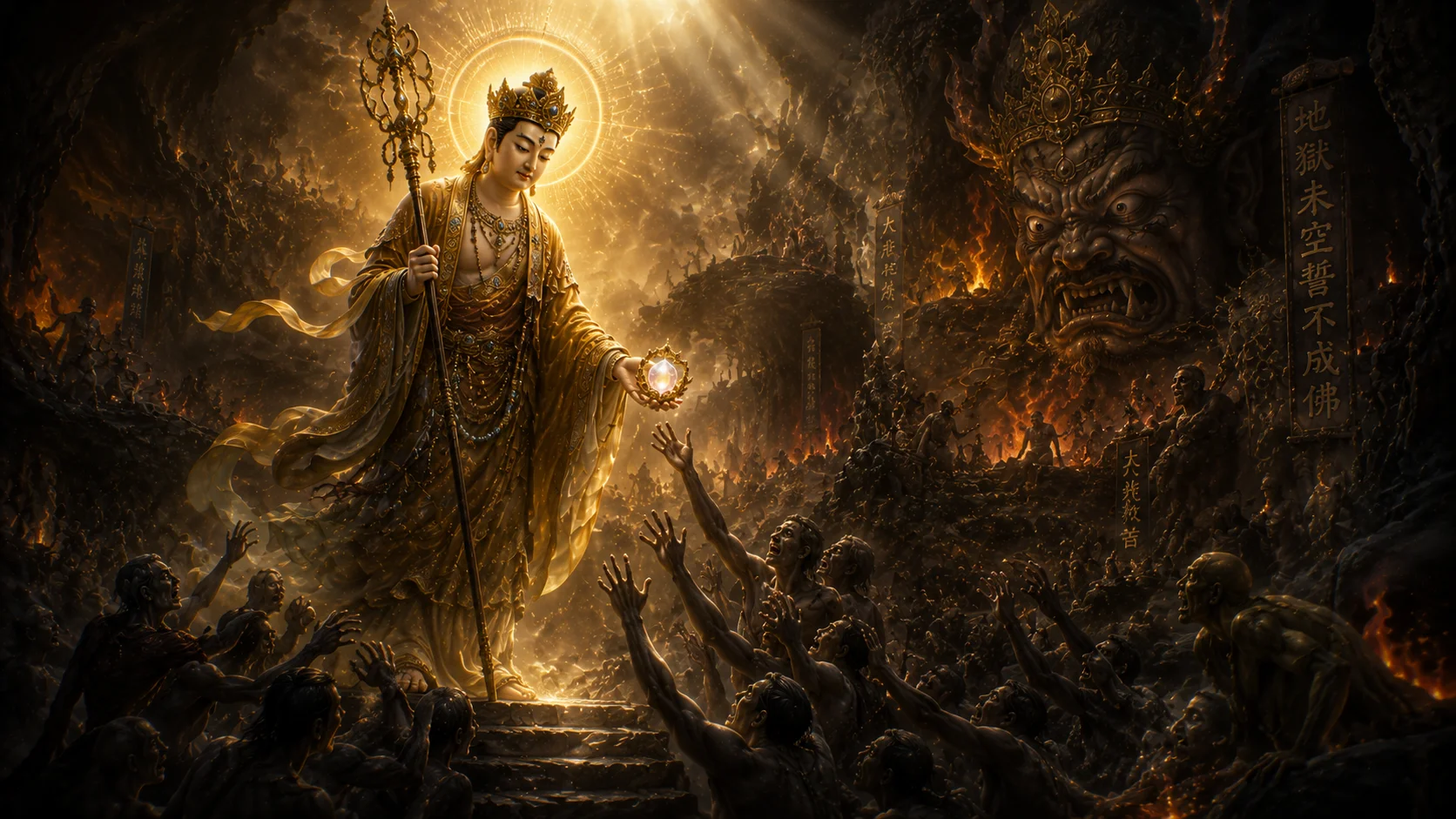
Ksitigarbha — “Earth-Store,” “Earth-Womb” — is the great bodhisattva who vowed to descend into the hell-realms to save the suffering, taking as his charge the beings of the lowest and darkest destinies and the souls of the dead. Bearing the staff that opens the gates of hell and the jewel that lights the darkness, he is the compassionate guardian of the underworld and, in Japan as Jizo, the beloved protector of children.
The Vow Not to Rest
Ksitigarbha is renowned above all for the immensity of his vow: he resolved not to attain Buddhahood until all the hells are emptied and every suffering being is saved — “Not until the hells are empty will I become a Lord Buddha; not until all beings are saved will I attain enlightenment.” This is the most radical of compassionate vows, for the hells are never empty, and so Ksitigarbha labours endlessly in the realms of greatest suffering, descending into the very pits of hell to bring comfort, teaching, and liberation to the damned and the dead, who have no other helper.
The Guardian of the Dead and the Hells
Ksitigarbha is the special protector of beings in the hell-realms and of the souls of the dead in their perilous passage through the afterlife and judgment. He is closely associated with the courts of the underworld and with Yama, the lord of death, intervening on behalf of the suffering dead. He is depicted as a serene monk (unusually among bodhisattvas, in monastic rather than princely form), holding a khakkhara — a ringed staff whose sound opens the gates of hell — and a wish-fulfilling jewel that illuminates the darkness of the underworld.
Jizo, the Protector of Children
In East Asia, and supremely in Japan, Ksitigarbha became one of the most beloved of all the bodhisattvas as Jizo (Dizang in China). There he is the gentle protector of travelers, of women, and above all of children — especially of the souls of dead children and the unborn, whom he shelters and guides in the afterlife. The small stone Jizo statues, often dressed in red bibs and caps by grieving parents, are among the most touching sights of Japan. In Ksitigarbha, Buddhism gave form to compassion that reaches even into hell — the Earth-Store bodhisattva who vowed to empty the hells and save the dead, the monk with the staff that opens the underworld’s gates, beloved across Asia as the tender guardian of children and the helper of the suffering dead.
A Sutra Preached for a Dead Mother
The scripture that carries Ksitigarbha’s name into the world opens with an absence: the Lord Buddha has climbed to Trayastrimsa Heaven, the heaven of the thirty-three gods, to preach to the mother he never knew in life — Maya, who by tradition died seven days after his birth and was reborn there. It is in her honour, before an assembly gathered from every corner of the universe, that he tells the story of Ksitigarbha. The text is the Sutra of the Fundamental Vows of Ksitigarbha Bodhisattva, credited in the Chinese canon to Siksananda, a monk from Khotan working in the closing years of the seventh century. No Sanskrit original has ever surfaced, which is why many scholars suspect the sutra was not translated in China so much as written there — a scripture about the Chinese dead, quietly made in China.
What it gives Ksitigarbha is not one life but four, each a past incarnation in which he is not yet enlightened and already unbearably compassionate. He is the son of a wealthy elder, awed by a buddha’s appearance and vowing to earn the same for himself only after liberating every suffering being first. He is a king who lets a neighbouring king reach buddhahood ahead of him. And twice — these are the two that stuck — he is a daughter watching a mother fall. A Brahmin girl remembered as the “Sacred Girl” sells everything she owns to buy offerings for a mother who had mocked the Three Jewels, and is carried down into the hell-realms to look for her. A woman named Bright Eyes learns from an arhat where her own dead mother has gone, and what begins as one daughter’s rescue has expanded, by the time she is finished swearing, into a vow to empty the hells entirely. That is the sutra’s real move, performed twice so the reader cannot miss it: grief for one person, refusing to stay the size of one person.
The Judges Who Report to Him
The Chinese afterlife was bureaucratic long before Buddhism reached it — a realm of registers, summonses and magistrates modelled with straight-faced precision on the courts of the living. What the Tang era added was a specific bench: ten kings, ten tribunals, the dead moving from one to the next while a sentence is assembled against them. The Ten Kings are unknown to Indian Buddhism and surface in China only around the eighth and ninth centuries, which means they arrived after Ksitigarbha rather than before him. In their earliest surviving images — the painted scrolls and wall paintings sealed in the caves at Dunhuang — he is already there, seated at the centre with the kings ranged around him, and the hierarchy is unmistakable: the judges report to him. He is not counsel for the defence, pleading upward to a sterner authority. He is the authority, sitting at the head of a court whose entire caseload he has sworn to empty. In Chinese and Korean versions of the composition a monk named Daoming often stands at his side, one ordinary human placed inside the machinery of judgement.
The Monk Whose Body Would Not Decay
Each of China’s four sacred Buddhist mountains belongs to a bodhisattva, and three of them — Manjushri at Wutai, Samantabhadra at Emei, Guanyin at Putuo — are reached through vision and scripture. Jiuhua Shan, in the hills of Anhui, claims something more literal: a body. Kim Gyo-gak, Jin Qiaojue to the Chinese, was a prince of the Korean kingdom of Silla who saw Tang China as a young man, went home to take monastic vows, and in 719 crossed back to settle on the mountain as an ascetic. He stayed for the rest of a very long life and died in 794, aged ninety-nine. His body, tradition holds, did not decompose; his disciples waited three years, found it intact, and enshrined the gilded remains. Pilgrims who came to look concluded they were seeing Ksitigarbha in the flesh, and Jiuhua Shan has been his mountain ever since — a place people climb in order to stand directly above the realm he administers.
What the Rings Count
The ringed staff began as ordinary equipment. A mendicant under a rule of silence needed some way to announce himself at a stranger’s door without speaking, and a walker needed to warn insects and small creatures off the path ahead before he trod on them; the khakkhara — literally a sounding staff — did both jobs, and only afterwards became the instrument that rattles open the gates of hell. Count the rings on Ksitigarbha’s and there are usually six, read either as the six perfections or, more commonly, as the six realms of rebirth: god, demigod, human, animal, hungry ghost, hell-being. The sound is addressed to all six at once. Nobody is out of earshot.
Chinese images give him something no other bodhisattva has: a mount that cannot be lied to. Diting is a composite animal — a tiger’s head, a single horn, a dog’s ears, a dragon’s body, a lion’s tail — whose name means something close to “attentive listening,” and whose gift is to hear the truth of any matter anywhere. Jiuhua Shan folds the beast into the story of Kim Gyo-gak, holding that he was once the white dog the Silla monk brought with him across the sea. Chinese readers know him better from Journey to the West, where two identical Monkey Kings brawl their way through heaven and earth with nobody able to tell them apart, until the fight reaches the underworld and Ksitigarbha’s creature simply listens, and knows.
The Riverbank of Lost Children
Japanese folklore gave Jizo a story the sutra never told. Sai no Kawara is the dry riverbed on the border between this world and the next, where children who die before their parents — the stillborn, the miscarried, infants gone before they could accumulate merit of their own — are sent to wait. They pass the time stacking pebbles into small stone pagodas, prayers in cairn form for the parents they left behind, and every night demons come and kick the towers flat, and the children begin again, crying. Jizo enters as the one who ends it: he gathers them up, hides them in his sleeves where the demons cannot reach, and carries them across. No scripture stands behind any of this. It spread instead through the Edo period as a wasan, a folk hymn chanted by ordinary people at a time when burying a child was a common experience — and it did more than any sutra to make Jizo the figure a grieving parent could still address by name.
That grief still has an address. Families across Japan bring small statues — mizuko jizo, “water-child Jizo” — to temples to mark a miscarriage, a stillbirth, an abortion, an infant death, and leave toys and paper pinwheels turning in the wind beside them. The knitted red caps and bibs are neither decoration nor only sentiment: red is the colour Japanese folk belief has long used to drive off sickness and frighten demons away, so dressing the statue is a protective act and a parental one at the same time — clothing, by proxy, the child Jizo is now looking after. The same figure stands in plainer stone at crossroads and village boundaries across the countryside, where he took over an older post from the dosojin, the native road-and-boundary deities, and never gave it back.
What the Living Are Told They Can Do
The reason the sutra is read at funerals is that it refuses to leave the bereaved as spectators. For forty-nine days after a death, it says, the outcome is not yet fixed: the dead wait in a kind of daze while their case is decided, and good done in their name inside that window can lift them clear of a bad destiny altogether. Then comes the detail that gives the whole practice its strange honesty. Of the merit the living generate on behalf of the dead, the sutra allots the dead one part in seven; the other six stay with whoever performed the good deed. It is an unsentimental piece of accounting — nobody is bought out of hell wholesale, and the mourner is told plainly that most of the benefit is his own — and it may be exactly why the practice never lapsed. Every seventh lunar month, when the gates of the underworld are said to stand open, the sutra is recited again in Chinese, Korean and Vietnamese temples, for named ancestors and for the dead nobody remembers. A vow to empty the hells cannot be completed inside any one lifetime. Reciting it is how people take a turn.
Sources & traditions
- EncyclopediaWikipedia — Kṣitigarbha
- TraditionBuddhist texts, oral tradition and village tellings (South/Southeast Asia)
Myths change from area to area and from time to time. This chronicle follows the most widely told versions; tellings in other villages, regions and eras may differ.