Samantabhadra — “the Universally Worthy,” “the All-Good” — is the great bodhisattva of practice, meditation, and the active application of the Buddhist path: the embodiment of the vows and deeds of the bodhisattva, who completes the trinity of wisdom and compassion with the perfection of practice. Where Manjushri is wisdom and Avalokiteshvara is compassion, Samantabhadra is enlightened action made manifest.
The Bodhisattva of Practice
Samantabhadra embodies practice and the vow — the actual carrying-out of the bodhisattva path in deed, the application of wisdom and compassion through tireless beneficial action. He is most famous for his “Ten Great Vows,” set forth in the Avatamsaka (Flower Garland) Sutra — vows to honour all Lord Buddhas, to praise them, to make offerings, to confess faults, to rejoice in the merits of others, to request teachings, to ask the Lord Buddhas to remain in the world, to follow the teachings, to serve all beings, and to dedicate all merit to the liberation of all. These vows became a foundational framework of Mahayana practice.
The Rider of the White Elephant
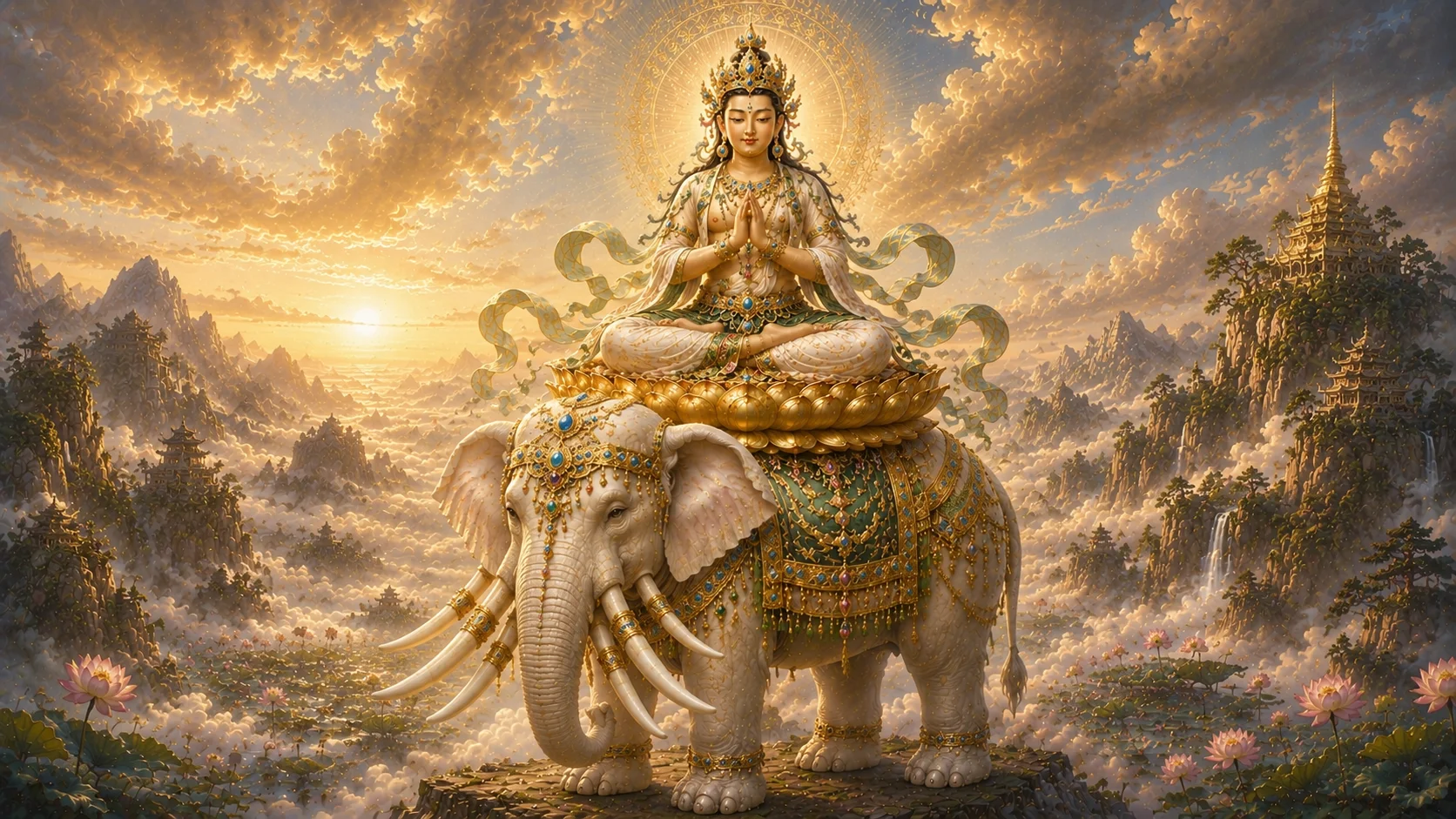
Samantabhadra is most often depicted riding a great white elephant with six tusks — the six tusks representing the overcoming of attachment in the six senses, or the six perfections (paramitas), and the elephant symbolizing the steady, powerful, unstoppable progress of practice. Serene and majestic, he embodies the patient, methodical, all-encompassing application of the path, the “universally worthy” conduct that extends compassion and wisdom into every action and every realm.
The Bodhisattva of the Sacred Mountain
Samantabhadra is one of the principal bodhisattvas of the Mahayana, often paired with Manjushri as attendants of the Lord Buddha (the two representing practice and wisdom, the elephant and the lion). In China he is Puxian, venerated at the sacred Mount Emei, held to be his abode; in Japan he is Fugen, important especially in the Tendai and esoteric schools and as a protector of those who uphold the Lotus Sutra. In Samantabhadra, Buddhism gave form to enlightened practice and the bodhisattva vow — the universally worthy bodhisattva on his six-tusked elephant, the embodiment of the tireless, all-encompassing application of wisdom and compassion in deed, the completion of the path in action.
Origins in the Flower Garland Sutra
Long before he became a fixture of temple halls across East Asia, Samantabhadra was the destination of a merchant’s son. The Gandavyuha — the closing book of the vast Avatamsaka (Flower Garland) Sutra — follows the pilgrim Sudhana as he seeks awakening from teacher after teacher: kings, mariners, a courtesan, children, few of them what a seeker expects a teacher to look like. The pilgrimage does not end with a sermon. It ends with a vision: Sudhana beholds Samantabhadra and sees, folded into the pores of that single body, world upon world, each containing all the others without contradiction. Only then does Samantabhadra speak.
The sutra reached China in stages, and the stages matter. Buddhabhadra rendered a sixty-fascicle Avatamsaka around 420; Sikshananda produced a longer eighty-fascicle version at the close of the seventh century, some two hundred and eighty years later. Neither carried the Ten Great Vows in the form East Asia would come to recite. Those arrived last, around 798, when the monk Prajna translated the Gandavyuha again in forty fascicles — and its final fascicle, the chapter of Samantabhadra’s conduct and vows, promptly broke free of the scripture that contained it. It was appended to Sikshananda’s edition, and it has been chanted as a stand-alone liturgy ever since, by generations who never read the sprawling sutra it came from.
The Elephant That Comes When Memory Fails
The Lotus Sutra gives Samantabhadra a narrower and stranger assignment than the Avatamsaka does. He does not belong to this world at all; in the sutra’s final chapter he arrives from the east, from the land of a buddha named King Above Jeweled Dignity and Virtue, with a host so large the earth trembles — and then makes a promise remarkable for how small it is. To anyone who takes up the Lotus Sutra and tries to keep it alive, he offers this: if that person should forget a single phrase or verse, I will prompt him and join him in reading and reciting so that he will gain understanding.
A cosmic bodhisattva crosses the universe with an army of attendants in order to help someone remember a line they lost. That disproportion is the whole character of the figure. The vow is aimed squarely at where a spiritual life actually fails: not at the dramatic crisis but at the long tedious middle, where conviction thins into habit and the text one swore to uphold quietly goes out of one’s head. Samantabhadra’s specialty was never dazzling metaphysics. It was showing up.
The Ritual of Confession
A companion text, the sutra on the procedures for visualising the Bodhisattva Universal Worthy, gave Samantabhadra a second office: receiving confession. Traditionally read as the epilogue to the Lotus, it is known so widely for this that it is sometimes simply called the Sutra of Repentance. It turns the bodhisattva from a guardian into a mirror. Practitioners were taught that sincere contemplation would bring him — elephant, tusks and all — into view, and were walked through a repentance of the six sense-faculties one at a time: the eye that grasped, the ear that fed on gossip, the mind that would not stop wanting. Here the elephant’s six tusks stop being a static emblem and become a checklist — the ritual works through the senses in turn, and the animal is the diagram of the work.
The Tiantai patriarch Zhiyi built an entire retreat discipline on this material. His Lotus Samadhi — the third of his four kinds of samadhi, the one practised half walking and half sitting — runs twenty-one days of recitation, ritualised confession and sustained visualisation of Samantabhadra, and it survives today in Chinese practice and in the Hokke Senbo of Japanese Tendai. Stripped of its liturgical scaffolding the logic is plain: insight can arrive in an instant, but a life of harm accumulates one small act at a time, and undoing it, this tradition insisted, would have to happen the same slow way — a very Samantabhadra idea to have.
Puxian’s Mountain
Emeishan in Sichuan is where the cult stopped being purely visionary and acquired an address, and the mountain preserves the two extremes of that devotion within a day’s walk of each other.
- At Wannian Temple sits a bronze Puxian on his six-tusked elephant, cast in 980 under the Northern Song: 7.35 metres tall, sixty-two tonnes, and the largest ancient bronze Buddhist statue surviving in China. It is housed in the Beamless Brick Hall, a domed Ming-dynasty structure built entirely of brick and stone without a single wooden beam, which has outlasted four centuries of earthquakes that the timber halls around it did not.
- On the Golden Summit, at the other end of the mountain and of the millennium, stands a gilded Puxian raised in 2006 — forty-eight metres and six hundred and sixty tonnes, ten heads stacked in three tiers facing the ten directions, mounted not on one elephant but on four.
A thousand years and roughly two hundred metres of altitude separate them. That both were built for the same bodhisattva, and that pilgrims still climb past the first to reach the second, is the plainest evidence that the cult never went quiet. It just kept building.
Two Samantabhadras
Travel from East Asian Buddhism into the Tibetan Nyingma school and the name splits into something else entirely. In Dzogchen teaching, Samantabhadra — called there Kuntuzangpo — is not a bodhisattva at all but the primordial buddha, the awareness that never departed from awakening and so never needed to attain it. He is painted naked and sky-blue, seated in open space inside a halo of rainbow light: naked because the nature of mind is unstained by any trace of concept and wears no conceptual clothing, blue because that nature is likened to sky, indifferent to whatever weather crosses it. He is shown in indivisible union with a consort, Samantabhadri, the pairing standing for awareness and openness as one undivided fact rather than two things joined. Nyingma teachers keep this figure carefully distinct from the elephant-riding bodhisattva of the Avatamsaka and Lotus traditions — the same name, translated the same way, pointing at categorically different things. It is one of Buddhism’s clearer reminders that a name carried between traditions does not always carry its job with it.
Action Without a Witness
Set beside Manjushri’s sword and Avalokiteshvara’s many reaching arms, Samantabhadra’s attribute can look almost inert. No blade cutting through delusion, no cry answered mid-disaster. That restraint is the point. Wisdom can be a private realisation and compassion can be a private feeling, but practice does not exist until it has actually been done — in the open, repeatedly, usually with nobody watching and nothing to show for it.
Which may explain the oddly modest promise at the centre of his cult. The tradition could have had him appear at the moment of understanding, and instead put him at the moment of forgetting: the lost verse, the twenty-first morning of a twenty-one-day retreat, the confession of an ordinary week’s worth of ordinary harm. Buddhism built an entire bodhisattva around the least glamorous half of the path, the part that begins after the insight arrives — because that is the half where a path is actually decided, and it needed someone to preside over it.
Sources & traditions
- EncyclopediaWikipedia — Samantabhadra (Bodhisattva)
- TraditionBuddhist texts, oral tradition and village tellings (South/Southeast Asia)
Myths change from area to area and from time to time. This chronicle follows the most widely told versions; tellings in other villages, regions and eras may differ.