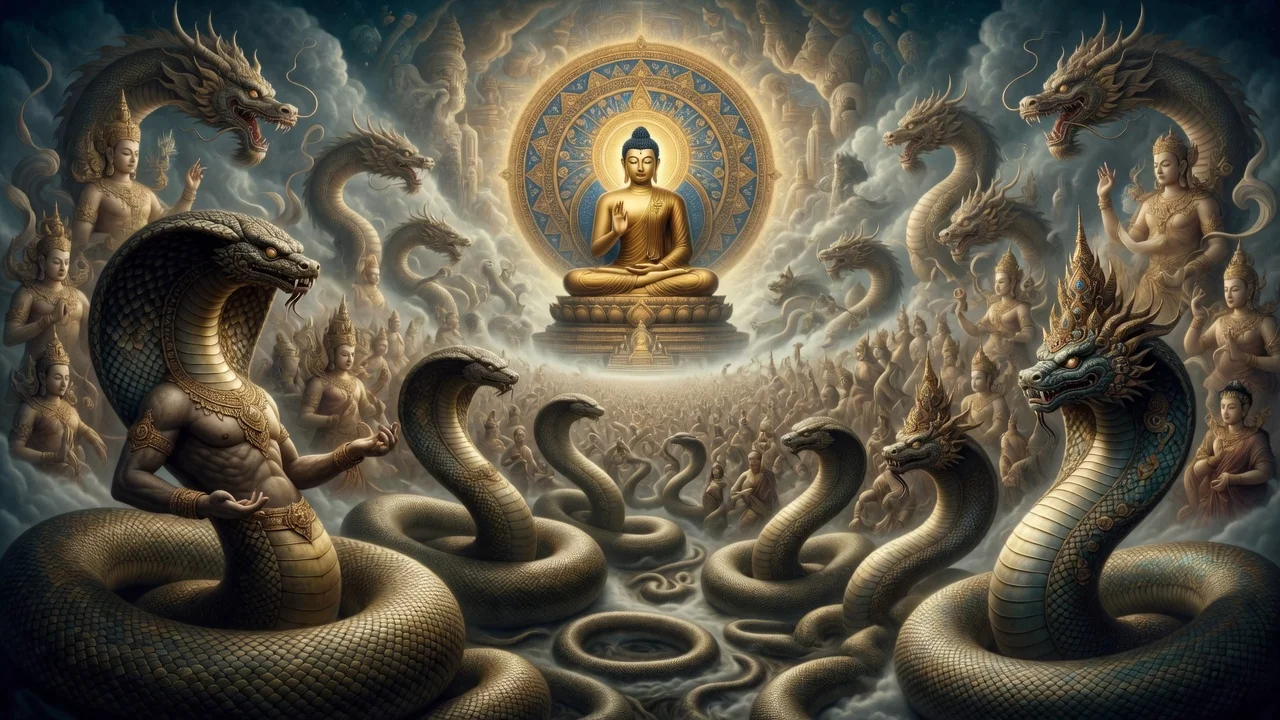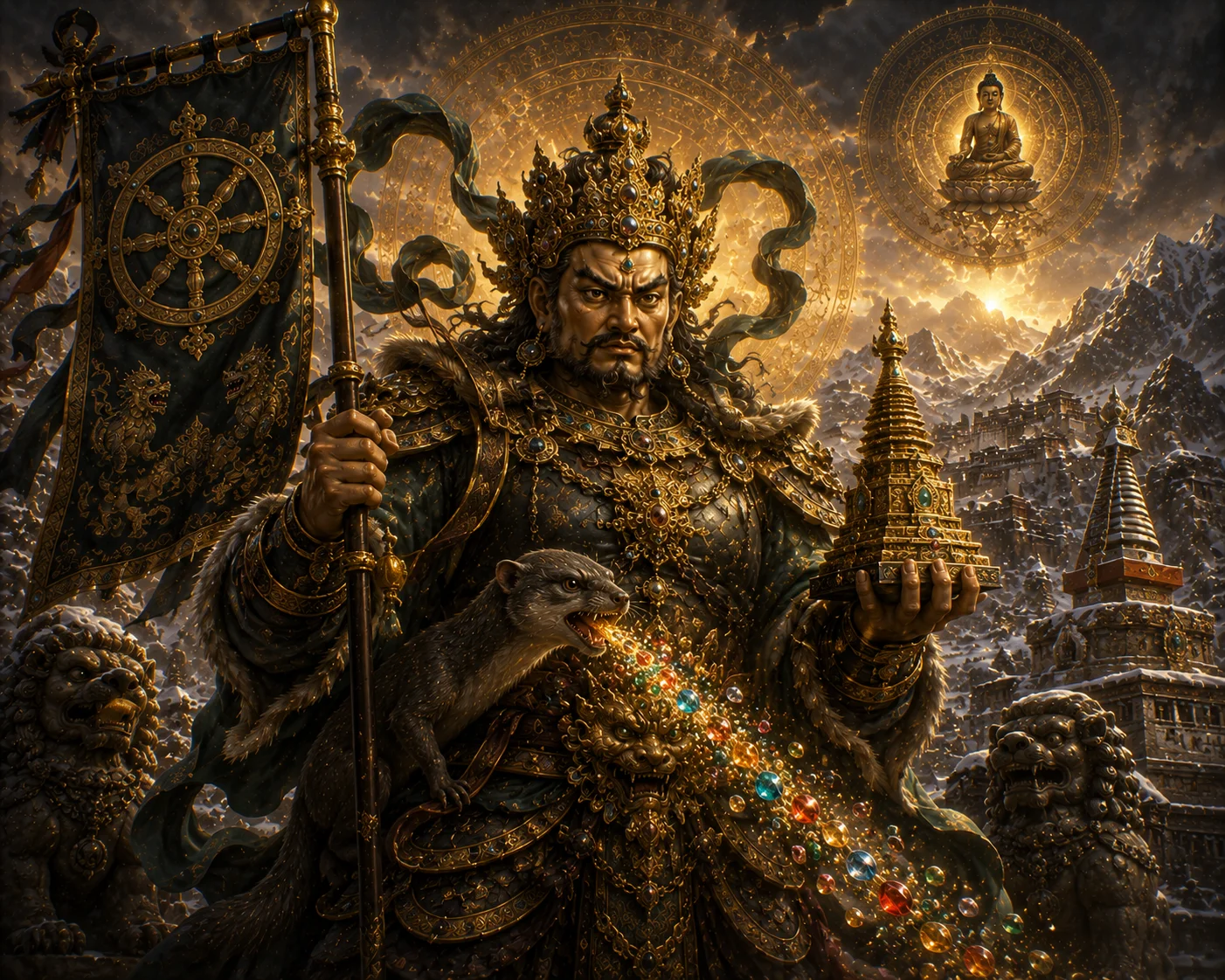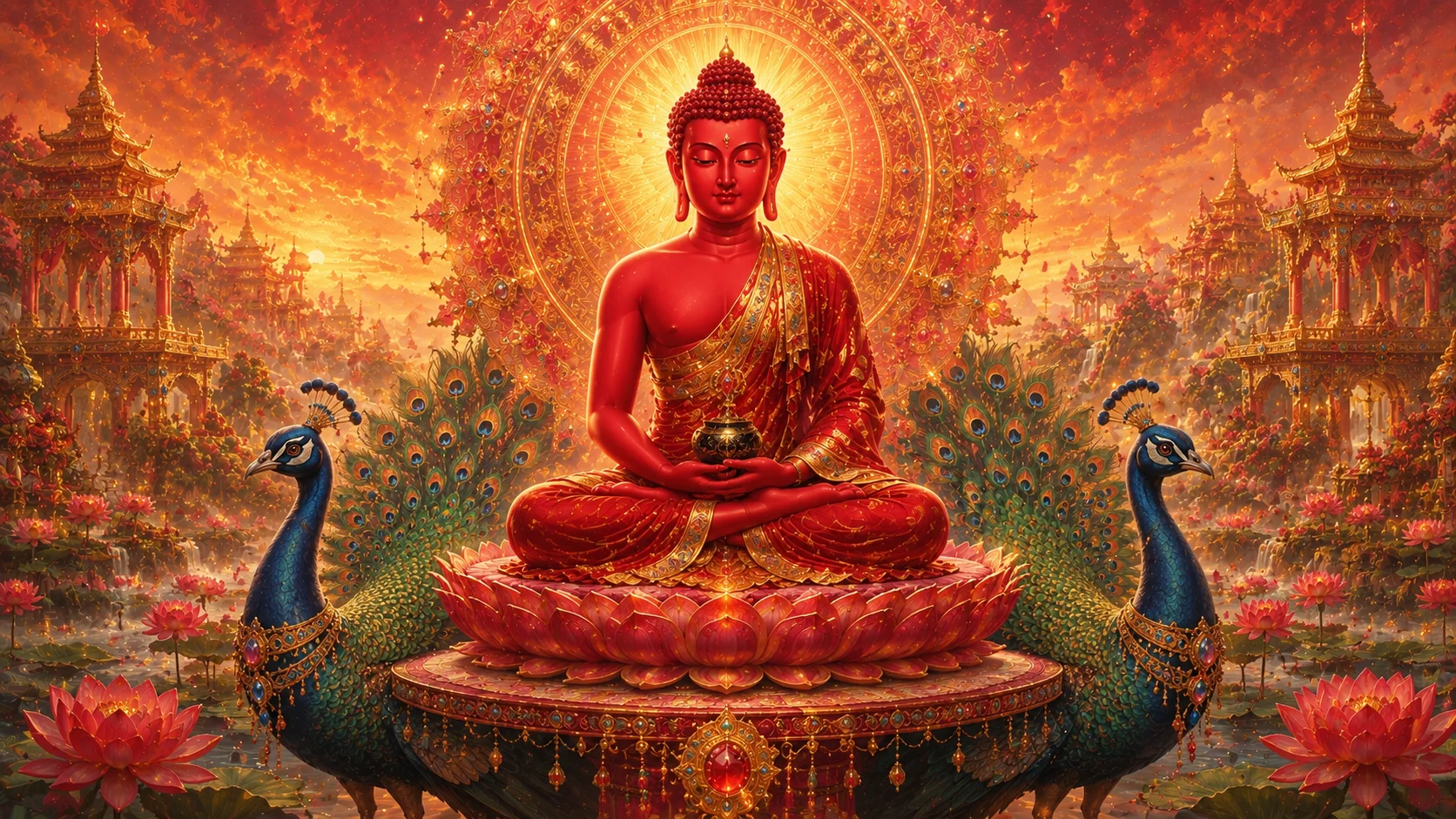
Amitabha, the Lord Buddha of Infinite Light and Infinite Life, is among the most beloved and widely worshipped of all the Buddhas: the lord of the western Pure Land of Sukhavati, whose boundless compassion offers rebirth in his paradise to all who call upon his name with faith.
The Radiance That Knows No Measure
Amitabha's very name is a declaration: Amitabha, Infinite Light, and Amitayus, Infinite Life, two epithets for one boundless presence, the endless radiance of his compassion and the endless span of his enlightened existence. Some texts speak of these as two names for a single Lord Buddha, emphasizing light in one breath and lifespan in the next; others treat them as closely related aspects of the same being rather than fully separate figures, depending on which text is consulted. Across the Buddhist world he carries many names in many tongues — Amituofo in China, Amida Butsu in Japan, Amita-bul in Korea, Öpakmé, "Infinite Light," in Tibet — yet in every language the devotion he draws is the same: boundless trust placed in a boundless Lord Buddha.
The Monk Who Would Not Rest Until All Were Saved
The great Sukhavativyuha Sutras, the Longer and Shorter Pure Land Sutras, Mahayana texts composed in the early centuries of that tradition, tell that countless ages ago, before a Lord Buddha named Lokeshvararaja, there lived a monk named Dharmakara. Moved by the suffering of beings adrift in the round of rebirth, Dharmakara made forty-eight great vows, promises of a solemn and total kind. Chief among them was this: that he would not accept the fruit of Buddhahood at all unless he could bring into being a Pure Land of perfect conditions, a land into which any being who sincerely called upon his name with faith would be reborn. It was not a vow made lightly or for himself. It was a vow that bound his own enlightenment to the salvation of others, so that his becoming a Lord Buddha and the opening of the gate to liberation for all beings would happen in the very same instant, or not at all.
Aeons of Unseen Labor
Between the vow and its fulfillment lies an almost unimaginable stretch of practice. The sutras describe Dharmakara laboring across many kalpas, immense aeons of time, accumulating merit with a patience that has no equal in the ordinary measure of a human life. There is no single dramatic trial recorded in this account, no adversary to overcome; the labor itself is the trial, sustained without faltering across a span of time the mind can scarcely hold. When at last the accumulated merit was sufficient and the forty-eight vows fully realized, Dharmakara attained Buddhahood and became Amitabha, and in that same moment his Pure Land, Sukhavati, the Land of Bliss, came into existence in the western reaches of the cosmos, exactly as he had vowed it would.
Sukhavati, the Land of Bliss
Sukhavati is described in the sutras as a realm of extraordinary beauty, free of the sufferings and distractions that make awakening so difficult to reach in an ordinary human life. It is not, in most classical accounts, final nirvana itself — it is better understood as a way-station, a supremely conducive environment in which beings reborn there may continue their practice toward full enlightenment unhindered by the obstacles of ordinary existence. To be born in Sukhavati is not the end of the path but a removal of every obstacle that had made walking that path so hard. The promise is not that struggle ends the moment one arrives, but that the ground beneath the struggle finally becomes level.
A Gate Opened by Faith Rather Than by Effort Alone
What makes Amitabha's promise so widely cherished is its radical accessibility. Where much of the earlier Buddhist path called for arduous self-discipline sustained within monastic life, the vow of Dharmakara offers what the traditions later called tariki, "other-power": liberation made possible not solely by one's own unaided effort but through faith in Amitabha's vow and the sincere recitation of his name. In Chinese this recitation is nianfo; in Japanese, nembutsu — Namu Amida Butsu, "Homage to the Lord Buddha Amitabha." It stands in contrast to jiriki, "self-power," the path of solitary monastic striving, without displacing it entirely; the two are understood in the tradition as different doors onto the same liberation. Recitation of the name is a practice open to anyone, in any circumstance, requiring no monastery and no lifetime of solitary austerity, only sincerity of heart.
The Triad of the Western Paradise
In the art and devotion of East Asia, Amitabha rarely stands alone. He is flanked by two great bodhisattvas who together form the Amida Triad, a grouping seen across countless paintings, statues, and temple halls throughout the region. On his left stands Avalokiteshvara, known across East Asia as Guanyin or Kannon, the embodiment of compassion; on his right stands Mahasthamaprapta, called Seishi in Japan. Avalokiteshvara's bond to Amitabha runs deeper still: in some traditions the bodhisattva is described as emanated from or crowned by him, and is often shown wearing a small image of Amitabha set into his headdress — a mark of spiritual lineage rather than of literal parentage, a sign of where that compassion is understood to originate. The Triad as a whole embodies the promise at the center of Pure Land devotion: that a being calling out in a final hour is not calling into emptiness.
Among the Five Tathagatas
In the mandalas of the later Vajrayana traditions — a tantric development distinct from, and considerably later than, the earlier Pure Land sutras — Amitabha is counted among the Five Tathagatas, the Five Dhyani Buddhas, alongside Vairocana, Akshobhya, Ratnasambhava, and Amoghasiddhi. Within this cosmological scheme he presides over the western direction, associated in various tantric systems with the element of fire and with the skandha of perception, the very faculty by which beings discern and misperceive the world around them — a fitting domain for a Lord Buddha whose light is said to dispel delusion. This five-Buddha arrangement belongs to a different layer of Buddhist thought than the Sukhavativyuha Sutras, and the tradition itself is careful to keep the two frameworks distinct even as it holds them both.
The Traditions That Grew from His Vow
Amitabha's vow gave rise to entire schools of Buddhism built around faith in his name. In China, Pure Land Buddhism, Jingtu zong, became one of the most widely practiced forms of the religion. In Japan, the monk Hōnen founded Jōdo-shū, the Pure Land school, in the twelfth century, and his disciple Shinran founded Jōdo Shinshū, the True Pure Land school, in the thirteenth, each placing the nembutsu and trust in Amitabha's vow at the very center of practice. Together these traditions remain among the most widely followed forms of Buddhism across East Asia to this day, carrying Dharmakara's ancient promise into the devotional life of millions of households, temples, and funerary rites.
Bronze Cast in His Likeness
Few images convey the scale of devotion to Amitabha as powerfully as the Great Buddha of Kamakura, the monumental bronze Daibutsu completed in Japan in 1252. Seated in solemn stillness, it depicts Amitabha himself, and it remains one of the most recognized Buddhist images in Japan, a work of bronze and patience that has watched over its city for over seven centuries — a fitting monument to a Lord Buddha whose own path, according to the sutras, was defined by aeons of unhurried labor before a single vow was fulfilled.
A Question Left Open by Scholars
The historical roots of devotion to a Lord Buddha of infinite light, seated in a paradise to the west, have prompted speculation among some scholars, who have proposed possible influence from Persian or Zoroastrian solar traditions given the resonance of the imagery. This remains a debated academic hypothesis rather than any doctrinal claim recognized within the tradition itself, and it is offered here only as a matter of scholarly curiosity, not as an account of Amitabha's origin honored by those who venerate him. Within the tradition, the account that matters is the one told in the sutras themselves: the vow, the aeons of practice, and the Pure Land that came into being when both were complete.
Light and Life as Two Faces of One Devotion
That Amitabha should be known by two names, one for light and one for life, is itself a kind of teaching. Infinite light suggests a compassion that reaches everywhere at once, leaving no being in shadow it cannot cross; infinite life suggests a patience that outlasts every human measure of time, a vow honored across kalpas rather than abandoned when it grew difficult. Devotees who recite Namu Amida Butsu are not choosing between these two qualities but calling upon both together, trusting that the same Lord Buddha who labored unseen for aeons remains present, without diminishment, in the single moment a sincere voice calls his name.
The Promise That Endures
In Amitabha, Buddhism gave lasting form to a compassion without limit and a hope open to all: a Lord Buddha whose vow, sustained across unthinkable aeons, opened the gate of his western paradise to every being who calls upon him with a sincere heart. Of all the promises of liberation within the Buddhist world, few are held with such wide and enduring devotion as this one — infinite light, infinite life, and a Pure Land waiting in the west for whoever turns toward it in faith.
Sources & traditions
- EncyclopediaWikipedia — Amitābha
- TraditionBuddhist texts, oral tradition and village tellings (South/Southeast Asia)
Myths change from area to area and from time to time. This chronicle follows the most widely told versions; tellings in other villages, regions and eras may differ.