Akshobhya — “the Immovable,” “the Imperturbable” — is one of the Five Wisdom Buddhas of Mahayana and Vajrayana Buddhism: the Lord Buddha of the eastern paradise of Abhirati, the lord of unshakable resolve and the transmuter of anger into the mirror-like wisdom that reflects all things without distortion. He embodies the steadfast, immovable mind of enlightenment.
The Immovable Lord Buddha
Akshobhya’s name means “the unshakable” or “the immovable,” and it springs from his founding vow. As a monk, the legend tells, he resolved never to feel anger or disgust toward any being — a vow so difficult that to keep it unbroken across countless ages was to be truly immovable. He kept it, and attained Buddhahood, becoming the lord of the eastern Pure Land of Abhirati (“the Joyous”), a realm of bliss where the conditions for enlightenment are perfect and rebirth there is a great blessing.
The Mirror-Like Wisdom
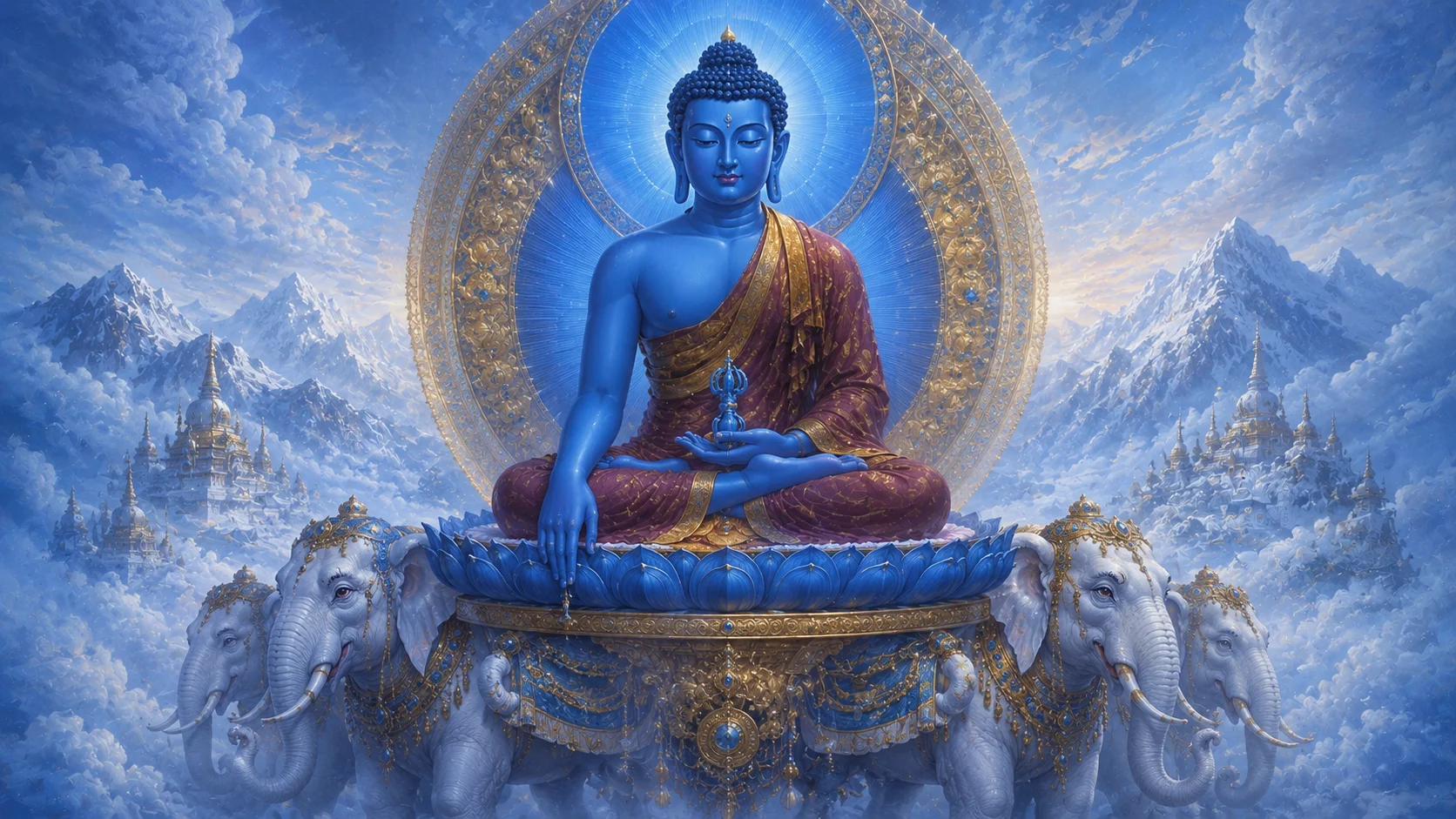
Among the Five Wisdom Buddhas, Akshobhya presides over the East and embodies the mirror-like wisdom (adarsha-jnana) — the enlightened awareness that reflects all phenomena clearly and impartially, like a perfect mirror, without grasping or aversion. He is the transmuter of the poison of anger and hatred: the deluded fire of wrath, purified, becomes this clear, reflective wisdom. He is associated with the colour blue, the element of water, the elephant as his vehicle, and the vajra (thunderbolt-diamond) as his emblem, symbolizing the indestructible, unshakable nature of the awakened mind.
The Lord of the East
Akshobhya is invoked for the overcoming of anger and the cultivation of steadfast, imperturbable equanimity, and his mantra and practice are held to purify negative karma. In the great mandalas he sits in the east, one of the five who together map the transformation of the five poisons into the five wisdoms and the five aspects of Buddhahood. In Akshobhya, Buddhism gave form to the immovable mind — the Lord Buddha whose unbroken vow against anger made him the unshakable one, the lord of the eastern paradise, the transmuter of wrath into the clear mirror-wisdom that reflects reality as it truly is.
The Other Pure Land
Akshobhya has a scripture of his own, the Akshobhyavyuha Sutra, and it is among the earliest Mahayana texts to survive anywhere: it was rendered into Chinese by the Kushan monk Lokaksema in the late second century CE, at the very beginning of Mahayana’s transmission eastward. Long before devotion to Amitabha’s western paradise became the dominant pure-land aspiration of East Asia, the eastern paradise of Abhirati was already a place the faithful could set their hearts on, and some historians of the tradition regard the Akshobhya cult as the older of the two. Sukhavati eventually eclipsed it so thoroughly that most people who know the Pure Land know only one.
The sutra also records why he never wavered. Hearing a buddha of that eastern world describe what the bodhisattva path demands, a monk rose and made a vow of a kind almost nothing else in the canon dares repeat: that from that moment until his own awakening he would never give rise to anger or ill will toward any living being — not toward one who insulted him, not toward one who struck him — and that were he ever to do so, he would stand as a deceiver before every buddha in every world. Most bodhisattva vows promise what their maker will do for others. His set a standard for his own mind and allowed it no exceptions, across lifetimes beyond counting. He did not break it. That is the whole meaning folded into the name: immovable is not a temperament he happened to have, it is a record he kept.
Abhirati, the Land Where No One Falls Back
The paradise the vow bought is described in oddly domestic detail. In Abhirati there are no hells, no hungry ghosts, no rebirth as an animal — the lower architecture of suffering that structures Buddhist cosmology everywhere else is simply absent. What the sutra lingers on is not cosmic splendour but relief from ordinary difficulty: garments and ornaments hang ready on the trees, food and drink arise without labour, and women there are held to be free of the pains and defilements that attend pregnancy and childbirth in this world. Its single most important property, though, is neither comfort nor beauty but security — a being reborn in Abhirati is said never to fall back from the path to enlightenment again.
That guarantee is why Akshobhya sits at the centre of Tibetan practice for the dead. The Mitrugpa rites — his mantra and dharani recited over the dying, over the corpse, and inscribed to be placed with the ashes — are held to purify the negative karma that would otherwise drag a consciousness downward at the moment it is least able to resist. It is the same power the vow was made of, deployed at the one hour when a mind is hardest to hold steady.
The Family He Heads, and the Wrath That Serves Him
In the tantric systems built around the Five Wisdom Buddhas, each presides over a “family” of deities who share his essential quality. Akshobhya heads the vajra family, and in several enumerations his consort is Lochana, whose name simply means “eye” — a fitting partner for a wisdom described as a mirror. The more striking inheritance, though, is darker: a great many of Vajrayana’s wrathful figures — snarling, flame-wreathed, garlanded in skulls — are classed within the vajra family, which traces its lineage back to the one buddha in the pantheon whose defining trait is that he never, in any life, gave way to anger.
The tradition is not being careless here; it is making a point. The fiercest images on a Vajrayana altar are meant to be read as wrath already transmuted, wearing the face of the poison precisely to show that it has been mastered rather than indulged. Rage that has been converted does not become mild. It becomes exact.
In the Guhyasamaja Tantra this centrality becomes literal. Where the standard mandala of the Five Buddhas places Vairocana at the centre and Akshobhya in the east, the Guhyasamaja system swaps them: Akshobhya takes the centre and Vairocana is moved out to the east. A whole tantric lineage is making the argument architecturally — that the transmutation of anger, not the luminous totality Vairocana stands for, is the axis its system turns on.
Reading Him in Stone and Paint
Akshobhya is one of only two figures regularly shown making the bhumisparsha mudra, the earth-touching gesture: the right hand reaching down past the knee to call the ground itself as witness. The other is Shakyamuni, caught at the exact moment of his awakening beneath the Bodhi tree, summoning the earth to testify against Mara’s challenge. The two are near-identical in posture and are told apart chiefly by colour — Shakyamuni in the golden or flesh tones of a historical human being, Akshobhya in the deep blue reserved for a cosmic buddha. Painters and sculptors are, in effect, quoting the Lord Buddha’s own moment of unshakability and assigning the quotation to the figure whose entire story is that he never left it.
The Immovable Lord Buddha Across Asia
The cult travelled early and unevenly. In China he is Achu Fo, present from those same second-century translations that carried his sutra into Chinese while most of the Mahayana canon was still unknown there. In Japan he is Ashuku Nyorai, holding the eastern position of the Kongokai, the Diamond Realm Mandala that the monk Kukai brought back from Tang China at the start of the ninth century and that still anchors Shingon esoteric practice. In the Kathmandu Valley, Newar Buddhism gives him a body in stone: the great stupa of Swayambhunath sets shrines to the Tathagatas into the base of its dome at the cardinal points, and the eastern one — at the head of the long stairway, facing the sunrise — is his, circumambulated daily by people for whom none of this is antiquarian.
Why an Unbreakable Vow Against Anger Still Matters
Most traditions ask their adherents to suppress anger, to starve it of expression until it goes quiet. Akshobhya’s asks something rarer and considerably harder: not to smother the fire but to change what it is made of, so that the energy which would have become rage becomes instead a surface that reflects everything without flinching and without grabbing at it. Nothing in that promise requires the world to stop provoking you. The elephant beneath his throne is the animal that does not bolt; the mirror is the object that does not look away. Eighteen centuries after a scribe first set that vow down in words, it is still an unusually demanding offer — not calm because nothing reaches you, but calm because there is nothing left that could.
Sources & traditions
- EncyclopediaWikipedia — Akshobhya
- TraditionBuddhist texts, oral tradition and village tellings (South/Southeast Asia)
Myths change from area to area and from time to time. This chronicle follows the most widely told versions; tellings in other villages, regions and eras may differ.