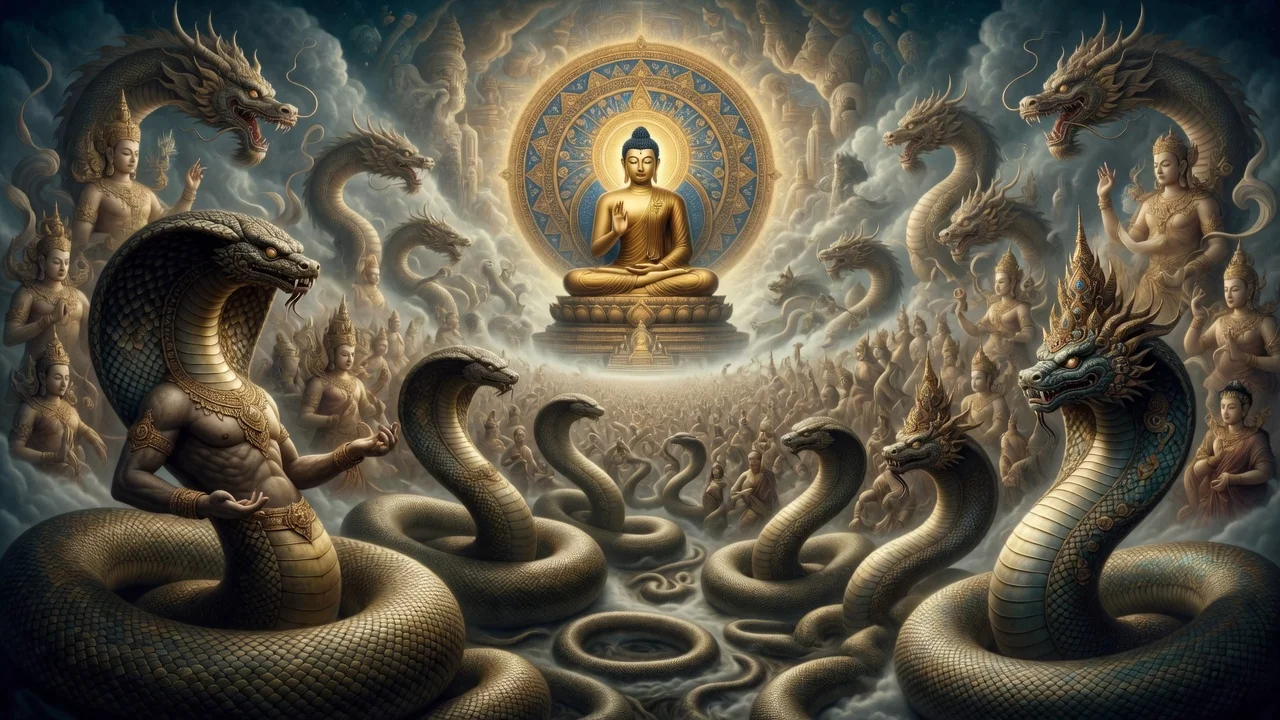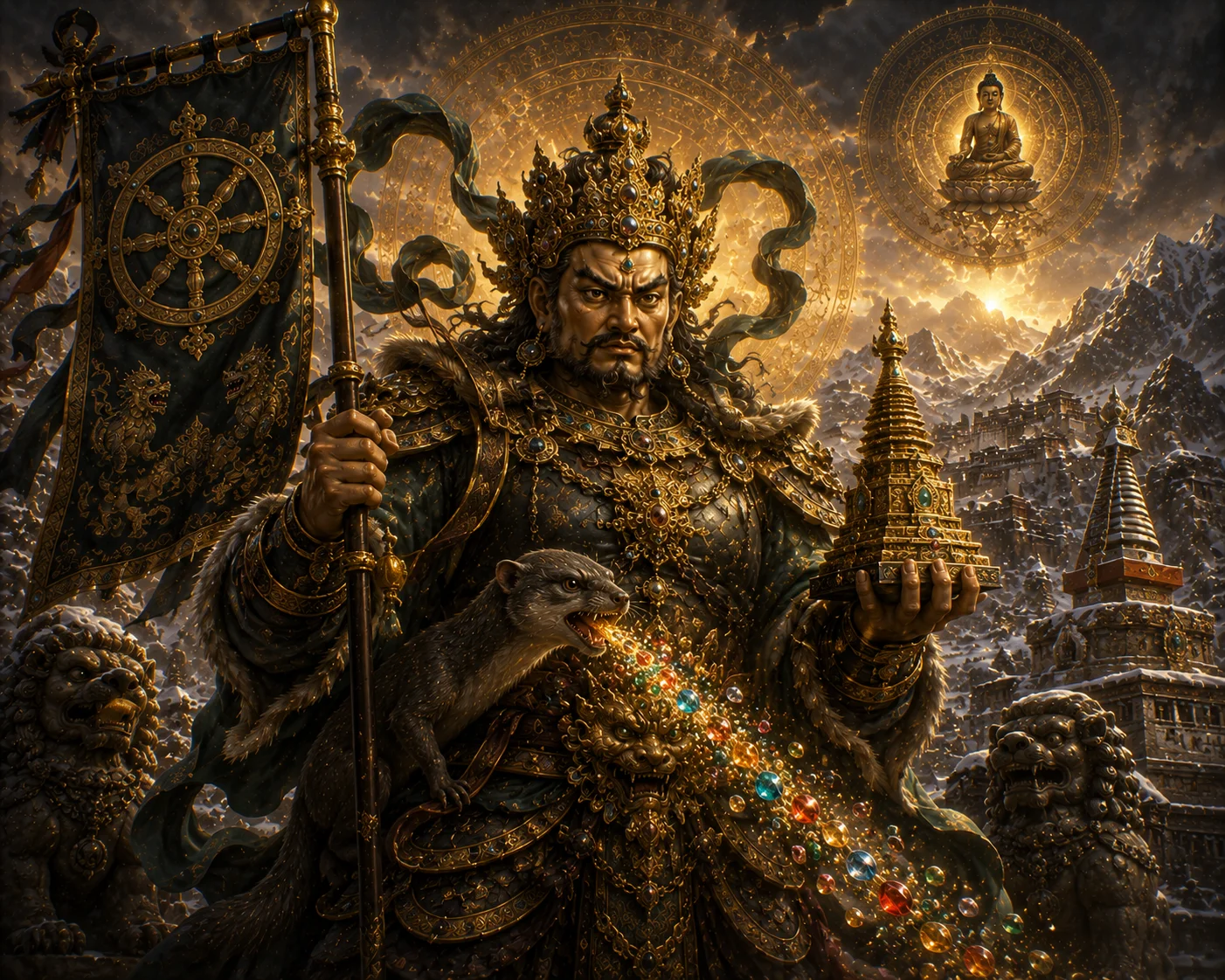
Amoghasiddhi, the Unfailing Accomplishment, is one of the Five Wisdom Buddhas of Mahayana and Vajrayana Buddhism: the Lord Buddha of the North, the lord of fearless action and the accomplishment of all aims, who transmutes the poison of envy and jealousy into the all-accomplishing wisdom that acts spontaneously for the good of all beings.
He Whose Accomplishment Is Never in Vain
The name Amoghasiddhi joins two Sanskrit roots: amogha, unfailing or never empty-handed, and siddhi, accomplishment or spiritual attainment. Together they are rendered as He Whose Success Is Unfailing, or Infallible Accomplishment — a Lord Buddha whose every enlightened action reaches its purpose without waste, without hesitation, and without the possibility of failure. Within the fivefold system of Tathāgatas most fully systematized in tantric compendia such as the Sarvatathāgata-tattvasaṃgraha, and elaborated across centuries of Vajrayana commentarial and iconographic tradition, Amoghasiddhi represents the culmination of enlightened activity: not contemplation alone, not compassion alone, but the actual, effective doing of what benefits beings. He is the Lord Buddha of the deed that lands true.
Throned in the Direction of the North Wind
In the mandala architecture that organizes the Five Tathāgatas around the cardinal points, Amoghasiddhi presides over the north. He is one of five Buddha-families, or kula, that structure the entire cosmology of Vajrayana practice — the Buddha-, Vajra-, Ratna- and Padma-families and his own, the karma or action family. Where Akṣobhya in the east anchors immovable clarity and Amitābha in the west opens boundless compassion, Amoghasiddhi in the north completes the circle with the energy of accomplishment itself: the capacity of awakened mind to act, to finish, to protect. His family name, karma, should be understood in its root sense of action rather than the popular sense of fate — it names the Buddha-family whose essential work is doing.
The Crossed Vajra and the Hand Raised in Fearlessness
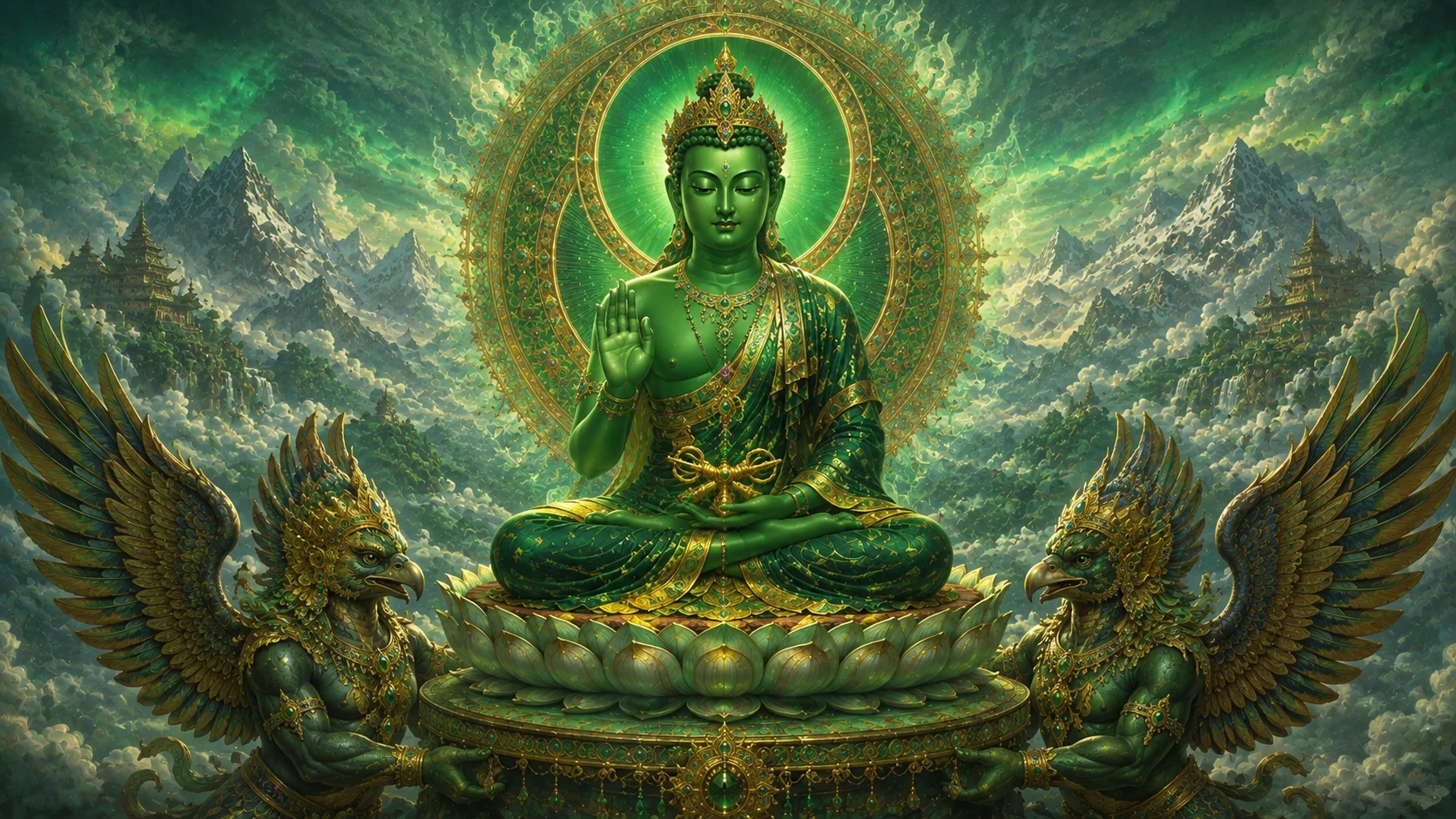
Amoghasiddhi's emblem is the viśvavajra, the double or crossed vajra formed of two thunderbolt-scepters intersecting at right angles, radiating toward all four directions at once. It is a visual statement of totality — that his accomplishment reaches every quarter of existence, leaving nothing untouched. His defining gesture is the abhaya mudrā, the right hand raised, palm turned outward, fingers extended upward: the immemorial gesture of fearlessness and protection, offered to whoever stands before him. It is this mudrā, more than any other single feature, that distinguishes him at a glance from his four companion Buddhas — Akṣobhya's hand touches the earth in the bhūmisparśa mudrā, Amitābha's hands rest in meditation, Ratnasambhava's hand extends in the gesture of giving, and Vairocana's hands turn the wheel of teaching at his heart. Amoghasiddhi alone lifts his hand outward, and the gesture itself is the teaching: do not be afraid, for the work will be accomplished.
Green as the Living Wind
Amoghasiddhi's iconographic color is a deep, dark green, the color most often associated in this fivefold scheme with growth, vitality, and the unseen force of movement itself. His element is vāyu, air or wind — the element that cannot be grasped or held still, that moves through and animates all things, that carries scent and sound and breath. Wind is the fitting element for a Lord Buddha of action, since action, like wind, is invisible in itself and known only by its effects: the branch that bends, the seed that scatters, the fire that spreads or is extinguished. To meditate on Amoghasiddhi's green and his wind is to meditate on activity as an element in its own right, as fundamental to reality as earth or water.
Garuda-Borne and Sky-Swift
Amoghasiddhi's throne-support or vehicle is most commonly given in the textual and iconographic traditions as the garuḍa, the great mythic bird of Indic cosmology, though some sources instead describe a pair of shang-shang-like harpy beings supporting his seat — an attribution that varies somewhat across region and lineage. The garuḍa's association fits him precisely: a creature of unmatched speed and unerring flight, moving through the same element of air that is Amoghasiddhi's own, arriving at its destination the way his accomplishment arrives — swiftly, and without failure.
The Poison of Envy, Turned to Tireless Wisdom
Each of the Five Tathāgatas is paired in Vajrayana psychology with one of the five root afflictions, or kleshas, and with the purified wisdom into which that affliction is transmuted through practice. Amoghasiddhi's affliction is envy or jealousy, īrṣṣā — the corrosive comparison of oneself to others, the resentment that begrudges another's success. In its transmuted form this same energy becomes kṛtyānuṣṭhāna-jñāna, the all-accomplishing wisdom: awareness that acts on behalf of all beings without the self-referential sting of rivalry, that can watch another succeed and simply continue its own unhesitating, generous work. Where envy contracts around the self, all-accomplishing wisdom acts outward, tirelessly, asking nothing back.
Saṃskāra: The Aggregate of Mental Formations
The five Buddhas are also mapped, in the same correspondence system, onto the five skandhas or aggregates that Buddhist psychology holds together constitute the deluded experience of a self. Amoghasiddhi's skandha is saṃskāra, usually translated as mental formations or volitional impulses — the aggregate of habitual patterns, intentions, and karmic momentum that shape how a mind moves toward action. That this is precisely his aggregate is not incidental: saṃskāra is the seed of doing itself, the moment where intention becomes movement, and it is exactly this aggregate that his all-accomplishing wisdom purifies and directs toward benefit rather than compulsion.
Seed-Syllable and the Mantra of the North
Amoghasiddhi's bīja, or seed-syllable, is given in different sādhana and lineage traditions as either ĀḤ or KHA, the single condensed sound from which his entire form is visualized to arise and into which it dissolves again in meditation. His mantra, recited across Tibetan and Newar Vajrayana ritual practice alike, is Om Amoghasiddhi Āḥ — a short invocation that carries within its few syllables the whole of his name and his unfailing promise.
Tārā and the Consorts of the Karma Family
In most Tibetan iconographic sets, Amoghasiddhi's consort is Tārā, most often in her Green Tārā form — a pairing whose color affinity with his own dark green underscores their shared family. Certain tantric schemes instead name Samayatārā or Ārya-Tārā as his consort, and this variation should be read honestly: consort assignments across the mandala traditions are not perfectly uniform, but shift somewhat according to the specific text and lineage transmitting them. What remains constant is the presence of a Tārā figure at his side, embodying an active, swift compassion that mirrors his own swift accomplishment.
Viśvapāṇi, His Emanated Bodhisattva
As each of the Five Tathāgatas is understood to emanate a corresponding bodhisattva who carries forward his particular quality into active engagement with the world — as Amitābha emanates Avalokiteśvara — Amoghasiddhi is, in some mandala systems, linked with the bodhisattva Viśvapāṇi of the karma family. Viśvapāṇi stands as the emanated counterpart through whom Amoghasiddhi's all-accomplishing energy is understood to reach further into the activity of teaching and liberating beings.
Facing North Among the Living Stupas of the Kathmandu Valley
Beyond the textual and meditative traditions of Tibet, Amoghasiddhi holds a distinct and continuously practiced place in Newar Buddhism of the Kathmandu Valley, where the Five Buddhas are enshrined together in the architecture of caitya and stupa. At Svayambhunath, the great stupa's niches face the four cardinal directions plus the zenith, each housing one of the Five Buddhas, with Amoghasiddhi conventionally placed to face north — his position in the mandala made permanent in stone and worshipped as living devotion rather than studied only as doctrine. This Newar tradition stands as an attested, well-documented ritual lineage distinct from, and complementary to, the purely textual transmission preserved in Tibet.
His Face in the Bardo
Later Nyingma and broader Tibetan tantric reception carried the Five Dhyani Buddhas, Amoghasiddhi among them, into the teachings on the intermediate state after death recorded in the Bardo Thödol, the Tibetan Book of the Dead. There, each of the five is said to appear to the consciousness of the deceased in both peaceful and wrathful aspect, corresponding to the purification of each of the five skandhas as the mind passes through the bardo. Amoghasiddhi's wrathful counterpart is generally identified as one of the Herukas within the wrathful deity cycle, though the exact pairings differ somewhat between the various Nyingma terma cycles that transmit these visions — a variation the tradition itself acknowledges rather than resolves into a single fixed account.
Not to Be Mistaken for His Namesakes
The root amogha, unfailing, appears in the names of at least two other significant figures of Buddhist history and iconography, and the overlap is a documented and common source of confusion. Amoghavajra was an eighth-century tantric master and translator active in China, a historical human teacher entirely distinct from the transcendent Lord Buddha of the mandala. Amoghapāśa, meanwhile, is a form of the bodhisattva Avalokiteśvara, likewise textually and iconographically separate from Amoghasiddhi despite the shared root in their names. Devotion offered to Amoghasiddhi, the Lord Buddha of the North, should be kept clear of both.
The Circle of Five Completed
Amoghasiddhi is invoked for the overcoming of envy and fear, for the fearless and effective accomplishment of beneficial action, and for protection. In the great mandalas he sits in the north, completing the circle of the five Lord Buddhas whose together map the full transformation of the deluded mind into the fivefold wisdom of enlightenment. In Amoghasiddhi, Buddhism gave form to fearless, effective action, the unfailing Lord Buddha of the North, the transmuter of envy into the all-accomplishing wisdom that acts spontaneously and tirelessly for the liberation of all beings.
Sources & traditions
- EncyclopediaWikipedia — Amoghasiddhi
- TraditionBuddhist texts, oral tradition and village tellings (South/Southeast Asia)
Myths change from area to area and from time to time. This chronicle follows the most widely told versions; tellings in other villages, regions and eras may differ.