Pariacaca (Paria Caca, Paryaqaqa) is the great mountain god of Huarochirí, the high country east of Lima in the central Peruvian Andes. He is a god of storm, rain and the waters that irrigate the valleys of the Pacific slope, and the principal deity of the narratives preserved in the Quechua text now called the Huarochirí Manuscript. He first appears as five eggs on a mountain, hatches as five falcons, and becomes five men who are also one god. He destroys the proud, breaks the rule of a fire-and-hunger deity named Huallallo Caruincho, and leaves behind a country of lakes, canals, snowpeaks and pilgrim roads that his worshippers could read as his body and his biography. He is not “the supreme god of the Andes.” He is a regional power whose story is unusually well documented, and the way it was documented is part of the story.
The Mountain
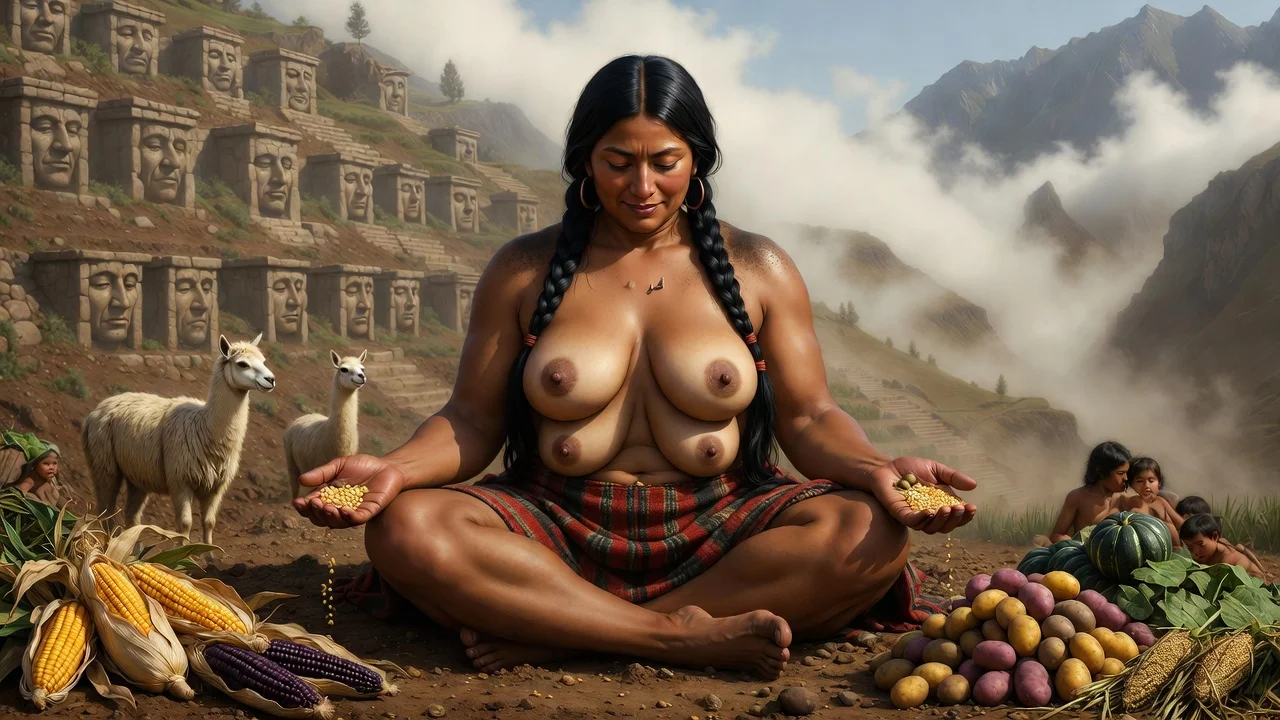
Pariacaca is first of all a place. The Pariacaca range, also called the Huarochirí range, belongs to the Cordillera Central and runs between the Lima and Junín regions; its highest summit, Nevado Pariacaca, is usually given as about 5,750 metres, though sources differ by a few metres. In the manuscript the god is a snowcap, described by its modern editor as a majestic double-peaked mass visible on the eastern horizon from the heights of Huarochirí. The name is commonly divided into paria and caca, rock or crag; the second element is secure, while proposals for the first, such as “reddish,” remain proposals.
In the manuscript the mountain is more than a symbol. The god and the mountain are one being, and he is also spoken of as the five persons who share his name; the people of the region went to worship him on the heights.
The Manuscript and How It Was Made
Almost everything known of Pariacaca comes from one source, and it is not an innocent one. The Huarochirí Manuscript is a text of some thirty-one chapters in Quechua, with a few Spanish headings and marginal queries, held in the National Library in Madrid, where it was published in a bilingual edition by the German scholar Hermann Trimborn in 1939; José María Arguedas published the first Spanish translation in 1966, and Frank Salomon and George Urioste published the English translation in 1991.
The manuscript was compiled during the Spanish campaign against native religion. Francisco de Ávila, born in Cuzco about 1573 and posted in the late 1590s to the parish of San Damián de Checa, came to be the great persecutor of the local huacas, the sacred beings and places. He dated his own Spanish report on the errors and false gods of the people of Huarochirí to 1608, and the Quechua text appears to be earlier or contemporary. Salomon points out that the common attribution of the manuscript to Ávila is erroneous. The Quechua text was written by an anonymous native author or authors from testimony of villagers. Antonio Acosta and Taylor have argued that its compilation began around 1608 at Ávila’s order, while Arguedas and Duviols proposed about 1598; and Alan Durston has argued that the Indigenous leader Cristóbal Choque Casa, Ávila’s collaborator, may have been its author. Authorship and date remain debated.
Two consequences follow. The stories are in the voices of Quechua-speaking villagers, told in their own language and with evident love of their mountains, yet they were gathered under pressure by a priest whose purpose was to find and destroy their shrines. And the manuscript draws on several tellers from rival villages, such as the Checa and the Concha, each presenting their own descent from the god, so that it contains alternative versions. Clements Markham had published an English version of Ávila’s Spanish report in 1873, a different and shorter text.
Before Pariacaca: Huallallo Caruincho
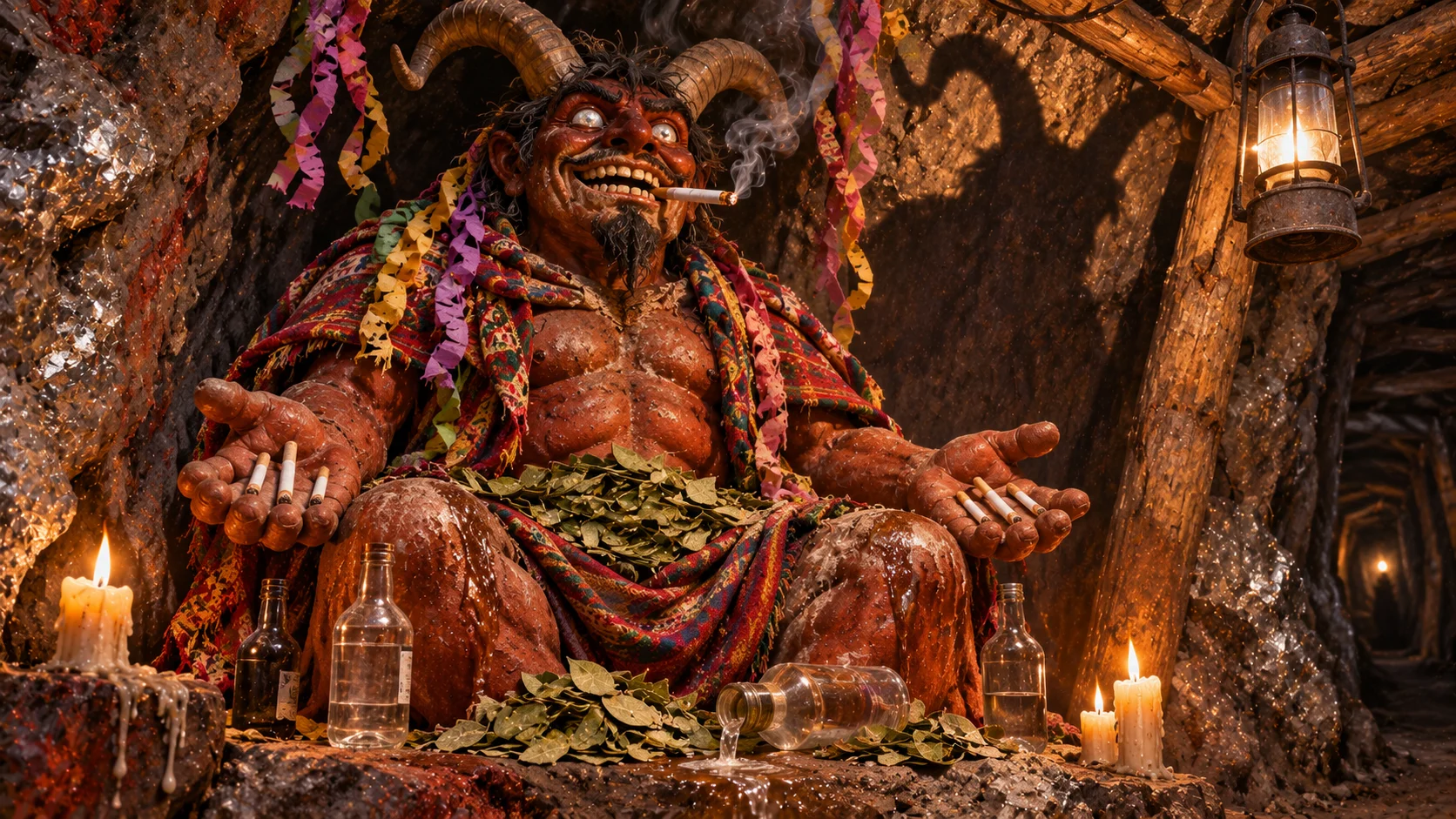
The first chapter of the manuscript describes the world as it was before the god arrived. The ruling huaca was Huallallo Caruincho, whose title is rendered by the translators as the Man Eater and the Man Drinker. People then lived in a hot, lush country, a land of macaws, toucans and abundance, which the text calls yunca, the warm lowlands, even up on the heights. They did not die permanently: the dead came back to life on the fifth day, and crops ripened in five days. The price was that no woman might raise more than two children, and one of every two was sacrificed to be eaten by Huallallo. Ávila, retelling this in Spanish, says the same.
It is a world of plenty with a terrible tax, and it is the system that Pariacaca overturns. Cuniraya Viracocha, a trickster-creator with stories of his own in the manuscript, belongs to the same body of tales.
Five Eggs, Five Falcons
The fifth chapter tells how, on a mountain called Condor Coto, five eggs appeared. Nearby lived a poor and ragged man named Huatya Curi, called a son of Pariacaca in Ávila’s version, who ate only parboiled food. In the same district lived a rich and powerful lord, Tamta Namca, whose house was roofed with yellow and red feathers and whose llamas were red, blue and yellow, and who called himself a god and creator. He fell ill, and nobody could cure him, so that people began to murmur that a god who is ill is no god.
Huatya Curi, sleeping on a hillside, overheard two foxes talking and learned the true cause. A grain of maize had popped from the griddle while the lord’s wife was toasting it; she had served it to a man, and the tellers reckon that act as a sexual fault. As a result a snake had made its home on top of the great house, and a two-headed toad lived beneath the grinding stone. He cured the man by uncovering these things, was given his younger daughter, and then defeated the husband of the elder daughter, a very rich man, in a series of contests of dancing, drinking, costume and house-building, in each of which his father, the unborn Pariacaca, supplied the means. At the last the rich man panicked, turned into a brocket deer and ran away, and his wife was turned to stone.
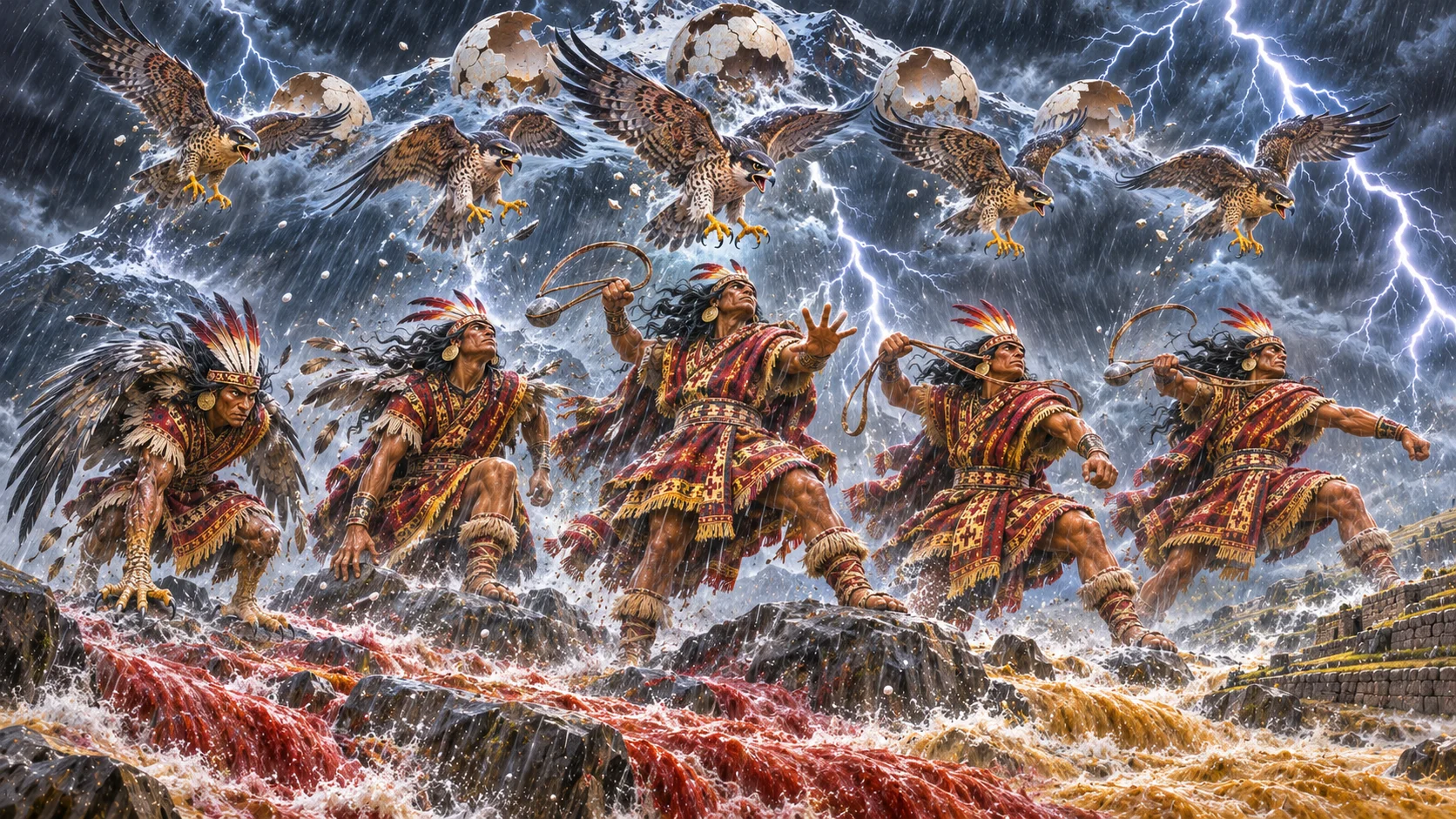
When Huatya Curi had finished, the manuscript says, Pariacaca flew out of the five eggs in the shape of five falcons, and the falcons became men. Hearing that Tamta Namca had said “I am a god” and been worshipped, the new god became furious and, rising up as rain, washed away the man, his house and his llamas to the ocean. He also swept away a great tree called the Pullao, which formed an arch between two mountains and sheltered monkeys, toucans and birds of every colour.
The Stranger at the Feast
The sixth chapter, titled in the Salomon and Urioste translation “How Paria Caca Was Born as Five Falcons and Then Turned into Persons,” gives the best-loved story. Pariacaca, grown to full height, goes in search of his enemy Huallallo, and on his way comes to Huauqui Usa, a village of the lowland yunca, where a great festival is under way. He sits down at the end of the banquet, like a stranger who has not been invited. All day nobody offers him a drink. At last one woman, a native of the village, exclaims at the shame of it and brings him maize beer in a large white gourd.
He tells her that it is lucky for her that she did so and that five days from then something terrible will happen; she must be far away with her children and must tell no one. She goes. On the fifth day Pariacaca climbs the mountain above Huarochirí, and from there, rising as yellow hail and red hail, he sends a torrential storm and a mudslide that washes the villagers to the sea and shapes the high slopes and valleys. In the manuscript’s telling, the high slopes and valleys carry the traces of such storms. The moral is hospitality: the god reveals himself to the one who feeds the stranger.
Fire Against Water
The eighth chapter tells the war itself. Huallallo’s seat was on the high country, and the place that is now a lake called Mullo Cocha, the Lake of the Thorny Oyster Shell, was his dwelling; the text says the god made the lake in order to put him out. Before the battle, a man came weeping along the road, carrying his child as food for Huallallo and bringing a thorny oyster shell, coca and balls of ticti, a food offering made from the residue of maize beer, as his offering. One of the five told him to take his child home and give the offerings to him instead, and the five ate the shell with a crunch. He told the man to come back in five days and watch: if the waters won he should shout that their father was beating Huallallo, and if the fire won, that the fight was over.
When the day came, Pariacaca, who was five persons, began to rain from five directions, a rain that was yellow and red, and flashed as lightning from five directions. From early morning until sunset Huallallo flamed up like a fire reaching almost to the heavens, and would not be put out. One of the five, Llacsa Churapa, knocked down a mountain and dammed the waters in a lake, which almost drowned the burning god. Under the lightning, Huallallo fled toward the Anti lowlands to the east. Pariacaca’s brother Paria Carco was left at the pass to stop his return, and according to the text he remains there “in the form of a heavily snowcapped peak.” A demoness who had accompanied Huallallo, Mana Namca, was driven into the sea after wounding Chuqui Huampo, one of the god’s party, in the foot; he stayed behind, lame, to watch for her, and the coca-growers of the valleys were commanded to bring him coca first.
Later chapters add episodes to the flight. In a later chapter Huallallo hides in a cliff and is blasted by lightning, and looses a two-headed serpent, an amaru, which Pariacaca stabs with a golden staff and turns to stone; the text says that people still strike it and carry the chips as medicine. Huallallo then sends a toucan, whose wing Pariacaca breaks and turns to rock, and flees at last to the Antis. In another passage Pariacaca passes sentence on him: because he once ate people, let him now eat dogs, and let the Huanca people feed them to him.
Scholars have read the battle of water and fire as a figure of the contest between the highland world of rain and snow and the hot country below; the manuscript itself tells it in terms of persons and places.
Water and Desire: Chuqui Suso
The best-known of Pariacaca’s other deeds is not a battle but a courtship. After the destruction of Huauqui Usa, he crosses to the fields of the Cupara, who farm with little water from a spring that comes from a high lake. There he finds a beautiful woman, Chuqui Suso, weeping because her maize is drying. He stops the mouth of her little pond with his cloak and asks to sleep with her; she says: first the water. He releases water, she waters her fields, and again she defers. He promises a canal from the river, and pumas, foxes, snakes and birds clean and fix the old ditch from the ravine of Coco Challa. The fox claims the right to lay out the line, but a tinamou, a partridge-like bird, bursts up whistling, the startled fox falls, and the snake is given the task; the canal therefore runs lower than it might have. When the water reaches the fields, Chuqui Suso keeps her promise, leads Pariacaca to the mouth of the canal, and turns to stone there.
The story is also an account of cult, and the next chapter says so. In the month of May, when the canal had to be cleaned, the Cupara people, who made up one kindred, went to Chuqui Suso’s dwelling with maize beer, ticti, guinea pigs and llamas, built an enclosure of quishuar wood and stayed inside it for five days, and came home dancing, leading one woman among them whom they greeted as Chuqui Suso. The teller adds that the canal is cleaned this way “today, too.” Canal-cleaning rites of this kind are still a ritual high point of the year in many highland Andean communities.
The Cult
The manuscript goes on to describe how Pariacaca established his own worship. His law, in the text’s phrase, was one and the same in all villages: “We are all of one birth.” In each village one person, the huacsa, was to re-enact his life once a year and dance three times a year carrying coca.
Some scholars have suggested that parts of the narrative are verbal scripts of these performances, in which the huacsa enacted the god’s life. After the conquest the god and his brothers, the text says, entered the crag of the mountain and made it their home.
Pariacaca and the Inca
The manuscript preserves one fragment of the god’s relation to Cuzco. In chapter 23 the Inca summons all the huacas, and one of Pariacaca’s sons, Maca Uisa, defeats the Inca’s enemies with rain that becomes a mudslide and with lightning, and he asks the Inca to dance the priestly dance of the cult “the way our children from the Yauyo do.” The text presents the Inca as a patron, not as the founder. Sources written from the Cuzco side, such as the account attributed to Santa Cruz Pachacuti Yamqui, tell the history of the provincial huacas in the Inca’s favour, and I have not tried to reconcile them with the Huarochirí version here. The difference is a reminder of who is telling the story.
What the History Behind It Might Be
Scholars have asked what real events the myth could be telling. The Peruvian historian María Rostworowski proposed that the stories reflect a gradual descent of highland herders, the people called Yauyo, from the headwaters of the Cañete River through the warm irrigated valleys of the Mala, Lurín and Rimac toward the Pacific, displacing or absorbing the earlier lowland farmers, the Yunca. She has documented Yauyo populations across that country in independent colonial records. The picture the text itself draws is more complicated: its Checa tellers regarded their own ancestors as Yunca, scorned the Yauyo as half-wild nomads, and still counted themselves children of Pariacaca. The myth can be read as a charter for a federation of unlike groups sharing a god, a canal system and a pilgrimage.
Reading the Sources
The evidence has three layers. The Spanish layer, Ávila’s report and the extirpation literature that followed, such as Arriaga’s manual of 1621, describes the cult as the devil’s work, and in that layer Pariacaca is an “idol.” The Quechua layer, the manuscript, is the best evidence for what the god meant to his worshippers, but it was extracted by an extirpator and edited by hand, and its fairness is therefore uneven. The modern layer includes ethnographic accounts of canal-cleaning rituals in the Andean highlands.
Huallallo, in short, is not simply a villain driven away. He is the god of an older order, sent to the Antis and given dogs to eat; and the victory over him is ethnic and agricultural as much as cosmic. The mountain is still there.
Sources & traditions
- EncyclopediaWikipedia — Pariacaca
- TraditionIncan texts, oral tradition and village tellings (Andes)
Myths change from area to area and from time to time. This chronicle follows the most widely told versions; tellings in other villages, regions and eras may differ.