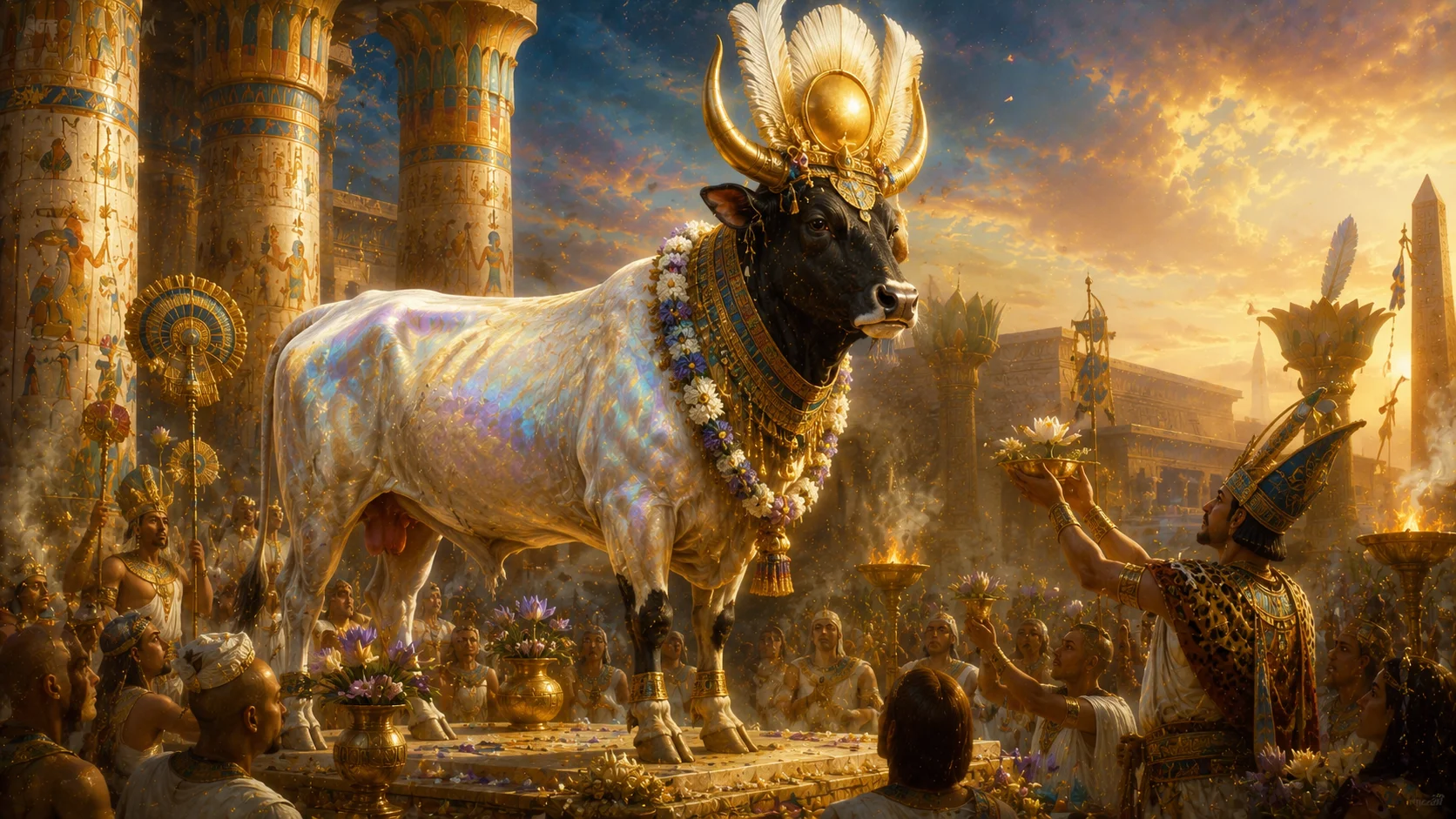
Nefertum was the Egyptian god of the lotus, perfume, beauty and the dawn — the beautiful young god who emerged from the primordial lotus blossom at the first dawn of creation, the divine fragrance of the sacred blue lotus, and the son of Ptah and Sekhmet in the great triad of Memphis. He is the sweet-scented beauty of the first sunrise, the lotus from which the sun was born.
The God of the Lotus
Nefertum (Egyptian Nefertum, “beautiful one who closes” or “perfect one”) was the god of the lotus blossom, perfume, fragrance and beauty. He was intimately associated with the sacred blue lotus (the blue water-lily), a flower of immense significance in Egyptian religion: the blue lotus opens at dawn and closes at dusk, and its sweet fragrance and beautiful blossom made it a symbol of the sun, of rebirth, and of beauty and pleasure. Nefertum was depicted as a handsome young man crowned with a great lotus blossom (often with two tall plumes), the embodiment of the flower's beauty and fragrance.
The Lotus of Creation
Nefertum's deepest significance lay in the myth of creation and the first dawn. In one of the great Egyptian creation myths, the primordial waters of chaos brought forth a lotus blossom, and from this first lotus, opening at the dawn of time, emerged the sun — the first sunrise, the beginning of light and life. Nefertum was bound up with this primal lotus and the sun that rose from it: he was “the lotus at the nose of Ra,” the sweet fragrance that the sun-god breathed, and the beauty of the first dawn. As the god of the lotus from which the sun was born, he embodied the freshness, beauty and fragrance of the very first morning of creation, the sweet-scented dawn of the world.
The Son of Memphis
Nefertum was the son of the creator-god Ptah and the lioness-goddess Sekhmet, completing the great triad of Memphis (Ptah, Sekhmet and Nefertum). This gave the beautiful, fragrant lotus-god a notable parentage: born of the divine craftsman and the fierce lioness, he united creation and beauty. He also had a fiercer aspect at times, linked through his mother Sekhmet to the lion and to protective power. But he was beloved above all as the god of perfume and beauty — the divine fragrance, the sweet scent of the sacred lotus, the god to whom the lovely smells of perfumes and flowers belonged. The Egyptians, who loved perfumes and scented oils, honoured Nefertum as the source of these pleasures.
The Fragrance of the First Dawn
Nefertum endures as one of the most beautiful and gentle of the Egyptian gods — the god of the lotus, perfume and beauty, the divine fragrance of the sacred blue lotus, the beautiful youth who emerged from the first blossom at the dawn of creation, the son of the Memphite triad. He embodies the Egyptian love of beauty, fragrance and the lotus, and the lovely myth of the sun born from a flower at the first dawn; and he remains the sweet-scented god of the lotus and the morning — the beauty and fragrance of the very first sunrise of the world, renewed in every dawn and every blossom.
The beautiful youth who rose from the first lotus at the dawn of creation, the sweet fragrance the sun-god breathes — the god of the lotus, perfume and the beauty of the morning.
The Oldest Words We Have
Long before Memphis made him the third figure of its great triad, Nefertum was already old. He is named in the Pyramid Texts — the spells carved into the burial chambers of pyramids at Saqqara from around the twenty-fourth century BCE, and the oldest substantial body of religious writing to survive from Egypt. The phrase that fixes him there is stark and strange: Nefertum, the lotus blossom at the nose of Ra. It is worth sitting with what that image implies. In the earliest layer of Egyptian religious thought we can still read, the sun-god does not simply appear each morning in perfect condition — the god of scent is present at the moment he rises. Sunrise, in this scheme, is something attended to, and one of the things attending it is a smell.
The Boy Who Wore a God’s Face
Among the first objects recorded when Howard Carter’s team began clearing Tutankhamun’s tomb in 1922 was a carved and painted wooden head: a young man’s face rising from the open petals of a lotus. It is Tutankhamun — but not as a living pharaoh. He is shown as the child sun-god emerging from the primordial flower at the dawn of the world, which is why the piece has been known ever since as the head of Nefertum. Its purpose was precise. To be carved rising renewed from the lotus was to claim, on behalf of a dead king, the same daily rebirth the sun was granted. On funerary equipment that is not decoration. It is an argument about what happens next.
Other Mothers, Other Cities
The tidy Memphite family — Ptah, Sekhmet, Nefertum — was never the only version told. Egyptian religion did not enforce a single genealogy on its gods, and Nefertum’s mother changes with the source. He is named as the son of Wadjet, the cobra-goddess who guarded Lower Egypt from Buto in the Delta marshes; and as the son of Bastet, the cat-goddess of Bubastis — a substitution that made sense to Egyptian eyes, since Bastet and Sekhmet were understood as two temperaments of a single feline power, one gentled into a household cat, one left raging as a lioness. None of these traditions cancelled the others out. A worshipper moving between temples was not choosing the correct myth over the false ones; they were meeting the same fragrant god through whichever fierce mother their own city already knew.
The Lion Beneath the Bloom
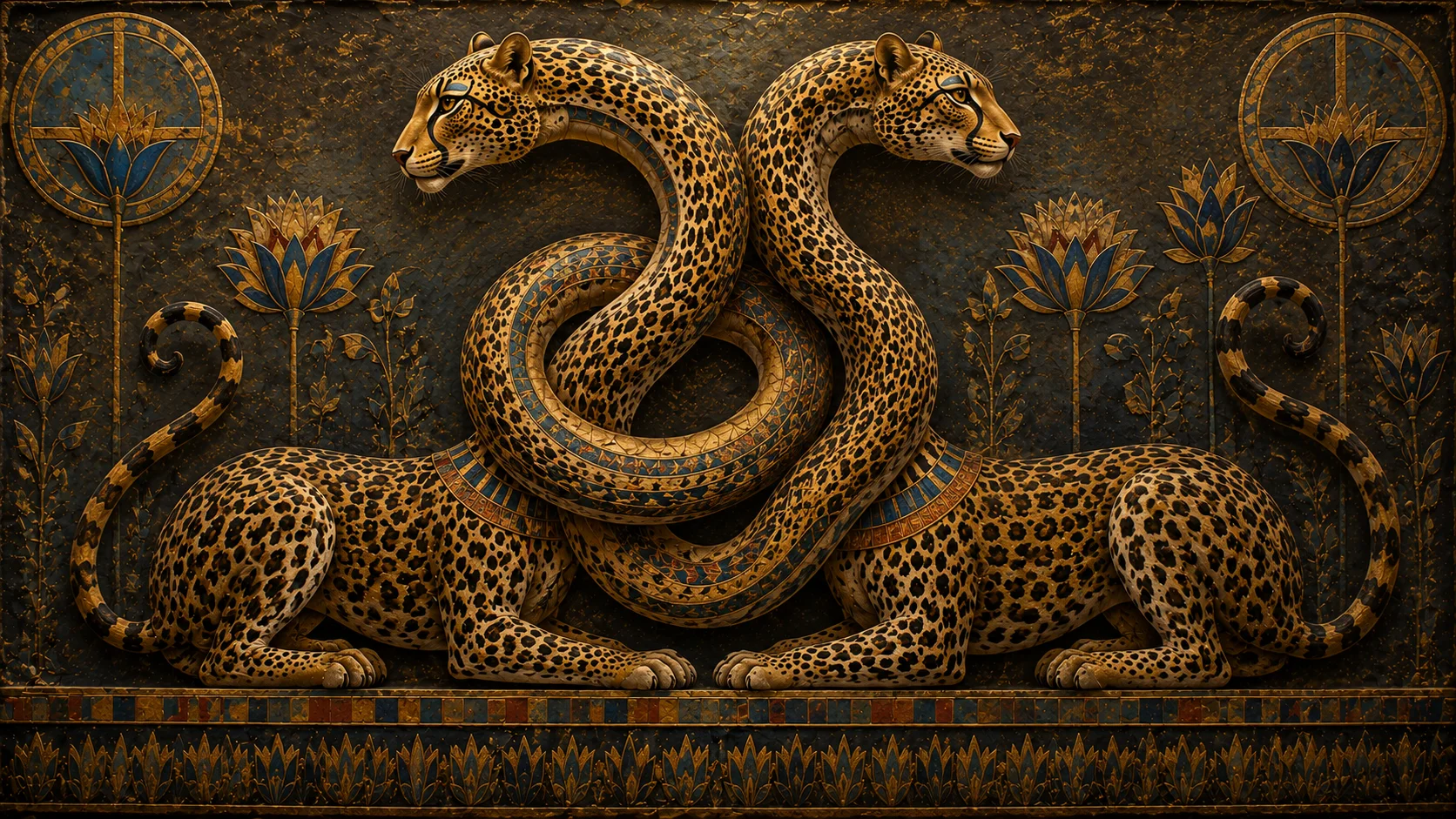
Egyptian craftsmen did not hide the shadow behind the flower. Bronze figures show Nefertum standing on the back of a lion, and some images give him a lion’s head outright — a form that appears particularly in the later periods, when the line between him and his leonine mothers grew thin. The lotus-crowned youth and the lion-headed figure were one god in two moods, on the same logic that let a sweet-scented flower and a lioness share a bloodline. He was also among the commoner subjects of faience amulets, the small glazed charms worn by ordinary Egyptians rather than kings — which may be the more telling fact about him. The god of perfume was something people carried on their bodies.
To Become the Flower
Funerary religion took the creation myth and turned it into a procedure the dead could use. Among the spells of the Book of the Dead is one for being transformed into a lotus — spell 81, which a person could have written into their own burial equipment so that in the afterlife they might speak it and become the flower itself: pure, newly opened, risen out of the water. What it asks for is not a single resurrection but a renewable one, because the lotus does not rise once. For the Egyptians, the sun’s return each morning was not merely a fact of nature. It was the standing proof that the same thing could be asked on behalf of a human being.
A Name That Argues With Itself
Even the god’s name will not settle. Nefer is secure enough — beautiful, perfect, complete. It is the second element, tem, that fractures: read one way it carries the sense of completing or closing, read another it functions as a negation, so the same name yields both “the beautiful one who closes” and “the beautiful one who does not close.” A third reading hears in it the name of Atum, the creator-god of Heliopolis. Egyptologists have not settled the question, and there is little sign the Egyptians felt any pressing need to. A name that can mean closure, endless reopening, or kinship with the creator suits a god whose entire myth turns on a threshold crossed and recrossed — shut at dusk, open at dawn, one small flower standing in for the whole of creation every morning it manages it again.
Sources & traditions
- EncyclopediaWikipedia — Nefertem
- TraditionEgyptian texts, inscriptions and later retellings
Myths change from area to area and from time to time. This chronicle follows the most widely told versions; tellings in other villages, regions and eras may differ.