Min was the ancient Egyptian god of male fertility, procreation and the eastern desert — one of the oldest attested deities of Egypt, with roots reaching back to the Predynastic period. He was worshipped as the ithyphallic embodiment of generative male potency, the guardian of the desert roads that led toward the Red Sea, and a central figure in the royal rites that renewed the king's procreative power.
A God Older Than the Written Word
Min's worship reaches further back into Egyptian prehistory than that of almost any other deity later recorded in the temples of the Nile Valley. Imagery resembling his standing, ithyphallic form is already visible on Naqada-period material, meaning that by the time Egypt's earliest dynasties were forming a unified state, Min was already an old god. This depth of antiquity meant that later Egyptians themselves regarded him as a figure from the very beginning of things, a power whose worship needed no explanation because it had simply always existed. His continuity is remarkable: he is attested from those Predynastic beginnings through to the Greco-Roman period, a span encompassing nearly the entire recorded history of ancient Egyptian religion.
The Unmistakable Form
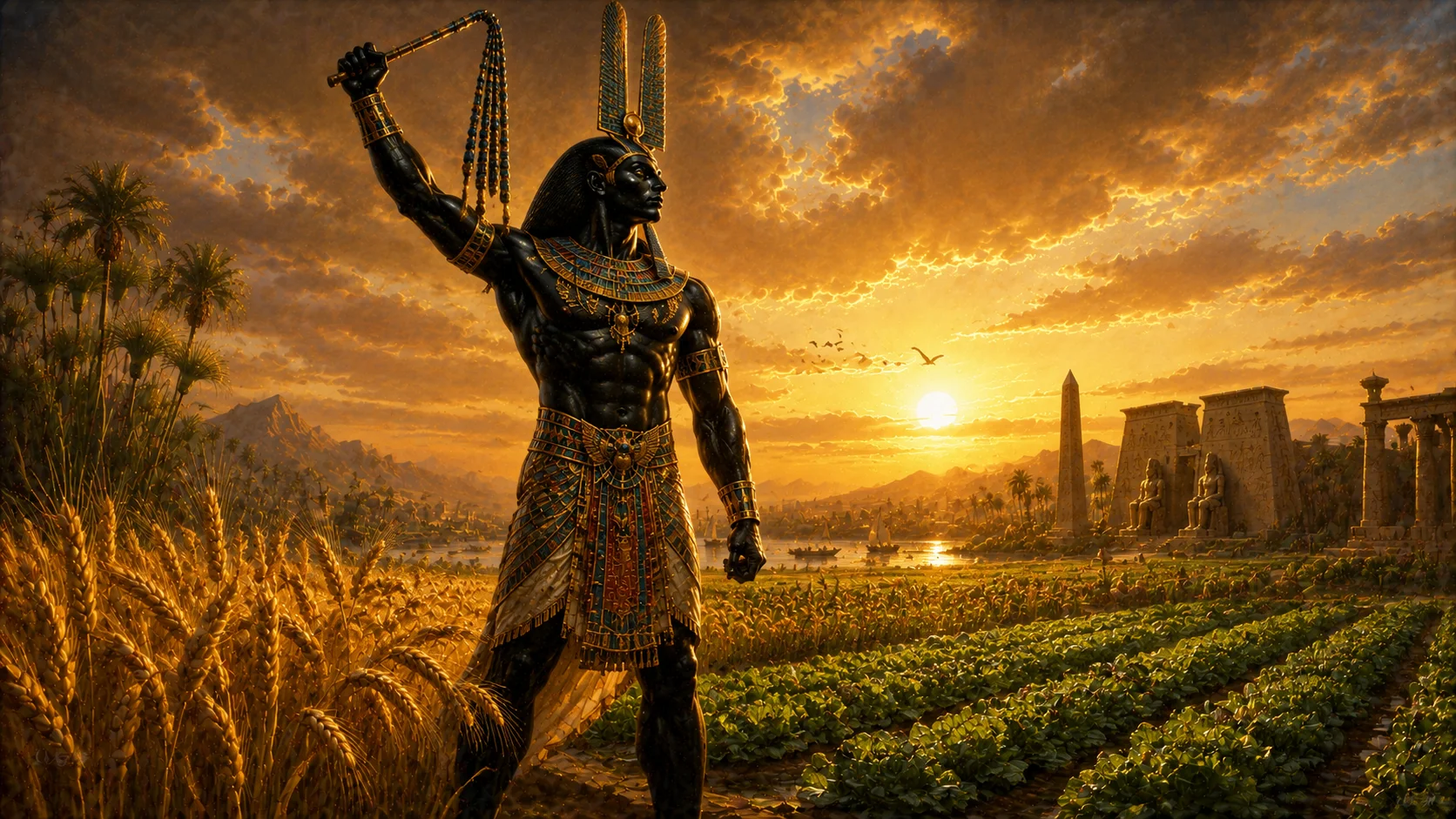
Min's iconography was among the most direct and immediately recognizable in the entire Egyptian pantheon. He was shown as a standing, mummiform male figure, his body wrapped close as though bound like a mummy, yet very much alive and potent. One arm was raised, holding aloft a flail, the same implement of authority carried by kings and by gods of rule and order. Upon his head sat a crown bearing two tall plumes, marking him as a figure of the highest rank among the gods. And, unmistakably, he was depicted ithyphallic — with an erect phallus, displayed without concealment as the frank visual statement of his nature. This was not incidental ornamentation; it was the entire point of his image, a theological claim rendered in stone and paint rather than left to inference.
Lord of the Eastern Desert
Beyond his fertility aspect, Min held a distinct geographic domain: the eastern desert of Egypt, the harsh stretch of land between the Nile Valley and the Red Sea coast. He bore the epithet Lord of the Eastern Desert, and in this role he was the protector of the routes that crossed it — the tracks used by miners extracting stone and minerals, and by traders and travelers making their way toward Punt and the Red Sea. To cross that desert was to leave the safety of the cultivated valley and enter a domain that belonged to Min, and those who undertook the journey looked to him for protection along the way.
Akhmim and Coptos, the Two Great Seats
Min's principal cult centers were Akhmim, known to the Greeks as Panopolis, and Coptos, modern Qift. Both cities anchored his worship for millennia, but Coptos held a particular strategic importance: it stood at the gateway where routes into the eastern desert branched off from the Nile Valley, making it the natural point from which expeditions toward the Red Sea coast set out. A temple to Min at a crossing point of this kind was not simply a place of devotion but a practical waystation in the religious sense — the last invocation of the god before travelers left settled Egypt behind.
The Lettuce and Its Meaning
Among the more distinctive elements of Min's cult was his association with the lettuce plant, Lactuca sativa. Egyptian thought connected the plant with aphrodisiac and fertility-related properties, largely on account of its milky latex sap, and lettuce plants were often grown and displayed near Min's cult images as a living botanical extension of his character. This pairing of a garden vegetable with a god of virility might seem an unlikely combination to a modern eye, but it fits precisely within Min's larger identity as a god whose power was expressed through visible, tangible signs of generative and procreative force, whether in the human body, in the crops of the field, or in a plant believed to carry the same latent potency.
Bull of His Mother
Min carried the epithet Bull of His Mother, a title that underscored his procreative character in the most direct terms available to Egyptian theology. The bull was, across Egyptian religious imagery generally, a symbol of raw physical strength and virility, and applying that image to Min in this particular formulation tied his generative power to concepts of self-renewing potency. Alongside Lord of the Eastern Desert, this epithet reveals the two poles of his identity: procreative force on one hand, and guardianship of a specific and demanding geography on the other.
The Festival That Renewed the King
Min stood at the center of one of the most significant royal ceremonies in Egyptian religious life: the Min Festival, celebrated at harvest time. This festival was bound up with the renewal of the king's own procreative and generative power, a ritual reaffirmation that the pharaoh retained the vital force needed to sustain the kingdom. Kingship in Egypt was never treated as a purely administrative office; it was understood as a role sustained by divine potency flowing through the ruler, and the Min Festival was among the primary occasions on which that potency was ceremonially renewed, with the harvest itself serving as the visible proof of fertility successfully sustained across the land.
The White Bull in Procession
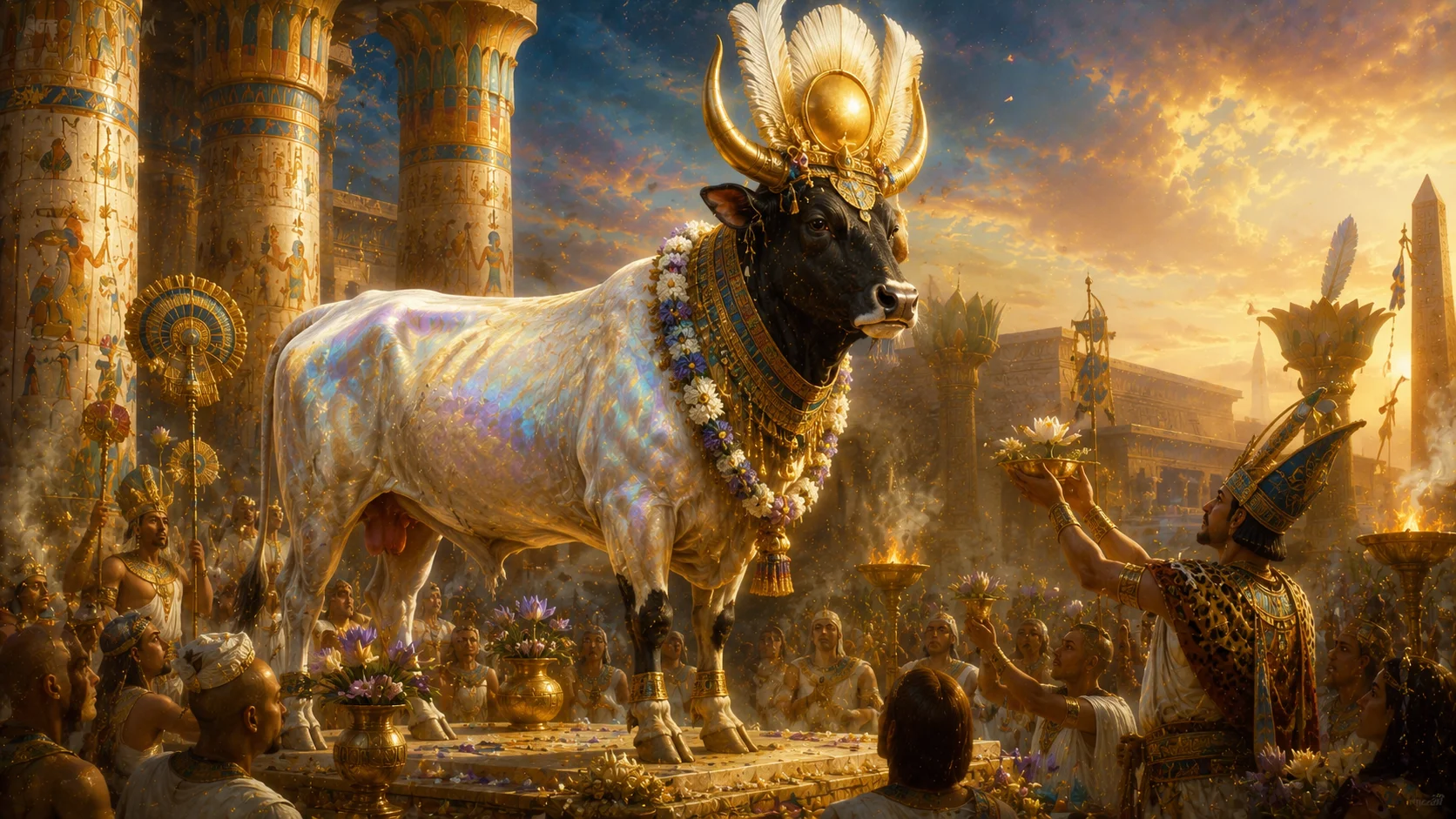
Processions during Min's festivals featured a white bull as his sacred animal, led along the ceremonial route as a living embodiment of the virility and strength the god represented. The presence of the bull turned the abstract theology of procreative renewal into something the gathered crowd could see and follow with their own eyes: a specific, powerful animal, visibly present, standing for the same force the king's rites were meant to renew in him. Sacred animal processions of this kind were a common feature of Egyptian temple festivals more broadly, but the choice of a white bull for Min's rites aligned precisely with his epithet as Bull of His Mother and with the raw, physical register in which his cult expressed itself throughout.
Min and Horus, the Establisher
Min was linked with Horus in the specific form Min-Horus, glossed as "Horus the establisher of his mother." This form connected Min's procreative character to Horus's own mythic role, drawing the two gods together around a shared thread of generative and familial potency rather than collapsing them into a single undifferentiated figure. The pairing let Min's virility resonate within the wider theology surrounding Horus and kingship, reinforcing, through a different divine partner, the same connection between procreative force and royal legitimacy that the Min Festival expressed in ritual form.
Merging With Amun at Thebes
By the Middle Kingdom, Min had become closely syncretized with Amun, producing the composite god known as Min-Amun, or Amun-Min. This merging reflected a genuine theological logic: Amun's theology at Thebes was deeply concerned with kingship and with the concealed, generative power that sustained the created world, and Min's explicit fertility aspect offered a natural point of convergence. Rather than Min being absorbed and erased, the combination let Amun's kingship theology draw directly on Min's older, more explicit language of procreative power, folding one of Egypt's oldest gods into the theology of one of its most dominant.
Pan of the Egyptian Desert
When Greek visitors and settlers encountered Min's cult, they recognized in his ithyphallic imagery a clear counterpart to their own god Pan, and the identification stuck closely enough that Ptolemaic-period sources sometimes rendered Min in explicitly Pan-like terms, an instance of the broader Greek practice of interpretatio Graeca, mapping foreign gods onto familiar figures from their own pantheon. That the equation centered specifically on Min's ithyphallic form shows how central that single visual element was to outside perception of the god; it was the feature by which he was most immediately identified, by Egyptians and Greeks alike.
A Power Undimmed Across Millennia
Few gods in the Egyptian pantheon carried their core identity across so long a span with so little alteration. From Predynastic imagery through dynastic temple cult at Akhmim and Coptos, through syncretism with Amun and with Horus, and into the Greco-Roman world where Greek visitors read him as their own Pan, Min remained recognizably himself: the standing, mummiform figure with raised flail and plumed crown, ithyphallic and unambiguous, lord of the fertility that renewed both the harvest and the king, and guardian of the desert roads that carried Egypt's traders and miners out toward the Red Sea and back again.
Sources & traditions
- EncyclopediaWikipedia — Min (god)
- TraditionEgyptian texts, inscriptions and later retellings
Myths change from area to area and from time to time. This chronicle follows the most widely told versions; tellings in other villages, regions and eras may differ.