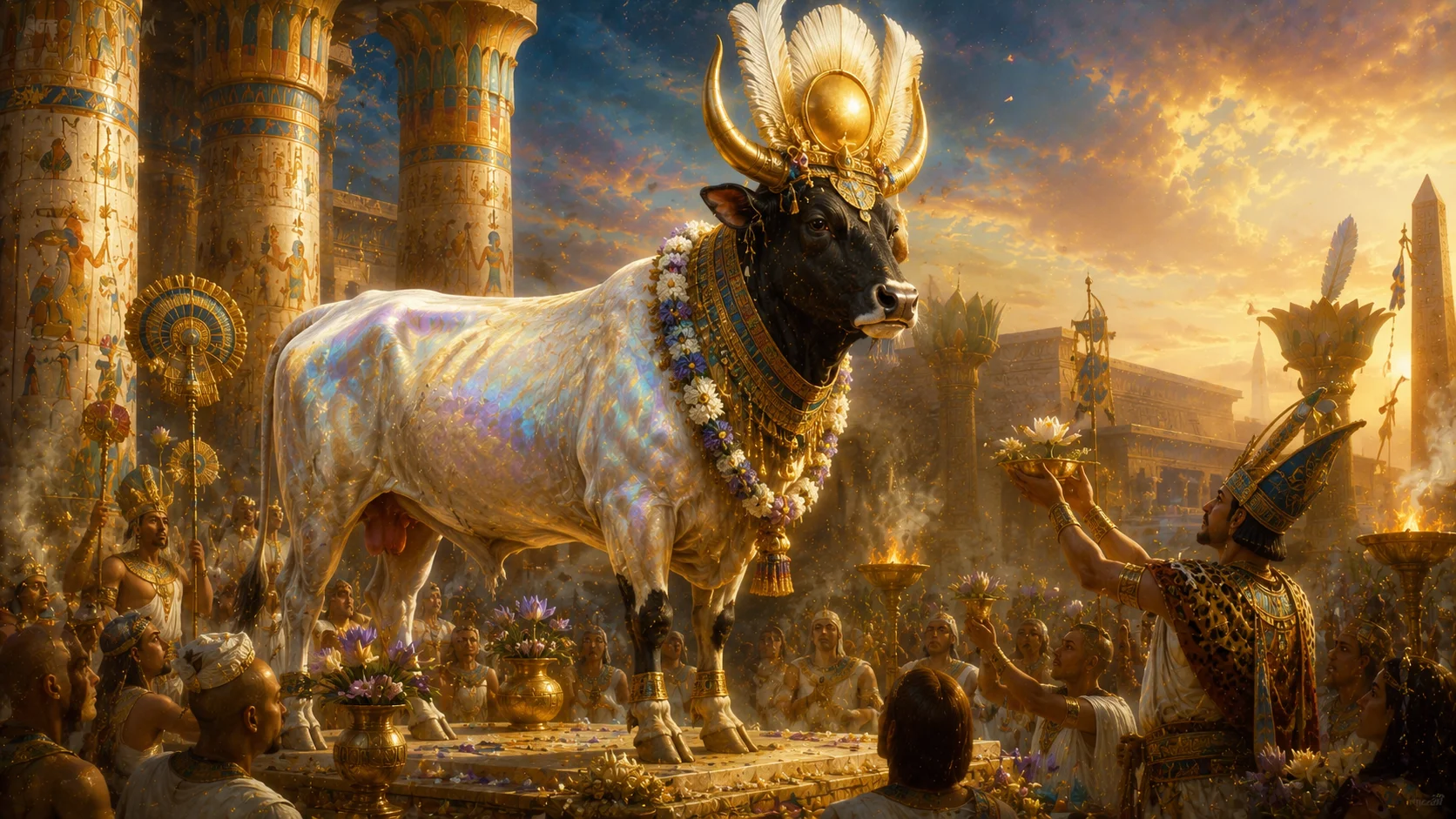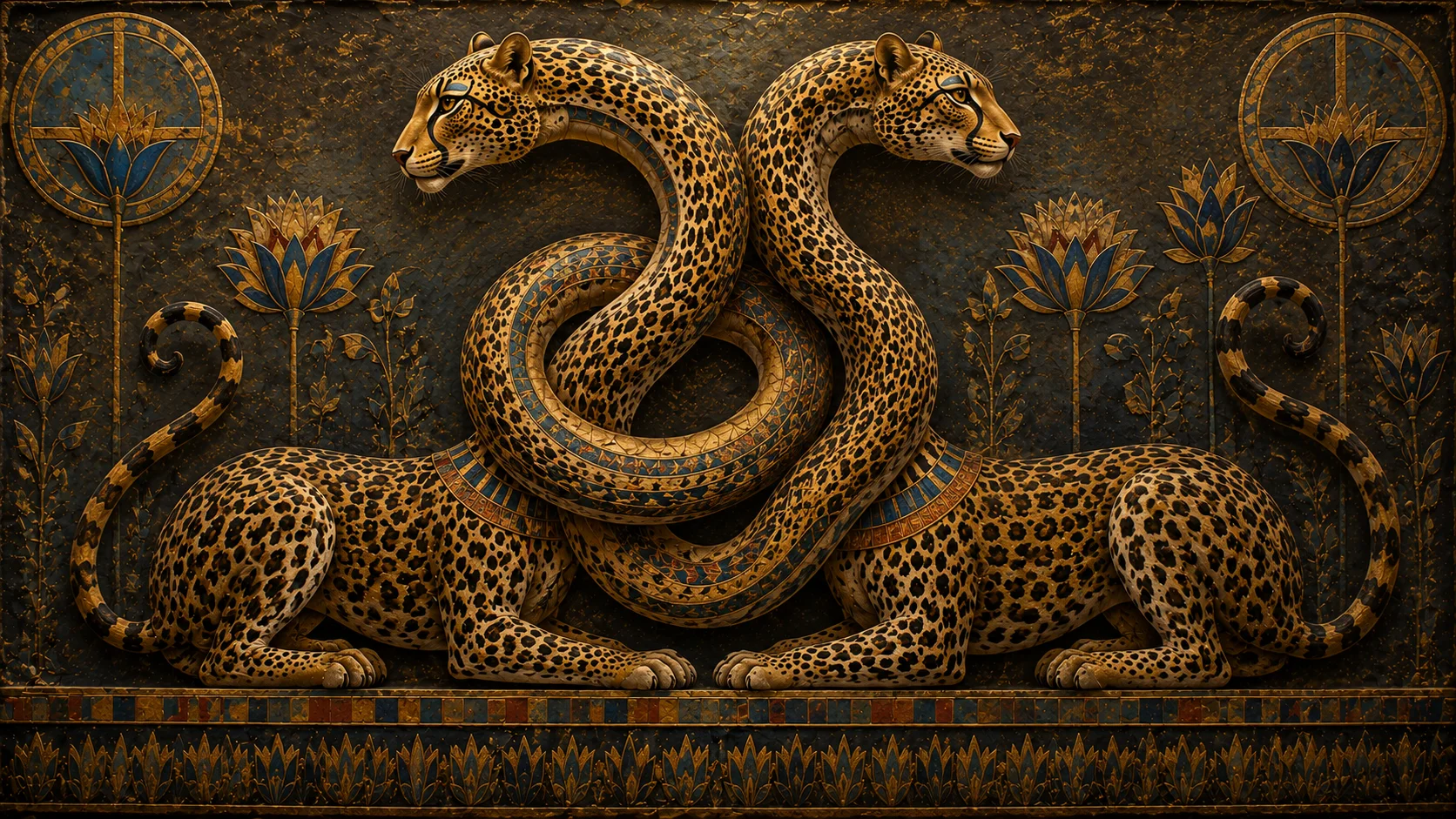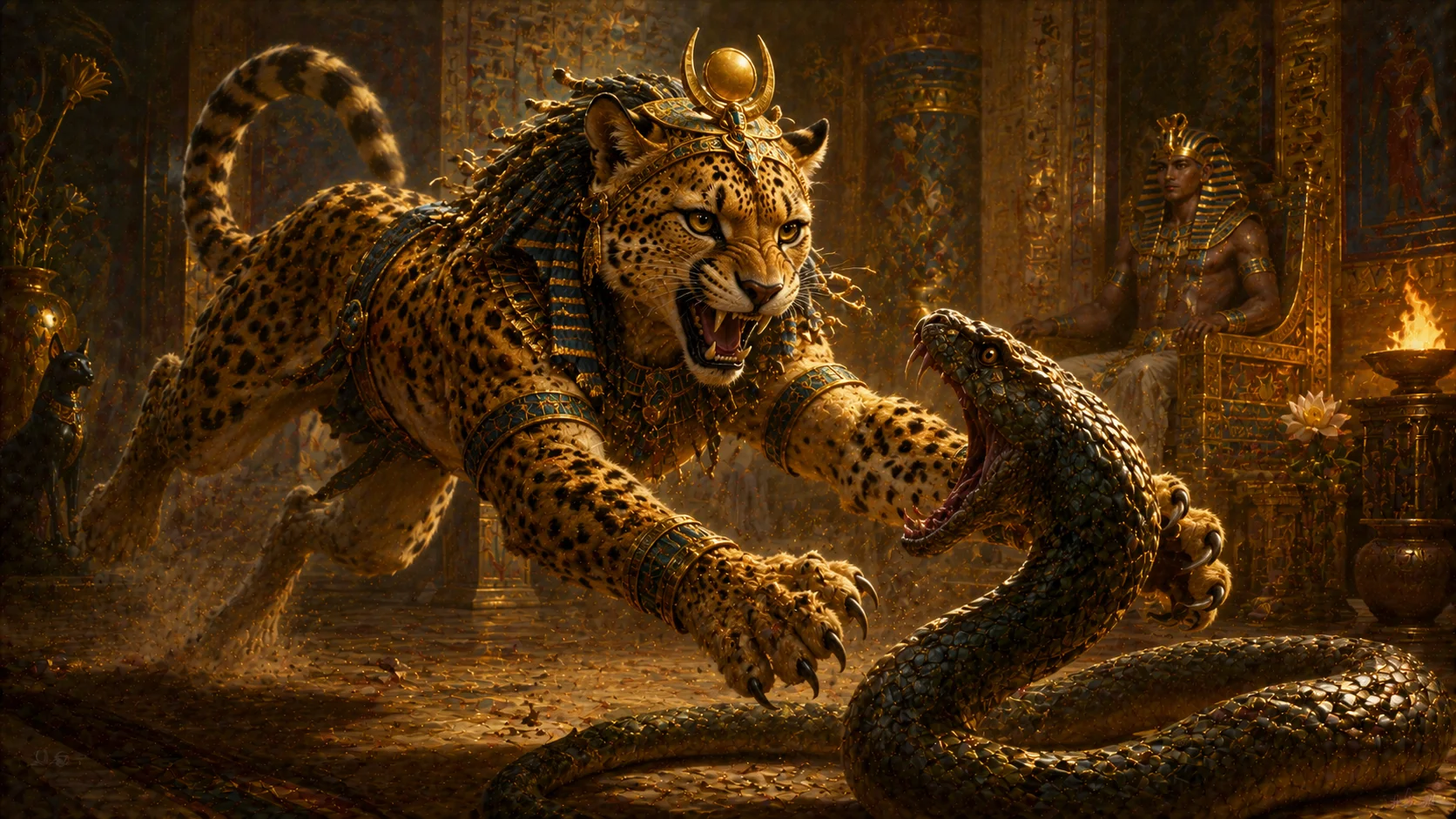
Mafdet was one of the most ancient protective goddesses of Egypt — a fierce feline goddess of justice, execution and protection against venomous creatures, who slew snakes and scorpions and tore apart the enemies of the king and the gods. Older than Bastet and Sekhmet, she was the original feline guardian, the swift and deadly protectress whose claws defended against poison and chaos.
The Ancient Feline Goddess
Mafdet (Egyptian Mafdet, perhaps “she who runs swiftly”) was one of the oldest deities of Egypt, attested from the very earliest dynasties — predating the more famous feline goddesses Bastet and Sekhmet. She was a feline goddess, depicted as a cat, a cheetah, a leopard, a mongoose, or a woman with feline features, often associated with a swift, deadly hunting animal. Her speed and her claws were her power — she was the swift, pouncing predator who struck down the dangerous and the wicked.
The Slayer of Snakes and Scorpions
Mafdet's most important role was as a protectress against venomous creatures — snakes and scorpions, the deadly dangers of Egyptian life. Like a cat or mongoose that kills snakes, Mafdet pounced upon and slew serpents and scorpions, defending people, the king, and the gods from their venom. She protected the pharaoh's chambers and the sacred places against these creatures, and she was invoked for protection from snakebite and scorpion-sting. Her claws tore apart the venomous beasts, and she defended even the sun-god against the serpents of chaos. As a slayer of the dangerous serpent, she was a protector of cosmic and royal order against the creatures of poison and chaos.
The Goddess of Justice and Execution
Mafdet was also a goddess of justice, judgement and execution — the deadly enforcer who carried out the punishment of the wicked and the enemies of order. She was associated with the legal system and with the execution of criminals and the enemies of the king: she was said to tear out the hearts of wrongdoers and deliver them, or to slay the condemned with her claws. In this she was a fierce instrument of justice, the divine executioner whose swift claws fell upon the guilty and the enemies of Ma'at (cosmic order). Her protective ferocity and her role as the slayer of the wicked made her a goddess of both protection and punishment, defending the righteous and destroying the guilty.
The Swift Claws of Protection
Mafdet endures as one of the most ancient protective goddesses of Egypt — the swift feline goddess of justice, execution and protection against venomous creatures, the slayer of snakes and scorpions, the deadly defender of the king and the gods. She embodies the Egyptian way of confronting the deadly dangers of their world — the venomous creatures, the criminals, the enemies of order — through a fierce protective deity; and she stands as the original feline guardian, older than the famous cat- and lioness-goddesses, the swift claws that defended Egypt against poison, chaos and wickedness.
The swift feline goddess whose claws slew the snakes and scorpions and tore apart the wicked — the ancient protectress and deadly executioner who guarded the king against poison and chaos.
Egypt's Oldest Named Protector
Long before Anubis wore his familiar jackal head or Isis spread her protective wings across painted tomb walls, a lean, spotted predator was already being cut into stone with her name set beside her. Mafdet is attested in royal inscriptions of the First Dynasty — the founding centuries of pharaonic Egypt, when hieroglyphic writing itself was barely a few generations old. Few deities in the Egyptian pantheon can be followed back so far. Gods who would later dominate state religion, Osiris and Amun among them, had not yet risen to prominence when Mafdet's name was already being written, which makes her one of the earliest Egyptian deities we can identify by both a fixed name and a recognisable form.
That earliness shaped everything about her. Mafdet belonged to a stratum of Egyptian religion concerned less with cosmic origins — the birth of the sun, the separation of sky from earth — and more with the immediate, physical dangers of daily life along the Nile: the snake coiled in the grain store, the scorpion under the sleeping mat. She was never a goddess of beginnings. She was a goddess of the next five minutes.
A Goddess With No Temple
Search the ruins of Egypt for a temple to Mafdet and you will not find one. No great pylon gate carried her image in procession, and no organised priesthood is known to have built festivals around her the way they did for Bastet at Bubastis or Sekhmet at Memphis. Mafdet worked differently: she lived in spells and on the walls of the royal burial chamber rather than in public sanctuaries.
The Pyramid Texts, carved into the burial chambers of Old Kingdom pharaohs to guide and protect the dead king, invoke her directly against serpents — Mafdet leaps at the neck of the hostile snake, her claws finishing what her speed began. This was not poetic decoration. In a funerary literature preoccupied with the dangers a royal spirit would meet on its passage through the underworld, Mafdet's swiftness became a weapon lent to the dead ruler himself, a borrowed set of claws against the serpents waiting in the dark.
This is very likely why she never acquired a cult centre of her own. She was not a goddess ordinary Egyptians travelled to petition at a shrine on a festival day, but one whose name was reached for at the moment danger actually arrived — spoken over a bite or a sting, written into a spell meant to be recited rather than displayed. Her protection was portable because the danger she answered was portable too.
Mafdet and Serqet: Two Guardians Against Poison
Egypt's pantheon rarely left a threat unanswered by only one deity, and the peril of venom was no exception. Alongside Mafdet stood Serqet, the scorpion goddess, whose territory overlapped Mafdet's closely enough that the two answered the same fear. But their long-term fates diverged sharply, and the difference says something about how Egyptian religion sorted its protectors into those who endured and those who did not.
Serqet was absorbed into the permanent machinery of state funerary religion. She became one of the four goddesses stationed at the corners of the canopic shrine, each paired with one of the four sons of Horus and entrusted with one of the mummified organs — in Serqet's case, standing watch beside Qebehsenuef over the embalmed intestines. That single appointment gave her a fixed, guaranteed place in burial practice for the better part of two thousand years, carved onto sarcophagi and canopic chests from the Middle Kingdom down to the Ptolemaic period.
Mafdet received no equivalent office. She remained a specialist without a permanent institutional seat — less formally bound than Serqet, and correspondingly more exposed to being quietly forgotten, because in Egyptian religion rank and memory travelled together, and Mafdet had never been given the rank.
Fading Behind the Great Cats
Egypt's feline theology grew crowded as the centuries went on, and gentler, more legible cousins won the public's devotion. Bastet's cult at Bubastis swelled into one of the most popular in the country — above all in the Late Period, when kings of the Twenty-second Dynasty ruled from her city; Herodotus, writing in the fifth century BCE, reported that her festival there drew larger crowds than any other in Egypt. Her domestic-cat warmth made her a far easier goddess to love than one defined purely by the instant of the pounce. Sekhmet, meanwhile, absorbed the fire and violence that Mafdet's ferocity might otherwise have claimed, becoming the lioness of plague and royal wrath, served at Memphis by priests whose office shaded into medicine because the epidemics they treated were understood as her arrows. Squeezed between a goddess of comfort and a goddess of terror, Mafdet's narrower, older office — the specific killer of specific venomous things — had steadily less room left to stand in.
She did not disappear. Her name goes on being written in later funerary literature, and the serpent spells that set her against the creatures of the dark were recopied long after the Pyramid Texts themselves fell out of use. But she never again received the kind of public monument that turned Bastet and Sekhmet into names still recognised outside Egypt today. Her decline is, in its way, as instructive as her longevity: Mafdet shows that survival within a pantheon was never simply a matter of how old or how genuinely useful a god was, but of whether later generations found a story in them still worth retelling out loud.
That may be the real reason she is worth returning to now. Mafdet answers an anxiety almost too basic to need a myth at all — the sudden, disproportionate danger of a small venomous animal against a human body with no natural defence against it. Any culture that has lived alongside snakes and scorpions has needed a guardian faster than the threat itself. Egypt's answer to that fear arrived before its own writing system had fully matured, and quietly outlasted several later, grander attempts to replace her.
Sources & traditions
- EncyclopediaWikipedia — Mafdet
- TraditionEgyptian texts, inscriptions and later retellings
Myths change from area to area and from time to time. This chronicle follows the most widely told versions; tellings in other villages, regions and eras may differ.