Wadjet was the cobra-goddess of ancient Egypt — the fierce serpent-goddess and patron of Lower Egypt, the protector of the pharaoh whose image reared upon the royal crown as the uraeus, spitting fire at the king's enemies. One of the oldest Egyptian goddesses, attested continuously from the Early Dynastic Period through the Ptolemaic era, she is the rearing cobra of royal power and protection, the fiery guardian of the king and the land.
The Green One of the Delta Marshes
Her name is generally read as "the green one" or "papyrus-coloured one," a fitting name for a goddess whose home was the reed-thick, water-veined Delta of Lower Egypt. She was depicted as a cobra — usually a rearing, hooded Egyptian cobra poised to strike — or as a woman with a cobra's head, or sometimes as a fully human goddess wearing the Red Crown of Lower Egypt, the crown whose colour and shape were bound up with her own identity as patroness of the northern kingdom. Wherever she appeared, the sense of coiled, watchful readiness followed her: a goddess who did not need to move to be dangerous, only to rear.
Buto and the Shrine of Pe
Wadjet's cult centre was the city of Per-Wadjet, known to the Greeks as Buto, deep in the Delta marshland of Lower Egypt. Within it stood the shrine of Pe, a site bound up with the earliest Predynastic traditions of kingship in the north. Long before the two lands were united under a single crown, Pe and its goddess were already entwined with the idea of rule — so that when Lower Egypt's identity was folded into a unified Egyptian state, Wadjet's ancient authority over kingship in the Delta did not vanish. It was absorbed into the new order as one of its founding pillars, carried forward in ritual and title for the length of pharaonic history.
The Two Ladies of a Unified Land
Wadjet did not stand alone as guardian of the throne. She was paired with Nekhbet, the vulture-goddess of Upper Egypt, and together the two formed the Nebty, the "Two Ladies" — one a serpent of the northern marshes, the other a bird of the southern cliffs, standing for the two halves of Egypt joined into one kingdom under one ruler. This pairing was no poetic flourish confined to temple wall or hymn. From the Early Dynastic Period onward, the formal royal titulary — the sequence of names that made a pharaoh's kingship official and cosmically legitimate — included a Nebty name that invoked both goddesses by name, Wadjet first among the pair as often as not, anchoring the king's authority in both the Delta and the south at once.
Serpent Upon the Royal Brow
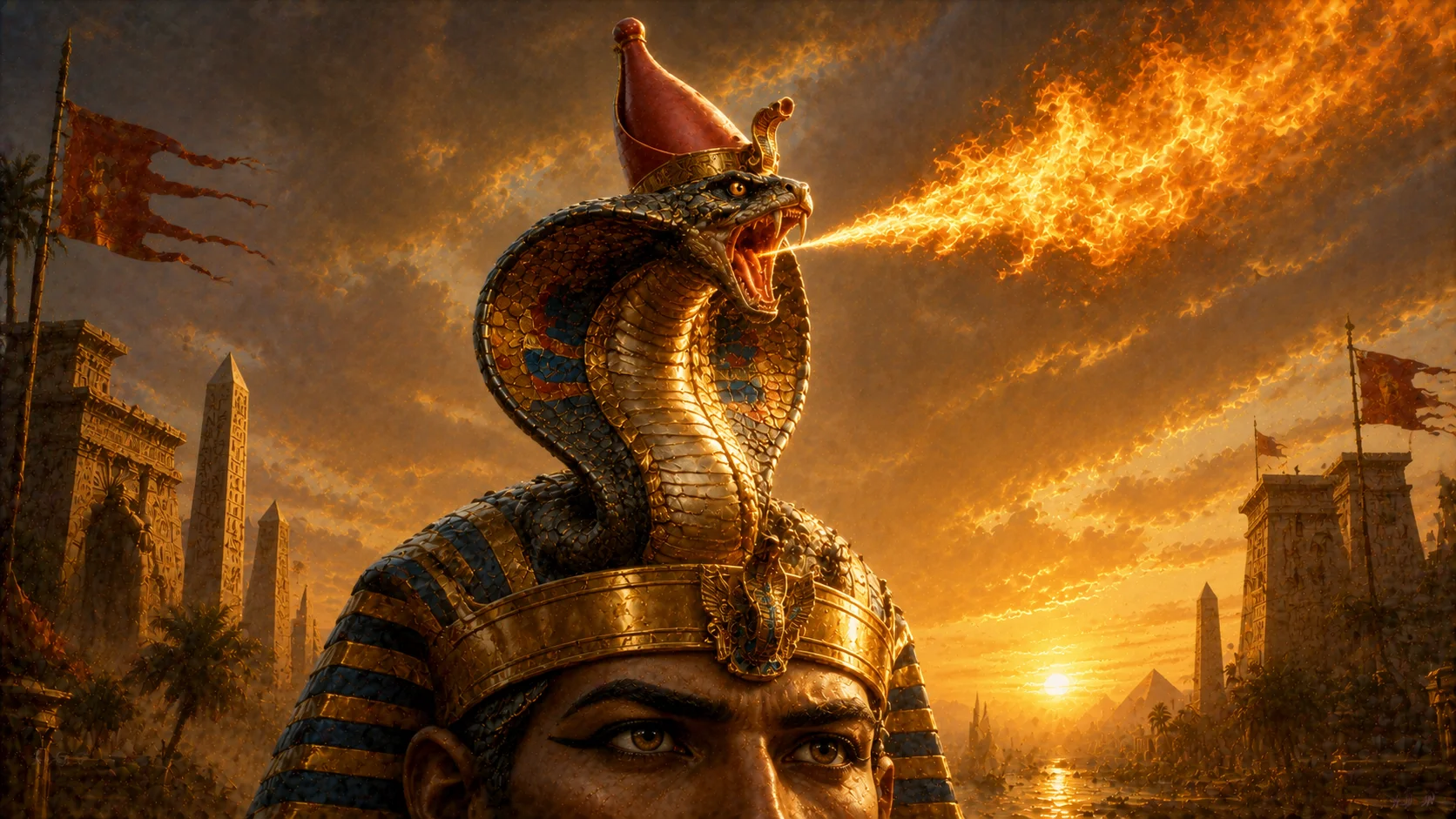
Wadjet's most famous and enduring manifestation was as the uraeus — the rearing cobra mounted on the front of the pharaoh's crown and headdress. This was not ornament. The uraeus-cobra was understood to be Wadjet herself, reared up on the king's brow, ready to spit fire and venom at any enemy who threatened him. Worn by pharaohs and by gods alike, the rearing serpent was a living emblem of sovereignty and protection fused into a single image: the ruler was shielded not by metaphor but by a goddess coiled at the very centre of his identity, positioned exactly where an enemy's gaze would first fall.
Guardian of the Infant Horus
Among the stories attached to Wadjet, one stands out for its tenderness set against her fierceness: her role in the protection of the infant god Horus. She is said to have hidden and guarded the young god in the papyrus marshes of Chemmis, also called Khemmis, in the Delta — the same low, reed-choked country that was her own home ground. The goddess whose venom could scorch a grown enemy of the sun is, in this telling, the same goddess who kept a vulnerable infant safe among the reeds until he was ready to claim his place. Her protection was not reserved only for kings already enthroned; it reached back to the god whose rightful kingship the whole Osirian succession turned upon.
Fire in the Eye of Ra
Wadjet was closely associated with the Eye of Ra, the fierce, fiery, protective feminine power that rode upon the sun god and defended him against his enemies. In this role her venom and flame were not simply weapons of self-defence but instruments of cosmic order, spat outward at the forces of chaos that threatened Ra as he crossed the sky. The uraeus on the sun god's own brow was frequently identified as Wadjet at her post, standing guard over the greatest of the gods just as she stood guard over Egypt's kings — the same coiled readiness serving both the solar and the royal order, because in Egyptian thought the two were never far apart.
Lady of Flame, Great of Magic
Among her epithets, two capture the character ancient worshippers gave her: "Lady of Flame" and "Great of Magic." Both point to the same underlying power — the destructive, protective force of the uraeus, a force that was simultaneously a weapon and a spell, a physical strike and a magical ward. To call her Great of Magic was to recognise that her protection worked on a register beyond mere physical guarding: it was potent, invisible, and effective against threats that no ordinary defence could reach. Fire and magic together made her a guardian suited to a king who needed defending not only from armies but from the unseen.
A Disputed Thread to the Distant Goddess
Some traditions draw Wadjet into the wider mythic cycle of the Distant Goddess, the fierce feminine power who withdraws from Egypt and must be coaxed or pacified into returning. This role, however, is more firmly and consistently attached to goddesses such as Hathor, Sekhmet, and Tefnut than to Wadjet herself, and the extent of her overlap with that cycle remains disputed among those who study the material. What can be said with more confidence is that Wadjet belonged to the same broad family of fierce, fiery, feminine powers as those goddesses — deities whose destructive potential was harnessed in service of protection and order rather than left to run unchecked.
Kinship With the Lioness-Guardians
Wadjet's ferocity places her in company with the lioness-goddesses of Egypt, whose deadly nature was likewise turned outward in defence of those they guarded rather than inward in random violence. Like them, she was sometimes paired or merged with other protective and solar goddesses, sharing in a single current of fierce, fiery, feminine power that ran through several figures of the pantheon and converged, again and again, on the defence of the pharaoh, the sun god, and the order both were held to uphold. Her venom, in this light, was never wanton; it was ferocity with a purpose, aimed only at what threatened the world she was set to protect.
Guardian Beyond the Living King
Wadjet's protection did not end at the boundary of a pharaoh's earthly reign. She guarded the king in life and continued to guard him in the afterlife, extending her role as protector to the dead more broadly. A goddess whose venom drove off enemies, evil, and chaos in the world of the living was equally suited to standing watch over the perilous passage into whatever came after — her readiness to strike making no distinction between a threat to a living ruler and a threat to a soul in transition.
An Ancient Presence Through Every Dynasty
Few Egyptian deities can claim a span as long as Wadjet's: she is attested from the Early Dynastic Period through to the Ptolemaic era, making her one of the oldest goddesses whose worship can be traced across the whole of pharaonic history. Kingship changed hands, dynasties rose from the Delta and from the south in turn, foreign rulers eventually wore the double crown — and through all of it, the Two Ladies formula and the uraeus on the royal brow persisted, carrying Wadjet's name and image forward as a fixed point in an otherwise shifting political landscape.
The Rearing Cobra of Royal Power
Wadjet endures as one of the most ancient and iconic of the Egyptian goddesses — the cobra-goddess of Lower Egypt, one of the Two Ladies who protected the unified land, and above all the uraeus, the rearing fiery cobra on the pharaoh's crown who guarded the king and struck down his enemies. She embodies the Egyptian vision of royal power as divinely protected by deadly force, and of the cobra — feared and revered — as the fierce guardian of the king and the land; and her rearing image upon the royal brow remains one of the most recognisable symbols of the pharaohs of ancient Egypt.
The rearing cobra upon the pharaoh's crown is the goddess herself — reared up and ready to spit fire at any enemy of the king, the deadly serpent-guardian of Egypt's throne.
Sources & traditions
- EncyclopediaWikipedia — Wadjet
- TraditionEgyptian texts, inscriptions and later retellings
Myths change from area to area and from time to time. This chronicle follows the most widely told versions; tellings in other villages, regions and eras may differ.