Nekhbet was the vulture-goddess of ancient Egypt — the protective patron of Upper Egypt and the pharaoh, who spread her great wings over the king as his guardian, and who, with the cobra-goddess Wadjet, formed the “Two Ladies” that represented and protected the unified land. The mother-vulture of royal protection, she sheltered the king beneath her outstretched wings.
The Vulture of Nekheb
Nekhbet took her name directly from her cult city, Nekheb — the site known today as El Kab, on the east bank of the Nile in Upper Egypt. Her name was written with the vulture hieroglyph itself, the same sign the Egyptians used more generally as their ideogram for “mother.” That is not incidental: the goddess and the word for motherhood shared a single image on the page long before any myth was told about her, so that to write her name at all was to invoke maternal protection. She was shown as a white or griffon vulture, wings spread in flight, or as a woman wearing the vulture headdress and the White Crown of Upper Egypt, sometimes with vast vulture wings sweeping out from her arms in place of a woman’s.
White One of Nekhen, Mother of Mothers
Two epithets carried her cult: “the White One of Nekhen” and “Mother of Mothers.” The first ties her, again, to place and to colour — the pale plumage of her vulture form and the White Crown she was so closely bound to. The second names what she was understood to be at the root: not a mother within a family of gods, but mother in the abstract, the protective principle behind all mothers and, by extension, behind the birth and safekeeping of every child, king included. She was invoked as a protector of childbirth generally, not only of royal birth, though it is the pharaoh’s protection that dominates her surviving iconography.
The Two Ladies of the United Realm
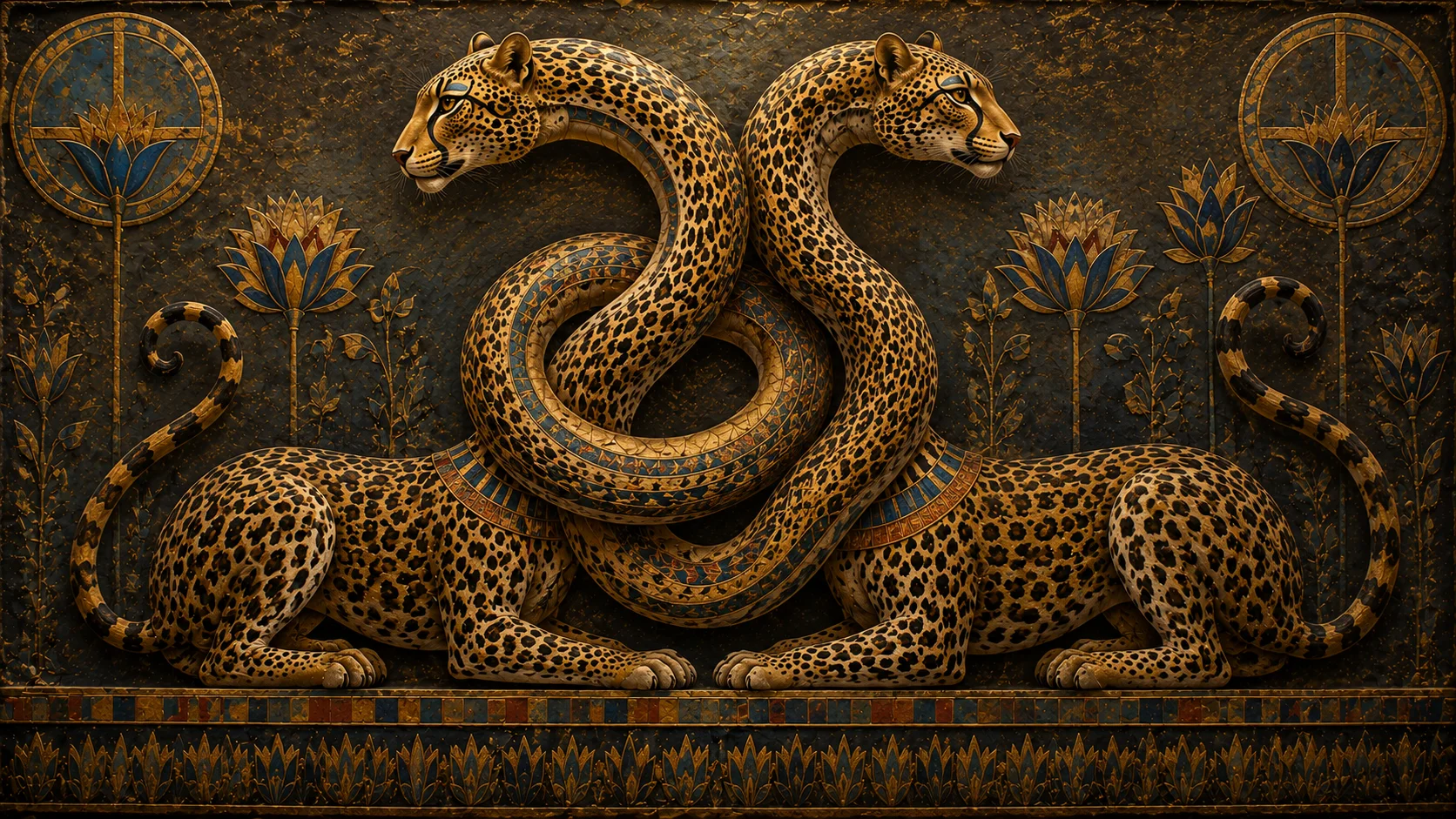
With Wadjet, the cobra-goddess of Lower Egypt, Nekhbet formed the pairing the Egyptians called the Nebty, the “Two Ladies.” Between them the two goddesses stood for the two halves of the land joined into one kingdom — Nekhbet for the south, Wadjet for the north — and together they protected the single ruler who held both. This pairing was old enough and important enough to be written into the pharaoh’s formal titulary: since at least the First Dynasty, part of naming a king was giving him a Nebty name, a name held under the joint protection of Nekhbet and Wadjet. To bear that name was to be declared, in the most durable way Egyptian kingship had, watched over by both goddesses at once.
Wings Above the Hypostyle Hall
Temple relief repeats one image of Nekhbet more than any other: the vulture hovering with wings fully outstretched above the moving figure of the king, following him along processional ways and across ceilings as though keeping pace with his steps. The most famous surviving instance spans the Hypostyle Hall at Karnak, where her wings stretch protectively over the path the king was meant to walk beneath. The composition recurs across royal regalia and crown imagery as well, where the vulture and the cobra’s uraeus flank the king’s crown together — Nekhbet and Wadjet rendered side by side in a single small piece of royal iconography, the Two Ladies made physically present on the king’s own head.
The Nurse and Mother of the King
Beyond guardianship, Nekhbet held the specific role of the pharaoh’s divine mother and nurse. Temple scenes show her purifying the king and taking part in his crowning, acts that cast her less as a distant tutelary spirit than as an intimate, maternal presence at the ceremonies that made a man into a ruler. This nurturing role sat alongside, rather than instead of, her fiercer protective character — the vulture that shelters its young is the same bird that is unmistakably a bird of prey, and Egyptian religious imagery held both readings of her at once without needing to resolve them into a single temperament.
Guardian of the White Crown
Nekhbet’s association with the Hedjet, the White Crown of Upper Egypt, mirrored Wadjet’s with the Red Crown of Lower Egypt, and the pairing gave Egyptian regalia a consistent visual grammar: white crown, vulture, south; red crown, cobra, north. A king shown wearing the White Crown carried Nekhbet’s protection with him as plainly as a king shown with the uraeus at his brow carried Wadjet’s. The two crowns could also be combined into the double crown of the united kingdom, and where they were, both goddesses’ protection was understood to be combined with them.
The Ring of Eternity in Her Talons
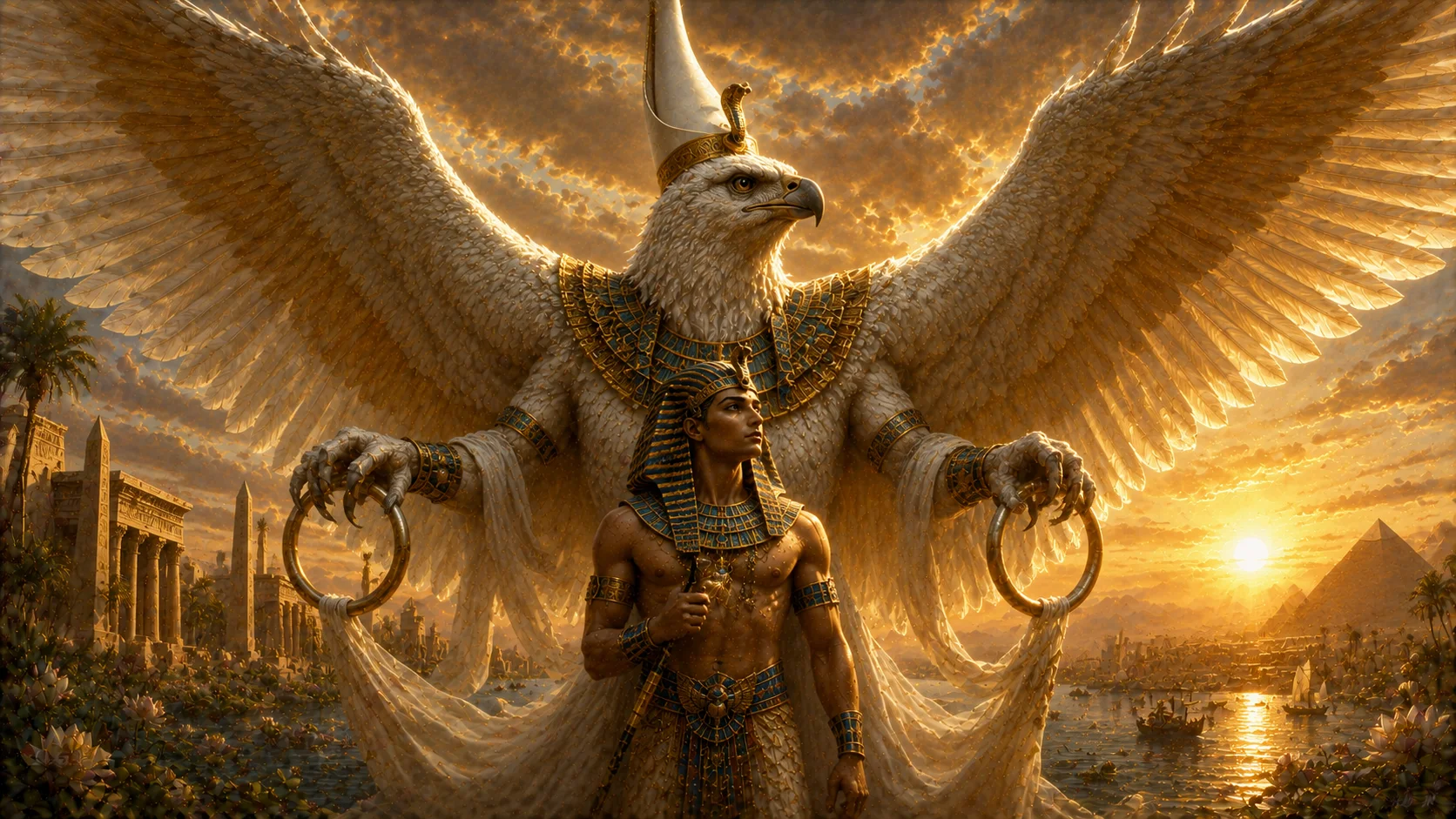
In her hovering, wings-spread form, Nekhbet is frequently shown grasping the shen ring in her talons — a loop of rope tied to symbolise eternity and the encircling protection that went with it. The image condenses her whole function into a single gesture: a mother bird, wings thrown wide, holding not a weapon but a symbol of unending safekeeping, delivered directly over the king’s own figure. Where the shen ring appears elsewhere in Egyptian art it is generally a marker of eternal protection in its own right; carried in Nekhbet’s claws, it reads as that protection made explicit and personal, extended specifically to the ruler beneath her.
Kinswoman of the Solar Eye
Nekhbet was also drawn into the wider Egyptian complex of fierce protective goddesses associated with the Eye of Ra and the uraeus — the class of divine females whose task was the defence of the sun god and, through him, of cosmic order against chaos. Her placement within that company is consistent with her character elsewhere: a goddess whose gentleness toward the king coexists with a readiness to strike at what threatens him, the same duality carried by a vulture that can nurture its young and stoop on prey within the same day.
Renewer of the Jubilee
Nekhbet’s crowning and purifying role reached its fullest expression in the Sed festival, the royal jubilee held to renew a pharaoh’s strength and legitimacy partway through a long reign. In the iconography of that renewal, she appears attending the king as the kingship itself was symbolically remade, her presence lending the ceremony the same maternal, protective authority she brought to a king’s original coronation. A goddess who helped make a king at the start of his reign was, fittingly, called on to help remake him partway through it.
From Nekhen to Nekheb: A Cult as Old as Kingship
Nekhbet is one of the most anciently attested deities in the Egyptian record, worshipped at Nekheb since the Predynastic period. Her city sat directly across the Nile from Nekhen (Hierakonpolis), the predynastic seat of Horus-kingship and one of the earliest centres of organised rule in the Nile valley. That geography is not decorative: it places Nekhbet’s cult on the doorstep of the very institution — Egyptian kingship itself — that her later mythology exists to protect. Few Egyptian deities can claim so direct and so early a tie to the origin of the monarchy they were later folded so completely into serving.
Absorbed into Mut of Thebes
As Theban theology grew to dominate later Egyptian religious life, Nekhbet came to be syncretised with Mut, the mother-goddess of the Theban triad. The absorption suited both figures: Mut’s own name carried maternal weight, and Nekhbet’s ancient, unimpeachable credentials as royal protector and “Mother of Mothers” gave that Theban maternal cult a still older lineage to draw on. Rather than being displaced, Nekhbet’s identity was folded into a newer centre of religious power without her older cult at Nekheb ceasing to matter.
A Goddess Without a House of Gods
What is notable about Nekhbet’s mythology is what it does not contain. She has no standard spouse, no children, no fixed place in a family tree of gods of the kind the Ennead of Heliopolis provides for figures like Osiris or Isis. She functions almost entirely as a tutelary and protective presence rather than as a character embedded in a genealogy or a narrative cycle. Her relationships are defined instead by function and pairing — with Wadjet as the Two Ladies, with the king as nurse and guardian — rather than by kinship. That absence of a family narrative did nothing to diminish her importance; if anything it kept her role sharply focused for millennia on the one task her cult was built around, watching over the ruler of Egypt.
The Sheltering Wings of Egypt
Nekhbet endures as one of the most ancient and important protective goddesses of Egypt — the vulture-goddess of Upper Egypt, one of the Two Ladies who protected the unified land, the great mother who spread her wings over the pharaoh as his guardian and nurse. She embodies the Egyptian vision of royal power as sheltered beneath the protective wings of the divine mother, and of the vulture — a bird as capable of predation as of tenderness — recast as the eternal guardian of the king; and she stands, with the cobra Wadjet, as the two goddesses who together watched over Egypt and its pharaoh from the earliest stirrings of kingship at Nekhen to the temple ceilings of Thebes.
The great mother-vulture who spreads her wings over the pharaoh to shelter him — the protective guardian of Upper Egypt and the king, holding the ring of eternity in her talons.
Sources & traditions
- EncyclopediaWikipedia — Nekhbet
- TraditionEgyptian texts, inscriptions and later retellings
Myths change from area to area and from time to time. This chronicle follows the most widely told versions; tellings in other villages, regions and eras may differ.