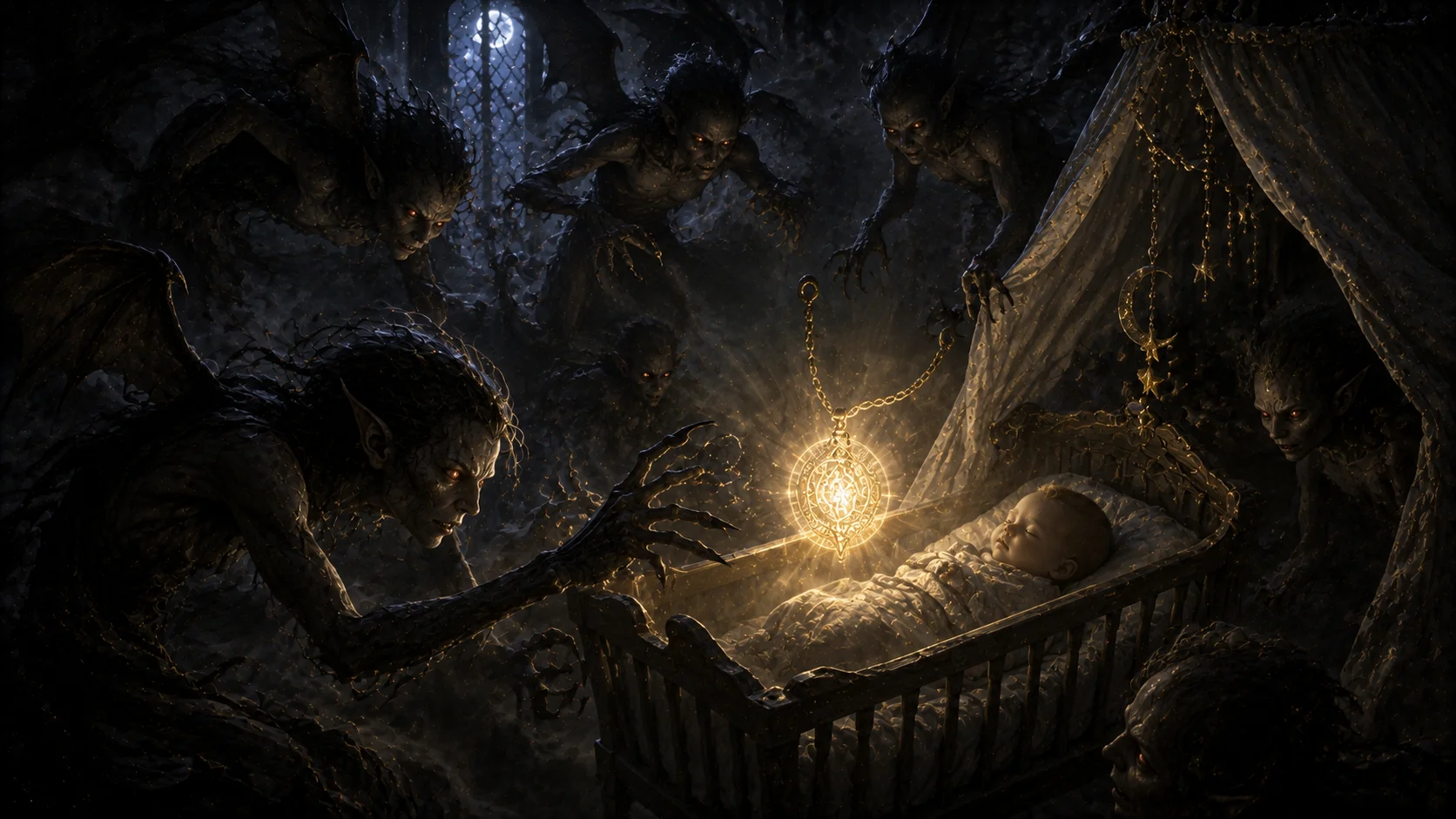
The Lilin are the night-demons of Jewish lore: a host of malevolent spirits, the demonic offspring of Lilith, who haunt the darkness and prey especially upon children and women in childbirth, a class of dangerous nocturnal demons against whom the protective amulets and charms of the tradition were raised. They are the children of the night-demoness.
The Children of Lilith
The lilin (singular lili; related to the lilim) are the demonic offspring of Lilith — the host of night-demons born of the night-demoness, whether from her own breeding or from her seduction of men in their sleep. They are a class of malevolent spirits of the darkness, kin in nature to their dread mother, and like her they are creatures of the night who threaten the vulnerable. Their name, like Lilith’s, derives from the ancient Mesopotamian lilitu, the night-spirits, and from the Hebrew for “night.”
The Predators of the Night
The lilin share their mother’s dread predations. They are especially dangerous to children — haunting the night to harm or steal newborns and infants — and to women in childbirth and the newly delivered, and they afflict the vulnerable in the darkness. Like Lilith, they were warded off by protective amulets, charms, and the invocation of holy names and the three angels (Senoy, Sansenoy, and Semangelof), hung over cradles and birthing-beds to protect mother and child from the night-demons. They are also associated, like their mother, with the seduction of the sleeping and the breeding of further demons.
The Host of the Demoness
The lilin belong to the broad demonology of Jewish lore, the host of malevolent night-spirits that, with their mother Lilith and the broader class of the shedim, populate the dark and threaten the order of human life. They embody the dangers of the night, of childbirth and infancy, and of the demonic feminine descended from Lilith. In the Lilin, Jewish lore gave form to the demonic offspring of the night-demoness — the host of night-demons born of Lilith who haunt the darkness and prey upon children and women in childbirth, the dread children of the night against whom the amulets and holy names of the tradition stood guard.
The Lilu, the Lilitu, and the Ardat-Lili
Centuries before a Hebrew scribe wrote the word lilin, the night already had three names in Mesopotamia, and none of them meant anything good. Sumerian and Akkadian demonology recognised a trio of restless spirits sharing the same root: the lilitu, a female spirit of wind and waste places; the lilu, her male counterpart, who came to women in their sleep; and the ardat-lili, a “maiden of the night” who had died before marriage and motherhood and wandered ever after in search of the husband and children fate had refused her, troubling sleeping men and other women’s infants instead. The root is not the Hebrew word for night: it goes back to Sumerian lil, wind or air, the proper stuff of a spirit that moves through open country. That Hebrew laylah, “night,” happened to sound so close was an accident the tradition never stopped making use of. What matters more is the shape of the trio — sterile, nocturnal, and dangerous exactly where ordinary life is most exposed, at the marriage bed and the cradle. It is the profile Jewish lore would later pour into a single mother and her multiplying brood.
The oldest image usually attached to these spirits comes from the Sumerian poem of the huluppu tree, the prologue to Gilgamesh, Enkidu and the Netherworld. A tree Inanna has planted is occupied by three squatters she cannot evict: a serpent at its roots, the Anzu-bird in its branches, and a female demon in its trunk, until Gilgamesh fells the tree and drives all three into the wild. Whether that demon is a lilitu is not settled. The identification comes from Samuel Noah Kramer’s influential translation, which rendered her as Lilith outright, and later Assyriologists have argued the Sumerian will not carry that weight. The passage is worth knowing, and worth knowing as disputed: a surprising share of what gets said about Lilith’s great antiquity rests on this one contested line.
A Name on a List: Isaiah and the Qumran Hymns
Lilith appears exactly once in the Hebrew Bible, and she does nothing there. Isaiah 34:14 sets her among the wild things that will inherit the ruins of Edom, in the company of howling desert creatures and night-birds — a name in an inventory, with no story attached to it. The Dead Sea Scrolls show what such an inventory was for. Fragments from Qumran preserve the Songs of the Sage (4Q510–511), apotropaic hymns written for the community’s Maskil to recite aloud against the spirits of the night, and their roll-call of hostile powers — destroying angels, bastard spirits, demons, howlers and desert-dwellers, the vocabulary lifted straight out of Isaiah — has Lilith standing in the middle of it. No husband, no garden, no curse: only a name to be sung away along with the rest. That is precisely the move the idea of the lilin would later formalise — not one demon with a biography, but a category of danger carrying a shared name, multiplied to however many the night required.
Hormin, Son of Lilith
Give a demon a mother and sooner or later someone will ask its name. The Talmud obliges roughly once. Amid the tall tales of tractate Bava Batra, Rabbah reports having seen Hormin — the manuscripts also give Hormiz — named as a son of Lilith, running along the parapet of the wall of Mahoza so fast that a horseman riding below could not keep pace with him. That is the whole of him: a name, a wall, and an impossible speed. He is one of the very few lilin the tradition individuates at all, and the fact that it bothered even once shows the same instinct for genealogy that runs through the rest of Jewish demonology, which ranked and named its dangers the way it ranked and named everything else.
The medieval Alphabet of Ben Sira explains why the host is never short of members. Overtaken at the Red Sea by the three angels sent after her, and still refusing to return to Eden, Lilith is let go under a condition she accepts: a hundred of her children will die every day. Read beside that bargain, the lilin are not simply Lilith’s family but her replacement stock — a population that exists in the numbers it does because it is being destroyed at a fixed daily rate, and must therefore breed as relentlessly as it is culled.
The Grammar That Could Not Decide
The word itself could never settle what a lili was. Talmudic Aramaic gives the masculine plural lilin — the Aramaic -in where Hebrew puts the -im of lilim — while the magical bowls of Babylonia habitually name their target twice over, binding the male lilith and the female lilith in the same breath, as though no practitioner was willing to guess which of them had come. The hedging is older than the bowls: Mesopotamia had already split the danger three ways, between a male lilu, a female lilitu, and the ardat-lili. A tradition that never fixed the gender of its own demons was admitting that the fear ran in more than one direction — even if it is the cradle and the birthing-bed that the best-remembered charms were raised to guard.
Bound in Clay: The Incantation Bowls
Ordinary households did not wait for scripture to deal with a lili. They sued it. Hundreds of Aramaic incantation bowls, inscribed in a spiral of script and buried mouth-down beneath the floors, thresholds and corners of houses across Sasanian Babylonia between roughly the fifth and eighth centuries CE, name liliths among the spirits they were written to expel; the excavations at Nippur turned them up by the score. Many take the form of a mock legal instrument. The demon is served with a bill of divorce, worded after an actual Jewish get, formally severing it from the house and its occupants and ordering it out, never to return — the reasoning being that a lili who has attached herself to a sleeper is a kind of spouse, and a spouse can be lawfully dismissed. That the bowls speak of liliths in the plural, rather than of one mythic mother, matches the lilin exactly: this was never a scholars’ debate but a household hazard, and Jewish, Mandaean and Syriac Christian families across Babylonia all felt the need to paper against it, one buried bowl and one threshold at a time.
Why the Host, and Not Just the Mother
One demon can be blamed for one tragedy. A host of them can be blamed for every tragedy that has no other explanation. Infant death and death in childbirth were common in the ancient and medieval world and, to the people living through them, essentially arbitrary — a healthy birth one week, a silent cradle the next, and no cause any physician of the age could name. Multiplying Lilith into an unnumbered host gave that arbitrariness a shape. Not one enemy to be reasoned with once, but an entire class of them, present in every dark room, answerable to the same names and the same charms, whichever house and whichever night the loss fell on. It is a manoeuvre later ages have repeated without knowing how old it is: Neon Genesis Evangelion calls the whole human species Lilin, the many children of a single being named Lilith, and the Shin Megami Tensei games keep a lesser demon called Lilim in her train. Two thousand years apart the instinct is identical — take one frightening figure and multiply her, because a single monster makes a story, but a multitude makes an explanation.
Sources & traditions
- EncyclopediaWikipedia — Lilin
- TraditionJewish/Kabbalistic texts, grimoires and later commentary
Myths change from area to area and from time to time. This chronicle follows the most widely told versions; tellings in other villages, regions and eras may differ.