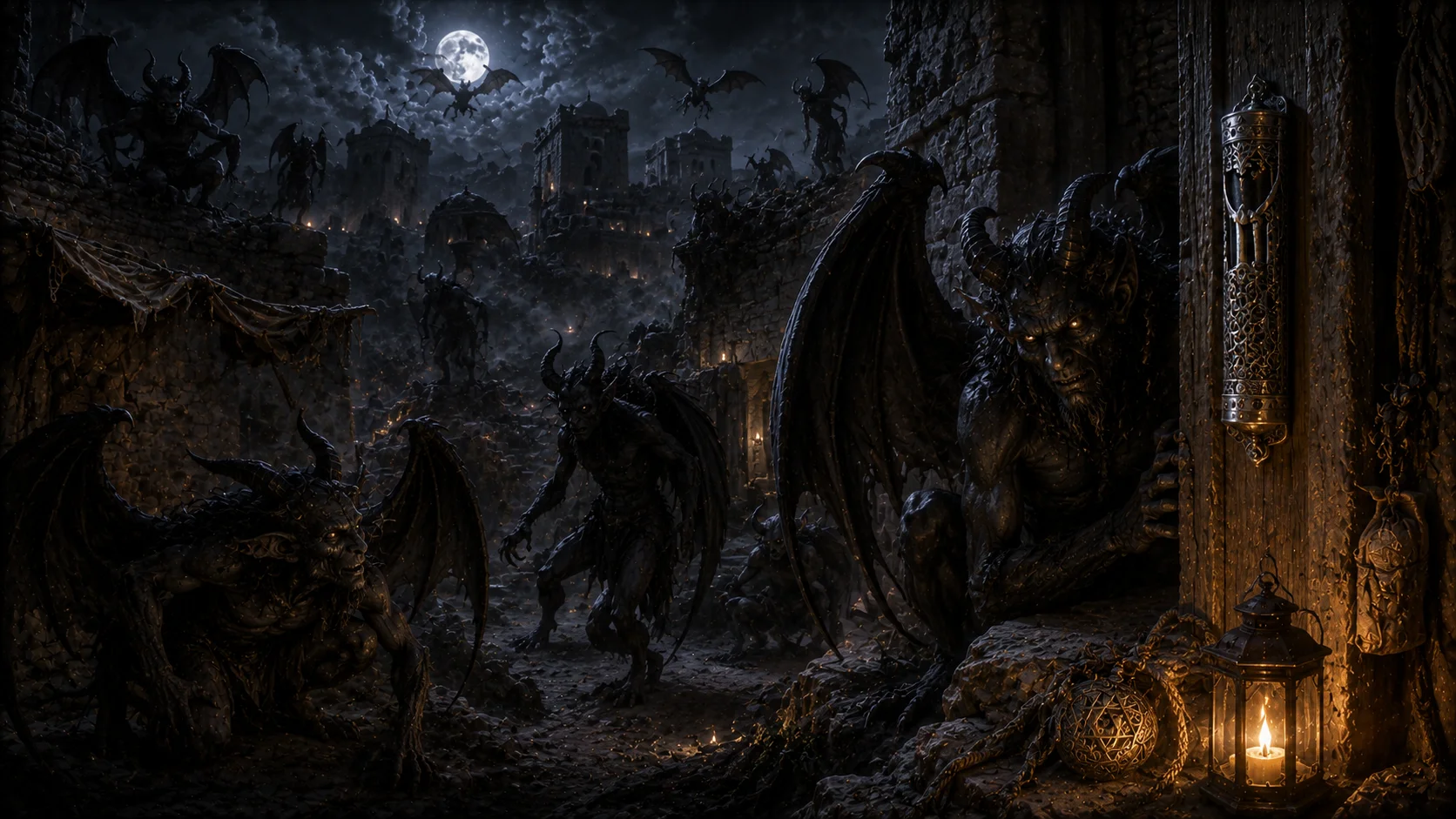
The Shedim are the demons of Jewish tradition: the general class of spirits, malevolent and, in the oldest sources, sometimes merely ambivalent, that populate the unseen world alongside humankind. They gather in deserts, ruins, and lonely places, they are counted in the thousands around every person who walks unguarded, and against them much of Jewish folk-practice and protective ritual has, for two millennia, been quietly directed. They are, in the fullest sense, the demons proper of the Jewish supernatural world — not a single figure with a face and a story, but the vast and largely nameless host beneath the named princes like Ashmedai.
Two Verses, and Almost Nothing Else
It is easy to assume that a being as thoroughly documented in later Jewish demonology as the shedim must have an equally rich biblical pedigree. It does not. The word shedim appears in the Hebrew Bible exactly twice — at Deuteronomy 32:17 and Psalm 106:37 — and both occurrences are polemical rather than descriptive. In each case the shedim are named only as the recipients of forbidden sacrifice: the wayward children of Israel are condemned for offering to shedim, to "not-God," to powers that are false gods rather than true divinity. Nothing in either verse tells us what a shed looks like, where it lives, or what it wants. The Bible's interest is not in describing the shedim as beings in their own right but in condemning the act of sacrificing to them at all. Whatever the shedim would become in later tradition, they begin as an accusation, not a character.
An Old Word Recast
Scholars have long noted that the Hebrew shedim is almost certainly a loanword, connected to the Akkadian šēdu — a term used in Mesopotamian religion for a protective spirit or guardian genius, not necessarily an evil one at all. A šēdu could stand beside a person or a household as a kind of tutelary presence. The biblical authors, borrowing the word, inverted its valence: what had been a protector elsewhere becomes, in Deuteronomy and the Psalms, a false and dangerous object of worship, unworthy of the sacrifice Israel owes to God alone. This etymology is a scholarly reconstruction rather than anything the biblical text states outright, but it matters for understanding what comes later — because the ambivalence buried in that borrowed word did not entirely disappear. It resurfaces, centuries afterward, in unexpected corners of rabbinic literature.
The Rabbis Build a World
The shedim of popular imagination — the vast, ambient, ever-present host that a Jewish household must ward against — are overwhelmingly a rabbinic creation, not a biblical one. It is in the Babylonian Talmud, and in the midrashic literature that grew up alongside it, that the two spare biblical verses are elaborated into a genuine demonology: numerous, layered, governed by its own internal logic, and threaded through tractates as varied as Berakhot, Chagigah, Pesachim, and Gittin. Where the Bible gave almost no descriptive content, the sages supplied an entire cosmology of the unseen, populating the space just beyond ordinary perception with beings who could be reasoned about, guarded against, and — in a few startling anecdotes — even consulted.
A Thousand on the Left, Ten Thousand on the Right
Nowhere is the rabbinic elaboration more vivid than in Berakhot 6a, which teaches that the shedim surround every human being in numbers almost too large to comprehend — a thousand at one's left hand and ten thousand at one's right, an image echoing the language of Psalm 91:7. The passage does not leave the claim abstract. It offers a method of seeing the invisible: scatter ashes around one's bed at night, and by morning the footprints of the shedim will be visible in them, like the tracks of a bird crossing sand. It is a striking piece of Talmudic imagination — half warning, half proof — insisting that the crowded unseen world is not merely a figure of speech but something that leaves physical evidence, if only one knows how to look for it.
Wings of Angels, Hunger of Men
Perhaps the single most quoted rabbinic formulation concerning the shedim comes from Chagigah 16a, which locates them precisely between two orders of being. Like the ministering angels, the sages taught, the shedim fly, they possess wings, and they know the future before it arrives. Yet like human beings, they eat and they drink, they reproduce, and — crucially — they die. No angel dies; no ordinary mortal flies or foreknows the future. The shed occupies a seam between the two conditions, borrowing capacities from each side without belonging fully to either. It is this formulation, more than any other single teaching, that gives the shedim their distinctive theological shape: not devils in the later Christian sense, not fallen angels, but a separate order of creation with a nature genuinely its own, poised at the threshold between the celestial and the human.
Unfinished at Twilight
That threshold status is given an origin story in a well-known aggadic tradition, preserved in sources including Genesis Rabbah and Pirkei de-Rabbi Eliezer: the shedim, it is said, were created by God at the very close of the sixth day, in the last light before the first Sabbath began. But creation itself takes time, and time ran out. Their spirits were formed, but before their bodies could be completed, the Sabbath arrived, and with it the cessation of all creative work. And so the shedim were left as they are — disembodied, or only partly embodied, spirits without the finished physical form that other creatures received. It is a spare and rather melancholy explanation, a tradition among several rather than a single canonical account, but it has proven durable precisely because it answers a question the earlier texts leave open: why should there exist a class of being that is real, active, and yet unseen? Because, the story answers, they were never quite finished.
A Second, Separate Thread
A different strand of tradition, found in later midrashic material and elaborated further in the Zohar, traces certain spirits and demons to a period in which Adam lived apart from Eve, describing beings born from his seed during that separation. This tradition runs alongside — and in the popular imagination is sometimes blended with — the distinct legends surrounding Lilith, though the sources behind each strand differ and are not part of a single unified narrative. It is worth holding the two traditions apart: one concerns the general demonic offspring attributed to a period of estrangement, the other belongs to Lilith's own, separately transmitted legend. Later tradition's tendency to braid them together should not obscure that they arrive by different roads.
Not Always the Enemy
It would be a mistake to read the classical shedim as uniformly malevolent, and modern scholarship — Gershom Scholem's studies of Jewish demonology chief among them, with later work by Joseph Dan extending the picture — has been careful to say so. In the earliest rabbinic anecdotes, a shed is not always an antagonist. There are Talmudic stories of sages who consult a shed, or who are aided by one, moments of information or assistance rather than harm. This moral ambiguity is not an aberration; it is a survival of the older Akkadian šēdu, the protective genius from which the Hebrew word likely descends, still faintly audible beneath centuries of demonization. The fully sinister shed of later folklore is a later accretion layered onto a figure that began, in its earliest rabbinic appearances, considerably more neutral.
Guarding the Threshold of the Night
Whatever their moral standing in a given story, the shedim were treated in Talmudic law and folk practice as genuinely capable of causing harm — illness, mishap, possession, misfortune arriving without visible cause. The response was practical rather than dramatic: counsel against walking alone at night, against entering certain places unaccompanied, and a whole grammar of apotropaic custom meant to close the gaps through which a shed might reach a person. This is worth pausing on, because it marks the shedim as something distinct from the great individualized demonic figures of the tradition. They are not, characteristically, antagonists with a name, a grievance, and a story, the way Samael or Asmodeus can be. They are a diffuse and ambient danger — closer to weather than to a rival — and the customs built around them respond to that diffuseness: not a single ritual defeat, but a lifetime of small, careful precautions.
The King Who Ruled the Host
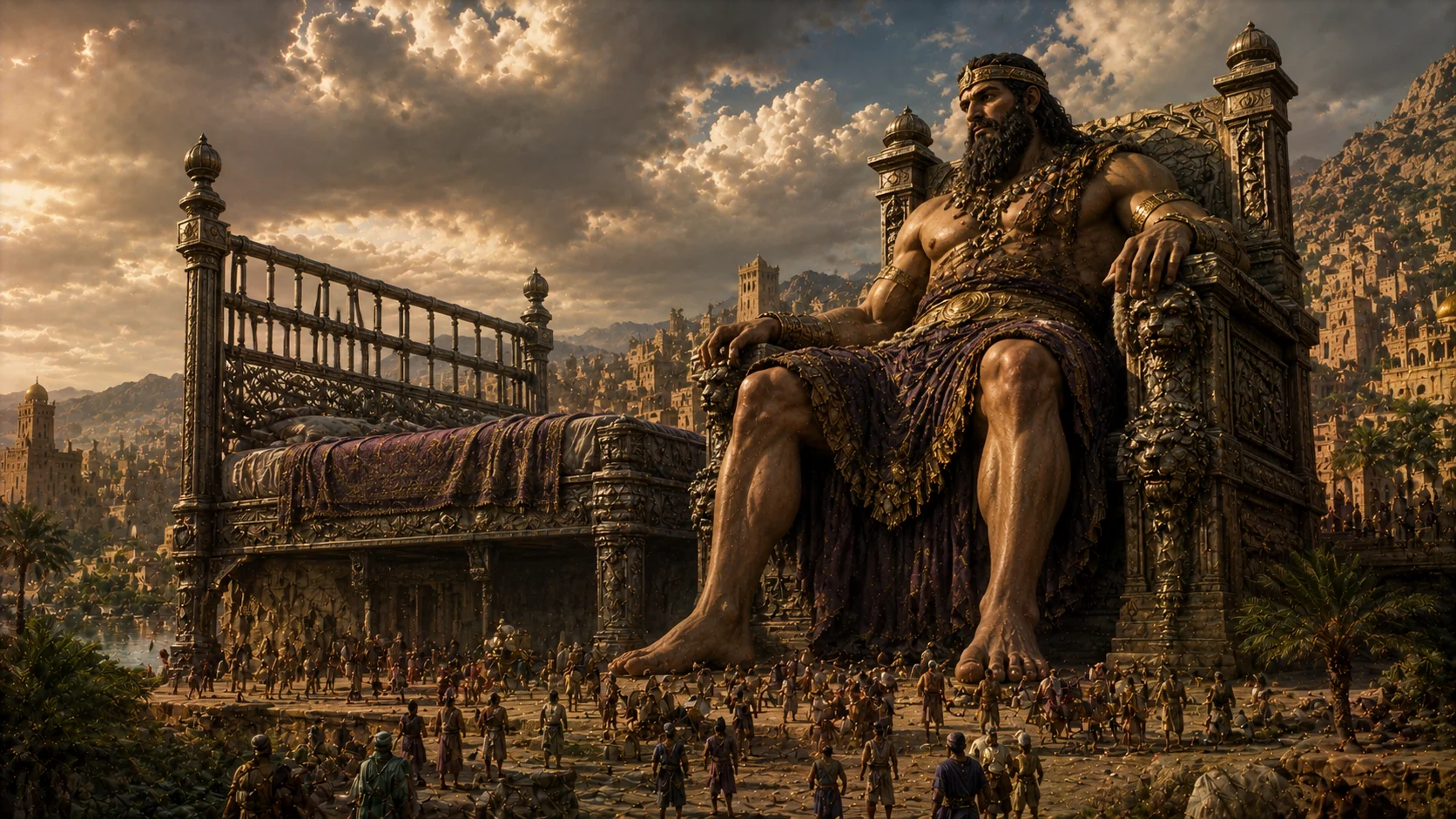
Where the shedim as a whole remain largely anonymous, rabbinic legend does furnish named rulers over them. Foremost is Ashmedai, known in later tradition as Asmodeus, described in Talmudic legend as king of the shedim — most famously in the narrative preserved in Gittin 68a concerning Solomon and Ashmedai. The relationship between the shedim and their named chiefs mirrors, in miniature, the relationship between the general angelic host and its named princes: a great collective governed, at least in legend, by particular figures who stand out from the mass by name and by story. Ashmedai's presence in the tradition is a useful marker for what the shedim, as a class, are not — they are the multitude beneath the throne, not the figure seated on it.
Beneath the Qliphothic Strata
Kabbalistic literature carries this structure forward into its own architecture of the unseen. The shedim are generally situated within, or closely associated with, the Sitra Achra — the "Other Side" — and its qliphothic orders, understood there as the common or lowest tier of the demonic host, structurally paralleling the many lower ranks of the angelic host on the side of holiness. Building on material found in the Zohar, some later Kabbalists went further, correlating particular classes of shedim with specific qliphothic strata. Such correlations are not uniform across the Kabbalistic corpus; different sources draw the map differently. What remains constant is the underlying architecture: a vast, layered lower order, matched rank for rank against the vast, layered upper order, with the shedim occupying the broad base of the darker structure rather than any single commanding position within it.
The Later Flowering of Folk Custom
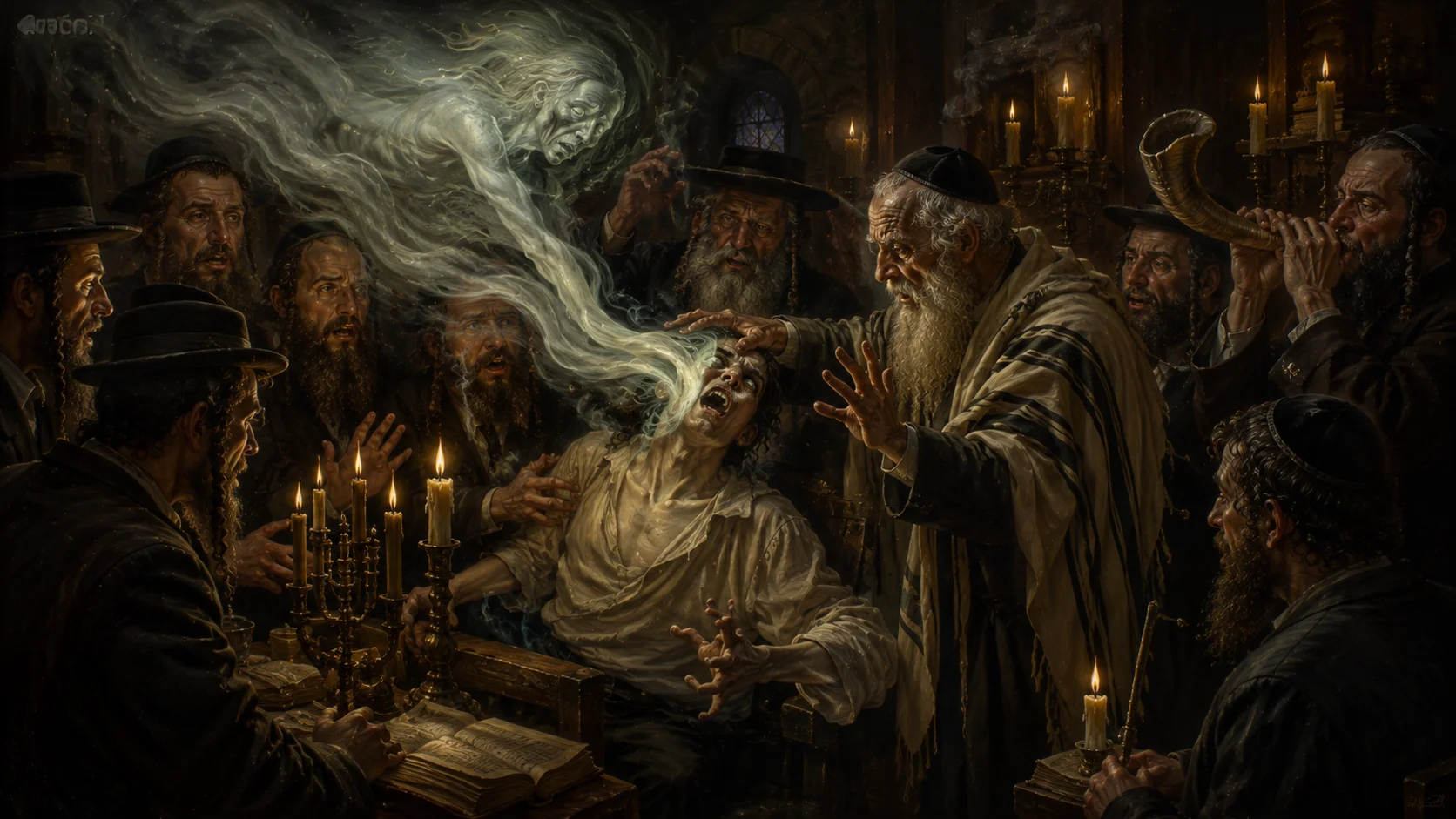
The shedim of the Talmud and midrash are not the end of the story. Post-Talmudic, medieval, and early modern Jewish folk tradition expanded the mythology of the shedim enormously, producing an entire literature and body of custom around dybbuk-possession narratives, protective amulets, and household ritual meant to keep the unseen host at bay. This later material is extensively documented in Jewish folklore studies and represents a real and important layer of the tradition — but it is a distinct and later layer, built atop the earlier Talmudic and midrashic core rather than continuous with it from the outset. Distinguishing the two matters: the ash-scattered footprints of Berakhot and the wings-and-foreknowledge formulation of Chagigah belong to the classical rabbinic period, while the fuller demonological folk practice of amulet and dybbuk grew up centuries afterward, in different times and different communities, even as it drew its authority from the older texts.
The Host That Remains Unseen
Across all these layers — biblical accusation, rabbinic elaboration, Kabbalistic architecture, and later folk custom — the shedim persist as something distinctive within Jewish tradition: not a single demon with a single story, but a whole populous order of spirits, winged and foreknowing like angels, hungry and mortal like human beings, left unfinished at the edge of the first Sabbath and never fully clothed in body since. They surround the living in numbers too great to count, leave their footprints in scattered ash, answer in legend to kings such as Ashmedai, and occupy, in the language of the Kabbalists, the lowest common ranks of the Other Side. They are neither uniformly evil nor safely ignored. They are, simply, the demons proper of the tradition — the vast and largely unseen host against whom a doorpost blessing, a careful custom, and a wary step at night have stood guard for two thousand years.
Sources & traditions
- EncyclopediaWikipedia — Shedim
- TraditionJewish/Kabbalistic texts, grimoires and later commentary
Myths change from area to area and from time to time. This chronicle follows the most widely told versions; tellings in other villages, regions and eras may differ.