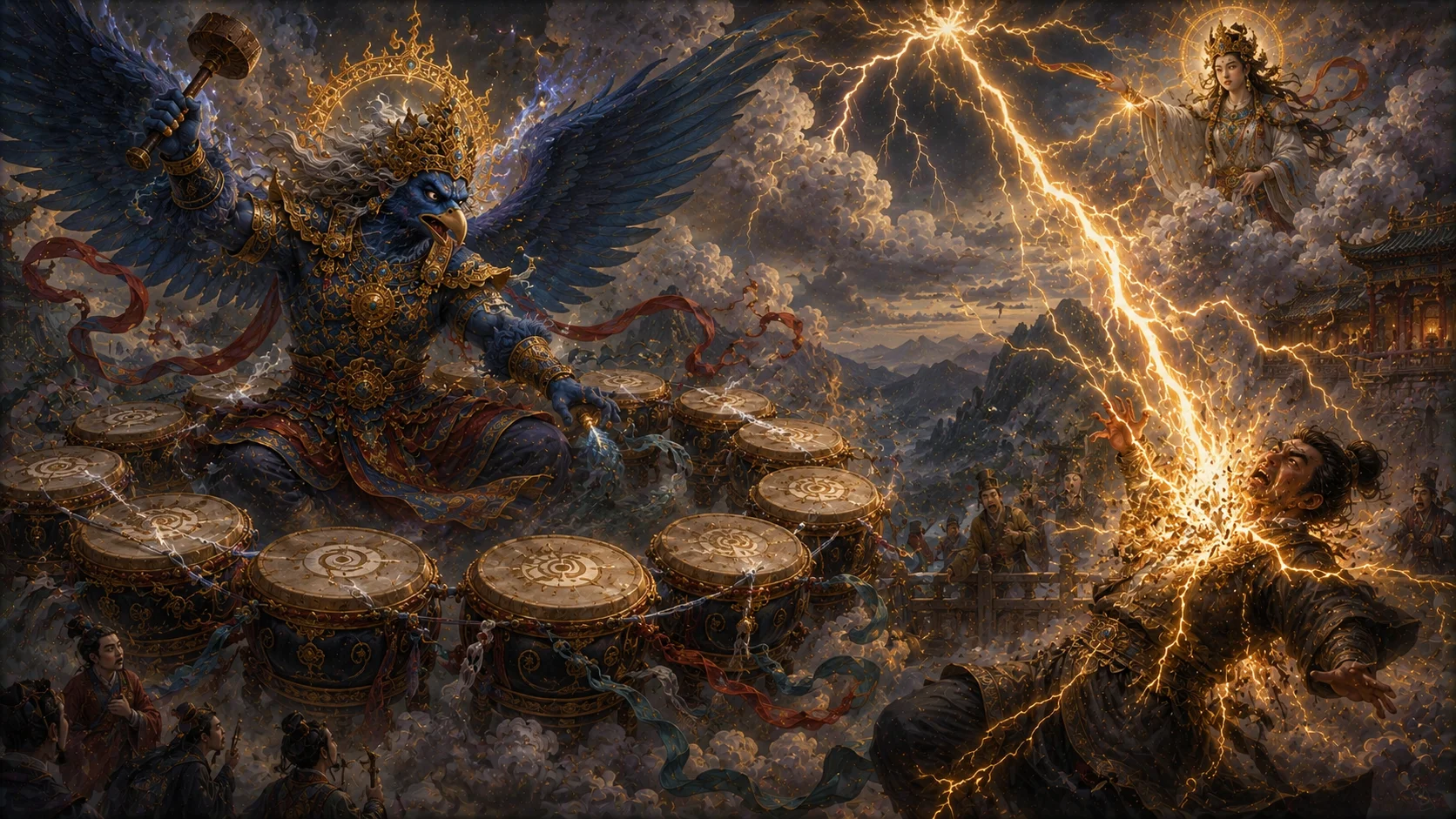
Leigong — Léigōng (雷公), the Duke of Thunder (also Leishen, the Thunder God) — is the god of thunder in Chinese mythology: a fearsome, beak-faced, winged deity who, with his hammer and drums, makes the thunder and strikes down the wicked, executing Heaven’s punishment on the guilty. The thunder-god of China, Leigong is the punisher of secret sins.
The Duke of Thunder
Leigong (“Lord/Duke of Thunder”) is the Chinese god of thunder — a fearsome and grotesque deity, typically depicted with a fierce, blue-skinned body, the beak and talons (and sometimes wings) of a bird (an eagle or a bat-like creature), a monkey-like or demonic face, and muscular arms, naked to the waist, carrying his instruments of thunder: a mallet (hammer) and a string of drums. He makes the thunder by beating his drums with his mallet — the rolling thunder of the storm is the sound of Leigong’s drumming. He flies through the storm-clouds, wreathed in the tempest, an awe-inspiring and terrifying figure.
Last updated .
The Executioner of Heaven's Justice
Leigong’s great office is divine punishment. He is the executioner of Heaven’s justice — it is Leigong who, at Heaven’s command, strikes down the wicked with his thunderbolts. In particular, he punishes secret crimes and hidden sins that have escaped human justice — the unfilial, the cruel, those who waste food or grain, those who commit crimes no earthly court has caught, and evil spirits and demons. A person struck by lightning was, in Chinese folk-belief, often assumed to have been secretly guilty of some terrible hidden sin and to have been executed by Leigong as a punishment from Heaven. Thus the thunder-god is a moral force — the dread enforcer who sees and punishes the secret wickedness that men conceal.
Leigong and Dianmu
Leigong works in concert with the other storm-deities, above all his consort or partner Dianmu, the “Mother of Lightning” — for there is a famous division of labour: Dianmu makes the lightning (flashing her two mirrors to send the lightning-flash) first, to light up and clearly reveal the target, so that Leigong can then strike accurately with his thunder and not, by mistake, kill an innocent person in the dark. (The lightning shows the way; the thunder strikes the guilty.) Together with the wind-gods, rain-gods, and cloud-gods, they form the celestial Ministry of Thunder, the bureau of the storm. Fierce, beak-faced, beating his thunder-drums with his mallet, striking down the secretly wicked with Heaven’s thunderbolts — Leigong is the thunder-god of Chinese mythology, the dread executioner of divine justice.
The Oldest Face of Thunder
Before Leigong wore a beak or carried a mallet, he was a dragon with a human head, and he made thunder by drumming on his own belly. That is the oldest surviving picture of the god, preserved in the Shanhaijing (the “Classic of Mountains and Seas”), the strange compendium of geography and monster-lore assembled across the Warring States and Han periods. Its thunder god executes nobody. He lives in a place called Thunder Marsh, he beats his own body, and the sky answers. A related Han-era tradition made that same marsh the seedbed of the whole mythic line: a woman named Huaxu is said to have trodden in the giant footprint left there and conceived Fuxi, first of the culture-heroes.
The composite figure familiar from Ming and Qing woodblock prints and temple statuary — beak, talons, wings, ring of drums, mallet raised to strike — was assembled afterwards, and not all at once. The drums and the hammer are early; they are already in place under the Han. The bird’s beak, the talons and the wings arrive later, as Leigong is drawn deeper into the ritual world of religious Daoism and its hierarchies of thunder-generals. The god did not arrive whole. He was built up feature by feature, out of whatever each age needed thunder to look like.
The Man Who Called Thunder a Lie
Not everyone believed the picture even while it was being painted. The Han sceptic Wang Chong (c. 27–100 CE), in his Lunheng (“Discourses Weighed in the Balance”), gave an entire chapter — Leixu, roughly “Thunder Debunked” — to demolishing it, and in the course of the demolition he describes exactly what the artists of his day were putting on the wall: a powerful figure with a string of linked drums, hauling at them to make the noise. Thunder, Wang Chong insisted, is nothing of the sort. It is fire — the violent discharge of yang qi, which is why it begins as the year warms, rages at the height of summer, and goes quiet in winter when yang is weak; and why the people it kills are found scorched, singed, and smelling of burning.
He was just as scornful of the moral machinery. The specific belief he sets out to puncture is that Heaven uses the thunderbolt as an executioner’s axe — that a person struck down must have committed some concealed offence, and the offence he names is the homely one of serving other people unclean food. Wang Chong’s polemic dislodged nothing; a rationalist tract rarely does. What it preserves is more useful than a victory. It proves that by the first century CE the folk image of Leigong the punisher was already old, already contested, and already durable enough to be worth two thousand words of argument.
The God Who Was Locked in a Cage
Among the Miao, Yao, Zhuang and Dong peoples of southern China, Leigong is remembered less as a remote official of Heaven than as a bad-tempered neighbour who once lost a fight — and whose revenge remade the world. In the most widely told version, Leigong comes down to punish a farmer, the two come to blows, and the farmer gets the better of him and shuts the god in an iron cage to await execution. While the farmer is away making his preparations, his two young children take pity on the prisoner and give him a sip of water — enough to restore his strength and let him burst the cage. Grateful, Leigong wrenches a tooth from his own jaw, presses it into the children’s hands and tells them to plant it. Overnight it grows an enormous gourd.
Then he returns to the sky and lets loose a flood that drowns the world, the farmer with it. The two children survive by hollowing out the gourd and riding the deluge on its surface. When the waters fall they are the only people left alive, and — after omens confirm that Heaven permits it — the brother and sister marry and become the ancestors of all later humanity. In many tellings the siblings are named as Fuxi and Nüwa, which makes Leigong at once the destroyer of the old world and the unwilling author of the new one.
It is a startling companion piece to the pious executioner of temple statuary. Here the Thunder God is petty, vengeful, outwitted by a farmer and then disarmed by two children — a trickster flood-god far closer to the world’s other angry sky-gods than to the dutiful civil servant of the Ministry of Thunder. Chinese communities never had to choose between the two faces. They kept both, and still do wherever the story is told.
Thunder Prefecture
On the southern tip of Guangdong, reaching into the strait that separates the mainland from Hainan, lies a peninsula whose name is a description of its weather: Leizhou — “Thunder Prefecture.” It sits under one of the highest counts of thunderstorm days anywhere in China, and those violent, frequent storms sustained one of the country’s most important regional Thunder God cults, centred on the ancestral thunder temple at Leizhou.
Local legend accounts for the bond with a story of its own. A hunting dog is said to have unearthed an enormous egg, from which emerged a boy already marked on his hands with the characters of the region’s name. Raised by the family that found him, he grew up to serve as a capable and well-loved prefect of Leizhou under the Tang, and after his death he was venerated as the Thunder Ancestor — a human face for a deity that everywhere else was too vast, and too heavily armed, to visit comfortably.
Stones Out of a Clear Sky
Farmers ploughing fields across southern China have for centuries turned up two kinds of small, hard, dark object that popular belief assigned straight to Leigong’s toolbox. The first are ground and polished stone axes and adzes — in reality Neolithic tools, made and used by people thousands of years before anyone told stories about a Thunder God. Surfacing with no visible source, often after a storm, they were read as thunder axes and thunder wedges: weapons Leigong had hurled from the clouds and failed to retrieve. Scholars as careful as the Song polymath Shen Kuo recorded the belief and the objects together.
The second kind really did fall out of the sky, though not from a storm. They are small, glassy black pebbles — tektites, splashed molten from a meteorite impact roughly 790,000 years ago and scattered across a strewn field that runs straight through Leizhou and Hainan. Folk tradition named them leigong mo, “Lord Thunder’s ink,” and a Tang-dynasty account of the southern provinces already reports them being gathered after storms as the ink the god shook from his brush while writing out his sentences. Neither object has anything to do, physically, with thunder. Both are reasonable answers to the same honest question a farmer might ask, turning one over in his hand: something fell out of that storm — so what was it, and whose?
The Ministry Multiplies
Leigong’s growth from a single storm-god into the head of an entire celestial department was not folklore’s work alone; organised Daoism built the bureaucracy in earnest. From the Song dynasty onward a body of ritual practice known as Leifa, “Thunder Rites,” taught ordained priests to summon and direct the thunder-generals themselves — to exorcise malevolent spirits, break droughts, heal the sick, and call down the same force Leigong used on hidden sinners, now channelled through a licensed human intermediary rather than left to Heaven’s discretion. The Shenxiao and Qingwei traditions made these rites their speciality, and a priest who commanded them commanded thunder.
The novel Fengshen Yanyi (“Investiture of the Gods”), which folded so much of late-imperial popular religion into a single sprawling narrative, gave the Ministry of Thunder its most famous head of department. Wen Zhong, the loyal Grand Preceptor of the doomed Shang, is killed in the novel’s wars and posthumously enfeoffed to preside over the Thunder Department and its twenty-four heavenly lords. Leigong, in this crowded later cosmos, is less a solitary figure in the clouds than the founding job description of an entire office — a post that Chinese religion, once it had invented it, kept finding new officials to fill.