Dianmu, the Mother of Lightning, is a goddess of Chinese Taoist and folk religion, honored as the one who produces the lightning-flash in the sky. She is paired with Leigong, Lord Thunder, as his consort or complementary deity, and together the two govern the visible violence of the storm: he the crack of the drum, she the blinding light that comes before it. In the popular religious imagination of Ming and Qing China, and in the vernacular fiction of those centuries, the pairing of Dianmu and Leigong was among the most familiar images of the heavens at work, a picture of justice carried out in the sky for everyone below to see.
Two Mirrors Raised to the Sky
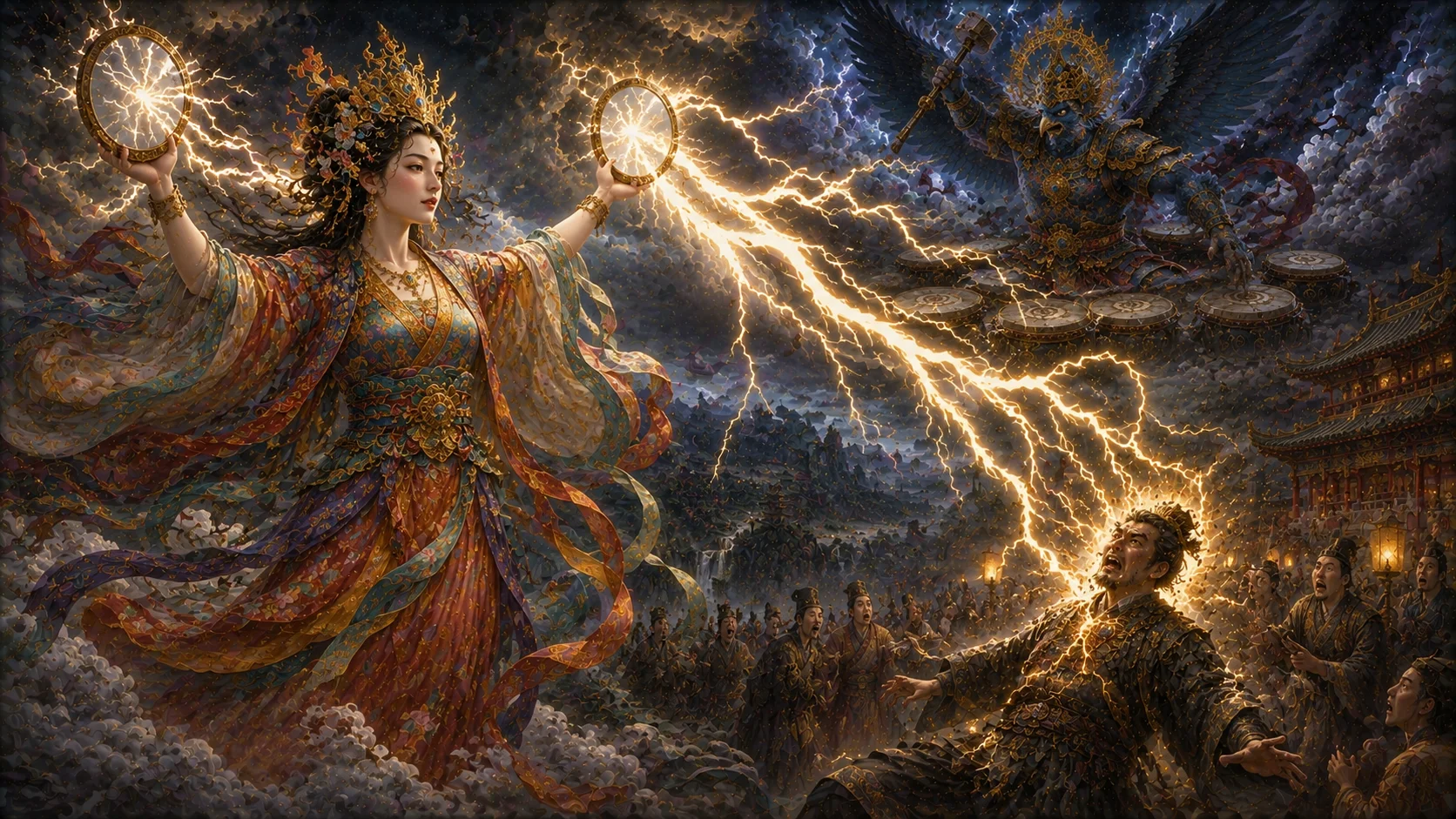
Dianmu's most distinctive and most consistently attested attribute is a pair of mirrors, or bright discs, one held in each hand. In temple art and popular prints she is shown lifting them, catching some unseen light and casting it outward as lightning. Where Leigong is rendered as a fierce, bird-beaked, drum-bearing figure, closer to a storm-demon than a courtly deity, Dianmu is given the opposite treatment entirely: an elegant woman, beautifully dressed, composed in her bearing even as she performs a violent act. The contrast between the two is not incidental. It is the visual grammar of the pairing, one figure fierce and one figure fair, and it recurs across Chinese temple art and popular religious prints wherever the two are shown together.
Last updated .
The Flash Before the Drum
In the standard division of labor attested in Ming-Qing popular religious texts, lightning is understood to arrive an instant before thunder for a reason grounded in the ordering of the storm-gods' work. Leigong produces the thunderclap by striking his drum. Dianmu produces the lightning flash with her mirrors. The sequence matters: her light comes first so that his blow can follow accurately. In this division, the flash is not merely a natural precursor to the sound, as it is in the physics of any storm, but an act of illumination in the older sense, a light that reveals what is hidden so that judgment can be applied where it belongs.
A Tale of a Wrongly Struck Woman
A widely circulated folk tale, offered across the tradition as etiology rather than scripture, tells how Dianmu came to hold her office. A woman was struck dead by Leigong, the story goes, over a misunderstanding rooted in filial piety — in the commonly told version, she was heard scolding her mother-in-law over rice that had gone missing, rice that had in truth been quietly set aside for a hungry beggar. Leigong, seeing only the appearance of an unfilial daughter-in-law and not the truth beneath it, struck her down in error. The Jade Emperor, Yudi, recognizing that an innocent woman had been killed by a mistaken blow, resurrected her and raised her to the rank of a goddess, appointing her specifically so that such an error could not happen again. As Dianmu, her charge was to light the target clearly before Leigong ever struck, so that the thunder would fall only on the truly guilty. It should be said plainly that this account is folk legend, carried down through oral and popular literary tradition rather than fixed scripture, and that its particulars vary from region to region even as its central shape, an unjust death answered with a deliberate and lasting office, remains constant.
A Post in the Ministry of Thunder
Within the structure of the Taoist celestial bureaucracy, Dianmu holds her place under the authority of the Jade Emperor, who oversees the Ministry of Thunder, the Leibu, to which both she and Leigong belong. This is not a loose or purely poetic arrangement. Chinese folk religion and Taoist ritual practice conceived of the heavens as an administration with departments, ranks, and delegated responsibilities, much as the earthly bureaucracy it mirrored, and the Ministry of Thunder was the department charged with the sky's most visible instrument of judgment. Dianmu's rank within that ministry places her among its recognized officers rather than as a freestanding or independent power, her authority understood as delegated from the Jade Emperor's own.
Titles of the Lady of Lightning
Dianmu is known by more than one name across the tradition. She appears as Dianmu Niangniang, "Lady Mother of Lightning," a title of the kind commonly given to female deities of standing in Chinese folk religion, and she is sometimes listed among the assistants or generals attached to the Thunder Ministry in Taoist liturgical texts, including material associated with the Shenxiao, or Divine Empyrean, Taoist tradition of the Song and Yuan periods. These titles and listings place her within a broader current of organized Taoist liturgy concerned with thunder ritual, a current in which the Thunder Ministry's officers, Dianmu among them, were named and invoked with some formality rather than treated as figures of story alone.
Kin to the Wind and the Rain
Dianmu does not stand alone even within her own weather. She belongs to a larger meteorological company that includes Leigong for thunder, Fengbo, or Feng Popo, for wind, and Yushi, the Rain Master, for rain. Together these deities were collectively invoked in Chinese folk religion and in Taoist ritual practice wherever control of the storm was sought, each one responsible for a distinct element of what, taken together, forms the full violence and mercy of weather: wind that moves the clouds, rain that falls from them, thunder that announces judgment, and Dianmu's lightning that reveals its target. She is best understood not as an isolated goddess of a single natural phenomenon but as one officer among several, her portion of the sky's work bound up with theirs.
Light as an Instrument of Judgment
The moral logic attached to Dianmu's lightning runs through the whole of the pairing's meaning in folk cosmology. Lightning, under her hand, was understood not simply as a bright event in the clouds but as an act of exposure: it revealed hidden sinners, unfilial children, and those guilty of secret wrongdoing, laying them open to view so that Leigong's bolt could fall on the one who deserved it. This is the broader Chinese folk-religious concept of thunder as an instrument of divine retribution, and Dianmu's part within it is the part of disclosure, the light that makes concealment impossible in the moment it matters. Where thunder alone might strike blindly, the pairing as a whole insists that judgment from the sky is not blind at all.
A Minor Figure in a Major Canonization
Dianmu appears in classical vernacular literature as well as in temple worship, including a mention in the Ming novel Fengshen Yanyi, the Investiture of the Gods, in which deities of the thunder pantheon are granted their canonized posts in the aftermath of the Shang-Zhou conflict recounted in that work. Within that telling, however, her individual role is comparatively minor and somewhat variable next to the greater prominence given to Leigong. This is worth noting honestly rather than smoothing over: Dianmu's presence in the great vernacular literature of her tradition is real, but it is a supporting one, and her fuller stature belongs more to folk religious practice and popular iconography than to the plot of any single canonized narrative.
Altars Within Larger Walls
Historically, shrines and altars to the deities of the Thunder Ministry, Dianmu included, existed across China, though typically as subsidiary altars set within larger Taoist temple complexes rather than as the center of standalone major cult sites built to her alone. This placement reflects her position within the ministry as a whole: she was worshipped and invoked as part of a functioning bureaucratic company of storm-deities, honored in her own right within that company but rarely, if ever, as the singular focus of an entire temple's devotion. Her presence was felt where the Thunder Ministry was felt, alongside her fellow officers rather than apart from them.
A Name Invoked at the Family Hearth
Beyond formal temple worship, Dianmu and Leigong together carried an ongoing life in everyday moral speech. Parents and elders invoked "Leigong striking" and the illuminating mirrors of Dianmu as a folk admonition against unfilial or deceitful behavior, a warning spoken in households rather than temples, meant to remind a child or a wrongdoer that concealment before Heaven was no concealment at all. This use of the pair's names in proverb and moral storytelling gave them a cultural resonance that outlasted and outran the boundaries of formal ritual practice, keeping Dianmu present in ordinary Chinese life as a figure of accountability as much as a figure of weather.
The Enduring Shape of Her Office
Taken as a whole, what remains constant about Dianmu across her mirrors, her titles, her place in the Thunder Ministry, and her presence in both temple and household is the shape of the office the Jade Emperor is said to have given her: to see clearly, and to make seen, before judgment is carried out. She is not remembered chiefly as a deity of destruction, though her light precedes a destructive blow, but as the corrective to an error, the light that was appointed after an innocent woman had already been wrongly struck down, so that the mistake would not be repeated. In that sense her mirrors carry a double meaning that the tradition has preserved with some consistency: they are the instrument of the storm's brilliance, and they are also, in the story told of her origin, an instrument of mercy answering an earlier injustice, held aloft in the hands of a goddess remembered as much for her composure as for the light she casts.