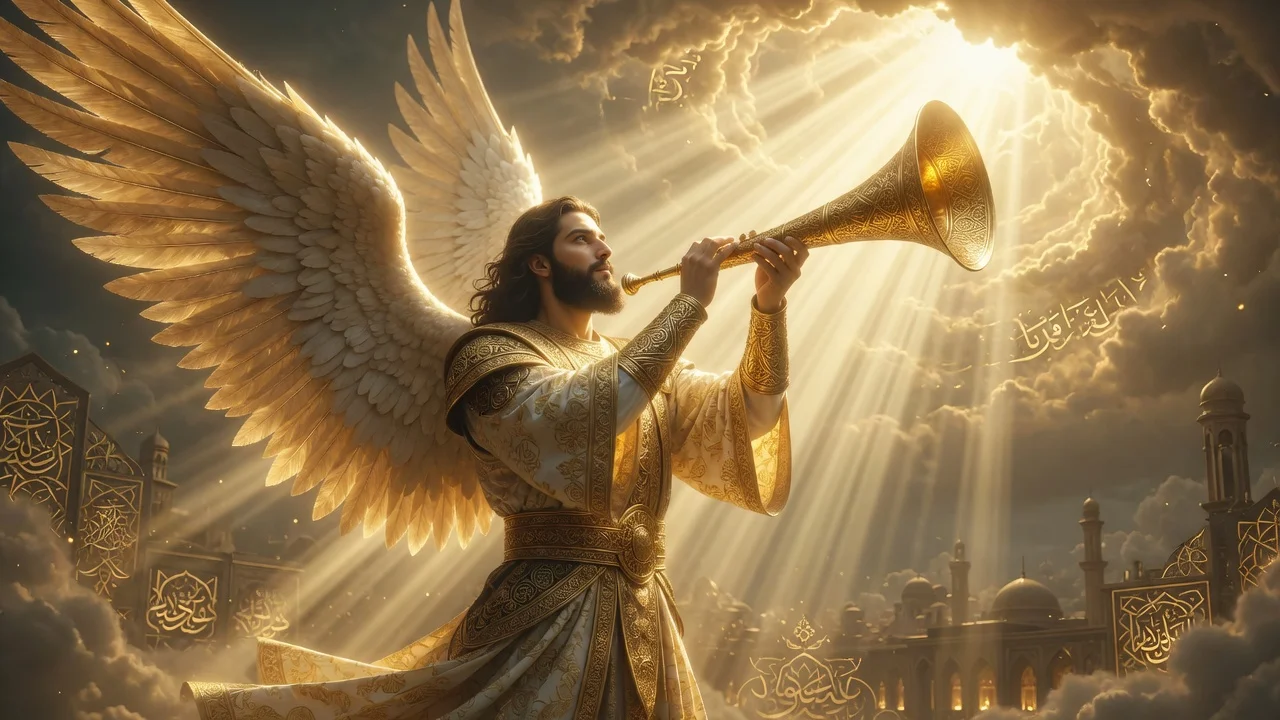
Israfil (Isrāfīl) is counted among the greatest of the archangels in Islamic tradition — the angel entrusted with the trumpet, the Sur, whose blast will end the world of the living and, at a second sounding, call all of creation back to life for the Judgment. He stands, in the imagery handed down through generations of Muslim teaching, in a posture of eternal readiness: the horn raised to his lips, his attention fixed toward the command of God, waiting through the unmeasured span of the world's life for the single instant when he will be told to blow. Alongside Jibril (Gabriel) and Mika'il (Michael), and often reckoned with Izra'il, the Angel of Death, as a fourth, Israfil belongs to the small company of angels whom Sunni tradition treats as foremost among the heavenly host — yet his own name is found nowhere in the Qur'anic text itself, a fact that later scholarship has been careful to hold alongside his towering theological importance rather than to smooth over.
A Name the Qur'an Never Speaks
It is a detail worth sitting with rather than passing over: unlike Jibril, who is named directly in the Qur'an — in surah 2:97, among other verses — Israfil appears nowhere by name in the scripture. What the Qur'an does attest, repeatedly and vividly, is the trumpet itself and its blast. Surah 39, verse 68, describes the moment in words that later generations of reciters and listeners have carried with them: "And the Horn will be blown, and whoever is in the heavens and whoever is on the earth will fall dead except whom Allah wills. Then it will be blown again, and at once they will be standing, looking on." The verse names the event with unmistakable force. It does not name the angel who performs it. The identification of that angel as Israfil belongs to the hadith literature and to the great works of tafsir — the Qur'anic commentary tradition — built up by scholars such as al-Tabari and Ibn Kathir in the centuries after revelation. This is not a minor technicality. It is the hinge on which any honest account of Israfil must turn: belief in the trumpet and its blast is a matter of Qur'anic text, affirmed as core doctrine; the specific name attached to the one who sounds it rests on a different, though still deeply rooted, layer of the tradition.
The Horn That Ends the World
The trumpet Israfil bears is called the Sur in the sources that describe it — not a horn among other instruments but the single mechanism by which the entire order of creation will be dissolved and then restored. Tafsir and hadith literature describe two blasts, each with its own name and its own consequence. The first is nafkhat al-sa'q, the blast of swooning or of death: at this sounding, every living thing in the heavens and on the earth will fall lifeless, the fabric of the cosmos itself undone. The second is nafkhat al-ba'th, the blast of resurrection: after an interval known only to God, the horn will sound again, and the dead — all of them, across all of time — will rise and stand, awaiting what comes next. Between these two blasts lies the whole of Islamic eschatology's central hinge: the end of the temporal world, fana' al-dunya, and the beginning of the Resurrection and the Judgment. It is worth being precise about what the Qur'an itself affirms here and what the tradition supplies: the two-blast structure, the specific names given to each blast, and the angel's identity are drawn from hadith and tafsir rather than stated explicitly in the Qur'anic verses, even as the verses themselves leave no doubt that a trumpet will sound and that its sounding will mark the hinge between this world and the next.
The Angel Who Waits
Among the images that Islamic homiletic literature has returned to again and again, few are as arresting as the picture of Israfil standing in permanent readiness — the trumpet already raised to his lips, his whole being oriented toward the moment of command, waiting not for a day or a year but for however long God wills before the Hour arrives. This image, widely circulated in exegetical and popular writing on the Last Things, carries a scholarly caveat that is worth stating plainly: the precise chain of transmission behind it is debated among hadith critics, and it should be understood as a widely used devotional and homiletic image rather than as a certainty on the level of the Qur'anic verses themselves. Its purpose in the tradition has always been practical rather than merely descriptive — it is invoked to press home the truth that the Hour, when it comes, will come suddenly, without warning granted to the world, and that Israfil's stance of unbroken vigilance is a model held up before the believer's own heart: a call to live in readiness for an ending that could arrive at any moment.
Counted Among the Foremost
Popular Sunni angelology places Israfil among the three or four greatest angels — grouped with Jibril and Mika'il, and often with Izra'il, the Angel of Death, as a fourth. This particular grouping, and the ranking implied within it, is not laid out as a single explicit list in the Qur'an; it is a synthesis drawn from hadith and from the accumulated judgment of scholars across generations. One hadith often cited in this connection — found in collections such as that of al-Nasa'i, though graded variably by hadith critics — describes the Prophet Muhammad's night-time supplications invoking Jibril, Mika'il, and Israfil together by name, as the angels closest to God. This report is frequently offered as the clearest evidence for Israfil's elevated rank standing beside the two archangels who are named directly in the Qur'an itself. The layering matters here as everywhere in Israfil's account: Jibril and Mika'il rest on Qur'anic naming; Israfil's place beside them rests on hadith affirmation, sound in the judgment of many scholars but resting on a different foundation nonetheless.
Voice, Breath, and the Praise of Creation
In the later cosmological and wonder literature of Islamic civilization — the aja'ib al-makhluqat tradition, exemplified in works such as those of al-Qazwini — Israfil gathers a further set of associations that reach beyond his trumpet-bearing office: he is linked with music, with the human voice, and with the arrangement of celestial praise, sometimes described in language that gives him a voice or a breath of extraordinary, almost cosmic scale. These elaborations belong to a distinctly literary and cosmological strand of the tradition rather than to scripture or to hadith proper, and they are best understood and preserved as such — the imaginative flowering that grew up around a figure whose core office, the sounding of the Sur, had already fixed him in the devotional imagination of generations of believers. They do not compete with the core doctrine; they surround it, the way legend surrounds history, adding color without claiming the same certainty.
The Preserved Tablet and the Carrying of Decrees
A further, more minor strand within certain commentaries credits Israfil with a role in relation to al-Lawh al-Mahfuz, the Preserved Tablet — holding it, reading from it, or conveying divine decrees recorded upon it. This attribution appears in some tafsir works but is explicitly a minority and elaborative strand rather than a duty widely and firmly agreed upon across the tradition in the way that the trumpet-blowing is. It sits alongside the trumpet office as a secondary thread — one commentator's elaboration taken up by others, rather than a function attested with the breadth and consistency that marks Israfil's central and defining role.
A Stature Beyond Measure
Popular and largely folkloric narratives, shaped in part by the broader current of isra'iliyyat material that entered Islamic storytelling from earlier scriptural traditions, describe Israfil in terms of an almost unimaginable physical scale — his feet set beneath the earth, his head reaching to the Throne, al-'Arsh, of God itself. Descriptions of this kind are not unique to Israfil; similarly hyperbolic language appears in hadith-adjacent literature describing Jibril and Mika'il as well, part of a shared idiom for conveying the sheer magnitude of the greatest angels relative to the human observer. It is important to state clearly, as many scholars themselves have, that such physical-scale descriptions are generally treated as weak (da'if) or unauthenticated reports. They are not part of core doctrine. They belong to the devotional imagination that has always surrounded the great angels — a way of gesturing at magnitude that the literal language of hadith criticism does not fully endorse, even as it has never fully displaced these images from popular telling.
The Pivot Between Two Worlds
What gives Israfil his enduring theological weight, despite the textual obscurity that surrounds his name specifically, is the sheer centrality of what he is understood to do. The blowing of the Sur is not one event among many in Islamic eschatology — it is the pivot itself, the mechanism by which the entire temporal order comes to an end and the entire order of resurrection and judgment begins. Every teaching about the Hour, about the signs that precede it, about the gathering and the reckoning that follow it, presupposes this single, irreducible act: a trumpet sounding, once to end, once to raise. That the Qur'an speaks with such force about the event while remaining silent about the specific angelic name attached to it has not diminished Israfil's place in the tradition; if anything, it has sharpened the way scholars discuss him, holding the certainty of the Qur'anic verses about the Hour and the trumpet separate from, but connected to, the hadith-based naming that gives that trumpet-blower his familiar identity.
Holding Certainty and Legend Apart
Classical and modern scholarship alike has tended toward a layered position on Israfil rather than a flattened one, and that layering is worth preserving rather than resolving into a single tone of certainty. Belief in the angel who will sound the trumpet at the Hour is treated as an article of faith, implicit in the Qur'an's own verses on the Last Day. The specific name Israfil, resting on hadith and tafsir rather than direct Qur'anic statement, is generally regarded as sound but secondary — well attested, widely accepted, but not carrying the same textual weight as a directly named Qur'anic figure. And the more elaborate physical and cosmological descriptions — the cosmic stature, the extraordinary voice, the tablet-bearing — are treated by many as weak or legendary accretions, valuable as devotional and literary inheritance but not as doctrine. To speak of Israfil honestly is to hold all three of these registers at once: the certain, the sound-but-secondary, and the legendary, each given its true weight rather than blurred into a single undifferentiated account.
The Waiting That Never Ends Until It Does
What remains, across every layer of the tradition — Qur'anic verse, hadith report, tafsir elaboration, and popular legend alike — is the image that has carried Israfil through centuries of Muslim devotional life: an angel of immense standing, grouped among the very greatest of God's messengers, holding a trumpet to his lips through the whole unmeasured duration of the world's existence, asking nothing, delaying nothing, simply waiting for the word that only God will speak. When it comes, it will come suddenly. That suddenness is the entire point of the image, and it is why Israfil, despite never once being named in the Qur'an, occupies so permanent a place in how the end of all things has been imagined and taught.
Sources & traditions
- EncyclopediaWikipedia — Israfil
- TraditionIslamic texts, grimoires and later commentary
Myths change from area to area and from time to time. This chronicle follows the most widely told versions; tellings in other villages, regions and eras may differ.