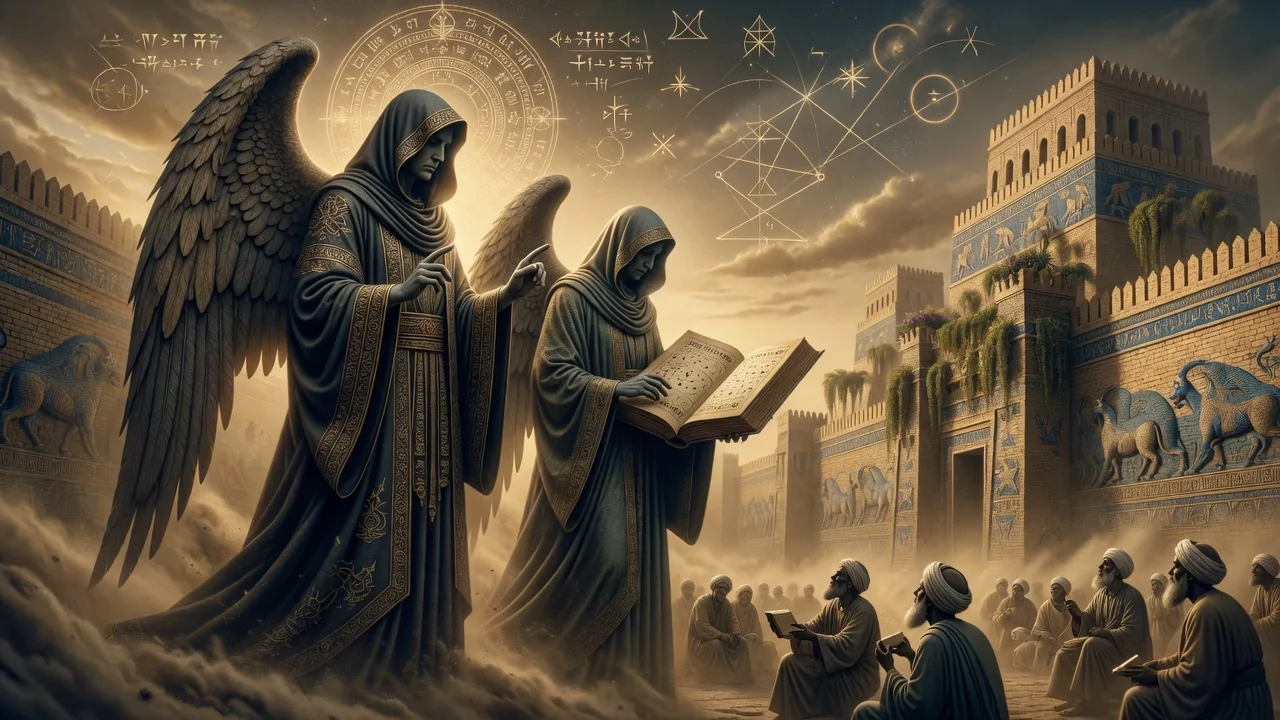
Harut, with his companion Marut, is one of the two angels of Babylon named in the Qur'an: a pair sent down to that city and bound up, in the sacred text itself, with the teaching of a knowledge of magic offered only as a trial — never without a warning spoken first, and never as an act of corruption. Their story is brief in scripture and vast in later retelling, and the distance between those two things is itself part of what the tradition asks a reader to hold with care.
What the Verse Actually Says
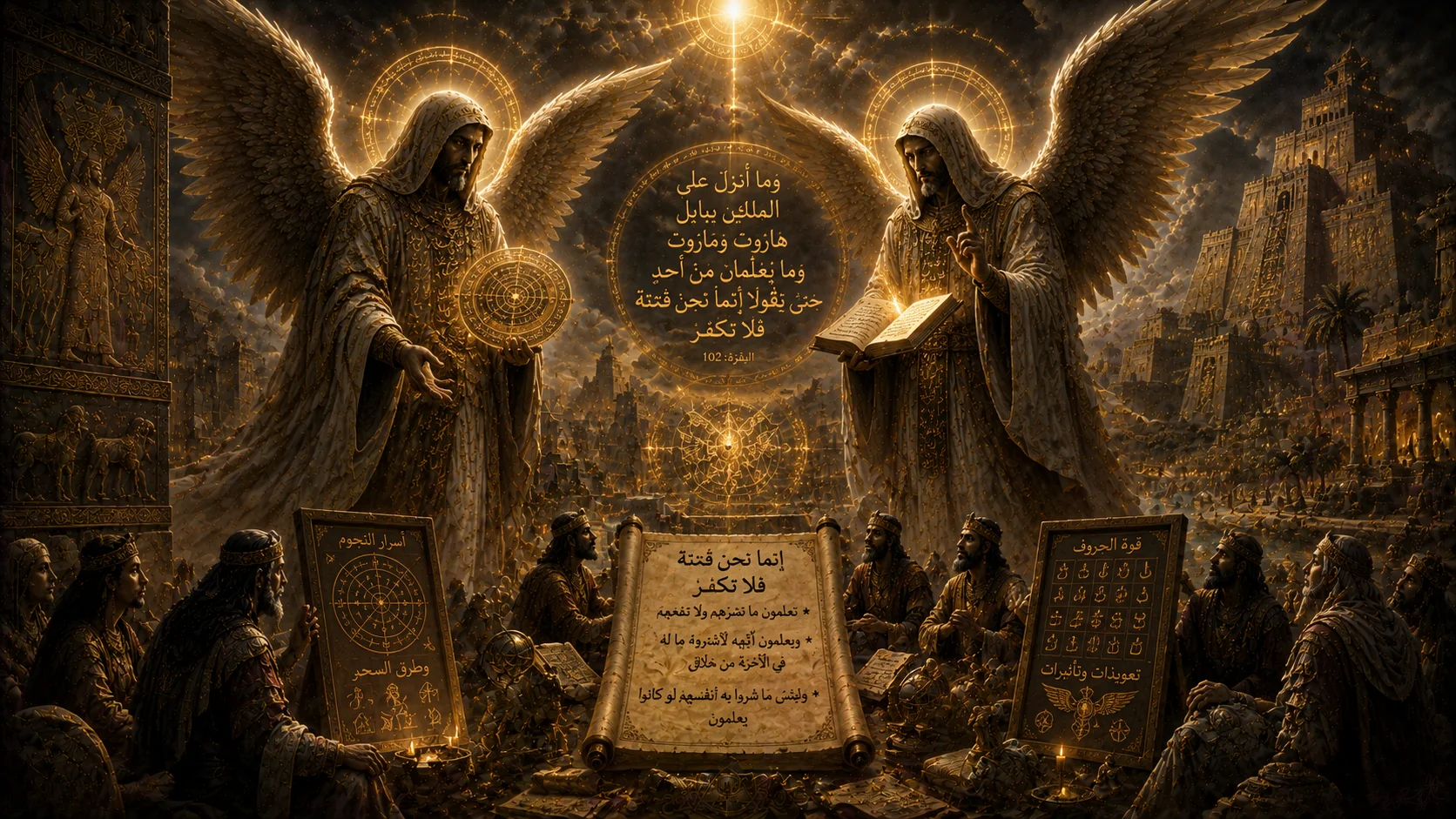
The whole of the canonical foundation for Harut and Marut is a single verse, Qur'an 2:102, in Surat al-Baqarah. It names them directly and together: "and what was revealed to the two angels in Babylon, Harut and Marut." This is the sole place in the Qur'an where the name Harut appears, and everything else said about him in later centuries of Islamic writing sits outside this verse, however far it may travel from it. The verse goes on to say that people learned from the two something of what causes separation between a man and his wife — the language of sihr, of magic capable of unmaking a marriage from within. Babylon, Babil, is named as the place. Nothing more geographic or narrative than that is given.
A Trial Spoken Aloud Before It Was Taught
The theological center of the verse is not the magic itself but the warning that precedes it. The Qur'an states plainly that whatever Harut and Marut taught was taught by God's leave, framed from the outset as a fitnah — a trial, a test — and that the two never taught a single pupil without first telling them so: "We are only a trial, so do not disbelieve." This detail matters enormously to how the tradition has read the two angels. They are not depicted as willing corrupters handing down forbidden secrets in silence. Every transmission of the knowledge came wrapped in its own warning label, spoken honestly, before the fact. A person who went on to use what they learned to sow harm — to separate a husband from his wife, to injure another through hidden means — did so having been told plainly what the knowledge was and what it could cost them. The verse says such people harmed themselves and gained nothing, forfeiting any share in the world to come. The moral weight of the episode falls, in the plain text, on those who chose to misuse what they had been warned about — not on the two who delivered the warning.
Two Angels, or Two Kings?
Even at the level of grammar, the verse is not without dispute among the classical commentators. The Arabic word rendered "the two angels," malakayn, is close enough in form to malikayn — "two kings," or two rulers — that a variant reading taking the second sense has been recorded and discussed by exegetes. This reading is attested but never became the dominant qira'ah or the dominant interpretation; the overwhelming weight of the tradition reads malakayn as angels, and it is as angels that Harut and Marut are remembered. Still, the existence of the variant is a reminder of how much of what surrounds this pair rests on careful, sometimes contested, reading of a very compact Qur'anic sentence.
A Related Discomfort of Syntax
Beyond the angels-or-kings question, some commentators — among them scholars working in the Kufan exegetical tradition and certain Mu'tazilite-influenced readers — preferred to parse the ambiguous syntax of 2:102 in ways that avoid attributing the teaching of magic directly to angels at all, reading the clause's grammar so that the sorcery is associated with the setting or with human transmitters rather than laid straightforwardly at the angels' feet. This is a real and recognized point of dispute in the exegetical literature, not a settled matter, and it reflects a broader unease among some scholars with any reading that has angels — beings of unwavering obedience in mainstream theology — instructing humankind in something as fraught as sihr, warning or no warning.
Solomon's Innocence, Named in the Same Breath
The verse does not appear in isolation. It sits inside a passage rebutting a slander against Solomon (Sulayman) — the claim that he himself had practiced sorcery or fallen into disbelief. The Qur'an's answer contrasts Solomon's prophetic innocence with sorcery's true source: not Solomon, but the devils (shayatin) who taught disbelief, and the episode at Babylon involving Harut and Marut. Read in context, Harut and Marut's mention is corrective and polemical before it is narrative — the verse is defending a prophet's reputation, and the two angels enter the account as part of clarifying what he did not do, and where sihr's real associations lay instead.
The Well of Babylon, and the Story the Qur'an Does Not Tell
Almost everything most people know about Harut and Marut beyond this — that they boasted of their own righteousness against sinning humanity, that they were sent to earth to be tested as humans are tested, that they fell into sin themselves, that the fall is tied to a woman figure sometimes named Zuhra or al-Zuhrah, and that they were punished by being suspended by their feet in a well in Babylon until the Day of Judgment, or transformed into the planet Venus — comes not from the Qur'an but from a much later and much more elaborate body of storytelling. This material entered Islamic literature substantially through Isra'iliyyat, material absorbed from Jewish and other Near Eastern sources circulating in the region, and it spread through exegetical and historical compilations rather than through the Qur'an or through sound hadith.
What the Great Commentators Actually Said About It
It would be a mistake to treat this elaborated legend as though it carried the same weight as the verse itself, and the classical exegetes were not shy about saying so. Ibn Kathir, in particular, examined the chains of transmission behind the "fell into sin and were punished" narrative and found them resting largely on Isra'iliyyat and unreliable narrators, explicitly cautioning that the story should not be relied upon as established doctrine. Al-Tabari preserved a great deal of this material in his Tafsir and his Tarikh, citing the earlier reports he had access to, and al-Qurtubi likewise recorded the range of interpretive traditions — but recording a report and endorsing its reliability are two different acts, and the major commentators were careful, in their own ways, to keep that distinction visible even while transmitting the fuller story.
No Anchor in the Six Books
It is worth stating plainly: there is no hadith in the six canonical Sunni collections — not Sahih al-Bukhari, not Sahih Muslim, nor the others — that supplies authenticated detail about Harut and Marut beyond what the Qur'an itself says. The richer story belongs to a different, later literary stratum. This is not a small technical footnote; it is the reason mainstream Sunni orthodoxy holds the position it does, accepting the Qur'anic core as revealed truth while treating the well, the boastful angels, the fall, and the punishment as widely circulated folklore rather than binding belief.
What the Episode Is Understood to Demonstrate
Set alongside its extra-Qur'anic afterlife, the verse's own claims are doing real theological work. They testify to the reality and the danger of sihr as something the Qur'an takes seriously enough to legislate a warning around. They establish fitnah, divine testing, as a category broad enough to be administered even through extraordinary or angelic agents, not only through ordinary hardship. And they fix a moral principle that outlives the specific story: any knowledge capable of harming others — of splitting a household, of injuring a spouse through hidden means — is condemned regardless of the source from which it was learned, and regardless of how honestly that source warned the learner beforehand. The warning does not transfer the responsibility away from the one who chooses, afterward, to use what they were told was a trial.
A Name Some Scholars Trace Further East
Outside the tradition's own self-understanding, some scholars of comparative religion have proposed that the names Harut and Marut derive from older Zoroastrian and Avestan concepts — Haurvatat and Ameretat, two of the Amesha Spentas representing wholeness and immortality respectively. This is worth noting as a genuine academic etymological hypothesis, discussed in the history of religions, but it is exactly that: a scholarly theory about linguistic descent, standing entirely outside the Islamic tradition's own account of who Harut and Marut are and what their names mean within it. It is not a claim the tradition itself makes about itself.
Life in Poetry and Popular Memory
Whatever the caution of the classical exegetes, the fuller legend of Harut and Marut took on a long and vivid life of its own in the literatures of the wider Muslim world. The two angels became recurring figures in Persian and Urdu poetic tradition — Hafez counted among the poets who reached for them — and they appear as stock references in folk magic manuals and popular storytelling across many centuries and regions, carried further still by parallels drawn from Judeo-Christian and Zoroastrian-adjacent material. This is a real and enduring cultural afterlife, but it is a literary one, distinct in kind from the Qur'anic verse that first set the two names down, and the tradition's most careful voices have always asked that the two be told apart.
The Trial That Remains
What endures past all the retellings is the shape of the trial itself: knowledge offered with its danger named up front, and a choice left afterward to the one who receives it. Harut, remembered beside Marut, stands in the Qur'an not as a tempter but as a warner — the angel who told the truth about what he carried before anyone reached for it, in a story whose most reliable core is also its shortest, and whose long shadow of legend the tradition has, again and again, asked to be handled with the same honesty its central verse insists upon.
Sources & traditions
- EncyclopediaWikipedia — Harut and Marut
- TraditionIslamic texts, grimoires and later commentary
Myths change from area to area and from time to time. This chronicle follows the most widely told versions; tellings in other villages, regions and eras may differ.