The Dabbat al-Ard (Dábbat al-Arḍ, “the Beast of the Earth”) is one of the great signs of the Last Day in Islamic eschatology: a wondrous creature that will emerge from the earth near the end of time to speak to humankind and to mark the believers from the unbelievers, one of the major portents heralding the approach of the Hour and the Resurrection. It is the Beast of the Earth, the sign of the Last Day.
The Beast of the Earth
The Dabbat al-Ard (Dábbat al-Arḍ, “the Beast (or Creature) of the Earth”) is one of the major signs of the Last Day (the portents of the Hour, ashárāṭ al-sá’a) in Islamic eschatology — named in the Qur’an and elaborated in the tradition. It is a wondrous and awesome creature that will emerge from the earth near the end of time, when humankind has largely turned away from faith, as one of the great signs announcing that the Hour — the end of the world, the Resurrection, and the Judgment — is near at hand. Its appearance is one of the unmistakable portents that the Last Day approaches.
The Marker of Faith
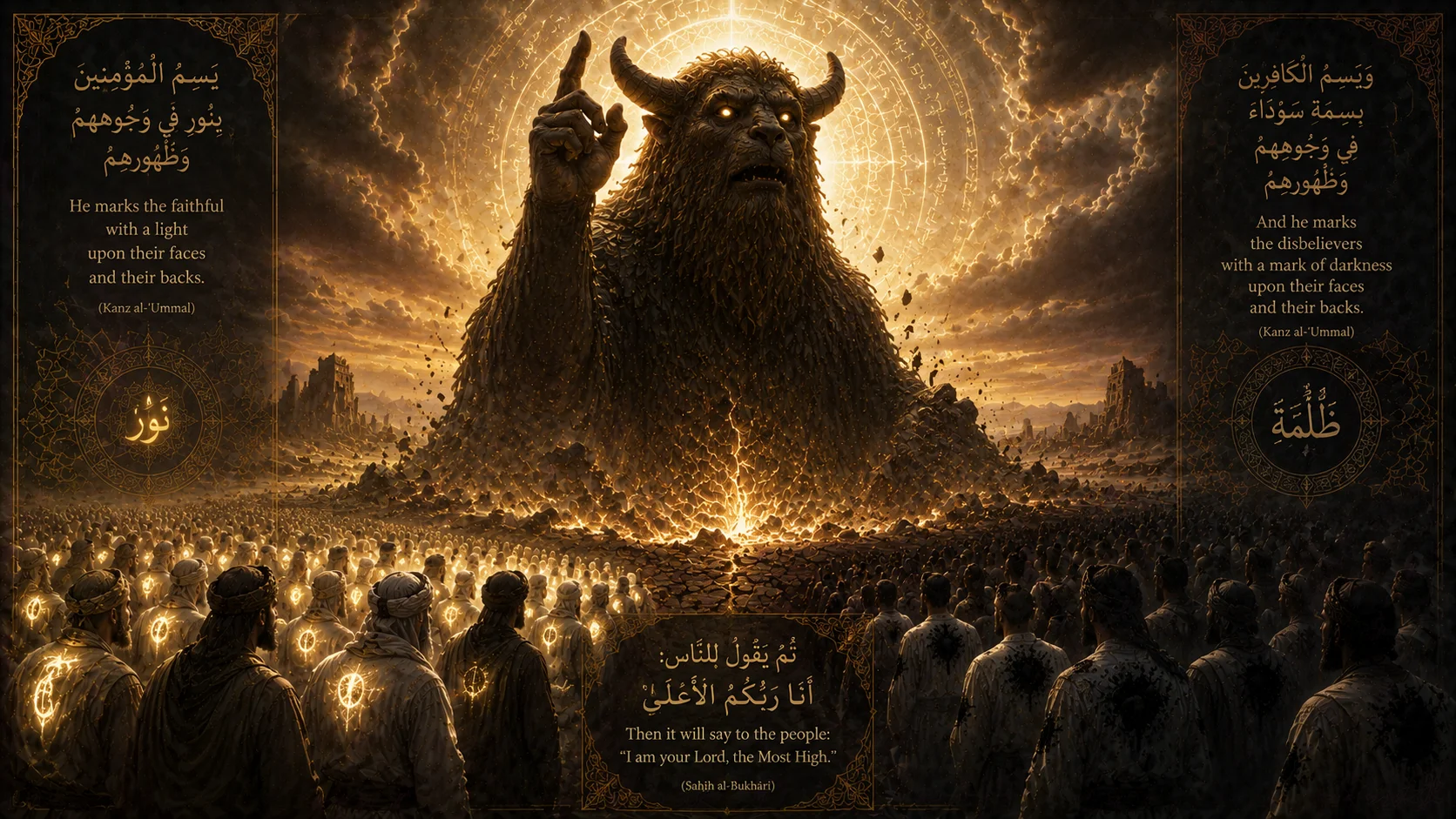
According to the Qur’an and the tradition, when the word is fulfilled against humankind (when faith has faded and the time has come), God will bring forth the Beast of the Earth from the ground, and it will speak to the people — for it is given the power of speech. Its great office is to mark and distinguish the believers from the unbelievers: it will speak to humankind concerning their lack of faith, and it will mark each person — sealing or branding the faithful believer and the unbelieving disbeliever each with a distinguishing mark (in the traditions, it marks the face of the believer so that it shines, and the face of the unbeliever so that it is blackened, or marks them so that all may know who is a believer and who is not). Thus the Beast makes manifest the inner state of faith or unbelief, dividing humankind visibly into the two camps as the end approaches.
The Sign of the Hour
The Dabbat al-Ard’s precise form is not specified in the Qur’an and is variously described in the later traditions (a great and strange composite or wondrous beast of immense size). It belongs to the dramatic signs of the Last Day in Islamic eschatology — alongside the coming of the Dajjal (the false messiah), the descent of Jesus (Isa), the emergence of Gog and Magog (Yajuj and Majuj), the rising of the sun in the west, and finally the blast of the trumpet of Israfil — the chain of portents heralding the end of the world and the Resurrection. As the wondrous Beast of the Earth that emerges to speak and to mark the faithful from the unbelievers as a sign of the Hour, the Dabbat al-Ard holds its place among the great signs of the Last Day. In the Dabbat al-Ard, Islamic tradition gave form to the Beast of the Earth — the wondrous creature that will emerge from the ground near the end of time to speak to humankind and mark the believers from the unbelievers, one of the great signs heralding the Last Day and the Resurrection.
One Sentence, and Everything After It
Take away the commentary, and the Qur’an says almost nothing about the Beast of the Earth. The entire scriptural basis for one of the most vivid signs of the Last Day is a single verse in Surah al-Naml, “The Ants” (27:82): when the word falls due against them, God will bring forth for them a creature from the earth, speaking to them, that mankind had no certainty in His signs. That is the whole of it — no description of its size, no account of what it looks like, not even a name beyond the plain descriptive phrase used to introduce it.
The underlying word is itself unremarkable. Dabbah is the ordinary Qur’anic term for a thing that crawls or walks, the word used for every living creature that moves upon the ground — “God has created every moving creature from water” (24:45). Scripture reached for the most mundane noun available and pointed it at the end of the world. That deliberate plainness is precisely what set later generations of readers to work: a name meaning simply ‘creature’ left almost everything — shape, size, origin, voice — for the exegetical and popular tradition to fill in, and fill it in they did.
There is a further oddity in the naming. The definite construct by which the Beast is now known, dābbat al-arḍ, is not the wording of its own verse; 27:82 has only the indefinite ‘a creature from the earth.’ That exact phrase belongs instead to 34:14, where it names something very small — the creature of the earth that gnawed through Sulayman’s staff, so that the jinn labouring under him learned of his death only when the propped body finally fell. The title now carried by the most colossal beast in Islamic eschatology belongs, in its own scripture, to something that ate through a stick.
The Staff and the Seal
One of the most frequently repeated elaborations gives the Beast two borrowed instruments rather than none. In this strand of the tradition it does not merely speak: it carries the staff of Musa (Moses) in one grasp and the seal-ring of Sulayman (Solomon) in the other, and performs its office with them — touching the believer’s face with the staff so that it brightens, and stamping the unbeliever’s face with the ring so that it darkens.
The choice of instruments is not incidental, though the two are not on equal footing. The staff is Qur’anic: it became a serpent before Pharaoh, and it struck the sea until the sea parted. The ring is not — the Qur’an grants Sulayman command of the wind and of the jinn without mentioning any ring at all, and the ring entered his story later, through the storytellers. But by the time the Beast was being imagined, both objects had long since become the tradition’s shorthand for delegated, unarguable authority. Handed to the Beast, they produce a judgment that needs no witnesses and allows no appeal: contact alone is the verdict.
A Shape Assembled from Every Animal
Where scripture is silent, storytellers reach for the familiar and combine it into the strange. One description repeated across the later exegetical and popular literature pictures the Beast as a composite of creatures its first audience knew well: the head of an ox, the eye of a pig, the ear of an elephant, the horn of a stag, the breast of a lion, the colouring of a tiger, the haunches of a cat, the tail of a ram and the legs of a camel — a chimera assembled, quite literally, out of the barnyard and the caravan route rather than out of anywhere otherworldly.
Scholars have long treated such physical detail with caution. Much of the most colourful material attached to the signs of the Hour — vivid, specific, and absent from the Qur’an itself — entered the exegetical record through the earliest generations of converts, who carried Jewish and Christian apocalyptic storytelling with them into Islam. That body of material came to be labelled isra’iliyyat, and was weighed far more cautiously than anything travelling on a sound Prophetic chain. The composite Beast sits squarely in that grey zone: pious, endlessly repeated, revealing of a real anxiety — and never elevated to the certainty of the verse that named it.
Where the Ground Is Said to Open
Tradition is similarly divided on where the earth will split. A number of narrations locate the emergence at al-Safa, the hillock within the Meccan sanctuary forever associated with Hajar’s search for water, still walked by every pilgrim performing the rite of sa’i — as though the ground closest to the House of God were also the ground thinnest between this world and the next. Other narrations decline to name a site at all, leaving the Beast to rise, as the verse itself has it, simply from the earth. The disagreement is worth noticing rather than resolving: it is the shape a tradition takes when the text withholds the one detail everybody wants.
Ten Signs, Not One
The Beast never appears in isolation. A hadith in Sahih Muslim has the Prophet enumerate ten portents that must occur before the Hour: a great smoke, the Dajjal, the Beast, the sun rising from its place of setting, the descent of Isa, the release of Yajuj and Majuj, three great sinkings of the earth — one in the east, one in the west, one in the Arabian peninsula — and last of all a fire that drives humanity before it to the place of their gathering. Set against that fuller list, the Beast is neither the first sign nor the final one, but a single item in a sequence understood to arrive in a tight cluster.
Within that cluster, a second narration in the same collection binds the Beast to one particular partner: the rising of the sun from the west. Whichever of the two comes first, it holds, the other follows close behind — sky and ground breaking their ordinary behaviour almost in the same breath, as if the physical world could no longer keep its silence once the appointed word had fallen.
A Mark Other Traditions Also Reached For
Sorting the saved from the condemned by a mark set on the body is not unique to this tradition. The Book of Revelation seals the servants of God upon the forehead, and sets against them a rival mark borne by those who follow the beast of that vision. Whether the resemblance reflects shared apocalyptic furniture or an actual line of transmission is not something the sources settle — but both are solving the same narrative problem: how to make an invisible, interior state suddenly and permanently legible on a face.
The Islamic account draws its own distinction sharply, though. The Beast’s mark decides nothing. Bound as it is to the sun’s rising in the west, after which faith is generally held to no longer avail the one professing it, the mark arrives too late to be a summons. It only publishes a verdict already settled by a lifetime.
Why This Sign, and Why the Ground
Among the great portents, the Dajjal is a false messiah, Yajuj and Majuj are swarming multitudes, the sun rising in the west is the sky breaking its own law — each a recognisable kind of threat, dressed in apocalyptic scale. The Beast of the Earth is the odd one out: not a rival power and not a celestial reversal, but the ground itself — mute, load-bearing, indifferent for the whole of human history — ceasing to be any of those things. That is arguably the sign’s real charge, and the reason a creature nobody can describe has outlasted portents that are easy to picture: the fear that the created world has been keeping score all along, and that its silence was never neutrality.
The sign has kept a foothold in the modern imagination for much the same reason. Popular apocalyptic writing and preaching have periodically tried to update the Beast’s ancient animal silhouette into something more recognisably contemporary — a machine, a technology — speculation sitting well outside the classical exegetical tradition, but testifying to the same unease reaching for a new vocabulary. What holds constant, ox-headed or otherwise, is the image that a plain Arabic noun for ‘creature’ was made to carry: a Last Day on which the world stops being scenery and becomes a witness.
Sources & traditions
- EncyclopediaWikipedia — Beast of the Earth
- TraditionIslamic texts, grimoires and later commentary
Myths change from area to area and from time to time. This chronicle follows the most widely told versions; tellings in other villages, regions and eras may differ.