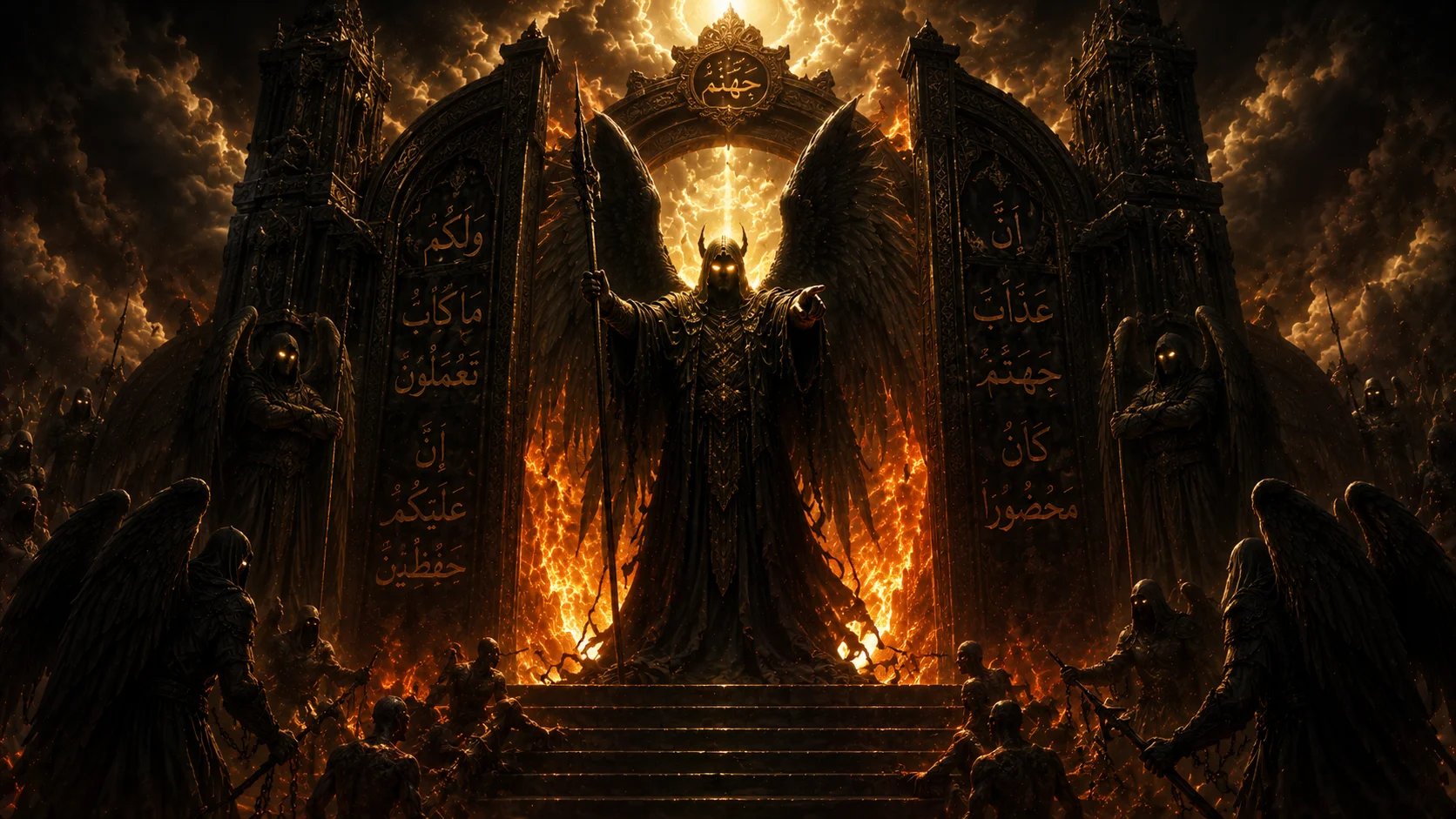
Maalik (Málik) is the angel who is the keeper of Hell (Jahannam) in Islamic tradition: the stern and mighty angel who presides over the Fire and commands the Zabániyah, the angels of punishment, the guardian of the place of torment to whom the damned will appeal in vain, the chief warden of Hell. He is the keeper of Hell, the angel of the Fire.
The Keeper of the Fire
Maalik (Málik) is the angel appointed by God as the keeper and guardian of Hell (Jahannam, the Fire) in Islamic tradition — the chief warden of the place of punishment, named in the Qur’an. He is the counterpart, in a sense, of Ridwan, the angel who is the keeper of Paradise (Janna): as Ridwan guards the Garden, so Maalik guards the Fire. Maalik is a mighty and stern angel, of awesome and forbidding aspect, who presides over Hell and all that happens within it, never smiling, grave and severe in his terrible office.
The Commander of the Angels of Punishment
Maalik commands the Zabániyah — the angels of punishment, the fierce and mighty guardians of Hell (nineteen in number over it, according to the Qur’an) who carry out the chastisement of the damned. Under Maalik’s authority, these angels administer the torments of the Fire upon those condemned to it. Maalik is thus the chief of the keepers of Hell, presiding over the punishment of the wicked, the unbelievers, and the damned who have earned the Fire by their deeds.
The Appeal of the Damned
The Qur’an gives a stark image of Maalik and the despair of the damned: the people of the Fire, in their torment, will cry out to Maalik, begging him to ask God to make an end of them — to let them die and escape their suffering. But Maalik will answer them, after a long delay, that they will remain — that there is no escape, no end, for they are to abide in their punishment. This terrible exchange marks the finality of the doom of the damned and the stern, inexorable nature of Maalik’s office. As the keeper of Hell, the commander of the angels of punishment, and the stern warden to whom the damned appeal in vain, Maalik holds his place among the great angels of Islamic tradition — the guardian of the place of torment, as others guard the Throne, the trumpet, and the gates of Paradise. In Maalik, Islamic tradition gave form to the keeper of Hell — the stern and mighty angel who presides over the Fire, commands the angels of punishment, and answers the appeal of the damned with the word that there is no escape, the warden of Jahannam.
A Name, Not a Title
Scripture is oddly sparing with angelic names. Of the countless angels Islamic tradition holds to exist, only a handful are named outright in the Qur’an rather than described by function — Jibril and Mikal among them, and Maalik. Isráfíl, Munkar and Nakír, Ridwan — all familiar figures in popular piety — are never named in the Qur’anic text at all; their names reach us through hadith and the exegetical tradition built up around it. Maalik’s appearance is a single verse, Sûrat az-Zukhruf, 43:77, and it is the only place in the whole of the Qur’an where his name is spoken. Everything else known about him — every title, every detail of his office — grew up afterward as commentary on that one moment.
The name itself is not incidental. It shares its root, m-l-k, with malik, “king,” and mulk, “dominion” — and the Qur’an applies the very same word to God. The opening chapter calls Him Málik yawm ad-dín, Master of the Day of Judgement; elsewhere He is addressed as Málik al-mulk, Master of all dominion. The warden of Hell therefore carries, as his only name, a word that belongs first to God. Whatever mastery he holds over that place is held by appointment — a sovereignty entirely on loan.
The Angel Who Has Never Smiled
Accounts of the Prophet’s Night Journey and Ascension — the Isra and Mi’raj — preserve an encounter with Maalik that appears nowhere in the Qur’anic text but became one of the most repeated images of him in later devotional literature. Shown the Fire on his passage through the heavens, Muhammad is said to have noticed that this one angel, alone among those who met him, offered no welcoming expression at all, and to have asked Jibril why. The answer preserved in the tradition is stark: Maalik has not laughed since Hell was made, and has no cause to. What the story fixes is not cruelty performed but a gravity that has never once had reason to lift — a face shaped entirely by an office.
A Warden, Not a King of the Damned
It is worth being precise about what Maalik is not, because the distinction is doing real theological work. Much of the imagery that reached wider popular culture through Christian tradition gives Hell a ruler — a fallen sovereign presiding over a domain of his own by right of the very rebellion that condemned him. Islamic cosmology draws the line somewhere else entirely. Iblís is destined for the Fire rather than set over it, and the Qur’an has him stand up on the Day of Judgement to tell those he misled that he never held any authority over them at all — that he only called, and they answered. Nothing gives him a throne below. The Fire is administered instead by an angel, and of its guardians scripture says only that they do not disobey God in what He commands them and do exactly what they are commanded. Hell, in this understanding, is not a rival kingdom contesting God’s rule. It sits entirely inside it, run by an appointee with no stake of his own in the punishment he carries out.
Ridwan’s Silence
Tradition likes to set Maalik and Ridwan against each other as matched thresholds, one keeper for each destination. The texts are far less symmetrical than the pairing suggests. Maalik is named in the Qur’an; Ridwan is not. The word ridwán occurs there often enough, but as an abstraction — God’s good pleasure, the acceptance promised to the blessed — and never as anybody’s name. The keeper of Paradise, so familiar from sermons and popular piety, acquired his name later, from the same commentarial tradition that named Munkar and Nakír. The asymmetry is easy to miss precisely because the symmetry feels so natural. But scripture was willing to name its warden of torment outright, in his own voice and in the voices of those who beg him, and left the keeper of reward to be named by the generations that came after.
Guardians of the Threshold
Maalik belongs to a far older habit of imagining the afterlife, one running across the ancient Near East and the Mediterranean and well beyond them: the conviction that whatever lies past death cannot be left unadministered, that it requires officers, thresholds, and someone posted at the gate. Egyptian funerary texts weighed the heart of the dead against the feather of Ma’at before a tribunal of assessors. Greek tradition set Charon at the river and Cerberus at the gate beyond it. In India, Yama was the first mortal to die and so became lord of the road he had opened, and later tradition made him judge of those who followed him down it. Maalik stands in this same lineage, reshaped by a strictly monotheistic frame in which even Hell is not lawless: it has a warden, a chain of command answering to a single God, and rules that not even the damned can bend by pleading. What such figures seem to offer, across traditions with no contact between them, is not the comfort of escape but the comfort of order — the sense that judgement, however terrible, is administered rather than arbitrary.
Picturing the Unseeable
Maalik is a rare figure to have been painted at all, and where he was painted it was not in a devotional setting. Figural religious imagery stayed out of the mosque and out of the Qur’an manuscript entirely; it was courtly book painting, in the Persianate and Turkic workshops, that felt free to depict angels — and free, in the illustrated Mi’ráj-náma manuscripts, to paint Hell itself, because the narrative went there and demanded it. Those cycles follow the Prophet scene by scene up through the heavens and then down into the Fire, past its punishments and its keeper. It is close to the only visual record of a figure Islamic tradition has otherwise known almost purely through text — a warden defined by the single sentence he is given to speak, and hardly ever by what anyone imagined him to look like.
Sources & traditions
- EncyclopediaWikipedia — Maalik
- TraditionIslamic texts, grimoires and later commentary
Myths change from area to area and from time to time. This chronicle follows the most widely told versions; tellings in other villages, regions and eras may differ.