Nakir is one of the two angels of the grave in Islamic tradition: with his companion Munkar, the angel who comes to the newly buried dead in the grave to question them about their faith — their God, their religion, and their Prophet — determining, by their answers, whether the grave shall be a place of light and peace or of darkness and torment until the Day of Judgment. He is an angel of the grave, the questioner of the dead.
The Companion of Munkar
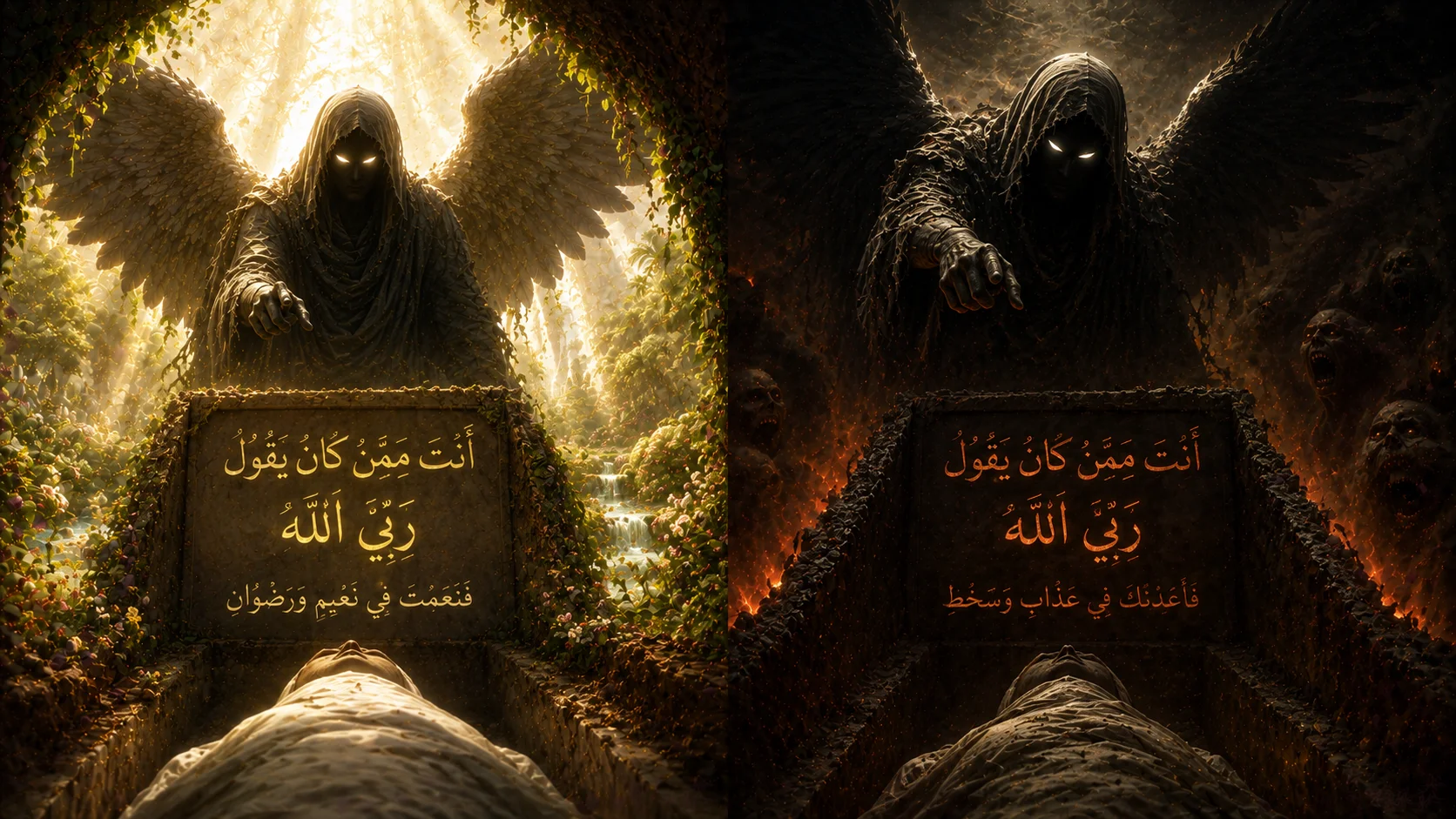
Nakir, with his companion Munkar, is one of the two angels of the grave in Islamic tradition — the awesome pair of angels who come to the dead in the tomb to administer the test of the grave. The two are almost always named and act together, Munkar and Nakir, and they perform the same office: when a person has been buried and the mourners have left, the two angels come to the deceased, raise them in the grave, and question them. They are described as fearsome and mighty in aspect, dark, with flashing or blue eyes, of dread appearance.
The Three Questions
Nakir and Munkar put to the dead the three great questions of faith: “Who is your Lord?” “What is your religion?” and “Who is your Prophet?” The true believer answers with firm faith — “My Lord is Allah; my religion is Islam; my Prophet is Muhammad” — and for them the grave is widened, filled with light, and made a garden of peace and ease, a foretaste of Paradise, where they rest in comfort. The unbeliever or the hypocrite, unable to answer truly, faces the punishment of the grave: the tomb becomes narrow, dark, and full of torment, a foretaste of the Fire, until the Resurrection. Thus the answers given to Nakir and Munkar determine the state of the soul during the barzakh — the intermediate period between death and the final Judgment.
The Test of the Grave
Nakir (whose name, like Munkar’s, is connected to the testing and the “unknown” or “denied”) and his companion thus represent the first reckoning that every soul faces after death — the questioning in the grave that is a central element of Islamic belief about death, the afterlife, and the importance of dying in true faith. The two angels are solemn and well-known figures, and the prospect of their questioning is a powerful spur to faith and right living. As one of the two angels of the grave who question the dead and determine their state until the Judgment, Nakir holds his place among the angels of Islamic tradition. In Nakir, Islamic tradition gave form to an angel of the grave — the awesome questioner who, with Munkar, comes to the buried dead to test their faith and determine whether the grave shall be light or darkness until the Day of Judgment, the angel of the test of the tomb.
A Name Built to Frighten
Both angels are named from the same Arabic root, n-k-r, a root that gathers its meanings around denial, non-recognition and revulsion — and scholarship has never entirely agreed which of those senses the names are carrying. Sebastian Günther renders the pair as “Reprehensible” and “Reproachful”: names that describe what the angels are. John MacDonald, noticing that both words are passive in form, read them instead as “unknown” or “disguised” — names that describe not the angels but the experience of being met by them, a face arriving at the one appointment in a life for which nothing familiar has been provided. A. J. Wensinck doubted the connection to that root altogether. What survives all three readings is the strangeness itself: whatever else Nakir is, he is nobody the dead have met before.
The Angels of a Lifetime, and the Angels of One Night
That strangeness is easiest to feel beside the other angelic pair in Muslim teaching about the individual soul. The Qur’an describes two receivers seated at a person’s right and left, and noble scribes who write down what is said and done; popular tradition names them Raqib and Atid, after the Qur’anic phrase for the watcher who is always at hand. Those two are companions. They are there from the first breath, they are never absent, and they never ask anything — they only record, and the record is read out much later, by someone else. Nakir and Munkar are their exact inverse. They come once. They come only after burial, only underground, only once the mourners have gone. And they do not write: they ask, and the answer falls due immediately.
A Doctrine Without a Verse
Neither name appears anywhere in the Qur’an. The scripture describes the barzakh, the barrier state between death and resurrection, and commentators read several verses as alluding to a trial that meets the dead — but it names no interrogators. Munkar and Nakir surface first in the hadith literature, in the collection of al-Tirmidhi.
That distinction mattered, because a doctrine resting on transmitted report rather than on scripture is exactly the kind of claim a rationalist theologian feels entitled to test. The objection raised against it was blunt and physical: a corpse is inert matter, without life or perception, so there is nothing there to question and nothing there to punish. Individual theologians of the early rationalist current pressed the point — Dirar ibn Amr is the name the tradition remembers first — though the Mu’tazila as a school did not on the whole follow him there, and Sunni orthodoxy moved hard in the opposite direction. The questioning of the grave was written into the short creeds by which orthodoxy defined itself: al-Tahawi’s creed affirms the punishment of the grave for those who deserve it, and the questioning by Munkar and Nakir by name. A scene that entered Islam as a story told by transmitters came out of the argument as an article a Muslim is obliged to hold.
The Shape Their Terror Takes
The report that first names them spends two words on their appearance: black, and blue. The later compilations that gathered such traditions are far less restrained — hair falling to their feet, tongues of fire in their mouths, teeth with which they dig down through the earth to reach the body, and hammers so vast that the whole of mankind together could not lift one. Fail the questioning, those traditions add, and the beating comes every day but Friday.
None of that is decoration. The horror is doing theological work, and it works in two directions at once. It makes the test impossible to hear described and then shrug off; and it sets up the contrast the whole scene exists to deliver, since for the one who answers rightly these same figures are said to turn gentle. The grave is not made frightening merely in order to frighten. It is made frightening so that the distance between the two outcomes can be felt as the distance it is.
Whispering the Answers in Advance
The questions are known in advance, and so are the answers — which has produced one of the few places where belief in these two angels becomes something people physically do. In the practice called talqin, someone stays behind at the graveside after the burial and speaks to the newly buried dead, prompting them with the answers they are about to need, the way one might coach a student on the threshold of an examination. Jurists differ over exactly when it is called for: the Shafi’i school treats it as recommended both at the point of death and after the grave has been filled, and it holds a settled place in Shi’a funeral custom. Stated plainly the theology is stark — the living are trying to get a sentence into the ear of the dead before Nakir arrives. It is the last practical thing a community can do for someone who can no longer do anything.
An Angel Islam Rarely Paints
Nakir has no iconography. There is no attribute by which a viewer picks him out the way a set of scales or a halo identifies a figure in Christian painting, and no devotional image of him at all — the tradition’s long discomfort with figural sacred imagery in public and devotional settings saw to that. Angels are nonetheless painted, and painted often, in the manuscript workshops of Persia and Ottoman Turkey, and the questioning in the grave does occasionally appear among their pages: one Ottoman Turkish copy of al-Qazwini’s Wonders of Creation, made in 1717, illustrates the two angels at a graveside. It is worth noticing where that places him. Not in a book of doctrine, and not in a devotional cycle, but in a compendium of the marvels of the created world — filed, in effect, among the wonders.
Why the Grave Needed Its Questioners
Strip away the names and Nakir belongs to a much older human intuition: that death is not the end of accounting but the beginning of it, and that something meets the soul at the threshold to ask what it has been. Zoroastrian tradition has the soul linger three nights by the body and set out at dawn on the fourth day for the Chinvat Bridge, where Rashnu holds the scales in which a life is weighed. Egyptian belief had the heart weighed against the feather of Ma’at before Osiris. Whether any of these pictures shaped the others is a question comparative religion treats with more care than confidence, and the honest answer is that the lines cannot be drawn. The recurrence is striking enough on its own: the interval immediately after burial — after the mourners leave, before any final judgment is pronounced — is a silence that culture after culture has refused to leave empty, and has filled with someone who comes to ask.
What Nakir does for Islam specifically is make accountability immediate. A Last Hour somewhere over the horizon of history can always be deferred in the imagination; the grave cannot be, because the grave might be tonight. By stationing an examiner at the door of death rather than at the far end of time, the tradition keeps its three questions from ever becoming abstract or academic. They are questions a person is taught, across an entire lifetime, to be able to answer without hesitation on a night nobody gets to schedule — which is why Munkar and Nakir remain, in sermon and in household instruction alike, so deliberately impossible to forget.
Sources & traditions
- EncyclopediaWikipedia — Munkar and Nakir
- TraditionIslamic texts, grimoires and later commentary
Myths change from area to area and from time to time. This chronicle follows the most widely told versions; tellings in other villages, regions and eras may differ.