Al-Khidr (al-Khiḍr, "the Green One") is the mysterious sage of Islamic tradition: a righteous servant of God endowed with hidden, directly-granted knowledge, the enigmatic guide who taught the Prophet Musa the limits of human understanding, and — in widespread popular and Sufi belief, though not in the Qur'an itself — an immortal wanderer associated with green renewal and living water, who is held by many to still walk the earth aiding travelers and the lost.
The One Who Is Not Named
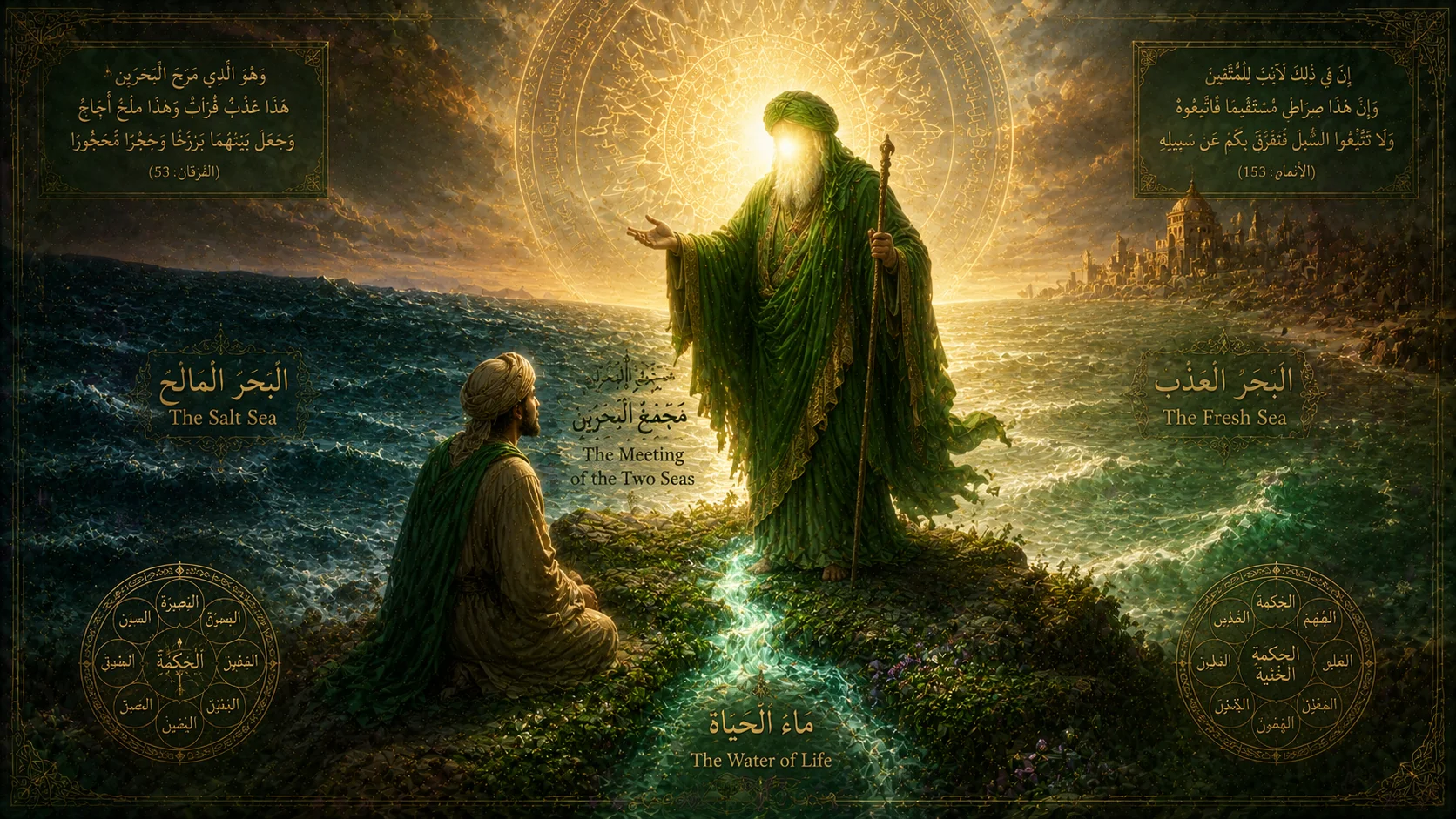
Nowhere in the Qur'an does the name Al-Khidr appear. In Surah Al-Kahf (18:60–82), Musa sets out with his young companion in search of "the junction of the two seas," seeking a servant of God to whom, the text says, mercy had been given "from Us" and who had been taught "from Us a certain knowledge" (18:65). This unnamed figure is never called Al-Khidr in scripture; it is Islamic exegetical tradition — tafsir — that has, essentially universally, identified him as such, reading the epithet back into the account from outside the revealed text itself. The name is not Qur'anic but prophetic in origin: it comes from hadith, most notably Sahih al-Bukhari (3401, 3402), where the Prophet Muhammad himself explains it — the figure sat upon a patch of barren white ground (farwa), and the ground turned green (ikhtaddarat) beneath him. The color is the sign by which he is known: contact with him leaves the world visibly renewed, however briefly, however small the patch of ground.
Servant, Saint, or Prophet
Islamic scholars have long disputed what, precisely, Al-Khidr was. Was he a prophet (nabi), a saint or righteous servant (waliy), or something closer to an angel? The question has never been settled by consensus. Most of the great classical exegetes — al-Tabari and Ibn Kathir among them — lean toward reading him as a prophet, resting their case chiefly on the Qur'anic description of one given mercy and taught knowledge directly "from Us," language that in other contexts marks prophetic address. But this reading is explicitly contested rather than agreed, and the honest state of the tradition is one of open scholarly disagreement, not settled doctrine. To call Al-Khidr a prophet, a saint, or leave the matter open are all positions with standing within Islamic scholarship; none should be presented as the final word.
The Ground That Turned Green
The Qur'anic episode begins with a condition. Musa asks to accompany this servant of God so that he might learn from him "of the right guidance" he has been taught (18:66). The servant answers plainly: Musa will not be able to bear with him patiently — "how can you have patience about something over which you do not have full knowledge?" (18:67–68). Musa promises obedience and patience; he is warned again not to question anything until it is explained to him (18:69–70). It is an agreement made in good faith and broken, as the narrative will show, three times over — not from malice, but because what Musa witnesses cannot be borne in silence by someone reasoning from the visible surface of events alone.
The Boat That Was Damaged to Be Saved
The two travel by sea, and the servant damages — in some tellings, scuttles — a boat belonging to poor fishermen. Musa, seeing an act of apparent vandalism against people who could least afford the loss, protests immediately: "Have you damaged it to drown its people? You have certainly done a grave thing" (18:71). The servant reminds him of his promise and says nothing more at the time. Only later, in the episode's closing explanation, does the reason emerge: a tyrannical king was seizing every seaworthy vessel by force, and the boat's flaw — a damage that could be repaired — kept it beneath his notice and so out of his hands (18:79). What looked like harm was protection; the wound was the boat's rescue.
The Youth and a Grief Not Yet Given
The second episode is the hardest of the three, and the Qur'an does not soften it. The servant kills a young boy they encounter, and Musa's objection is his strongest of the journey: "Have you killed a pure soul for other than [the retribution of] a soul? You have certainly done a deplorable thing" (18:74). The explanation, given afterward, is that the boy's parents were believers, and the servant feared that the boy would have caused them grief through disbelief and tyranny that his life would have carried forward — and that God intended to give them in his place a child better in purity and closer in mercy (18:80–81). This episode carries the heaviest theological weight of the three and is discussed at length in Islamic thought as a meditation on divine foreknowledge set against the apparent injustice of human sight — a case where the servant's granted knowledge reaches further than what any onlooker, however righteous, could see for themselves.
The Wall Raised Without Payment
The third episode turns on hospitality withheld rather than harm apparently done. In a town that refuses the two travelers food or shelter, the servant comes upon a leaning wall and repairs it without asking anything in return. Musa, exhausted and having just watched their reception, cannot understand the labor given freely to people who gave them nothing: "If you wished, surely you could have taken for it a payment" (18:77). The explanation follows: the wall belonged to two orphan boys of the town, and beneath it their righteous father had left a buried treasure meant for them. Had the wall fallen, the treasure would have been exposed before the boys came of age; it needed to stand a little longer, until they were grown enough to claim what was theirs (18:82).
Knowledge Taught from a Presence, Not from a Book
Across all three episodes, what distinguishes the servant is not that he knows more facts than Musa but that his knowledge is of a different order — 'ilm ladunni, knowledge that comes directly from God's presence rather than through the transmitted channels of prophetic law and scripture. Musa is a prophet bearing revealed law, reasoning from what an act appears to be; the servant reasons from what an act is for, seen from outside ordinary time. The Qur'an frames their companionship not as a contest between a greater and lesser figure but as two different modes of knowing set beside each other, each valid, each incomplete without the other.
The Parting
The agreement breaks at the third question, exactly as it was warned it would. Musa's third act of protest — after two that had already tested the bond — triggers the servant's response that this marks their parting: "This is parting between me and you. I will inform you of the interpretation of that about which you could not have patience" (18:78). What follows is the explanation of all three deeds, offered now that the condition has lapsed, and the two go their separate ways. The parting is not rendered as punishment. It is simply the natural end of an arrangement whose entire premise — patience in the face of what cannot yet be explained — has been used up.
The Wanderer Who Drank of the Water of Life
Beyond the Qur'anic episode, a separate and much wider body of belief holds that Al-Khidr is not merely long-lived in memory but literally still alive today, having drunk from the Water of Life — Ma' al-Hayat — and that he wanders the earth in the present age, appearing to help travelers, the lost, and the pious, and will continue to do so until the Day of Judgment. It needs to be said plainly that this belief has no basis in the Qur'an or in authenticated hadith. It is explicitly rejected by a number of major scholars, including Ibn Taymiyyah and Ibn Kathir, who regarded the reports behind it as weak or outright fabricated. The immortality tradition remains, to this day, disputed territory within Islamic scholarship — beloved in popular devotion and much of Sufism, but not a matter on which the tradition speaks with one voice.
The Hidden Master of the Sufi Path
Within Sufism, Al-Khidr became something more specific still: the paradigmatic figure of the hidden spiritual master, or murshid — a guide reachable not through the ordinary chain of formal transmission from teacher to student but through direct, sometimes unbidden encounter. He represents esoteric knowledge and guidance that comes straight from God, standing somewhat apart from the institutional lineages through which most religious learning passes. A number of major Sufi figures, Ibn Arabi among them, are recorded as claiming personal spiritual meetings with him across time — encounters treated within that tradition not as legend attached to a distant past but as a living possibility, open in principle to any sincere seeker in any age.
A Figure Who Gathers Other Figures
Al-Khidr has never stayed cleanly within a single narrative. Popular tradition has long conflated or merged him with other figures of parallel character: with legends attached to the Qur'anic Dhul-Qarnayn's companions, and — perhaps most persistently — with the Biblical and Qur'anic Ilyas (Elijah), with whom he is frequently paired in folk tradition as a second immortal, wandering figure. In parts of the Levant and Anatolia the identification runs further still, merging Al-Khidr with the Christian Saint George (known locally as Mar Jirjis or Aya Yorgi), an identification visible at shrines shared by both traditions, such as the one at Beit Jala and the site associated with the Hıdırellez festival in Istanbul. None of these pairings derive from scripture; they are the product of centuries of shared devotional space between communities, and they vary sharply by region rather than forming any single settled composite.
Hızır and the Turning of Spring
In Turkish, Balkan, and Central Asian folk Islam, Al-Khidr is known as Hızır, and is honored each year at the spring festival of Hıdırellez, held on the sixth of May. The festival commemorates a folk tradition in which Hızır and Ilyas meet once a year, and it visibly blends much older, pre-Islamic Turkic and Anatolian spring rites with the veneration of an Islamic figure layered on top of them. This is a documented ethnographic practice, well attested in the communities that keep it, and it stands apart from — rather than as an extension of — normative textual Islam and the Qur'anic account itself.
Khwaja Khizr of the River
In the Indian subcontinent, the figure takes yet another regional shape as Khwaja Khizr, venerated specifically in connection with rivers and running water — most notably the Indus. A shrine to Khwaja Khizr on the Indus, near Bukkur and Sukkur, has long drawn shared devotion from both Hindu and Muslim communities, a pattern of localized, syncretic veneration distinct in character from Arab Islamic tradition and rooted instead in the specific geography and religious life of South Asia. As with the Anatolian Hızır, this is a regional and ethnographic development rather than a scriptural one.
What Holds Across the Variations
For all the regional difference in name, ritual, and paired companion, certain threads run through every version of Al-Khidr: hidden wisdom that exceeds what is visible on the surface of events; guidance offered at moments of genuine moral perplexity, when the right course cannot be judged by appearance alone; protection extended to travelers and the lost; and a persistent association with water, with green growth, and with renewal. What shifts from region to region — the specific rites observed, the companion figure he is paired with, whether he is approached through a Sufi shrine, a spring festival, or a riverbank — is ethnographic and devotional rather than scriptural, and the distinction matters: the Qur'anic core in Surah Al-Kahf remains fixed and textually attested, while everything built up around it since — the name itself, the immortality, the festivals, the shared shrines — belongs to the long, varied, and still-living work of communities carrying the figure forward in their own settings.
Sources & traditions
- EncyclopediaWikipedia — Khidr
- TraditionIslamic texts, grimoires and later commentary
Myths change from area to area and from time to time. This chronicle follows the most widely told versions; tellings in other villages, regions and eras may differ.