The Buraq occupies a singular place among the creatures of Islamic tradition: not a beast of folklore or fable, but the mount of a single, unrepeatable night in which the Prophet Muhammad ﷺ was carried from Mecca to Jerusalem and, in most accounts, upward through the heavens. It is not named in the Qur'an itself — the sole Qur'anic anchor for the journey is Surat al-Isra 17:1, which speaks only of God's servant being taken by night from al-Masjid al-Haram to al-Masjid al-Aqsa, without naming what carried him. The name al-Buraq, and the vivid description that surrounds it, comes instead from hadith literature: most notably the narrations of Anas ibn Malik and Malik ibn Sa'sa'ah preserved in Sahih al-Bukhari and Sahih Muslim. This makes Buraq a well-attested hadith figure rather than a directly scriptural one — a distinction classical scholars have always been careful to preserve, and one worth preserving here.
A White Steed Between Mule and Donkey
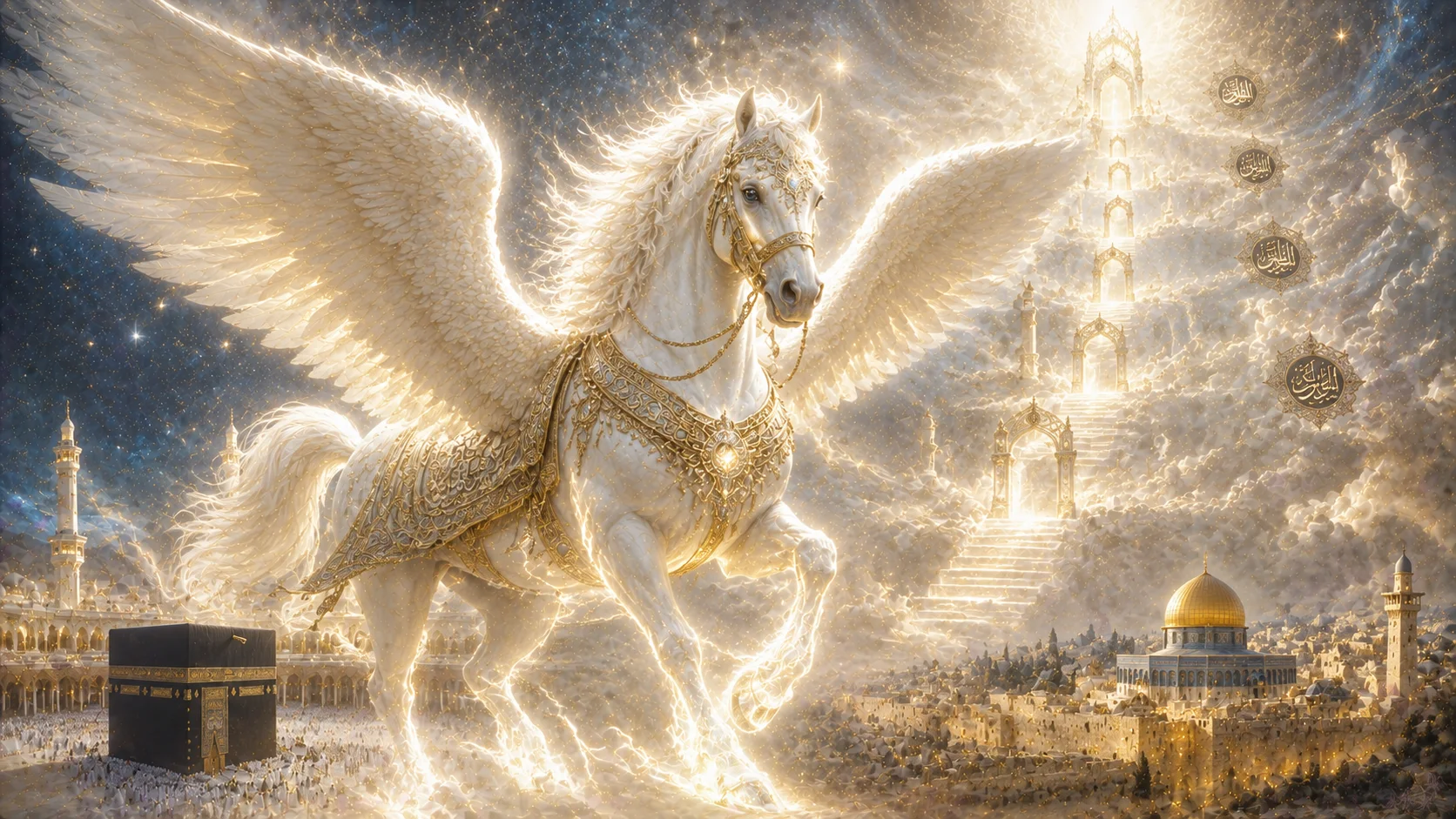
The hadith description is spare and precise rather than fantastical. Buraq is described as a white animal, smaller than a mule but larger than a donkey — a deliberately modest frame of reference, pinning the creature to animals its first hearers would have known well rather than to invention. The same narrations note that earlier prophets before Muhammad ﷺ had also ridden this mount, a detail that does something quietly important: it places the Night Journey within a continuous prophetic lineage rather than presenting it as an isolated wonder. Buraq, in this reading, is not created new for one occasion but is a recurring sign entrusted across generations of prophethood.
Where the Eye Could Reach
What marks Buraq as miraculous is not its shape but its stride. A commonly cited hadith description states that its stride reached as far as the eye could see — that is, each step carried it to the farthest point visible to its rider. This is not offered as biology; it is a way of conveying speed that ordinary language cannot otherwise hold. The image is less a measurement than a statement: that the journey Buraq made possible was outside the ordinary reach of distance and time altogether, accomplished within the compass of a single night.
The Lightning in the Name
Scholars and commentators widely trace the name Buraq to the Arabic root b-r-q, meaning lightning (barq). This is a philological observation rather than a textual claim spelled out in the hadith itself, but it is broadly agreed upon, and it fits the creature it names with unusual precision — brightness, suddenness, and speed folded into a single word. The exact grammatical form of the derivation (whether intensive or elative) remains a matter for philologists; what has always mattered more to the tradition is the resonance itself, a name that carries its meaning on its surface.
The Servant Who Would Not Be Still
The hadith accounts preserve a small, human moment before the journey begins: Buraq is initially skittish, resistant to being mounted. In some versions the angel Jibril (Gabriel) restrains or calms the animal directly; in others, Buraq itself is addressed and responds with recognition and submission. Either way, the moment is not decorative. It establishes Jibril as Buraq's direct companion and handler for the whole of what follows, and it frames the mount not as an inert vehicle but as a creature capable of hesitation — made compliant, in the end, not by force but by address and recognition.
Rider, Mount, and Guide
Throughout the Isra and the Mi'raj, Buraq and Jibril appear together but never interchangeably. Buraq is the conveyance; Jibril is the guiding angelic escort who accompanies Muhammad ﷺ at every stage, including through the encounters with the earlier prophets during the ascension. The hadith accounts keep these two roles distinct and complementary — one bears the Messenger across distance, the other leads him through what lies beyond it. Where later tradition tells of Jibril's own presence in these narrations, the two figures remain bound together as parts of a single account rather than as separate stories.
Mecca to Jerusalem, and Beyond
The Isra proper is the leg most firmly fixed in the hadith record: Buraq carrying Muhammad ﷺ from the Sacred Mosque in Mecca to the Farthest Mosque in Jerusalem. What happens afterward is treated with more care by the sources themselves. In most traditional accounts Buraq also carries the Prophet ﷺ partway through the subsequent Mi'raj, the ascension through the seven heavens. Some narrations, however, distinguish this second stage as proceeding by other means — a ladder, which is what the word mi'raj literally denotes, "a means of ascent" — after Buraq's part in the journey ends at Jerusalem or at a particular heavenly station. The tradition does not force these accounts into artificial agreement; it holds them as they were transmitted.
A Sign Against Disbelief
Buraq's role is not only narrative but theological: the creature functions in the tradition as a marker of the miraculous, or mu'jiza, nature of the Isra wal-Mi'raj — proof that the journey was extraordinary and divinely enabled rather than an ordinary trip across ordinary distance. Sira literature records that when word of the journey reached the Meccans, many refused to believe it. Abu Bakr's affirming response to the news is remembered as the origin of his title al-Siddiq, "the truthful one" — and this disbelief, and the trust that answered it, are often narratively linked to the very swiftness Buraq represents: a distance no caravan could cross in a lifetime, crossed in a night.
The Tethering Place in Jerusalem
Tradition locates the place where Buraq was tethered in Jerusalem at what became known, in later usage, as the Buraq Wall, near al-Aqsa and the wider Haram al-Sharif. This is a site whose name and significance carry, in the present day, historical and political weight well beyond the hadith account itself. That contemporary sensitivity is noted here only descriptively, as part of the site's layered history, without taking any position on its modern contested usage — the concern of this account is the place as it appears within the prophetic narration.
Neither Jinn Nor Ordinary Beast
Islamic tradition does not classify Buraq among the jinn, nor does it treat the creature as an ordinary earthly animal. It occupies its own category: a miraculous, otherworldly creature created for prophetic transport. Some scholars have grouped it loosely alongside other extraordinary animals that appear in prophetic accounts — the she-camel of Salih is the most frequently cited comparison — treating each as a sign, an ayah, rather than a natural creature bound by the rules of biology. Even within this framing, though, Buraq's precise ontological status feeds into a larger and older theological discussion: whether the Isra and Mi'raj occurred bodily, in the flesh, or as a vision granted to the Prophet ﷺ. Classical authorities such as al-Qadi 'Iyad and Ibn Kathir debated the question at length, weighing the hadith evidence with care. The majority Sunni position holds that the journey was bodily, and that Buraq was accordingly a real, physical mount — not a figure of vision alone.
Wings, Faces, and the Painter's Hand
The Buraq familiar from popular imagination — winged, human-faced, adorned with jeweled trappings — belongs to a later layer of the tradition. Sira literature such as Ibn Ishaq's account as preserved by Ibn Hisham, and later devotional works, embellished the hadith's spare description considerably. Scholars widely recognize these additions as devotional and artistic elaboration rather than part of the core hadith account, which nowhere mentions a human face. This visual tradition reached its fullest expression in Persian, Ottoman, and South Asian manuscript painting, where, from roughly the fourteenth century onward, Buraq is most famously rendered with a human or woman's face and peacock-like tail feathers. These images are devotional and cultural artifacts in their own right — a centuries-deep artistic afterlife running alongside, but distinct from, the hadith's own restrained description of a white animal between mule and donkey.
What the Steed Carries
Taken together, the hadith record and its later devotional elaboration describe two things that are related but not identical: a mount attested in the most rigorously preserved traditions of the Prophet's ﷺ life, and a figure of extraordinary visual imagination built up around it over the centuries that followed. The first grounds Buraq firmly within Islamic sacred history — present at one of the most significant nights in the Prophet's ﷺ life, guided by Jibril, witnessed in memory by the earliest generations of Muslims. The second is the tradition's ongoing act of wonder before that night: an attempt, in paint and verse, to give form to a swiftness the hadith itself describes only by saying that its stride reached as far as the eye could see.
Sources & traditions
- EncyclopediaWikipedia — Buraq
- TraditionIslamic texts, grimoires and later commentary
Myths change from area to area and from time to time. This chronicle follows the most widely told versions; tellings in other villages, regions and eras may differ.