Munkar is one of the two angels of the grave in Islamic tradition: with his companion Nakir, the angel who comes to the newly buried dead in the grave to question them about their faith — their God, their religion, and their Prophet — determining, by their answers, the nature of their wait until the Day of Judgment. He is an angel of the grave, the questioner of the dead.
The Angel of the Grave
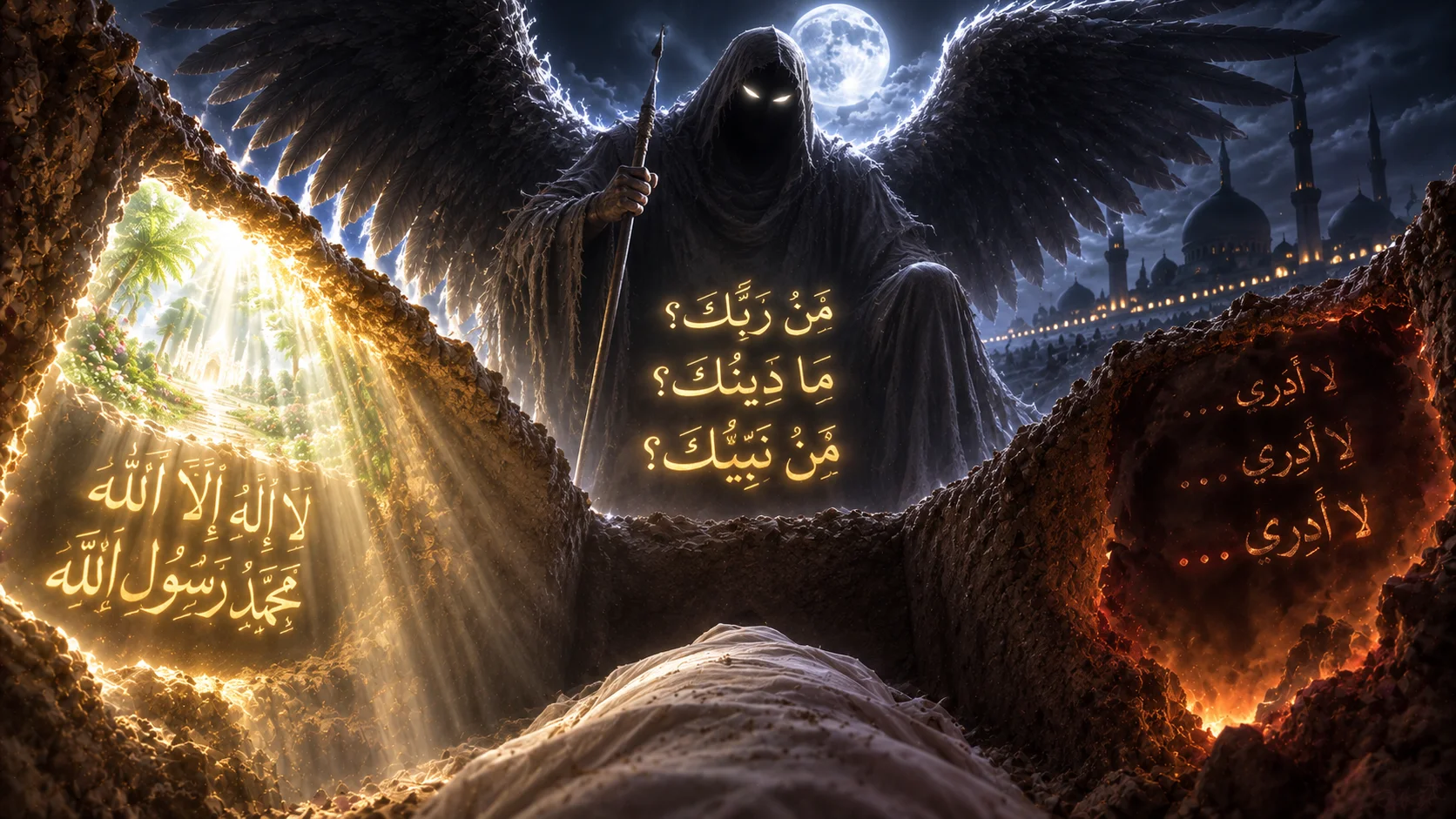
Munkar, with his companion Nakir, is one of the two angels of the grave in Islamic tradition — the angels who come to the dead in the tomb to test and question them. According to the tradition (based on the Hadith), when a person has died and been buried, and the mourners have departed, the two angels Munkar and Nakir come to the deceased in the grave. They are described as awesome and fearsome in appearance — dark, with blue or flashing eyes, of frightening aspect — and they raise the dead person to a sitting position in the grave to question them.
The Questioning of the Dead
Munkar and Nakir put to the dead three great questions, the test of the grave: “Who is your Lord?” “What is your religion?” and “Who is this man (the Prophet) who was sent among you?” The faithful believer, whose faith is firm, answers rightly and without fear: “My Lord is God (Allah); my religion is Islam; and this is Muhammad, the Messenger of God.” For such a one, the questioning is passed, and the grave is made spacious and filled with light and peace, a foretaste of Paradise, where the soul rests in ease until the Resurrection. But the unbeliever, the hypocrite, or the wrongdoer cannot answer — they stammer, “I do not know,” or give a false answer — and for them the grave becomes a place of darkness, torment, and punishment (the “punishment of the grave,” adhab al-qabr), a foretaste of the Fire, until the Day of Judgment.
The Test of the Tomb
Munkar (whose name is connected to the “denied” or “unknown,” the testing of what is professed) and Nakir thus administer the first reckoning after death — the test of faith in the grave that determines the state of the dead during the long wait (the barzakh, the intermediate state) between death and the final Resurrection and Judgment. The questioning of the grave is an important element of Islamic eschatology and belief about death and the afterlife, and the two angels are well-known and solemn figures. As one of the two angels of the grave who question the dead about their faith and determine their state until the Judgment, Munkar holds his place among the angels of Islamic tradition. In Munkar, Islamic tradition gave form to an angel of the grave — the awesome questioner who, with Nakir, comes to the buried dead to test their faith and determine the nature of their wait until the Day of Judgment, the angel of the test of the tomb.
What the Name Means
Say the word munkar to an Arabic speaker outside the context of the grave and they will hear something closer to “wrongdoing” than “angel.” The name comes from the root n-k-r, which gives Arabic its vocabulary for denial, repudiation, and the unfamiliar — the same root behind al-munkar, “the reprehensible,” the forbidden half of the Qur’anic pairing “enjoining the good and forbidding the wrong.” Nakir’s name sits beside it, built from the same family of meaning: denial, disavowal, the face you do not recognise. Classical commentators read this as more than coincidence. The two angels are named for the effect they have on the soul that meets them — they arrive as strangers. A believer who spent a lifetime among the familiar rites of prayer and the recognisable comforts of faith is confronted, the moment the mourners’ footsteps fade, by something unrecognised. The names are not incidental labels. They are a description of the encounter itself.
A Belief Without a Verse
Open the Qur’an looking for Munkar and Nakir by name and you will not find them. Neither angel is mentioned in the revealed text at all — the entire tradition of the grave’s interrogation descends instead through hadith, the body of reports transmitting what the Prophet was remembered to have said and done, and from there into the creedal statements that later scholars used to draw the boundary of orthodoxy. This is a detail worth sitting with, because it explains why the doctrine feels at once so vivid and so fixed: it did not arrive as poetry open to interpretation, but as a report to be affirmed or denied. By the time the classical schools of Sunni theology had settled their creeds, belief in adhab al-qabr — the punishment or trial of the grave — and in the questioning carried out by the two angels had become one of the tests of correct belief itself, set down alongside the reality of the Resurrection and the Scale. To deny the grave’s interrogation was not treated as a minor disagreement but as stepping outside the consensus of the community. Later scholars took the problem seriously enough to work at it in detail: Ibn Qayyim al-Jawziyyah, writing in the fourteenth century, devoted a whole treatise on the soul to questions of exactly this kind — what a body in the ground can be said to hear and feel, and whether the trial touches the body, the soul, or some reunion of both that living eyes cannot see.
The Squeezing Grave
The hadith literature does not leave the scene of the grave in the dark. It describes it with the same unflinching physicality it gives to battle and famine. The failed soul, unable to answer, is struck — not merely reproached but struck, with an iron mace so heavy that if a mountain were hit with it the mountain would turn to dust. The cry that follows is heard, tradition says, by every creature nearby except two: mankind and the jinn, spared the sound because to hear it would be to lose the composure needed to keep on living. The grave itself is an active participant rather than a passive box of earth. For the one who answers, a door is opened toward the garden and its air and its scent reach him where he lies; for the one who cannot, a door is opened the other way, and the earth is made to close in until, in the flat and terrible phrasing of the reports, his ribs interlock. This is the barzakh given texture — not an abstract waiting room but a space that responds, moment to moment, to the verdict just delivered.
Teaching the Dead What to Say
Belief in an examination this consequential produced, unsurprisingly, an instinct to help the dead pass it. Across much of the Sunni world — though jurists have long disagreed over whether the practice is sound or an unwarranted innovation — mourners observe a custom called talqin, the instruction of the deceased. Immediately after burial, while the grave is still open earth and the last of the mourners linger, someone leans toward the mound and addresses the dead person by name, reminding them, almost as a parent coaches a child before an examination, of exactly what they professed in life: remember that you departed this world upon the testimony that there is no god but God, and that Muhammad is His messenger. It is a striking piece of theatre when looked at plainly — the living speaking into the earth to prompt a mind that may or may not still be listening — and it exposes how literally the interrogation is taken. If the test were understood as pure metaphor, there would be nothing to coach. Communities that practise talqin are treating the first moments after burial as still within reach of the deceased, a narrow window in which help is still possible.
A Further Question, Elsewhere in the Tradition
Sunni sources converge tightly on the three questions of Lord, religion, and prophet, but Shi’i hadith preserves the interrogation with an added layer. Alongside those three, some reports have the dead asked about their wali — the rightful spiritual authority left after the Prophet, which in this reading means the Imam. The names Munkar and Nakir travel into this material largely intact, but the content of a right answer expands to include recognition of a lineage of authority that the Sunni version of the test does not ask after at all. It is a small variation with a large implication: the grave’s examination is not a neutral catechism floating above sectarian difference, but a scene onto which each community projects the specific content of what it means to have died correctly.
Other Interrogators of the Soul
The idea that a soul faces cross-examination in the first hours after death is not unique to Islam, though the shape each tradition gives it differs. Zoroastrian teaching holds that the soul lingers near the body for three nights before crossing the Chinvat Bridge, where it meets Daena, a figure who is in effect its own conscience given form — beautiful if the life was good, hideous if it was not — a judgment carried out by confrontation with the self rather than by an external questioner. Ancient Egyptian funerary belief staged its own immediate reckoning, the heart weighed on a scale against the feather of Ma’at, truth made a literal counterweight to the organ believed to hold a person’s deeds. Catholic theology, from a very different direction, holds to a particular judgment rendered on the soul the instant it separates from the body, long before any final Day of Judgment arrives. None of these are the same scene as Munkar and Nakir bending over a grave with an iron mace, and nothing here suggests one tradition borrowed from another. What they share is a more basic instinct: across widely separated cultures, people have resisted the idea that death simply defers accountability to some distant, collective future. Something, they insist, happens now — on the first night, in the dark, before the world above has even finished mourning.
Why the Grave Cannot Wait
What makes Munkar and Nakir different from most other reckonings imagined by the world’s religions is the sheer impatience of the thing. There is no long queue, no waiting for history to end, no comfortable deferral to a Judgment Day still unimaginably far off. The test arrives the moment the last handful of earth is thrown and the last mourner turns to walk home — while the grief is still raw, while the deceased’s name is still on everyone’s lips. That immediacy is the doctrine’s real engine. It converts belief from something a person holds into something a person must, in the end, perform correctly and alone, with no scholar, no family member, and no second chance to consult. Every sermon that invokes Munkar and Nakir, every parent who teaches a child the three answers before they are old enough to fully understand the question, every graveside voice reciting the talqin into freshly turned soil, is answering the same unspoken fear: that conviction untested in life might fail, unrehearsed, in the one moment it can no longer be revised.
Sources & traditions
- EncyclopediaWikipedia — Munkar and Nakir
- TraditionIslamic texts, grimoires and later commentary
Myths change from area to area and from time to time. This chronicle follows the most widely told versions; tellings in other villages, regions and eras may differ.