Iblis (Iblís, also called al-Shayṭán, the Satan) is the chief of the devils in Islamic tradition: the being — a jinn (or fallen angel) — who refused God’s command to bow before the newly created Adam, was cast out and cursed for his pride and disobedience, and who, granted respite until the Last Day, became the great tempter and adversary, sworn to lead humankind astray. He is the chief of the devils, the proud refuser of Islamic tradition.
The One Who Refused to Bow
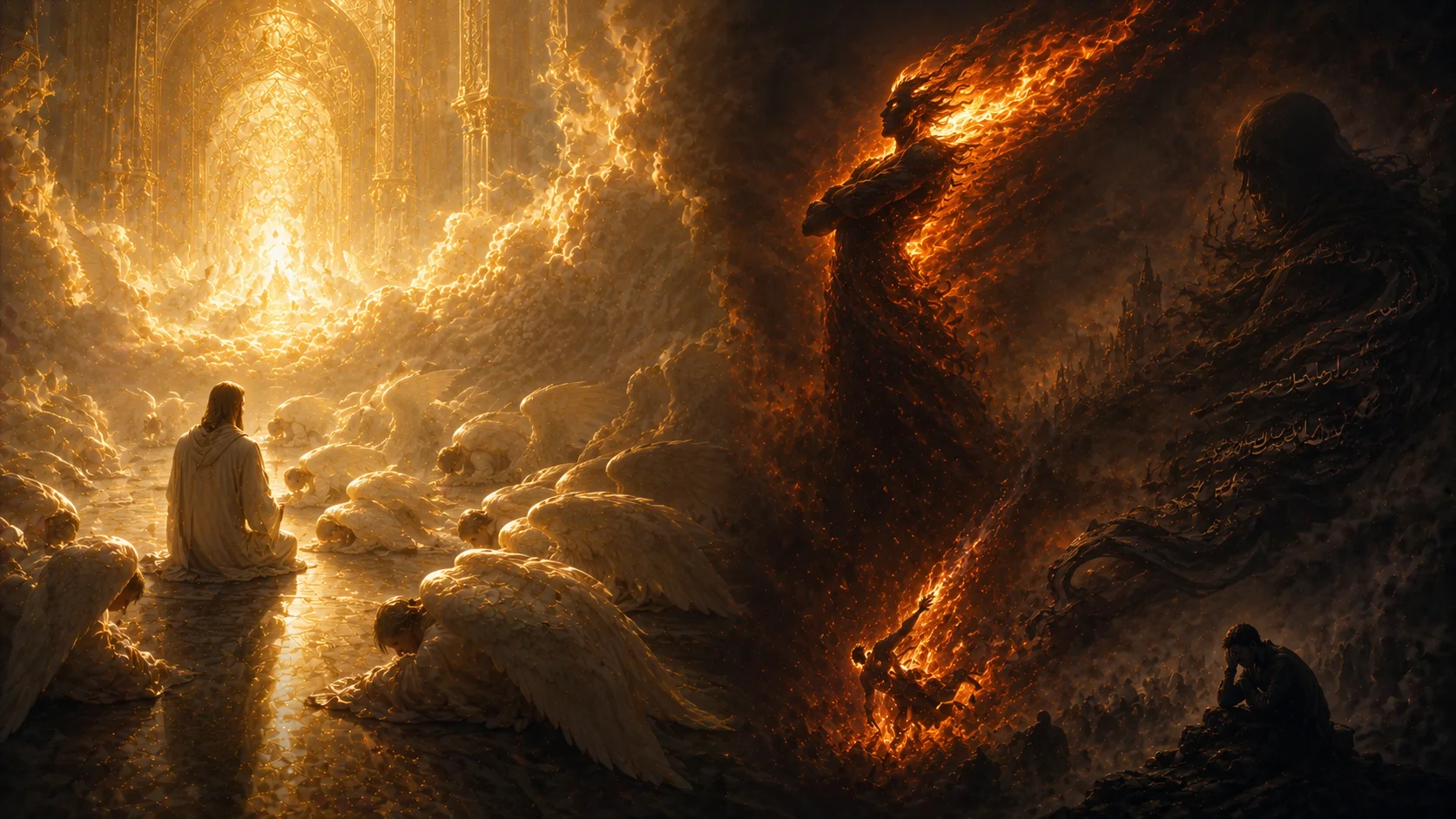
Iblis (Iblís) is the central figure of evil in Islamic tradition — the chief of the shayāṭin (the devils) and the great adversary of humankind. According to the Qur’an, when God created the first human, Adam, from clay and breathed His spirit into him, He commanded the angels to prostrate themselves before Adam in honour. All the angels bowed — but Iblis refused. Iblis (who is described as one of the jinn, beings created by God from smokeless fire, though he was in the company of the angels) was filled with pride and would not bow: he argued that he was better than Adam, for he was created from fire while Adam was made of mere clay, and so he would not humble himself before a creature he deemed lesser. This refusal — born of pride, arrogance, and disobedience — was his great sin and his fall.
The Curse and the Respite
For his refusal and his pride, God cursed Iblis and cast him out from the ranks of the honoured, condemning him and expelling him from grace. But Iblis, defiant, asked God for a respite — a reprieve until the Day of Resurrection — and God granted it (for reasons of His own wisdom and the testing of humankind). Iblis then vowed that, in the time granted him, he would devote himself to leading humankind astray: he would lie in wait for the descendants of Adam, tempt them, deceive them, and turn them from the straight path, to drag as many as he could down with him into ruin — sparing only the sincere servants of God, whom he could not sway. Thus Iblis became the great tempter, the whisperer of evil suggestions (waswas), the sworn enemy who works to corrupt and mislead humankind until the Last Day.
The Adversary and the Tempter
As al-Shayṭán (the Satan, the adversary), Iblis is the source and chief of temptation and evil suggestion, the leader of the devils, and the great deceiver who whispers in the hearts of people to lead them into sin, pride, despair, and disobedience. He tempted Adam and Eve in the Garden; he tempts every soul; and he will continue his work until the Judgment, when he and those he has led astray will face their doom. Iblis embodies the principle of pride, disobedience, and the refusal to submit to God — the very opposite of islam (submission) — and stands as the archetype of the rebel and the tempter. As the proud being who refused to bow, was cursed and cast out, and became the chief of the devils and the great tempter of humankind, Iblis is the central figure of evil in Islamic tradition. In Iblis, Islamic tradition gave form to the chief of the devils — the proud refuser who would not bow before Adam, was cursed and granted respite, and became the great adversary and tempter sworn to lead humankind astray, the Satan of Islam.
The Name, and the Argument About It
Scholars have never settled where the word Iblīs comes from, and the disagreement itself is revealing. One line of argument keeps it inside Arabic, rooting it in the verb ablasa — to despair, to be cut off utterly from hope — which would make the name a verdict rather than a label: the one from whom mercy has been withdrawn. A rival line treats it as a loanword that reached Arabic from the Greek diabolos (“slanderer”, the same word that gives English its devil), carried by Christian communities in the region before Islam. The grammarians left a clue that still weighs on the question: in the Qur’an the name is diptote — it never takes the nunation an ordinary Arabic noun would carry — and the usual explanation for that is that it is a foreign proper name. Whichever camp is right, the consequence is the same: Iblīs is a name, and it belongs to one individual.
Shayṭān is not. It is a common noun for a whole category of corrupting being, and the Qur’an is explicit that such adversaries are found among jinn and among men alike — any spirit, or any person, who whispers deception and turns others from the path can be called a shayṭān. English flattens the distinction by rendering both as “Satan”. Later Arabic literature gave Iblis a third form of address, the kunya Abū Murra, “father of bitterness” — a byname that treats him less as a monster than as a bitter, wounded elder, which is close to how much of the later tradition prefers to imagine him.
A Refusal Told Seven Times
The Qur’an never tells the fall as a single continuous narrative. It returns to the scene again and again — in Sūrat al-Baqarah, al-A‘rāf, al-Hijr, al-Isrā’, al-Kahf, Tā-Hā and Sād — and each retelling lifts a different fragment of the encounter into view. In al-Baqarah the refusal is left bare, an act with no argument attached to it. In al-A‘rāf and Sād, Iblis is made to plead his case aloud, weighing fire against clay as though rank were a question of raw material. In al-Isrā’ he asks for his reprieve and announces in the same breath what he means to do with it. The two great oaths sit in different suras and are easily confused: it is in al-A‘rāf that he promises to lie in wait on the straight path and to come at humankind “from before them and from behind them, and from their right and from their left” — read ever since as a map of every avenue temptation can use — while in Sād he swears by God’s own might that he will mislead them all, excepting only God’s chosen servants. The repetition is not redundancy. Each sura turns the confrontation toward a different theological point, and only read together do they give the fullest account the tradition has.
Angel or Jinn? A Dispute the Text Itself Provokes
The command to bow was addressed to the angels, and Iblis is swept up in it as though he stood among them — yet Sūrat al-Kahf states plainly that he was of the jinn, and departed from the command of his Lord. Generations of commentators have worked at the seam between those two statements. One early current, transmitted from Ibn ‘Abbās, held that Iblis was an angel after all, a member of an angelic company that bore the name al-jinn, so that the order bound him directly and his fall is a fall from the very top of creation. The other, associated above all with al-Ḥasan al-Baṣrī, held that he was a jinn of the fire-born race who had risen through devotion to live and worship among the angels, and who was caught by a command addressed to the ranks he happened to be standing in. The second camp had the stronger textual hand: the Qur’an describes angels as beings who do not disobey what God commands them, so a creature who disobeyed could not have been one. The dispute was never fully closed, and it decides what kind of story this is — a jinn who overreached his station, or an insider of the highest order who broke.
The Saint Who Would Not Bow
Not every reader took the refusal for simple villainy. Among the Sufis a startling counter-reading took shape, argued most famously by the mystic al-Ḥallāj, who was executed in Baghdad for his teaching: that Iblis refused to prostrate not out of arrogance but out of an uncompromising monotheism. He had sworn himself to God alone and would not bow to any created thing, even when God Himself commanded it, even knowing what the refusal would cost him. In al-Ḥallāj’s Kitāb al-Ṭawāsīn Iblis is given his own defence to speak, and the argument turns on a distinction the tradition takes seriously: he held to God’s eternal will while disobeying God’s spoken command, and was destroyed for choosing the first. Two centuries later Aḥmad al-Ghazālī went further and held Iblis up as a model of pure monotheism. This was a minority position when it was written and has stayed one, but it endures because it refuses to let Iblis be simple: damned, on this reading, not for loving God too little but for loving Him so exclusively that he could not obey Him.
Stoning the Devil
Islamic tradition does not leave Iblis behind after Adam. It holds that he came to Ibrāhīm (Abraham) at three points along the road to the sacrifice of his son and tried, each time, to talk him out of obedience — and that Ibrāhīm answered him not with argument but with stones. Pilgrims re-enact that refusal every year at Minā during the Hajj, in the rite called Ramy al-Jamārāt: on the day of the feast seven pebbles are cast at the largest of the three jamarāt, and on each of the days that follow, seven at each of the three in turn. For most of the rite’s history the targets were stone pillars; the crush of modern crowds has since turned them into long walls. It is one of the very few places in Islamic practice where Iblis is not merely spoken of but physically confronted — and the same gesture is folded into the language itself. The Qur’an instructs the believer to say, before reciting scripture, “I seek refuge in God from Satan, the accursed”; the word rendered “accursed” is al-rajīm, which means the pelted one, the one driven off with stones. The phrase is murmured before prayer, before meals, before sleep, across the Muslim world — a small daily echo of the same throwing arm.
Why the Story Persists
Most monsters frighten by their strangeness. Iblis frightens by his proximity. He is not an outsider who broke in but an insider who reasoned his way out — a being who stood close enough to God to be addressed directly, and who fell not through ignorance or weakness but through a syllogism he found unanswerable: I am better than he is. That is what has kept the story working for fourteen centuries. It is not finally about a demon at all, but about the particular danger of being right and knowing it, of holding just enough genuine merit to believe that deference is beneath you. Every retelling carries the same warning — that the worst fall is not the one taken in ignorance, but the one taken with open eyes.
Sources & traditions
- EncyclopediaWikipedia — Iblis
- TraditionIslamic texts, grimoires and later commentary
Myths change from area to area and from time to time. This chronicle follows the most widely told versions; tellings in other villages, regions and eras may differ.