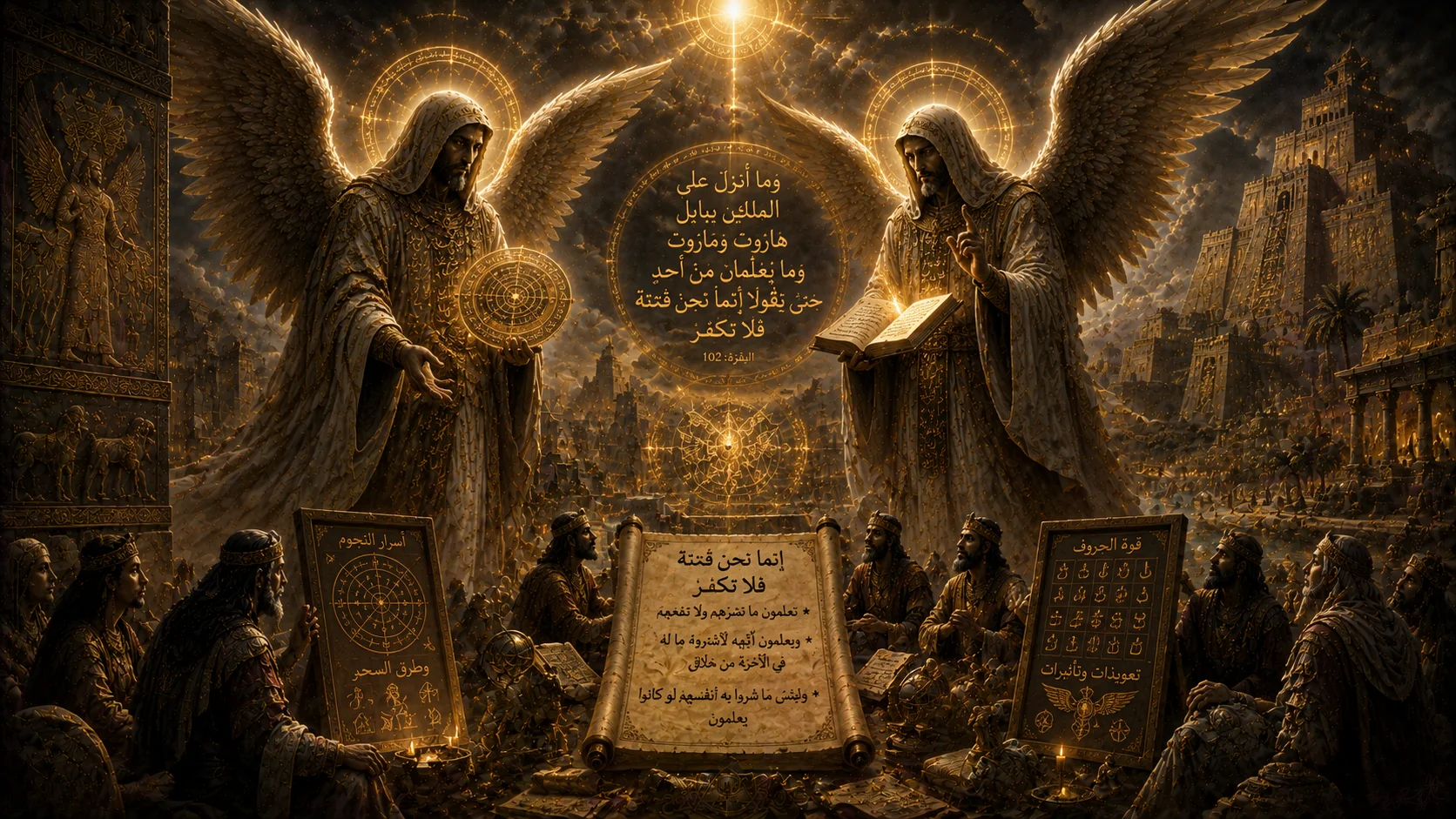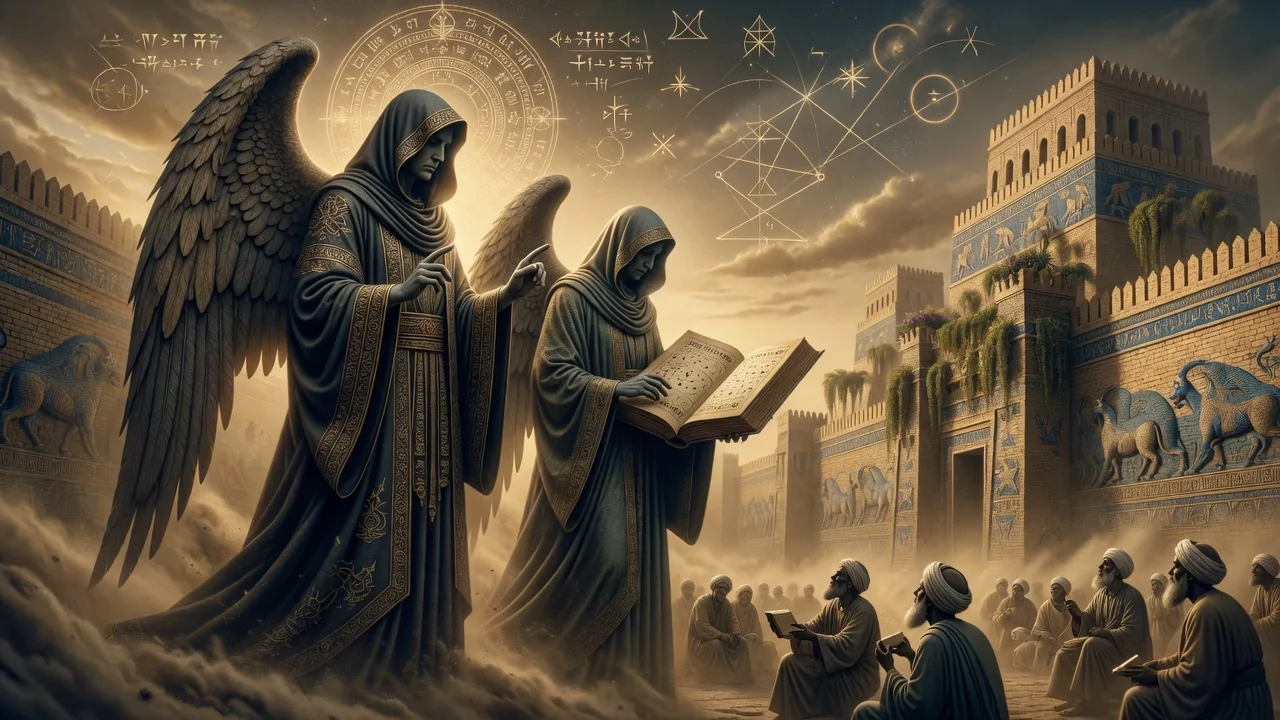
Marut, named always beside his companion Harut, is one of two figures — malakayn, "two angels," in the reading most classical exegetes have followed — described in the Qur'an as sent down to the city of Babylon (Bābil), where humankind learned from them the knowledge of sihr, magic or sorcery. The Qur'anic account, in surah al-Baqarah (2:102), is brief and exacting: through Harut and Marut people learned a magic capable of driving a wedge between a man and his wife, yet the two never taught anyone without first speaking a warning — "We are only a trial (fitnah); so do not disbelieve." Marut's presence in the tradition rests almost entirely on that single verse and the vast exegetical literature that grew up around it.
The Verse at Babylon
Everything that can be said of Marut with real confidence begins and ends in one place: Qur'an 2:102, where he and Harut appear together, unintroduced and undescribed beyond the bare fact of their sending-down to Babylon. The Arabic term used for the pair, malakayn, is a dual form that most classical commentators — al-Tabari and al-Qurtubi prominent among them — read as "two angels." A minority variant reading, malikayn, "two kings" or "two rulers," is also transmitted and noted in the tradition as a disputed qira'ah, an alternative recitation carrying an alternative sense. That disagreement is not a modern quibble; it runs through the exegetical record itself, and it means that calling Marut an angel, however standard in English usage, is already an interpretive choice rather than a settled fact of scripture.
Companion Without Separation
Marut is never once named alone. In every occurrence the two are bound together — Harut and Marut — sharing a single mission, a single warning, and a single place in the account of Babylon. This inseparability is itself part of what little the text discloses: the pair function almost as one figure in two persons, their names locked together in a single, fixed pairing found nowhere else in the Qur'an. Nothing in the text distinguishes one from the other in office, in speech, or in fate; whatever is said of Harut is, in the base text, said equally of Marut. Where later tradition does distinguish between them, it does so in material well outside the Qur'an itself, and should be weighed as such.
A Trial, Not a Temptation
The verse is explicit about the purpose behind the teaching: Harut and Marut taught sihr as fitnah, a trial or a testing, and they preceded every lesson with a caution against disbelief. This detail matters to how Marut is understood, because it forecloses reading the pair as tempters seeking to corrupt humankind. The teaching itself is presented as morally neutral — knowledge that could be turned toward harm or refused — while the warning that accompanied it placed responsibility for the outcome squarely on those who received it. Some among the people of Babylon disregarded the warning and pursued the magic that could sunder a husband from his wife, and in doing so brought loss upon themselves; the text is clear that such users gained a thing that would harm them and not benefit them, forfeiting any share in what is good in the life to come. Marut's role, in the verse's own terms, is instrumental to that test rather than authorial of the evil that followed it.
What the Qur'an Withholds
It is worth pausing on how little the sacred text actually gives. There is no description of Marut's form, no account of his creation, no report of words spoken to him individually, no statement of what became of him afterward. The entirety of his scriptural presence is contained in a single, terse Qur'anic notice about two figures teaching a dangerous knowledge under a spoken caveat. Everything more elaborate that circulates about Marut — a narrative shape, a personality, a fate — belongs to a different, later layer of the tradition, and the distance between that layer and the verse itself is the single most important fact to hold in mind when approaching him.
The Story That Grew Around Him
In the centuries after the Qur'an's revelation, a much fuller and more dramatic narrative attached itself to Harut and Marut: that the two angels descended to earth, were tempted by a woman — often named Zuhra in these accounts — succumbed to sin, and were punished by being suspended in a well at Babylon. Some later commentators and popular literature extend this same disputed strand further still, holding that the pair remain confined in that state until the Day of Judgment, there to stand as a lesson in the fallibility even of angelic beings. This story reached some early commentators, with reports of it transmitted and recorded by al-Tabari among others, and it is this version — vivid, moralized, complete with a fall and an unending punishment — that has done the most to shape popular imagination of who Marut is. But the story's own transmission history marks its limits: the well-suspension and its Day-of-Judgment extension are recognized within the Islamic scholarly tradition as material of isra'iliyyat origin, meaning it reached Muslim exegesis through Judeo-Christian folkloric channels rather than through the Qur'an or sound prophetic report, and later authorities, Ibn Kathir prominent among them, explicitly flagged the expanded tale as weak and unreliable. To repeat either detail as settled biography would misstate what the tradition itself says about its own reliability.
The Question of Angelic Sin
The tension between the popular fall-and-punishment story and orthodox theology is not incidental — it is precisely what drove some exegetes toward the alternative malikayn reading in the first place. Mainstream Islamic theology holds that angels are ma'sum, protected by God's will from sin; a narrative in which two angels are seduced, sin, and are punished sits uneasily against that doctrine. Rather than accept the contradiction, a number of scholars preferred to read the disputed term as "two kings" — human rulers of ancient Babylon rather than angelic beings — which would relocate the capacity for sin from an impossible subject (a sinning angel) to an entirely ordinary one (a sinning man). This is not a marginal footnote but a live point of classical exegetical disagreement, and it means the question "was Marut an angel who sinned, or a king who did not need to be one to sin" has never been closed within the tradition itself.
Babylon and Its Old Associations
The setting given in the verse, Babil, is not incidental scenery. Ancient Mesopotamia carried, in the cultural memory the Qur'an's first audience would have recognized, strong associations with astrology and divination — the very territory of forbidden or dangerous knowledge that the Harut-and-Marut episode addresses. Anchoring the pair's teaching specifically to Babylon ties the account to that older reputation, situating the trial of sihr in the place where such arts were, in the world the text speaks to, already most associated with the human reach for hidden power.
Silence in the Hadith
Outside the Qur'an, the sound hadith corpus — Bukhari and Muslim foremost among the collections regarded as most rigorously authenticated — contains no sahih narration describing Marut's biography, his appearance, or his ultimate fate. Nearly everything said about him beyond the single Qur'anic verse belongs to the tafsir layer, the vast body of exegetical commentary that ranges from careful grammatical and legal analysis to the transmission of older, looser folkloric material. That layer is enormously valuable as a record of how generations of scholars have read and argued over the verse, but it is not itself scripture, and its claims carry a correspondingly different weight. Presenting any of its more colorful content — including the well-suspension or its Day-of-Judgment extension — as established fact about Marut would misrepresent the tradition's own internal hierarchy of sources.
A Proof-Text Against Sorcery
Whatever remains uncertain about Marut's nature or fate, his story has served a clear and stable purpose within Islamic legal and ethical discussion. The verse describing Harut and Marut's teaching is cited repeatedly in fiqh treatments of sihr as scriptural evidence that the learning and practice of magic is prohibited. It is invoked alongside hadith material naming sihr among al-sab' al-mubiqat, the seven destructive sins attributed to the Prophet Muhammad, peace be upon him. In this role, Marut functions less as a subject of biography than as part of a scriptural argument: the pair's warning, and the ruin that befell those who ignored it, stand as textual proof that forbidden knowledge, however it is transmitted, remains forbidden in its use.
Neutral Knowledge, Human Choice
Read homiletically, the episode centers on a distinction that has outlasted every dispute over Marut's precise nature: that knowledge itself, including the knowledge of magic, is morally neutral, and that its lawful or unlawful use is a matter of human choice under trial. Marut and Harut taught; they warned; what was done with the teaching afterward belonged to the ones who received it. This framing gives the episode its enduring homiletic force independent of whether the reader takes malakayn as angels or as kings — the moral architecture of trial, warning, and consequence holds either way.
An Isolated Reference
Marut stands apart from the wider company of named angels in the Islamic tradition. He is linked in scripture to no one but Harut; the Qur'an draws no connection between the pair and archangels such as Jibril, Mika'il, or Israfil, nor does it place them within any angelic hierarchy or office beyond the single episode at Babylon. Where other angelic figures accumulate roles across multiple passages and extensive hadith description, Marut's presence remains confined to this one, isolated Qur'anic reference — a fact that itself shapes how cautiously any fuller portrait of him should be drawn.
How Marut Reached English Readers
The grammatical ambiguity of malakayn/malikayn has produced real divergence among translators, and that divergence is a large part of why Marut is popularly known in English-language treatments specifically as an angel. Influential renderings, including those of Yusuf Ali and Pickthall, translate the term as "the two angels," fixing the angelic identification in the form most English readers encounter first. Yet, as the classical disagreement over the reading shows, this is a translator's interpretive choice rather than a point of unanimous agreement within the tradition — a distinction worth holding onto even as the angelic name is the one that has traveled furthest.
Sources & traditions
- EncyclopediaWikipedia — Harut and Marut
- TraditionIslamic texts, grimoires and later commentary
Myths change from area to area and from time to time. This chronicle follows the most widely told versions; tellings in other villages, regions and eras may differ.