Hyrrokkin was a mighty Norse giantess of tremendous strength — the jötunn whom the gods summoned to launch Baldr's great funeral ship, when not even the gods themselves could move it. Riding a wolf and bridled with serpents, she pushed the enormous ship into the sea with a single shove so powerful it shook the whole world, in one of the most vivid scenes of the Baldr myth.
The Fire-Withered Giantess
Hyrrokkin (Old Norse Hyrrokkin, sometimes rendered Hyrrokin) carries a name that scholars commonly gloss as "fire-smoked" or "withered by fire" — a grim, striking epithet for a being whose one recorded deed has nothing to do with fire at all. No other title or honorific survives for her; the name itself is the only mark of distinction the sources leave behind. She is not a minor background figure padded out with genealogy or backstory. She appears in the tradition exactly once, in a single episode, and the silence surrounding everything else about her — her parentage, her dwelling, her kin — only sharpens the force of the one scene in which she does appear.
Last updated .
A Single Thread in One Book
Everything known of Hyrrokkin comes from one place: Snorri Sturluson's Prose Edda, in the section called Gylfaginning, chapter forty-nine, amid the telling of the death and funeral of the god Baldr. She does not appear in the older Poetic Edda, nor in any skaldic verse, nor in any other surviving witness to Norse myth. This makes her, in the strictest sense, a single-source figure — her existence and her deed are preserved by one author's hand alone, and nothing independently confirms or elaborates upon what he wrote. That should not diminish the vividness of the scene; it should simply be held in mind as the honest shape of what is actually known, rather than treated as one thread among many.
Grief at the Shore
The occasion for her appearance was sorrow. Baldr, brightest and most beloved of the Æsir, was dead, and the gods gathered to give him the funeral his stature demanded. He was to be sent to the sea in flame, laid upon his own ship, Hringhorni, the largest of all ships ever built, and burned as it was pushed out upon the water. It was meant to be a rite of overwhelming solemnity — the greatest of gods given the grandest of departures, upon the grandest of vessels. But grandeur has its own cost. A ship built to be the largest in existence is not an easy thing to move, and the gods, gathered in their grief, discovered that not even their combined strength was equal to the task before them.
A Ship the Gods Could Not Move
Hringhorni would not budge. The Æsir set their shoulders and their strength to it and the ship stayed fast upon the rollers, immovable, while the funeral it was meant to carry out to sea sat waiting on the shore. It is a striking detail precisely because of who is failing: this is not a company of ordinary men straining at a stubborn hull, but the gods themselves, and still the ship would not answer them. The story does not soften that failure or explain it away. It simply states it, and lets the gap it opens stand — a task too great for divine strength, requiring something the Æsir did not themselves possess.
The Summons to the Giants
Rather than continue struggling, the gods sent word into the land of the giants for aid, and the one who answered was Hyrrokkin. This detail matters more than it might first appear. In the surviving body of Norse myth, giants overwhelmingly appear as adversaries, threats to be watched, tricked, or fought — the natural enemies of the ordered world the Æsir maintain. Hyrrokkin's episode is one of the rare exceptions: she is invited. The gods need something only a jötunn's strength can provide, and they turn to the giant world for it, however briefly and however uneasily. She comes not as a raider or a challenger but as a specialist called in for exactly the task her strength suits her to.
Riding In on Wolf and Serpent
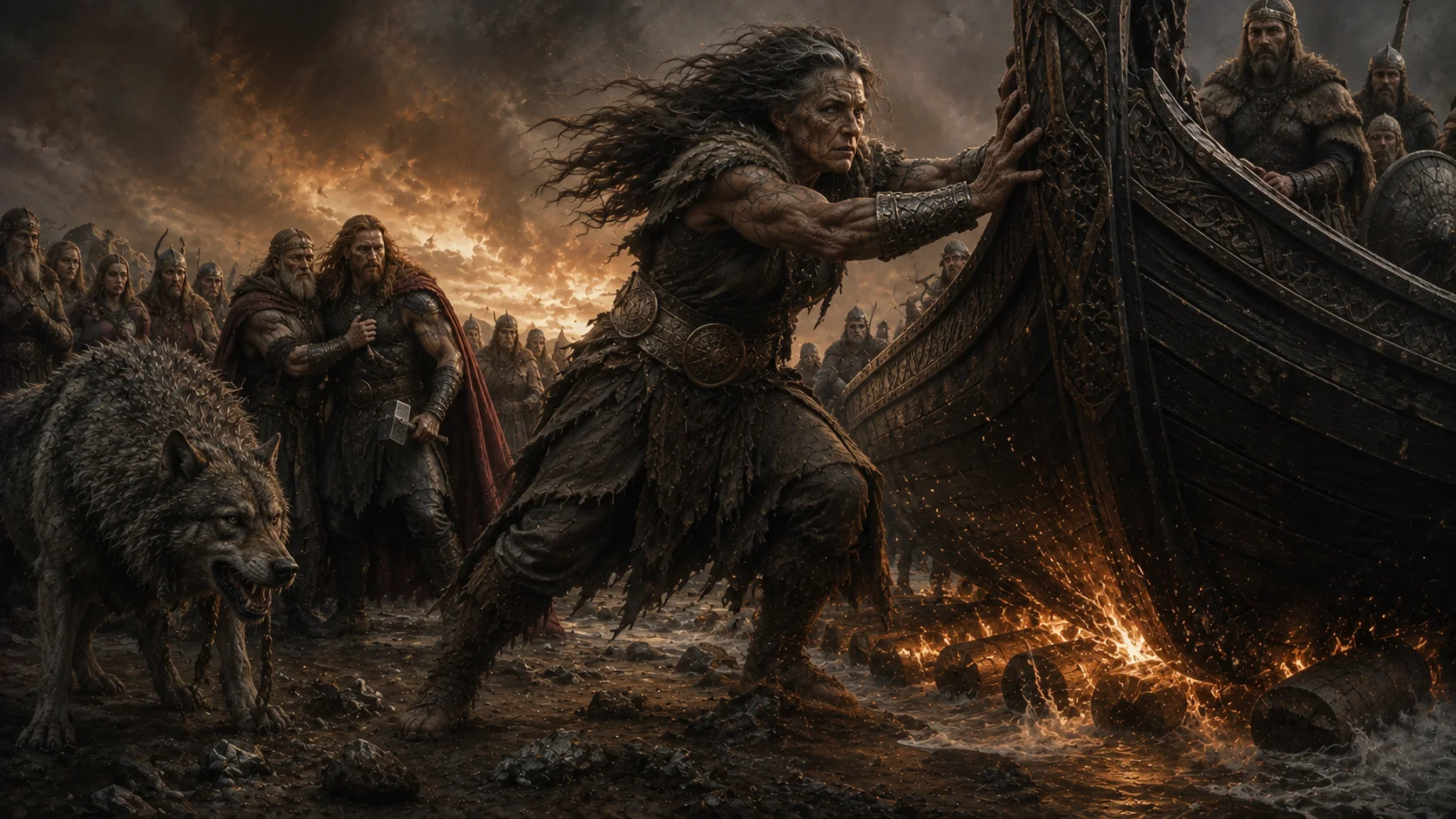
She did not arrive quietly. Hyrrokkin came riding a wolf — a beast large enough and fierce enough to serve a giantess as a mount — and in place of ordinary reins she held vipers, guiding the animal with living serpents in her hands. It is one of the most arresting images to survive from the whole cycle of the Baldr myth: a giantess descending on the funeral gathering astride a wolf bridled with snakes, self-possessed amid a scene the gods themselves are struggling to manage. The wolf-and-serpent mount recurs elsewhere in giant-lore as an image associated with giantesses in Norse tradition, and some who study the poems have drawn a line from this scene toward another wolf-riding giantess glimpsed in Völuspá in connection with the approach of Hel at the end of the world — though that later figure is never named as Hyrrokkin in the text itself, and the connection remains an interpretive suggestion rather than something the sources state outright.
Four Berserkers Against One Wolf
Even dismounting proved to be an ordeal. Hyrrokkin's wolf was too wild and too strong to simply be left standing while its rider walked away — it took four berserkers, warriors chosen precisely for their own ferocity and strength, to hold the animal in place, and even the four of them together could not manage it until they threw the wolf down to the ground and pinned it there. The detail is not decoration. It establishes, before Hyrrokkin has so much as touched the ship, the sheer scale of power she commands and controls: her mount alone requires four of the fiercest fighters among men to subdue, and it is still only tamed, not calmed.
The Shove That Shook the Earth
With her wolf finally held, Hyrrokkin went to the prow of Hringhorni and set herself to the ship. Where the assembled might of the Æsir had failed entirely, she needed only a single push. The ship shot forward on its rollers with such tremendous force that fire flew up from the wood beneath it, struck loose by the friction of the launch, and the shock of the motion was said to shake all the lands round about. One shove, from one giantess, accomplished in an instant what the gathered gods could not achieve at all. It stands as one of the purest demonstrations in the whole mythology of the raw physical power giants are said to hold — strength not merely equal to but plainly exceeding that of the divine.
Thor's Hammer Half-Raised
The feat did not sit well with everyone watching. Thor, whose whole role among the gods rests on being their strength and their defender, saw a giantess succeed where the Æsir had failed, and his response was fury rather than gratitude. He reached for Mjölnir and would have struck her down where she stood, and only the intervention of the other gods — who stepped in and restrained him, asking that she be spared — kept the hammer from falling. It is a small, sharp moment of tension folded into a funeral: the very strength that solved the gods' problem is the thing that nearly gets its bearer killed by the god most threatened by being outmatched. Hyrrokkin herself is not recorded as flinching from it or answering it; the text moves past the moment as quickly as it arrives, leaving the confrontation itself, rather than any resolution to it, as what lingers.
A Figure Without a History
What is just as notable about Hyrrokkin is everything the sources decline to say. No parents are named for her, no spouse, no children, no home among the giants, no other deeds before or after this one. She does not reappear elsewhere in the mythology, is not woven into any genealogy of jötnar, and carries no attested role beyond this single act of strength at a single funeral. She exists, as far as the surviving record goes, only in the moment she is needed and only for as long as that moment lasts. That absence of context is itself worth sitting with rather than filling in — she is defined entirely by one feat of strength and the anger it provoked, nothing more and nothing less.
Strength the Gods Themselves Lacked
Read against the wider pattern of Norse myth, Hyrrokkin's episode fits a theme that recurs across the surviving stories: the giants, for all that they are cast as adversaries, are consistently credited with physical power that can rival or outstrip the gods'. The Æsir maintain order and preside over the cosmos, but they are not always its strongest inhabitants, and more than once the myths quietly admit as much. Hyrrokkin's single shove of Hringhorni is among the clearest instances of that admission in the entire tradition — not a battle, not a trick, but a plain demonstration of strength that the assembled gods simply could not match, performed by someone they had to ask for help.
The Image That Outlasted the Episode
Hyrrokkin has found a long afterlife well beyond the single chapter that first records her, turning up in modern fantasy and games as a recognisable figure — almost always shown riding a wolf with serpents for reins, faithfully following the one detail the source material actually gives. There is no evidence of any medieval cult, shrine, or independent tradition built around her beyond that one passage in Snorri's telling; her modern presence is a revival of a single striking image rather than the continuation of any older, wider veneration. What endures is the picture itself: a giantess summoned in grief, arriving on a wolf bridled with snakes, who did with one shove what all the gods together could not, and nearly paid for it under Thor's raised hammer.
When all the gods together could not move Baldr's funeral ship, they sent for a giantess on a wolf bridled with serpents — and she launched it with one shove that set the rollers afire and shook the whole world.