Hoenir was a mysterious and ancient god counted among the Æsir — one of the three who found two lifeless logs upon the shore and made from them the first man and woman, a deity handed over to the Vanir as a hostage whose strange silence in council led to wise Mimir's beheading, and, in the world after the world's ending, a survivor who takes up the reading of the sacred lots. Tall and strikingly handsome in one account, wordless and indecisive in another, a giver of reason at the dawn of humankind and a diviner in the age still to come, Hoenir remains among the most enigmatic of the Æsir — a god the sources themselves cannot agree on.
A Log Upon the Shore
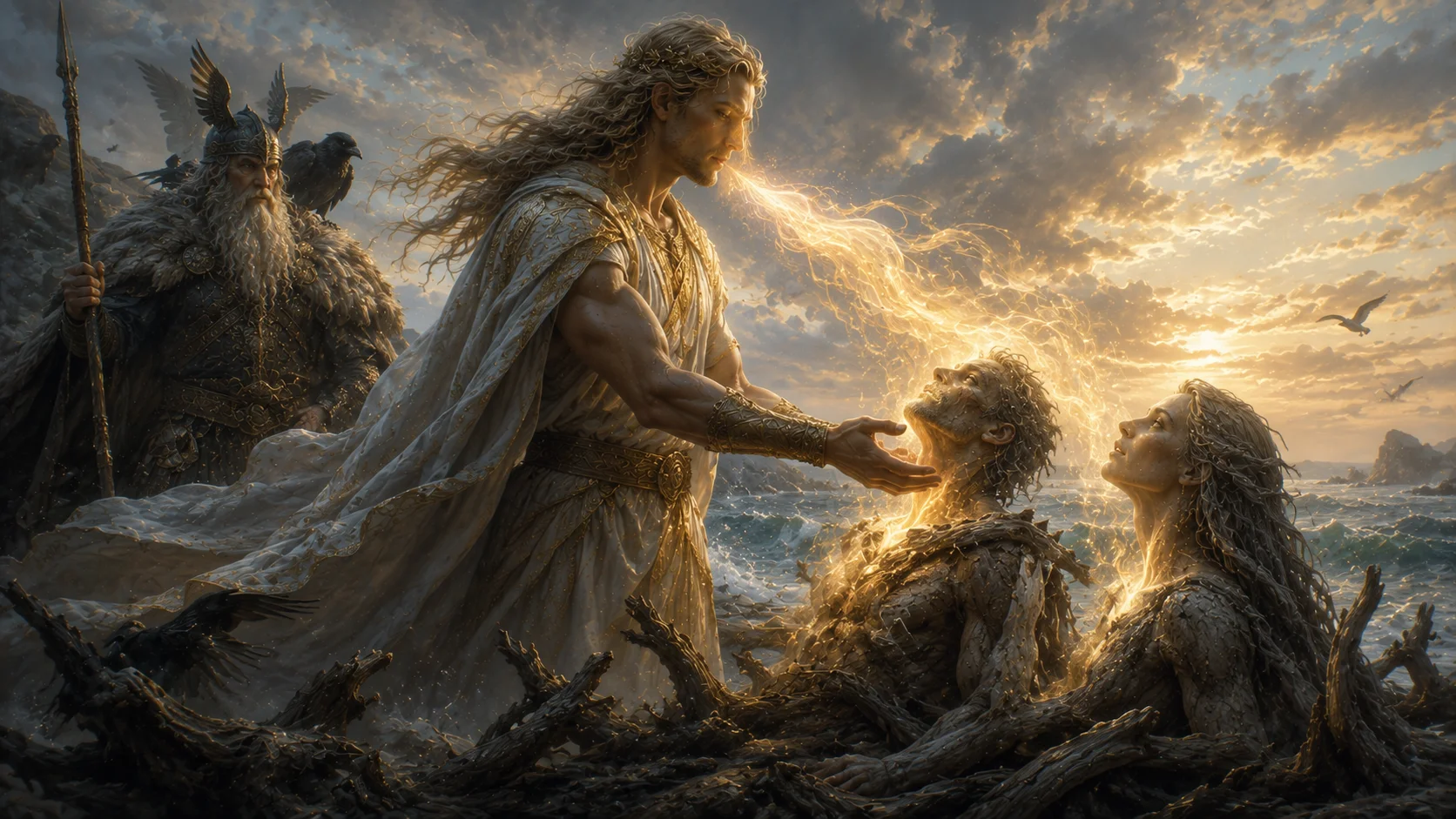
Before Hoenir is anything else in the myths, he is present at the very beginning of human life. The Völuspá of the Poetic Edda, echoed in the Gylfaginning of the Prose Edda, tells that three gods walked the world together and came upon two trees, or driftwood logs, lying on the seashore — without breath, without fate, without the colour of the living. These were Ask and Embla, ash and elm, the first man and the first woman, but they were nothing yet: only shapes waiting for gifts. The three who found them were Odin, Hoenir, and a third figure named Lodur in this telling (in others, Vili and Vé). Each god gave something of himself. Odin breathed önd into the logs — breath, the animating life-force itself. Lodur gave lá and litír góða, blood and warmth and good colour, the flush of the living body. And Hoenir gave óðr.
The Gift of Óðr
Óðr is not an easy word to carry into another tongue. It is usually rendered as reason, or spirit, or the faculty of sense and inspiration — the capacity of a mind to perceive, to feel keenly, to be moved. Where Odin's gift set the log breathing and Lodur's gift set its blood moving warm beneath fair skin, Hoenir's gift was the thing that made a body into someone — the interior world of thought and feeling, the sense by which a person understands and is moved. In this single act, at the very root of the mythology, Hoenir stands as co-author of human consciousness itself, an honour shared with no other figure but Odin and Lodur.
A Companion Named Beside Kings
Hoenir does not walk alone often in the surviving texts, but when he does, his company says something about his standing. He is present, alongside Odin and Loki, in the prose passage that opens the Reginsmál of the Poetic Edda's heroic cycle — the three gods travelling together when they come upon and kill the otter Otr, an act that sets in motion the taking of Andvari's cursed gold, the very treasure whose doom will fall across generations of the Völsung line. Hoenir is not the actor whose choices drive that story forward; the ransom, the curse, and the killing belong to Loki's cunning and Odin's presence. But his place in that company — one of three named gods walking the roads of the world alongside Odin himself — marks him as no minor figure, but one trusted to stand beside the highest of the Æsir on their journeys.
Tall, Fair, and Fit to Rule
After the long and grinding war between the Æsir and the Vanir, the two divine peoples made peace in the old way: by trading hostages, each side keeping something precious of the other's as surety. The Ynglinga saga tells that the Æsir sent Njord and his son Freyr to dwell among the Vanir, and in exchange received Vanir hostages of their own. But the Æsir also sent two of their own number outward: Hoenir, and beside him the being of deep wisdom named Mimir. Hoenir, the saga says plainly, was tall and exceedingly handsome to look upon, and when the Vanir first received him they judged him, on his appearance and bearing alone, fit to be made a chieftain among them. It is a rare thing in the myths for a god's physical presence to be dwelt on so directly — and it makes what follows sharper by contrast.
The Silence That Undid Him
The Vanir set Hoenir up as a leader, trusting the promise of his stature. And for a time, so long as Mimir stood at his side, that trust seemed well placed — for Hoenir would turn to Mimir's counsel and speak with the authority of the wisdom Mimir gave him. But the saga is exact about the flaw beneath the surface: whenever Hoenir was called upon to render judgement at the assembly without Mimir beside him, he could offer nothing of his own. He would say only, let others decide, and give no verdict, no ruling, no word of his own mind. A chieftain who cannot judge is no chieftain at all, and the Vanir began to see that the tall, handsome figure they had been given was, without his companion, an empty seat of authority — magnificent to look at and silent when it mattered.
The Price Paid in Mimir's Head
The Vanir's realisation did not stay a quiet disappointment. They came to believe that the Æsir had cheated them in the exchange — keeping for themselves, in the person of Mimir, the true wisdom that made Hoenir's judgements possible, while fobbing off on the Vanir a magnificent figurehead who could not decide a single matter alone. Their anger fell not on Hoenir but on Mimir: they seized him and struck off his head, sending it back across to the Æsir as a grim answer to what they judged a broken bargain. It is one of the starkest consequences in the whole mythology of a single character trait — a god's inability to speak for himself, indirectly, cost another being his life. Odin would later take up that severed head and preserve it as an oracle of its own, but the death itself traces straight back to Hoenir's silence in the Vanir's halls.
A Character the Sources Cannot Agree On
Scholars, Rudolf Simek prominent among them, have long treated Hoenir's inconsistency as a genuine puzzle rather than a solved question. The god who cannot answer a single question without Mimir beside him in the Vanir episode is difficult to reconcile with the god who, after the world's ending, will take up the tools of prophecy and read the future in the fall of the lots. Wisdom and indecision; authority and emptiness; a diviner's future and a figurehead's past — the surviving texts simply hold both, without explaining how one god carries both natures. Some who study the material argue that Hoenir preserves a fragment of an older, more primordial divine triad standing alongside Odin — a figure whose original nature predates the version of him caught in the Vanir hostage-tale, and whose contradictions are the seams where two different traditions about him were stitched together rather than reconciled.
Long-Leg, the Swift One
Skaldic diction preserves epithets for Hoenir that point toward another side of him again: he appears under kennings tied to swiftness, called something like the swift god in the poetic vocabulary of the skalds. A separate interpretive tradition, drawing on his association with the Reginsmál episode, has given him the name long-leg, though this reading is debated among those who study the poems rather than settled fact. Whether these names point to some lost story of a footrace, a flight, or simply a formula for a long-striding god who walked the roads with Odin, the sources do not say. They stand instead as another fragment in a figure built almost entirely from fragments — a name here, a kenning there, no single connected tale.
No House, No Heirs
Unlike many of the Æsir, whose genealogies knot together across the mythology — sons, daughters, wives, foster-kin — no source attributes a wife or offspring to Hoenir. He passes through the myths as a figure without a household of his own: present at the founding of humankind, present at Otr's death, present as a hostage among the Vanir, present again at the world's renewal, but never rooted to a family the way Thor or Freyr are. It leaves him oddly solitary among the major Æsir, a god defined entirely by the roles he plays in others' stories rather than by kin who might have carried his own story forward.
What Endures After the End of All Things
The final word the sources give on Hoenir belongs to prophecy, and it is, remarkably, a hopeful one. The Völuspá's vision of what comes after Ragnarök — after the wolf has swallowed the sun, after the gods and their great enemies have fallen together, after fire has taken the nine worlds — names a handful of survivors who will walk the green, renewed earth. Hoenir is among them. And in that reborn world, the poem says, he will take up hlautviðr, the lot-wood used for casting and reading omens, and practise the arts of divination once again. The god who could not render judgement without Mimir beside him becomes, in the world after the world, a reader of fates in his own right — whether that marks a genuine transformation, wisdom finally settled into him at last, or simply the poem's refusal to resolve what it never explained, the text does not say.
A Figure Assembled From Fragments
Modern retellings have never made much of Hoenir on his own; he has no independent adventure of the kind that gave Thor or Loki their later popular lives, and he survives mostly in scholarly discussion and in the retellings of the two myths that define him — the shaping of the first humans and the hostage exchange with the Vanir. That relative obscurity suits him. Hoenir is not a god who was ever given one finished story. He is a name that recurs at hinge-points of the mythology — present when humanity first draws breath, present when peace is bought between two divine peoples at a terrible price, present at the world's ending and present again after it — without ever quite becoming the hero of any of those moments himself. Tall and handsome, wise only with help, silent when it cost the most, and finally a diviner in a world remade: the pieces do not resolve into a single portrait, and perhaps that unresolved quality is the truest thing that can be said of him.
He gave the first humans the very reason by which they think and feel, yet could not find a word of his own to speak in the halls of the Vanir — and when the fires of Ragnarök have burned out, it is Hoenir who takes up the lots again, reading a future he once could not decide.
Sources & traditions
- EncyclopediaWikipedia — Hœnir
- TraditionNorse texts, inscriptions and later retellings (Scandinavia)
Myths change from area to area and from time to time. This chronicle follows the most widely told versions; tellings in other villages, regions and eras may differ.