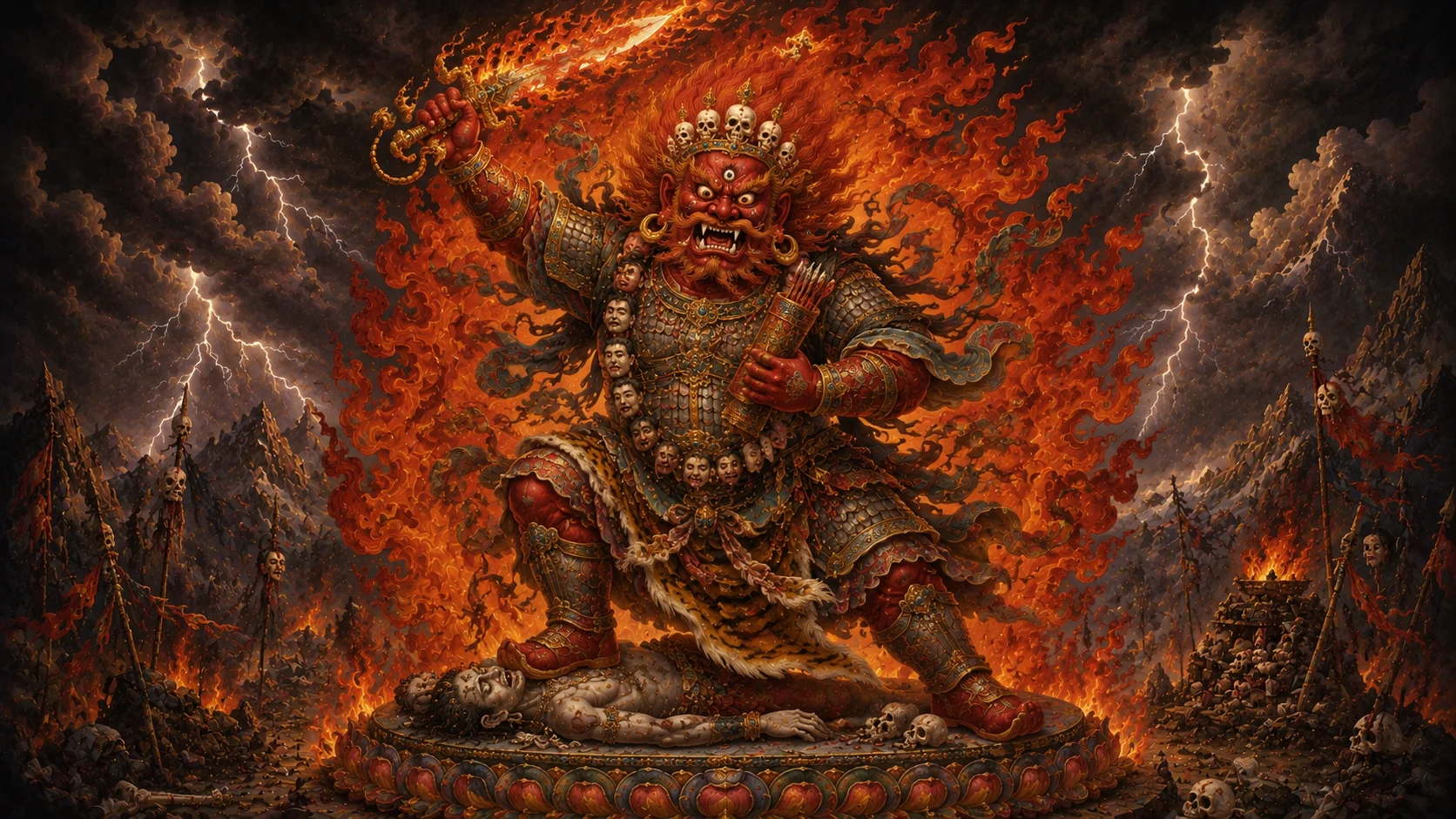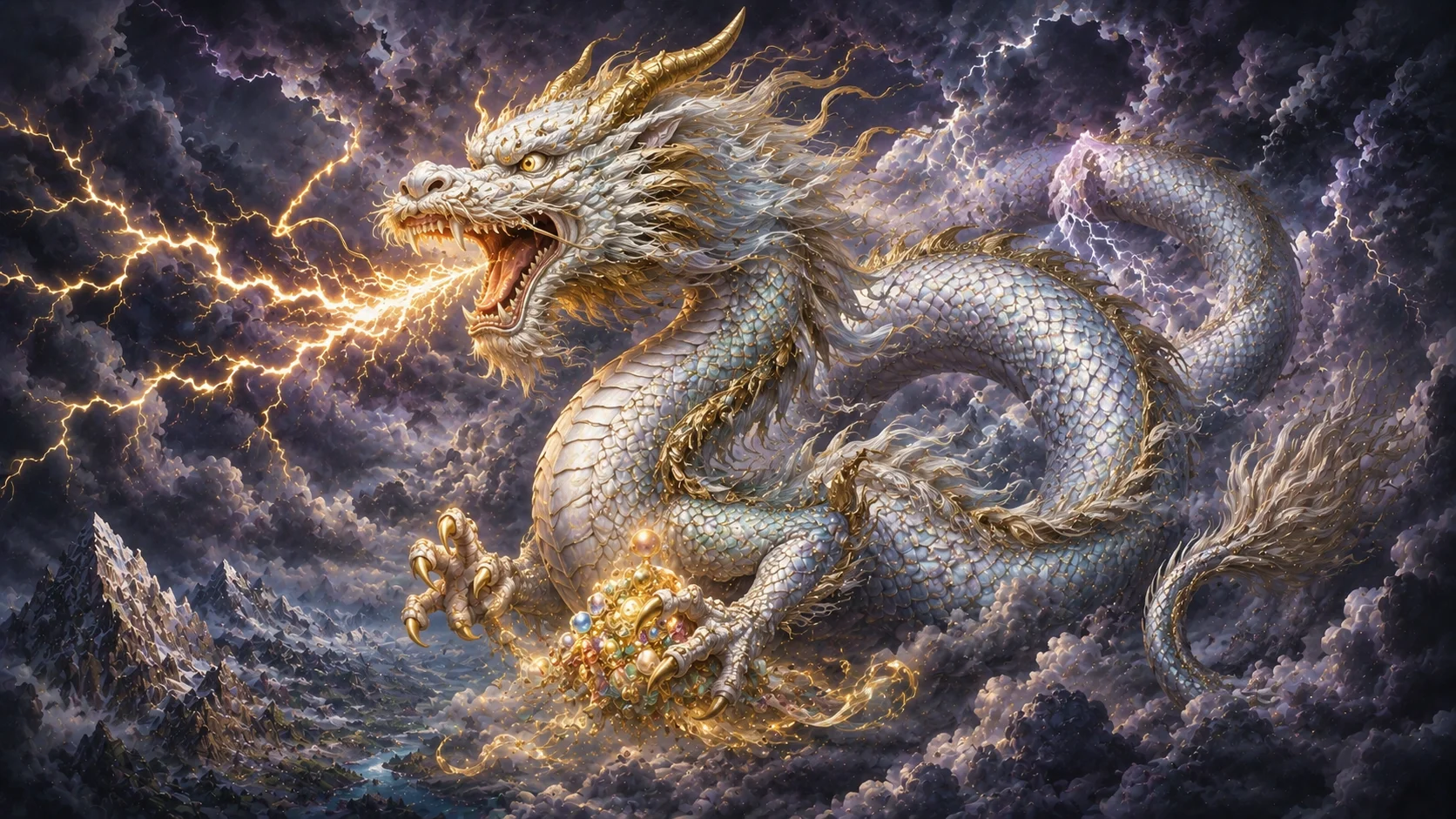
The Druk, the Thunder Dragon, is the great dragon of Tibetan and especially Bhutanese tradition: the roaring dragon of the storm whose thunder is its voice, the national symbol and very namesake of Bhutan, Druk Yul, the Land of the Thunder Dragon, and the emblem of a great school of Tibetan Buddhism.
The Voice That Rolls Through the Valleys
In the Tibetan language, druk ('brug) means simply "dragon," or, more precisely, "thunder dragon" — a being whose very movement across the sky is traditionally said to produce the thunder that rolls through the high Himalayan valleys. Where other traditions imagine thunder as a weapon's report or a god's footstep, Tibetan folk cosmology hears it as a voice: the great sky-dwelling dragon calling out as it moves unseen above the clouds. When storms gather over the peaks and thunder cracks and echoes from ridge to ridge, it is understood, in this telling, as the druk making itself heard.
A Being Among the Unseen Classes
The druk does not stand alone in Tibetan Buddhist cosmology but belongs to one of several classes of powerful non-human beings recognized alongside it — the nagas or lu, the nyen, and other local spirits of mountain, lake, and sky. These classes are older than Buddhism's arrival in Tibet, rooted in indigenous belief systems shaped by the Bon tradition, and as Buddhism spread across the plateau it did not erase them but absorbed them, giving each class a place within a larger Buddhist cosmological hierarchy. The druk's presence in Tibetan religious life today is best understood through this lens of incorporation: a being acknowledged, respected, and folded into a framework it did not originate from.
Kin to the Naga, Yet Its Own Nature
In popular usage, the druk is often spoken of in the same breath as the naga — called lu in Tibetan — and the overlap between them is real and longstanding. Both are associated with weather and water, both are beings whose displeasure can unsettle the world above and below. Yet Tibetan folk cosmology distinguishes them with some care: the naga, or lu, is more properly a serpent-like spirit of water, dwelling in lakes, springs, and rivers, while the druk is specifically the dragon of thunder and sky, its domain the storm rather than the still water beneath it. They are related categories, close cousins in the taxonomy of unseen beings, but they are not simply the same figure under two names.
Nine Dragons Over Ralung
The druk's most enduring legacy in Tibetan Buddhism is not as an object of worship but as a namesake. The Drukpa Kagyu — literally the "Dragon lineage" — is one of the major schools of Tibetan Vajrayana Buddhism, and its name comes directly from the druk. Tradition holds that when Tsangpa Gyare, who lived from 1161 to 1211, established the monastery of Ralung, nine dragons roared and flew into the sky at the moment of its consecration. This thunderous omen, so the lineage's own telling goes, was taken as a sign of great auspiciousness, and the school that grew from that monastery came to be called Drukpa — the Dragon-ians, the followers of the dragon. It is worth holding this story for what it is: a founding narrative carried within the lineage itself, a tradition of memory and meaning rather than an event independently verified outside it. Its truth, for those who carry it, lies less in documentary proof than in what it says about the moment a teaching took root.
A Roar Distinct From Its Neighbors
The identification of thunder with a dragon's roar is not unique to Tibet — neighboring Sinitic tradition carries its own long dragon (long), likewise bound to storm and sky. But Tibetan Buddhist tradition treats the druk as its own conception, indigenous to the Himalayan world rather than a borrowing from Chinese dragon lore. The resemblance is a parallel worth noting, not a lineage of transmission — two peoples, looking up at the same kind of storm, arriving at kindred but separately rooted ways of naming what they heard in it.
The Dragon on the Flag
Because of the Drukpa Kagyu's adoption of the dragon as its symbol, the druk became, in time, the central emblem of Bhutan itself. It appears on the national flag of Bhutan as a stylized thunder dragon, grasping jewels in its claws — jewels that symbolize wealth, a visual language of prosperity carried by the dragon rather than merely accompanying it. This is no small or decorative gesture: it is a state-level adoption of a Buddhist lineage's own dragon motif, carried upward from monastery banner to national emblem, so that the school's namesake became, over centuries, the namesake of a country.
Land of the Thunder Dragon
Bhutan's Tibetan and Dzongkha endonym is Druk Yul — the Land of the Thunder Dragon — and its people are called Drukpa in turn, the people of the dragon. This naming is cultural and national rather than theological: Bhutan is not claiming the druk as a distinct deity separate from the general concept found across Tibetan Buddhist tradition, but rather taking up the dragon, through the Drukpa Kagyu's long presence in the country, as the emblem of its own identity. The thunder that rolls over the Bhutanese Himalaya is, in this understanding, the same voice heard wherever Tibetan Buddhist communities have looked to the druk — but it is Bhutan that made the dragon its own name. Beyond the flag itself, the dragon's reach into modern Bhutanese identity has extended well past religious usage. It appears in the imagery of the ngultrum, the national currency, and across government emblems — a development that belongs chiefly to the nineteenth and twentieth centuries onward, distinct from the dragon's earlier, purely religious and lineage-bound meaning. The druk today lives simultaneously as a sacred symbol within the Drukpa Kagyu and as a secular marker of nationhood, two meanings layered over the same ancient figure rather than competing with one another.
Woven Into Temple and Thread
Within Tibetan Buddhist iconography and ritual art, the druk appears decoratively across a wide range of sacred contexts — carved and painted along temple architecture, worked into the imagery of thangkas, shaped into ritual implements, and stitched into the patterns of monastic robes. In each of these settings the dragon serves as an auspicious and protective presence, a marker of blessing and guardianship rather than a figure that receives worship in its own right. Its role is closer to that of a sanctified emblem than a devotional focus — present everywhere, called upon nowhere by name in the manner of a deity addressed directly.
Among the Symbolic Company
The druk rarely appears alone in Tibetan Buddhist and folk-religious decorative schemes. It is frequently paired with other auspicious symbolic beings — the snow lion, the tiger, and the garuda among them — in groupings sometimes referred to as the four dignities, representing qualities such as power and fearlessness. It should be said plainly that the precise membership of these symbolic-animal sets, and the exact meanings assigned to each figure within them, varies by region and by sectarian tradition. There is no single fixed doctrine governing which beings belong together or what each one signifies in every context; what can be said with confidence is that the druk's place among this company reflects its standing as a being of power and majesty, honored alongside other creatures who carry similar weight.
A Symbol Without a Sadhana
It is worth marking clearly what the druk is not, so as not to overstate its religious role. Unlike the wrathful protector deities, the Dharmapalas, who carry individual names, their own biographies, and dedicated tantric liturgies composed for their veneration, the druk as a class is not generally the subject of a distinct visualization practice or sadhana within mainstream Tibetan Buddhist ritual literature. Its religious significance runs chiefly through symbol and lineage — above all through its identity as the emblem of the Drukpa Kagyu — rather than through direct devotional cult or personal practice addressed to the dragon itself. This distinction matters: the druk is honored and invoked as a sign, not petitioned as a deity with its own liturgical calendar.
Roots Older Than the Monasteries
Beneath its Buddhist framing, the druk concept draws on pre-Buddhist Tibetan folk belief in sky and weather spirits, beliefs that predate the arrival of Buddhism on the plateau and were, like other originally Bon-influenced spirit classes, gradually folded into the Buddhist cosmological hierarchy — set alongside the lha, the lu, the nyen, and other categories of gods and spirits acknowledged within the tradition even as they remain subordinate to the Buddhist path itself. It should be said honestly that the finer details of this earlier, pre-Buddhist druk belief are not well documented in any surviving text; what can be reconstructed comes largely through inference from later syncretic layers rather than from a clear, continuous written record. The dragon's oldest history is, in this sense, partly a matter of careful scholarly reconstruction rather than settled fact.
Storms Over the Mountain Lakes
Alongside its place in formal Buddhist cosmology, the druk persists in regional and local folk tradition as a being said to live in the sky or in high mountain lakes, causing storms when disturbed or angered — a function closely paralleling the weather-controlling beliefs attached to nagas and lu tied to particular bodies of water. These are oral folk beliefs, varying considerably from region to region across the Tibetan and Bhutanese world, and they are not part of any single standardized canonical account. They are best understood and presented as living regional folklore, carried by communities near particular lakes and peaks, rather than as uniform doctrine taught across the tradition as a whole. That variation is not a flaw in the tradition — it is the ordinary shape of oral belief, shifting to fit the particular mountain, the particular lake, the particular community that tells it.
The Dragon That Named a Kingdom
In the druk, Tibetan and Bhutanese tradition gave form to the thunder of the Himalayan storms and to the spiritual identity of a people at once — the great thunder dragon whose roar is the thunder itself, who clutches the jewels of prosperity in the imagery of a nation's flag, the namesake and emblem of the Land of the Thunder Dragon, and the dragon of the Drukpa lineage whose nine roars over Ralung are still carried, generation after generation, as the sign under which a school of the dharma took its name.
Sources & traditions
- EncyclopediaWikipedia — Druk
- TraditionTibetan Buddhist texts, oral tradition and village tellings (Bhutan)
Myths change from area to area and from time to time. This chronicle follows the most widely told versions; tellings in other villages, regions and eras may differ.