Zephyrus was the god of the west wind — the gentlest of the four Anemoi, the soft breeze of spring that melted the winter and called the flowers into bloom. Yet beneath his mildness ran a streak of jealousy that turned, in one famous tale, to tragedy: the gentle wind was also the wind that killed a beloved youth.
The West Wind of Spring
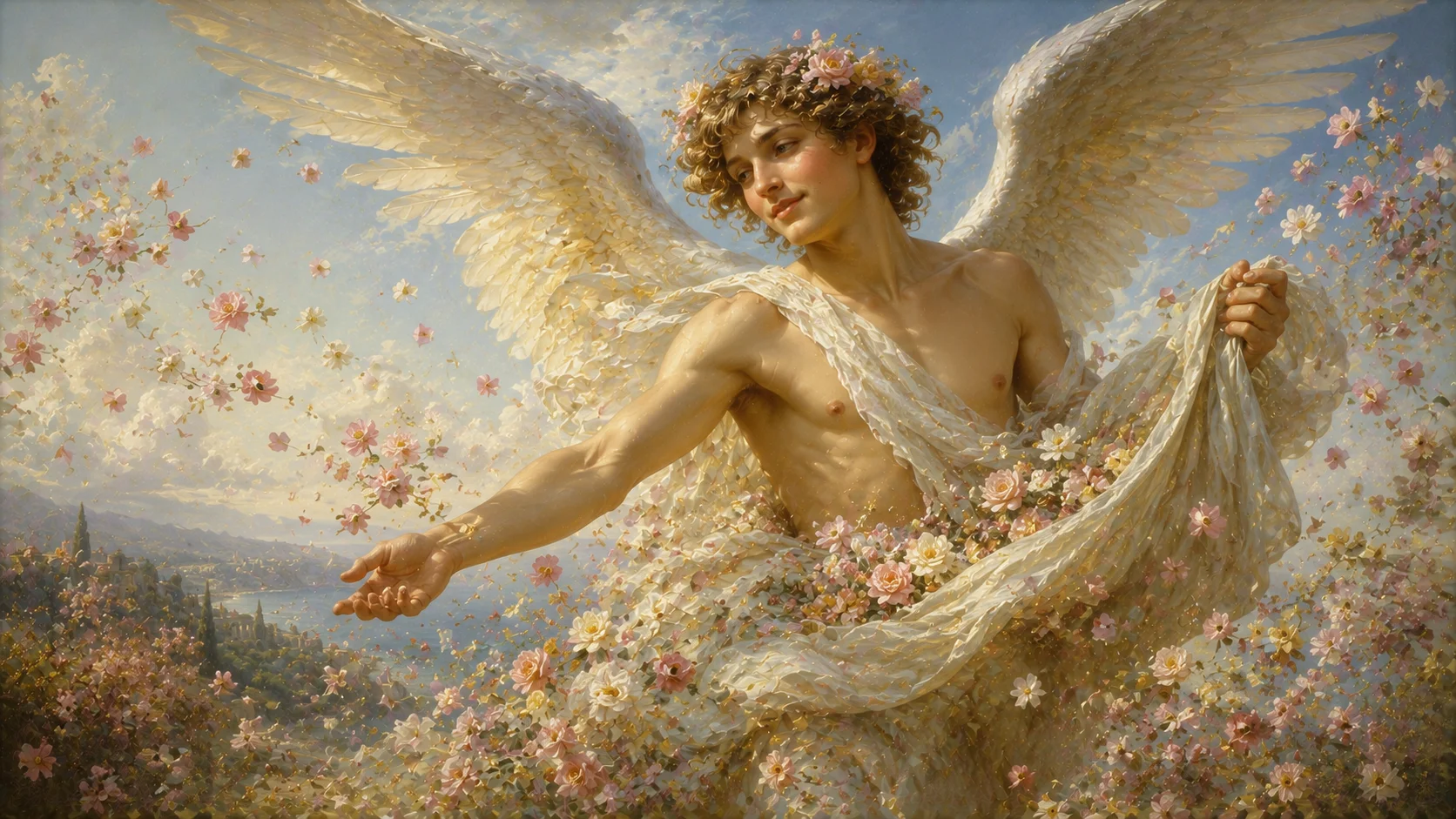
A son of the dawn-goddess Eos and the star-god Astraeus, Zephyrus personified the warm west wind that blew in the spring and early summer, the herald of fair weather and the bringer of gentle rains. Where his brother Boreas was violent and cold, Zephyrus was mild and fructifying — the breath that ripened the fields and opened the blossoms. He was imagined as a winged youth, often shown scattering flowers from his robe. By Chloris (the nymph of flowers, whom the Romans called Flora) he fathered Carpus, the spirit of fruit.
The Death of Hyacinthus
Zephyrus loved the beautiful Spartan youth Hyacinthus — but the boy preferred the god Apollo. One day, as Apollo and Hyacinthus played at throwing the discus, the jealous west wind blew the heavy disc off course so that it struck Hyacinthus in the head and killed him. From the boy's spilled blood Apollo raised the flower that bears his name. The tale gives Zephyrus a darker depth: even the gentlest wind, stung by jealousy, could become an instrument of grief.
Servant of the Gods
In the tale of Eros and Psyche, it was Zephyrus who gently carried the mortal princess Psyche on his soft breath to the hidden palace of her divine husband — the kindly wind as the servant of love. In this gentler role he is the wind we still imagine when we think of a warm spring breeze: the soft, life-giving air that means winter is over and the world is blooming again.
The Breath of Spring
Zephyrus endures as the very image of the gentle west wind — his name surviving in “zephyr,” a word for any soft, mild breeze. He embodies the Greek love of the spring and its renewing air, and the bittersweet truth that even gentleness can carry sorrow: the wind that opens the flowers is also the wind that blew the discus astray.
Boreas was winter's fury; Zephyrus was spring's soft breath — and even he, once, blew with grief.
Born of the Dawn, Brother to the Storm
The Greeks did not think all winds were the same kind of thing. Hesiod's Theogony sorts them into two households, and the division matters more than it looks. Zephyrus, Boreas and Notus are the children of Astraeus and Eos — starlight and daybreak — and they are named as winds that do good for mortals. The other winds, the sudden squalls that fall on a ship out of a clear afternoon and leave nothing to bury, are given a different parent entirely: Typhoeus, the last monster Zeus had to put down. A Greek sailor therefore inhabited a sky with a moral geography. Some winds had names, genealogies and a place in the order of things; others were the leftover breath of chaos, and you could not bargain with them.
Zephyrus holds the west of that sky, and the name itself may carry the dusk with it. It has often been connected with zophos, the word for gloom, murk, and by extension the western quarter where the sun goes down — though the derivation is a suggestion rather than a settled fact, and some linguists give up on the name altogether and file it with the words Greek inherited from whatever was spoken in Greece before it. If the link is right, there is a quiet irony buried in the god of flowers: the breeze that opens the crocus is named for the darkening edge of the world. The Greeks were not sentimental about direction. West was where the light went.
The Hard Zephyrus of Homer
The soft spring wind of the later poets would have puzzled Homer. In the Iliad and the Odyssey, Zephyrus is frequently a brute — a shrill, rain-heavy gale that piles up the sea, drives cloud across the water and makes the shore unapproachable. He blows in company with Boreas rather than in contrast to him. When the pyre of Patroclus will not catch, it is to Boreas and Zephyrus together that Achilles prays, and Iris who carries the message to them; the two winds come roaring over the Trojan plain and beat the flames into life all night, an image of the west wind as a furnace-bellows rather than a caress.
He is also, in the Odyssey, the wind of the homeward course. Aeolus binds every other gale into an ox-hide bag and leaves Zephyrus loose, so that it can carry Odysseus and his ships straight to Ithaca — and the crew, convinced the bag holds treasure, open it close enough to shore to see men tending their fires. Everything that follows in the poem depends on sailors mistrusting a favourable wind.
Twice, though, Homer lets Zephyrus be what he later became everywhere. In the description of Elysium, the plain at the world's end where the blessed do not die, it is the west wind that blows continually to refresh those who live there. In the orchard of Alcinous on Scheria, the same breath keeps fruit forming and ripening in an unbroken round, so that pear ripens on pear and fig on fig and the season never closes. Both are pictures of a place outside time, and in both, the sign that time has been suspended is that the west wind never stops.
The Wind That Fathered Horses
Achilles drives two immortal horses, Xanthus and Balius, and their pedigree is the strangest thing about Zephyrus. Their mother is the harpy Podarge, who was grazing in a meadow by the stream of Ocean when the west wind found her. Horses conceived by wind: it is the sort of detail that sounds like poetry until you discover how seriously it was taken. The belief that mares could be got with foal by the west wind alone survived for centuries in ancient stock-breeding lore, and it had an address — the herds of Lusitania, on the Atlantic edge of Iberia, where the mares were said to stand with their faces turned into the blowing Favonius and conceive from it. Roman writers on farming pass this on as a fact about a particular region rather than as a fable, and Pliny adds, with a straight face, that colts got this way are exceptionally swift but do not live past three years.
It is worth pausing on why the idea was plausible. Wind is the one force everybody could feel doing work without being seen doing it — bending trees, filling sails, carrying seed and scent across a valley. A culture that watched pollen move and had no theory of it had every reason to treat breath and breeding as neighbours. The Greek anemos and the Latin anima sit close to that same intuition, both reaching back to an older root meaning simply to breathe. Zephyrus is fertility precisely because he is invisible and irresistible, and the fastest horses in the Iliad are fast because their sire has no body to slow him down.
Where an Athenian Could Actually See Him
Zephyrus had little of the temple-and-sacrifice apparatus that surrounded the Olympians — the winds were more often appeased than housed, invoked at the moment they were needed. Pausanias, walking the Sacred Way from Athens towards Eleusis, notes an altar of Zephyrus beside the road, a little past the grave of Themistocles: the marker of a god you thanked in passing rather than one you visited.
The finest surviving image of him is architectural. The octagonal marble Tower of the Winds still stands in the Roman Agora at Athens, each of its eight faces carved with the wind that blows from that quarter, each figure flying horizontally with a personality of its own. Boreas, on the north face, is a shaggy bearded man muffled against the cold, blowing through a twisted shell. On the west face Zephyrus is a beardless youth, half-draped, carrying a fold of his mantle heaped with flowers he is about to scatter. That is the iconographic formula for the entire later tradition: youth, wings, drapery in motion, blossom spilling from cloth. If a figure in a painting has all four, you are looking at the west wind, whatever else the picture is doing.
Favonius, the Wind That Favours
Rome renamed him Favonius, from favere, to favour or to be well-disposed — less a description of weather than a verdict on it. And in Roman hands the god acquired something Greek myth never gave him: a date. The agricultural calendar treats the arrival of Favonius in early February as the hinge of the farming year, the moment the soil unlocks, the weeding of fallow begins and the vines and orchards are pruned. Writers on husbandry organise their instructions around it, and one of the Roman divisions of the year simply runs from the first blowing of Favonius to the spring equinox. Whatever the actual weather was doing, the return of the west wind was the official end of winter, and a farmer could plan against it.
This is the point at which Zephyrus stops being a character and becomes an idea. A god who reliably arrives on schedule and does something useful is halfway to being a season, and the sweetness that clings to the name in every later language comes largely from this Roman-agricultural reading rather than from the storm-wind of Homer.
Hyacinthus at Amyclae: The Grief Behind the Flower
The discus that killed Hyacinthus is one story; what the Spartans did about it every year is another, and it is far older. At Amyclae, a few miles south of Sparta, stood a colossal image of Apollo mounted on a base fashioned like an altar, and inside that base, they said, was the tomb of Hyacinthus. Each early summer the city kept the Hyacinthia, which the one detailed ancient description makes a three-day affair. It began in mourning: no garlands, no paean to Apollo, plain unleavened cakes in place of bread, and a sombre meal. Then it broke into celebration — boys playing the lyre and singing to the pipe, choirs, riders parading on decorated horses, girls carried in ornamented carriages, and a robe woven for the god each year by the women of Sparta. Spartans on campaign were released to go home for it, and the city let the business of state wait while it ran.
That double rhythm, grief then joy, is the signature of a vegetation cult: something beautiful dies and is mourned, and its dying is the condition of the year turning. Scholars have long read Hyacinthus as a pre-Greek figure, older than Apollo in that place and absorbed by him — his name carries the -nth- element that also runs through labyrinth and Corinth, a sound-pattern associated with the languages spoken in Greece before Greek. Seen from Amyclae, the myth is not really about a jealous breeze at all. It is about a dying youth buried under a god, and the flower is the receipt.
The jealousy is a late refinement — Ovid's influential telling of the death has no wind in it at all — and even once the guilty wind arrives, it is unstable. Servius and the Vatican Mythographers hand the fatal envy to Boreas rather than Zephyrus, which suggests the ancients themselves treated the jealous wind as a slot to be filled rather than a fixed fact. What never varies is the flower — and note that the ancient hyacinth is not the plant we now sell in bulbs at Christmas but something whose petals were said to carry the marks AI AI, the Greek cry of lament, written into them by Apollo's grief.
Chloris, Carpus, and a Household Made of Weather
The marriage to Chloris and the son named Carpus make the tidiest allegory in Greek myth — karpos is simply the word for fruit, so west wind plus new growth produces harvest, and the family tree doubles as a description of April. The genealogy is late; it survives in Servius, annotating Virgil around four hundred years after Christ. But Ovid, in the Fasti, had already given the marriage a voice. The Roman Flora tells the story herself: she was Chloris, seized by the wind in a spring meadow, granted dominion over all flowers, and given a name that Latin lips wore down out of the Greek. Ovid lets her forgive him in a single dry line — the rape becomes a marriage, and she says she has no complaint of her husband. Modern readers rarely find it as tidy as she does, and the discomfort is part of what keeps the passage alive.
Other genealogies attach him to Iris, the rainbow. Alcaeus made that pair the parents of Eros, a startling image if you take it literally: love born where the west wind crosses the light after rain. And Nonnus, writing in Egypt in the fifth century at the far end of the epic tradition, gives Carpus a story of his own. Racing his beloved Calamus in the current of the Maeander, the youth is taken by a wave and drowns; Calamus, unable to live after him, goes under the same water and rises as the reed that bends over it — the reed that pipes are cut from. Even at the very end of antiquity, the family of the west wind keeps producing the same plot: a beautiful boy dies, and a plant remembers him.
The Long Afterlife of a Breeze
Chaucer opens the Canterbury Tales by putting the west wind to work on the English landscape — “Whan Zephirus eek with his sweete breeth” — and with that line the classical god becomes permanent furniture in English poetry, the standard way of saying that spring has begun without saying it plainly. Botticelli painted him twice and unforgettably. In the Birth of Venus he is the blue-limbed figure at the left, wings spread, cheeks full, driving the shell to shore on a rain of roses. In the Primavera he is at the far right, blue and cold-looking, seizing a fleeing nymph from whose mouth flowers are already spilling — and the next figure along is Flora, crowned and scattering blooms. The painting shows the transformation from Ovid's poem happening in a single sweep of canvas: Chloris caught, Chloris changed, Flora walking free.
The word outlived the god, and travelled further than the weather. A zephyr is also a lightweight cloth, and a long line of ships, locomotives and cars named to promise smoothness. It is a rare afterlife: most Greek deities survive as characters, but Zephyrus survives as vocabulary, which is a deeper kind of persistence — people use him without knowing they are doing it.
Why the Gentle Wind Keeps Its Grip
What the Zephyrus material really preserves is an argument about mildness. Almost every culture makes its dangerous weather into a god; it takes a particular turn of mind to deify the pleasant kind and then insist on giving it a criminal record. The Greeks did both. They kept the Homeric gale and the flower-scattering youth in the same figure, and they kept the story in which the kindest of the brothers is the one who kills.
That is not an inconsistency to be tidied away — it is the point. Anyone who has lived by growing things knows that the warm spell which brings the blossom is the same warm spell that can bring it out a fortnight too early, to be destroyed by the next frost. The wind that carries Psyche safely to a palace and the wind that pushes a discus off its line are one wind. Zephyrus is the Greek acknowledgement that gentleness is not the opposite of harm, only a different route to it, and that spring — the season everyone claims to want — arrives every year over the top of something that had to die first.
Sources & traditions
- EncyclopediaWikipedia — Zephyrus
- TraditionGreek texts, inscriptions and later retellings (Greece)
Myths change from area to area and from time to time. This chronicle follows the most widely told versions; tellings in other villages, regions and eras may differ.