Boreas was the god of the north wind — the cold, violent breath of winter, mightiest and most feared of the four Anemoi (the wind-gods). When the icy gale roared down out of Thrace and froze the Greek world, it was Boreas who blew; and unlike his gentler brothers, he was a god of raw, abducting force, as ready to seize a bride as to wreck a fleet.
The North Wind
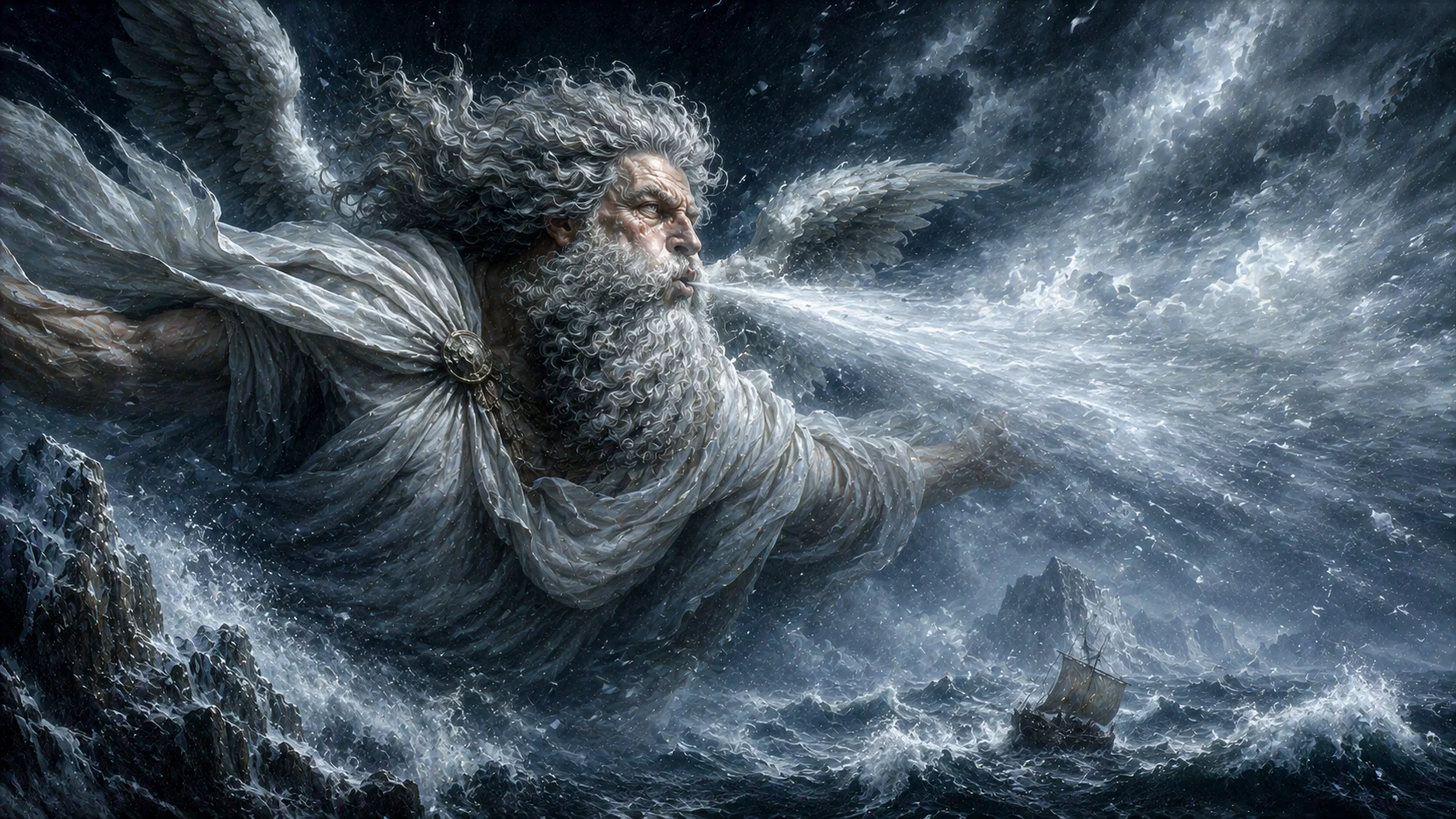
A son of the dawn-goddess Eos and the star-god Astraeus, Boreas was the personification of the north wind and the bringer of cold winter air. He was imagined as a strong, winged, bearded man, often shown with his cheeks puffed and his garment billowing, blowing through a conch shell. His home was in Thrace, the cold land to the north of Greece, from which the freezing winter wind seemed to come. Of the four chief winds — Boreas (north), Notus (south), Zephyrus (west) and Eurus (east) — he was the strongest and the most dangerous.
The Abduction of Oreithyia
Boreas loved Oreithyia, a princess of Athens, but his rough wooing was rebuffed. Impatient with courtship — for the north wind knew only force — he swept down, wrapped her in a cloud, and carried her off to Thrace to be his bride. By her he fathered the Boreads, the winged heroes Zetes and Calais who later sailed with the Argonauts, and two daughters. Through this marriage the Athenians came to count Boreas as a kinsman by marriage — a tie they would one day call upon.
Defender of Athens
When the vast fleet of the Persian king Xerxes threatened Greece, the Athenians prayed to their stormy in-law Boreas for help. The north wind answered: a great gale shattered hundreds of Persian ships against the rocks. In gratitude the Athenians built him a shrine on the river Ilissus — one of the few times a Greek city honoured a wind as its saviour. The same violence that made Boreas feared made him, that day, a deliverer.
The Breath of Winter
Boreas endures as the very image of the north wind and of winter's cold fury — his name surviving in “boreal” and the aurora borealis. He embodies the Greek sense of the winds as living, willful powers, and of the north wind in particular as a force of raw, irresistible strength: a god who courted by abduction and saved a nation by shipwreck.
The other winds whispered or warmed; Boreas seized — whether a bride or a fleet, the north wind took what it wished.
The Wind That Homer Already Knew
Long before he ever seized a bride, Boreas was already old enough to be prayed to. In the Iliad, Patroclus lies dead on his pyre and the wood will not catch; Achilles stands apart, pours libations from a golden cup, and calls the north wind by name. Iris carries the plea to the winds, who are feasting together in the house of blustering Zephyrus, and at the promise of offerings to come Boreas rises with his brother. The two cross the sea roaring, fall on the pyre, and beat it into a blaze that burns the whole night through. It is a small scene, easy to miss beside the abduction and the wrecked fleet — but it is the oldest portrait we have of Boreas, and it already shows the shape the later myths would keep: a god summoned by desperate ritual, who answers with rather more violence than anyone quite asked for.
Wings in the Rigging: Zetes, Calais, and the Harpies
The Boreads did not stay minor figures in a myth about their father; they got an adventure of their own. Sailing with Jason aboard the Argo, Zetes and Calais came ashore at the court of the blind seer-king Phineus, whose every meal was fouled by the Harpies before it reached his mouth. Winged like their father — Apollonius gives them golden-scaled feathers quivering at the ankles, and other tellings add wings at the temples — the brothers were the obvious choice to give chase. They drove the shrieking creatures out over open water as far as the Floating Islands, and broke off only when the rainbow-goddess Iris intervened and swore by the Styx that Phineus would be troubled no more. The islands took a new name from that moment: Strophades, the Turning Islands, after the point where the sons of the north wind turned back. One later strand of the tradition was far less kind to the brothers. It held that Heracles killed them both on the island of Tenos, still angry that they had argued the Argonauts out of going back for him when he was left behind searching for the lost Hylas — and that he raised two pillars over their grave, one of which stirs whenever Boreas blows.
Chione and Cleopatra: the Daughters of the North Wind
Oreithyia gave Boreas two daughters as well as his famous winged sons, and both became mothers of consequence. Chione was taken by Poseidon and, concealing the child she bore him, threw the infant Eumolpus into the sea; the sea-god caught him up, and he was raised far from Attica, returning in tradition as ancestor of the Eumolpidae, the priestly family that presided over the Mysteries at Eleusis. Cleopatra married Phineus — the same blind king her brothers would later deliver from the Harpies — and bore him two sons before he took a second wife, Idaea, who accused the boys of forcing themselves upon her. Phineus believed her, and the boys were blinded; in Sophocles' telling it is the stepmother herself who does it, driving weaving-shuttles into their eyes. It was Zetes and Calais, arriving with the Argonauts, who found their own nephews in that state and forced the reckoning that followed. A family that began with one abduction kept producing stories about cruelty answered by rescue.
Hyperborea, the Land Beyond the North Wind
If Boreas defined where the cold began, the Greeks also imagined where it stopped. Beyond his reach, they said, lay Hyperborea — literally "beyond Boreas" — a country the wind itself could not enter. Pindar's Hyperboreans neither sicken nor grow old; they live without toil and without battle, and Apollo delights in their feasting. Herodotus, sceptical of the whole business, still records the offerings said to travel from them wrapped in wheat straw, handed on from people to people across half the known world until they reached the sanctuary of Apollo on Delos; later writers gave the country a sun that rose and set just once a year. No expedition ever found it, and no two authors placed it in quite the same direction. The myth is really a measurement of Boreas himself: however far the Greeks pushed the cold, hostile edge of the world, Hyperborea was drawn just past it — the one place the north wind, for once, could not go.
The Tower of the Winds
In the Roman Agora at Athens, Boreas is still standing. The Horologion of Andronikos of Kyrrhos — better known as the Tower of the Winds — is an octagonal marble tower of the second or first century BC, with a sundial on every face, a water clock within, and a frieze of the eight winds running round the top, each carved on the side from which it blows. Boreas holds the north: an older man, heavily bearded, wrapped tight in a thick mantle, stout boots on his feet against the cold, blowing hard into a twisted conch. Turn the corner to the warm quarters and the sculptor's argument becomes obvious — Zephyrus is a bare-limbed youth with flowers gathered in the fold of his cloak. It is temperature rendered as clothing. Very little ancient wind iconography survives complete and in place; this does, and it holds the north wind's portrait fixed in stone for anyone who cares to walk up and look.
Aquilo, the Roman North Wind
Rome took the god over almost without translation, calling him Aquilo and keeping the marriage story intact; Latin poets used both names freely. Ovid retells the courtship in the Metamorphoses and gives the wind something the Greek sources never bothered with: an interior monologue. His Boreas complains that he laid aside his own weapons — force, rage, menace — and tried prayers instead, and that prayers were never his language; violence is what suits him. Only then does he shake out his wings, until the blast of them sweeps the whole earth and makes the wide sea shudder, and carry Oreithyia away wrapped in their darkness. It is the same abduction the Greeks told, now narrated from the abductor's side as a kind of self-justification. The instinct behind both versions is the one that gave him a Thracian bride, a shrine on the Ilissus and a family tree full of rescues: a wind strong enough to sink fleets and freeze a harvest overnight had, eventually, to be given a face — and something with a genealogy and a grudge is a little easier to bargain with than the weather itself.
Sources & traditions
- EncyclopediaWikipedia — Boreas
- TraditionGreek texts, inscriptions and later retellings (Greece)
Myths change from area to area and from time to time. This chronicle follows the most widely told versions; tellings in other villages, regions and eras may differ.