Notus was the god of the south wind — the hot, storm-bringing breath of late summer and early autumn, the wind that ripened the late crops but also wrecked them with sudden tempests. Of the four Anemoi, he was the wind of the rains and the autumn storms, feared by farmers and sailors alike.
The South Wind
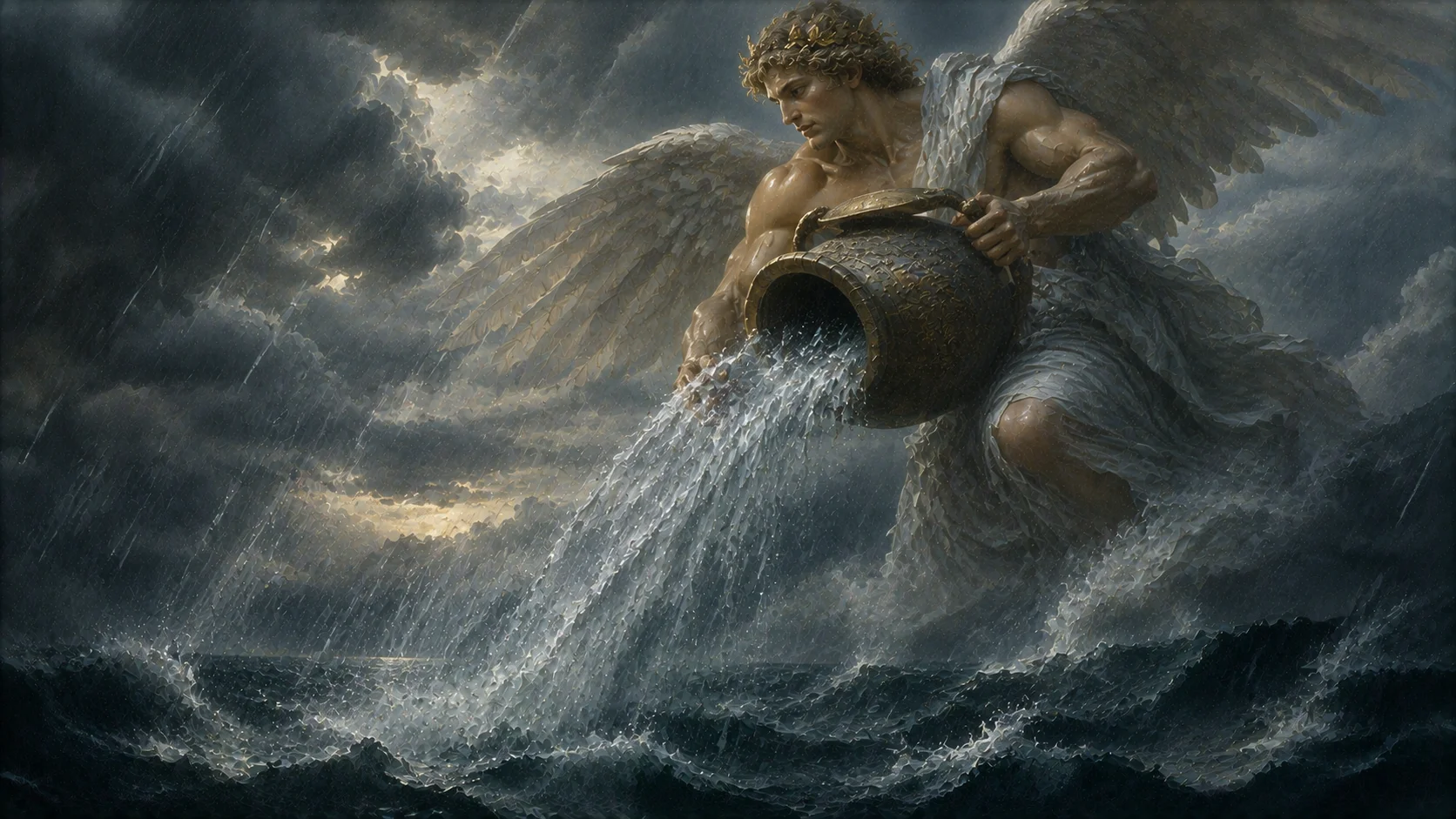
A son of the dawn-goddess Eos and the star-god Astraeus, Notus personified the south wind — the hot, wet wind that came in the season of the late harvest and brought with it the storms and rains of autumn. He was the wind that arose after the rising of Sirius, the Dog Star, in the sultry late summer, and his breath was associated with the fogs, the mists and the destructive downpours that could ruin a ripe crop in an afternoon. He was imagined as a winged man pouring water from an urn or shaking rain from his garment.
Brother of the Winds
With Boreas (north), Zephyrus (west) and Eurus (east), Notus made up the four directional wind-gods who answered, in many tellings, to the wind-keeper Aeolus. Each had his own season and temper: where Boreas brought winter's cold and Zephyrus spring's mildness, Notus brought the heavy, humid storms of summer's end. He was a power both fruitful and ruinous — the same warm rains that filled the rivers could just as easily flood the fields and sink the ships.
The Storm-Bringer
To the Greek sailor, the rising of Notus was a warning: the south wind meant rough seas, sudden squalls and the dangerous weather of the closing sailing season. The Tower of the Winds in Athens, which honoured all the Anemoi, depicted Notus emptying a water-jar — the very emblem of the rain-laden storm wind. He represents the Greek understanding of the winds as gods of mood and consequence, each capable of blessing or disaster depending on his temper.
The Breath of the Storm
Notus endures as the personification of the south wind and the autumn storm — the hot, rain-bearing breath that could ripen or ruin. He embodies the double face of the warm wind: bringer of the rains that feed the harvest, and bringer of the tempests that destroy it.
When the south wind rose and the sky darkened over the sea, the Greeks knew the storm-god Notus was emptying his urn.
Born of the Dawn and the Starry Sky
Hesiod gives the winds one of the strangest parentages in Greek cosmology. In the Theogony, Eos the dawn lies with Astraeus, the Titan of the starred dusk, and bears three sons — Zephyrus, Boreas and Notus — and then, from the same union, the morning star and the constellations that wheel above the sky. The winds are therefore siblings of the stars. Whoever first told it that way had watched the same thing every sailor watches: the wind changes at dawn, and the pattern of the sky at nightfall tells you what tomorrow's air will do.
Two details in that passage repay attention. The first is an absence: Eurus, the east wind, is not there. Hesiod's line of Astraeus produces only three. The tidy compass-cross of four Anemoi that later art loves is a later tidiness; the oldest surviving Greek account of where the winds come from names three brothers, and Notus is one of them.
The second is that Hesiod insists on two kinds of wind. Later in the same poem, when the monster Typhoeus is beaten down by Zeus, a brood of lawless winds is left behind from him — the squalls that fall on ships out of nowhere, scatter the cargo and drown the crews, and answer to nobody. Hesiod carefully exempts the god-born winds from that company: Notus, Boreas and Zephyrus, he says, are of divine stock and a great benefit to mortals. This is the whole theological problem of Notus in a single stroke. The wind that floods your fields is not a demon. He is a legitimate god doing legitimate work, and the ruin he causes is a side effect of a blessing. That is a far more uncomfortable idea than a monster.
The Wind That Closes the Sea
Hesiod's other poem, the Works and Days, is a farmer's almanac with a chapter on shipping, and it names Notus outright as the reason to get the boat out of the water. Haul her up, Hesiod tells his brother; do not wait about for the new wine and the autumn rain and the coming winter and the terrible blasts of Notus, who stirs the sea in company with the heavy autumn downpour of Zeus and makes the water cruel. It is one of the most practical sentences in archaic Greek literature.
Understand what that meant. Greek summer sailing ran under the Etesian winds, the dependable northerlies that blow down the Aegean for weeks at a stretch — hard work if you were beating north, but predictable. Notus was the interruption. When the south wind came up warm and wet at the end of the season, it was not merely one more hazard; it was the signal that the reliable pattern had broken and the year's window had shut. The rhythm of the Greek economy — grain moving by sea, colonies supplied, ships beached for the winter — turned on reading that change correctly. Notus was less a god you feared in the moment than a god whose arrival told you the moment was over.
Homer’s Notus: Mist, Not Thunder
The Notus of the Iliad and the Odyssey is subtler than his reputation. Homer's most memorable image of him is not a shipwreck at all: the south wind pours mist over the mountain peaks, a mist the shepherd hates and the thief loves, in which a man can see no further than a stone's throw. That is the poem's simile for dust rising off marching armies, and it is exactly right about a warm damp wind hitting cold high ground. Elsewhere Homer sets Notus with Eurus to churn the Icarian Sea, and in the storm that breaks Odysseus's raft all four winds crash together with Notus among them.
But the cruellest thing Notus does in Homer is to keep blowing. Marooned on Thrinacia, Odysseus's crew wait out a full month in which the wind holds from the south and the east and never once shifts to let them sail. Their provisions run out. They kill the cattle of the Sun, and that single act destroys every man aboard. The south wind does not sink them. It pins them — and starvation and bad judgement do the rest. It is a very sophisticated piece of storytelling about weather: the wind that ruins you can be the one that simply refuses to change.
Homer also gives Notus an odd epithet, argestes, a word tied to whiteness and brightening, which sits strangely on a wind of fog and rain. Later Greek wind-roses solved the puzzle by promoting Argestes into a separate north-westerly wind of his own. The disagreement is a useful reminder that the wind names were working vocabulary before they were mythology, and working vocabulary drifts.
Ovid’s Portrait — the Fullest Face We Have
No Greek text describes what Notus looked like at length. The great portrait is Latin, and it comes at the moment the world ends. In the first book of the Metamorphoses, Jupiter decides to drown mankind. He does not begin by opening the heavens; he begins by locking up the north wind and every other wind that drives clouds away, and then releasing this one. Notus flies out on soaking wings, his face hidden in pitch-black dark, his beard heavy with water, streams running from his white hair, cloud sitting on his forehead, his robes dripping.
Every element there is meteorologically literal — that is what makes it terrifying. Ovid has simply drawn a low warm front as a person. And the logic of Jupiter's method is the logic of Mediterranean weather: the flood does not need extra rain so much as it needs the drying winds shut away and the wet one left to blow unopposed. The Deluge, in Ovid, is what happens when Notus has no brother to stop him.
Auster: the Same Wind, a Different Country
Rome called him Auster, and the change of latitude changed his character. A south wind reaching Greece has crossed the sea; a south wind reaching Italy has crossed the North African desert first and then the sea, arriving hot, laden and often carrying dust. Latin poetry treats him accordingly. Virgil has Eurus, Notus and the squally Africus burst out together when Aeolus opens the mountain in the first book of the Aeneid, and Horace calls Auster the turbulent lord of the restless Adriatic. Pliny is blunter still: the south wind, he records, is simply unhealthy, and even animals eat less while it blows. The Greeks feared the storms Notus brought; the Romans also feared what he did to the air itself when he simply sat over a city.
Ancient observers were clear-eyed about the reason. A wind's temperament, they understood, is made by the land it has crossed. The same compass point could be a rain-bringer on one coast and a parching wind on another. This is why the wind-gods never quite settled into a single fixed pantheon-style biography: their personalities were local knowledge.
How People Actually Dealt With Him
No temple of Notus and no festival in his name is recorded, and that absence is itself informative. The winds were approached the way you approach anything you need to stop. Pausanias records a sanctuary of the winds at Titane in the territory of Sicyon, where one night each year a priest performed rites at four pits, offering to the winds and chanting charms to soften their fierceness — a ritual that is closer to magic than to civic worship, and deliberately nocturnal and secret. Herodotus reports that when the Persian fleet was bearing down on Greece, Delphi told the Delphians to pray to the winds, and afterwards they built the winds an altar. Achilles, needing a pyre to catch, promises the winds offerings, and Iris finds the whole family of them feasting in the hall of blustering Zephyrus.
Boreas went further than his brothers: Athens gave him a real cult after storms wrecked Persian ships. Notus never earned that kind of civic gratitude. He is a god you bargain with at the edge of a field or on a beach before launching, in the small, urgent, unrecorded religion of people whose livelihood depends on air they cannot see.
Sickness on the South Wind
Greek medicine took the winds seriously as a cause of disease, and Notus came off worst. The Hippocratic treatise Airs, Waters, Places instructs a physician arriving in an unfamiliar city to establish first which winds it lies open to; a town exposed to the hot southerlies and sheltered from the north, it warns, will have heavy, soft-headed inhabitants, poor digestion, brackish water and a particular catalogue of complaints. The Aristotelian Problemata devotes an entire book to the winds and keeps circling the same question — why does the south wind make people dull, weak and unwell?
This was not idle theorising. Vitruvius turns it into town planning: streets, he argues, must be laid out so that the prevailing winds are broken rather than funnelled, and he treats an alley aimed straight down the throat of a bad wind as a public health failure. A modern reader can see, behind the humoral vocabulary, real observations about damp heat, stagnant water and the fevers that breed in marshland when the air stops moving. And the belief has never entirely gone: around the Mediterranean the scirocco is still widely held to bring headaches, sleeplessness and short tempers, and people still explain a bad day by pointing at the sky.
From Four Winds to Eight: Reading the Tower
Four winds is a philosopher's scheme. Anyone actually working a boat knows the wind rarely does you the courtesy of blowing from a cardinal point, and Greek practice steadily subdivided the circle — Aristotle argues the problem out in the Meteorologica, and later geographers pushed the count to twelve.
The compromise that survives in stone is the octagonal marble Horologion in Athens, the building we call the Tower of the Winds, which Vitruvius credits to Andronicus of Cyrrhus and describes as being crowned by a bronze Triton whose rod swung round to point at whichever wind was blowing. It was a complete weather instrument: eight faces, a sundial on each, a water clock within, and along the top a frieze of eight winged gods flying round the building in order.
Notus holds the south face, and his neighbours tell you how finely the scheme was cut — Eurus to his south-east, Lips to his south-west. Each figure carries what his wind delivers: the north-easterly tips out a shield of hail, the westerly Zephyrus carries flowers loose in the fold of his cloak, the easterly brings fruit and grain, the south-westerly handles the stern of a ship. Notus carries the water jar, tilted and pouring. In a city where the summer is bone dry and the rain arrives on the southerly, that jar is not a threat and not a gift. It is both, and every Athenian looking up at it knew it.
The Name Outlived the God
Notus has an unusually long afterlife for a minor deity, because his name went on doing work after nobody sacrificed to him. In Greek, notos still means the south, and it always sat close to the vocabulary of wetness — notis, moisture; noteros, damp. Direction and dampness were the same idea, and the language never separated them.
The Latin side travelled further. Auster gave australis, ‘southern’, which gave the long-imagined southern landmass of European geography and eventually the name of Australia — a continent named, at several removes, after a Greek wind-god's Roman alias. The medieval Mediterranean compass rose kept him too, as Ostro, the south point, sitting between the scirocco and the libeccio. And every weather map that shades an advancing warm sector is drawing Ovid's dripping figure with different tools.
Why the South Wind Still Unsettles Us
Boreas is easy to understand: cold is an enemy, and you fight it. Notus is harder, and that is why he lasts. He carries the water without which nothing is sown, and he can deliver a season's worth of it between one morning and the next. He does not arrive as an invader. He arrives as the thing you were waiting for, in the wrong quantity, at the wrong speed.
That is a genuinely adult anxiety, and it explains the shape of the myth. The Greeks did not make the south wind a monster, because a monster can be killed and the harvest still needs rain. They made him a brother — one of a family, born of dawn and starlight, kin to the stars, occasionally hospitable, fundamentally beyond negotiation. You cannot renounce him. You can only watch the sky, get the boat up the beach in time, and hope that when he empties the jar he does it gently.
Sources & traditions
- EncyclopediaWikipedia — Notus
- TraditionGreek texts, inscriptions and later retellings (Greece)
Myths change from area to area and from time to time. This chronicle follows the most widely told versions; tellings in other villages, regions and eras may differ.