Aeolus was the keeper of the winds — the divine warden whom the gods set over the four Anemoi, charged with holding the storm-winds bound and releasing them as the gods commanded. It was Aeolus who, in one of the most famous episodes of the Odyssey, gave Odysseus the winds tied up in a bag — and watched the hero's folly undo a gift that should have brought him home.
The Warden of the Winds
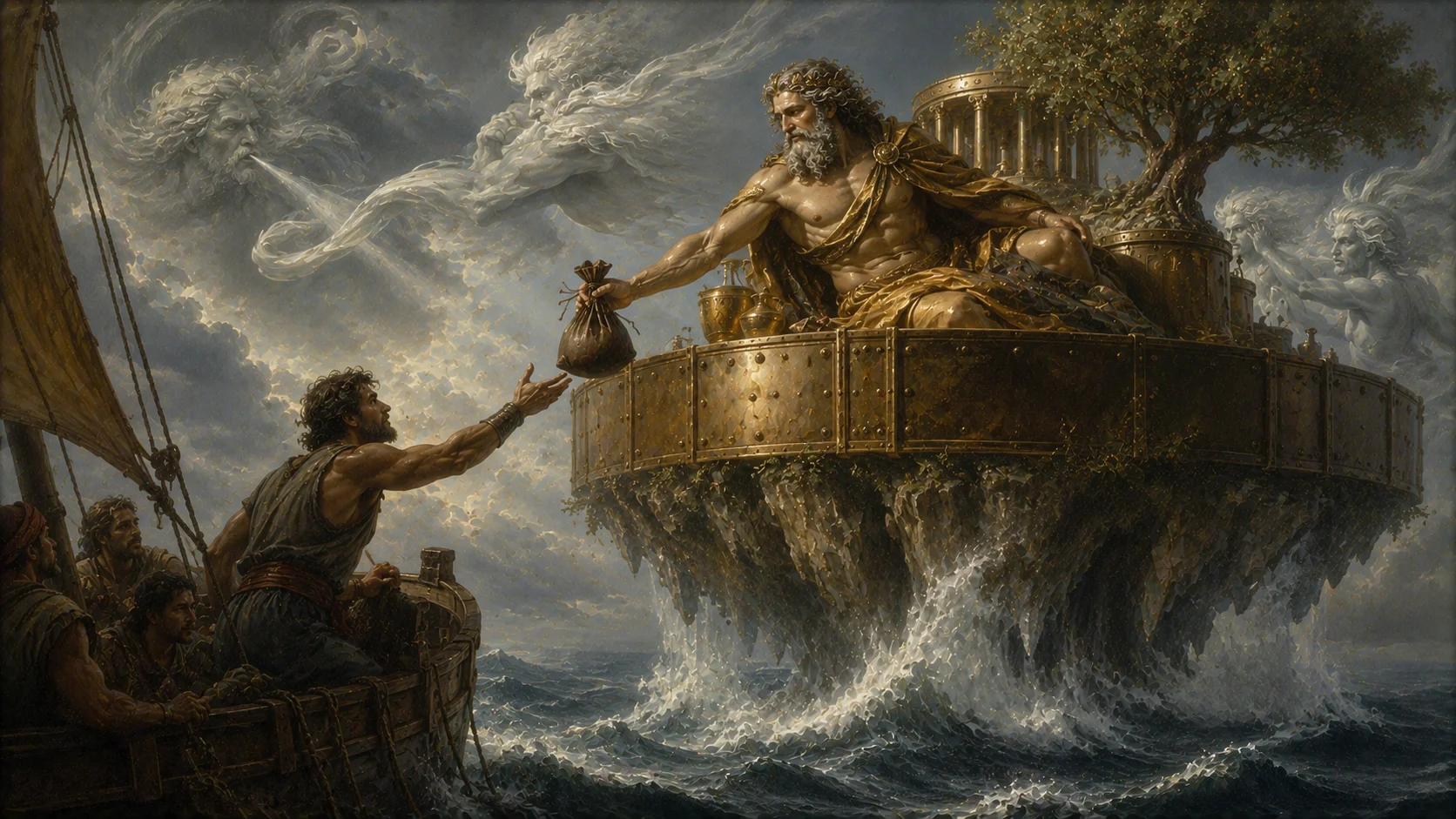
Aeolus dwelt on the floating island of Aeolia, a bronze-walled isle that drifted upon the sea, where he lived with his wife and twelve children in perpetual feasting. The gods had made him steward of all the winds, with the power to rouse or still them as he pleased — for the raw winds, if left to themselves, would tear the world apart. He kept them shut in a great cavern (or, in some tellings, in a leather bag), loosing each one only at need. He was thus less a wind himself than the jailer of the winds, the keeper of the storm.
The Bag of Winds
When Odysseus came to Aeolia on his long voyage home, Aeolus received him kindly and, at his departure, gave him a parting gift: a leather bag in which all the contrary winds were tied up tight, leaving only the gentle west wind free to carry the hero's ships straight to Ithaca. For nine days they sailed, and on the tenth their home island came into view — but as Odysseus slept, his greedy crew, believing the bag held treasure, opened it. The trapped winds burst free in a roaring storm and blew the ships all the way back to Aeolia. When Odysseus begged for help a second time, Aeolus drove him away, declaring that no man so hated by the gods deserved aid.
Keeper, King and Wind
Greek tradition was tangled, with several figures named Aeolus — a son of Hellen and ancestor of the Aeolian Greeks, a king, and this wind-warden — sometimes merged into one. But it is as the master of the winds that he endures: the god who held the tempests on a leash and could grant or deny the very breath that drove the ships of men across the sea.
The Master of the Storm
Aeolus endures as the keeper of the winds — his name surviving in “aeolian” (of the wind) and the aeolian harp that sings when the breeze passes through it. He embodies the Greek sense that even the wild winds answered to a master, and the bitter lesson of his most famous gift: that the surest course home can be wrecked by a single moment of folly.
Aeolus tied every wind that could harm Odysseus into a bag — and the hero's own crew untied his ruin.
Hippotades: The Man Who Was Not a God
The strangest fact about Aeolus is the one the Odyssey states plainly and almost everyone afterwards forgot: he is not a god. Homer calls him Aeolus Hippotades, son of Hippotes, and describes him as dear to the immortal gods — a phrase that only makes sense if he is not one of them. He is a mortal man to whom Zeus handed an office. The Greek word Homer uses is tamiēs: a steward, the household functionary who holds the keys to the storeroom and doles out the grain. Aeolus is the storeroom-keeper of the weather.
That single word carries the whole theology of the figure. Wind, in the Homeric world, is not a mood of the sky but a substance — something that can be measured out, portioned, locked up and issued. And the being entrusted with it is not a deity to be prayed to but an administrator to be visited, petitioned and, in the end, refused by. When Aeolus turns Odysseus away on his second arrival, he is not being cruel; he is a steward who has read the gods' ledger and will not sign against it.
His household runs on the same logic. Homer gives him six sons and six daughters, and he has married them to one another, so that the twelve feast at his table forever and no one marries out. The bronze wall keeps the sea off the island; the marriages keep the world out of the family; the ox-hide bag keeps the winds out of the air. Everything about Aeolia is a container that must not be opened — which makes what Odysseus's crew does to that bag less an accident than the inevitable violation of the one rule the place is built on.
Three Men Named Aeolus
Ancient mythographers were as confused by the name as modern readers are, and they solved it the way they usually did: by multiplication. They counted three Aeoluses, and kept them formally distinct even while every storyteller quietly blurred them.
- Aeolus son of Hellen, brother of Dorus and Xuthus, the eponymous ancestor of the Aeolians — the Greeks of Thessaly, Boeotia and the north-western coast of Asia Minor, who spoke the Aeolic dialect in which Sappho and Alcaeus wrote. This Aeolus has nothing to do with weather. He is a linguistic and genealogical ancestor, the founder of a branch of the Greek people.
- Aeolus son of Poseidon and Arne, a coloniser who is said to have taken the volcanic islands north of Sicily that still bear his name.
- Aeolus son of Hippotes, the wind-warden of the Odyssey.
The distinction is real, but it never held. Poets moved daughters and sons freely between the three, so that a heroine born to the ancestor of a dialect group ends up with a father who can command a gale. Nothing in Greek myth is tidier than a mythographer's list, and nothing is less obeyed.
What Aeolus Actually Ruled: The Anemoi
In the oldest sources Aeolus is not the father of the winds. Hesiod gives the directional winds a different parentage entirely: Zephyrus the west, Boreas the north and Notus the south are the children of Astraeus, a Titan of the starry sky, and Eos, the dawn. They are a benefit to mortals. Against them Hesiod sets a second, nameless class of winds: the squalls born of Typhoeus, which fall on the misty sea without warning, scatter ships and drown sailors, and against which, he says, a man has no defence at all.
That division is the key to the whole system. The Greeks distinguished the wind that blows from a direction — predictable, seasonal, useful, a thing a captain can plan around — from the wind that simply arrives, out of a monster's body, with no direction and no reason. Eurus, the east wind, sits awkwardly across the scheme; Homer knows him and lists him with the other three, but Hesiod leaves him out of the divine birth. Aeolus's office belongs to the second category. He is the answer to the terrifying possibility that chaotic wind has no master. Someone, the myth insists, is holding the door shut.
Later tradition promoted him: by the Roman period Aeolus is the acknowledged sovereign of the Anemoi, and the winds themselves are imagined as winged men — bearded and heavy-cloaked in the north, young and scattering flowers in the west. Anyone wanting to see how the Greeks pictured them can still walk into the Roman Agora at Athens and look up at the Tower of the Winds, an octagonal marble building with eight winged wind-figures carved in relief around its top, one to each face, above sundials, with a water-clock once running inside. It is the most complete surviving image of the family Aeolus was said to keep under lock.
Where the Winds Were Actually Worshipped
Aeolus himself has almost no cult. There are no great temples to him, no festival calendar, no priesthood of consequence — which is exactly what one would expect of a mortal steward rather than a god. But the winds he guarded were worshipped intensely, and by the people with the most to lose.
At Titane in the Sicyonian country there stood an altar of the winds where, on one night in each year, a priest sacrificed to them and performed secret rites over four pits, taming the fierceness of the gusts, chanting over them spells attributed to Medea. The detail is worth sitting with: not a public festival, not a procession, but a single man working in the dark at four holes in the ground, once a year, to keep the air from killing people.
Boreas received the most spectacular thanks in Greek history. When the Persian fleet was shattered by a storm off the coast of Magnesia, the Athenians — who claimed the north wind as a kinsman by marriage, since he had carried off the Athenian princess Oreithyia — credited him with the wreck and founded a sanctuary to him beside the river Ilissos. A city thanking a wind for a war is not a metaphor. It is a state acknowledging that its survival had been decided by weather.
For ordinary sailors the practice was simpler and constant: sacrifice before sailing, and a bargain struck with whatever held the air. That is the world Aeolus belongs to — not the temple, but the beach at dawn.
Halcyon Days: The Wind-Keeper as a Father
One of the loveliest stories in Greek myth turns on Aeolus's power, and he never appears in it directly. His daughter Alcyone married Ceyx, and the two loved each other so completely that — in one strand of the tradition — they took to calling one another Zeus and Hera, a presumption the gods did not let pass. Ceyx drowned at sea. Alcyone, finding his body washed to the shore, threw herself into the water, and both were transformed into halcyons, the kingfishers of the winter sea.
The halcyon was believed to build a floating nest on the open water at midwinter, at the very season when the Mediterranean is least survivable. And so, the tradition says, Aeolus shuts the winds up and keeps them in while his daughter broods: seven days of stillness in Ovid's telling, and in the older Greek reckoning fourteen — seven before the winter solstice for the building of the nest, seven after for the hatching. Sailors knew the calm and named it after the bird.
English still carries the phrase. Halcyon days now means a remembered stretch of peace, and almost nobody using it knows that the peace was granted by a wind-warden protecting his child. It is the one moment in the tradition where the jailer of the storms uses the office for tenderness rather than command.
The House of Aeolus and Its Darkest Story
Through the Aeolus who fathered the Aeolian Greeks runs one of the most productive bloodlines in Greek myth. His sons include Sisyphus, condemned to the stone; Athamas, whose ruined household launched the Golden Fleece; Salmoneus, blasted by Zeus for driving a bronze chariot and hurling torches in imitation of thunder and lightning; and Cretheus, founder of Iolcus and grandfather of Jason. The Aeolids are everywhere. Half the heroic age is a footnote to this one genealogy.
And out of the same house came the story the Athenians could not leave alone. Macareus and Canace, brother and sister, conceived a child. When it was discovered, Aeolus ordered the infant exposed and sent his daughter a sword, leaving her to understand what it was for. Euripides built a lost tragedy, Aeolus, around the scandal, and it was notorious enough that Aristophanes could raise a laugh by quoting it; Ovid later gave Canace a letter of her own, written with the blade already in her hand. Which Aeolus is her father depends on which author you read — the mythographers kept the three apart, the poets did not, and by the Roman period the man who fathered the Aeolids and the man who bottled the winds are handled as one.
Read against the Odyssey, the story is unnerving. Homer presents the sibling marriages on Aeolia as a picture of perfect enclosed happiness — the twelve at their father's endless feast. Tragedy took a household of exactly that shape and asked what it would actually be like from the inside. The answer was a locked island, a father with absolute authority over air and offspring alike, and a daughter who could not be allowed out.
Virgil's Aeolus: A King Who Could Be Bought
Roman literature inherited Aeolus and changed him fundamentally. In the opening book of the Aeneid, the winds are no longer in a bag or a loose cavern but imprisoned under the mass of a mountain, roaring at the barriers, held down by chain and by law. Aeolus sits above them in a high citadel with a sceptre, and Virgil is explicit about the constitutional arrangement: Jupiter set a king over them under a fixed covenant, with authority to tighten the reins or slacken them on command. Left unpoliced, Virgil says, the winds would carry off sea, land and the deep sky itself.
Then Juno arrives and offers him a bribe. If Aeolus will wreck the Trojan fleet, she will give him the nymph Deiopea, loveliest of the fourteen in her service, as a wife. Aeolus accepts, tells her that his whole realm and his seat at the tables of the gods are her gift, turns his spear and strikes the hollow flank of the mountain — and the winds pour out as though in column of march. Neptune, feeling his sea disturbed without leave, lifts his head above the water and puts an end to it with a rebuke so famous that Virgil breaks the sentence off unfinished.
The contrast with Homer is total. Homer's Aeolus is a generous host who gives freely and then refuses on principle when he reads the gods' will. Virgil's is a client king with a delegated portfolio — flattered, purchasable, anxious about his standing — who exceeds his authority the moment a superior power makes it worth his while, and is slapped down by a higher one still. It is the Greek myth rewritten as an incident of imperial administration.
Stromboli, and the Reading of Smoke
Aeolus's island was placed, from an early date, in the volcanic archipelago off the north coast of Sicily — the Aeolian Islands, which carry his name still. Lipari, Vulcano, Salina, Panarea, Filicudi, Alicudi and Stromboli: seven islands built out of the sea floor by fire, one of which has been in near-continuous mild eruption for as long as anyone has kept records. Stromboli's Greek name was Strongyle, the round one, and its plume is visible from a great distance at sea.
Ancient writers offered a strikingly practical explanation of the myth. Aeolus, they said, had been a real king of those islands, hospitable and pious, who studied the behaviour of the volcano's fire and smoke and learned to forecast from it the winds of the coming days. He passed the skill to sailors, and was credited with teaching them the use of the sail. Out of that reputation, the reasoning went, grew the story that he held the winds in his keeping.
It is a rationalisation, and it explains away the wrong thing. But it preserves something true about how the myth would have felt to the people who told it. On a volcanic island the direction the smoke leans really does report the wind aloft; a man who watched it every day for forty years really would have known, before the fishermen did, what tomorrow held. Divine stewardship of the air and shrewd local weather-lore are not so far apart — and it is not hard to see how a smoking cone, sliding in and out of haze as a ship moves, might earn a reputation for drifting.
Wind Sold by the Knot
The bag of winds is not only Greek. Sailors in the far north of Europe long bought weather from wind-sellers in the form of a cord tied with three knots: undo the first for a working breeze, the second for a strong wind, the third for a gale no one wanted. Northern seafaring lore is full of it, and the logic is identical to Homer's — wind treated as a commodity that can be captured, stored in a portable object, carried aboard and released in measured amounts, with catastrophe waiting at the bottom of the container for whoever is greedy or careless.
This is not borrowing, and there is no need to claim it is. It is what maritime cultures independently do with the one force they most need and least control. Give a sailor a god of the sea and he will make offerings; give him wind and he will try to buy some and keep it in a sack.
Why the Story Will Not Let Go
Every other danger at sea can at least be seen. Rocks are on a chart, a lee shore is visible, a wave announces itself. Wind is the only lethal thing on the water that is completely invisible and completely decisive, and for a civilisation whose grain, armies, colonies and news all travelled by sail, the question of who controlled it was not idle. Aeolus is the reassuring answer: not nobody. Someone has the keys.
But the part that survived is not the reassuring part. It is the tenth day — the moment when Ithaca is close enough that Homer's men can see people on the shore tending their fires, when the voyage is effectively over, when Odysseus finally lets himself sleep after nine days at the sheet, which he had handed to no one else in case it cost him a mile. That is precisely when the bag is opened. The myth is not really about weather. It is about the specific horror of being destroyed at the last possible instant, by your own people, because of something you were carrying yourself.
The figure keeps resurfacing wherever that idea is useful. James Joyce set the newspaper-office episode of Ulysses under his name, and filled it with gusts, drafts and windy rhetoric — a whole chapter of hot air, printed and blown away. And in 2018 the European Space Agency launched a satellite called Aeolus, which spent five years firing an ultraviolet laser into the atmosphere to measure, for the first time from orbit, the wind of the entire planet. Nearly three thousand years after Homer, we finally built the thing the myth was asking for: something above the weather, keeping track of every wind there is. We just cannot tie them up.
Sources & traditions
- EncyclopediaWikipedia — Aeolus
- TraditionGreek texts, inscriptions and later retellings (Greece)
Myths change from area to area and from time to time. This chronicle follows the most widely told versions; tellings in other villages, regions and eras may differ.