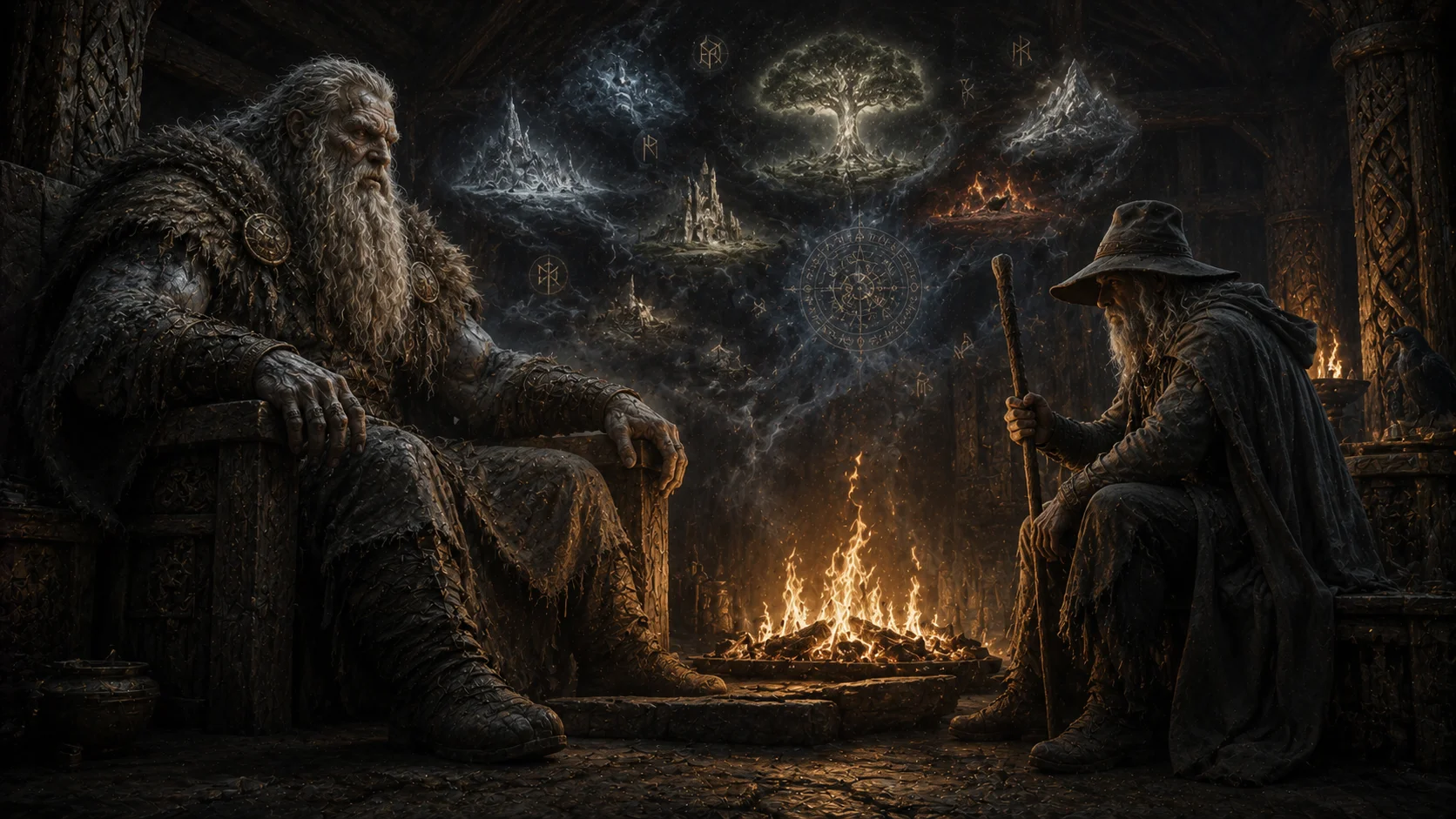
Vafthrudnir was the wisest of all the Norse giants — an ancient jötunn of immense knowledge who engaged Odin himself in a deadly contest of wisdom, a riddle-duel in which the loser would forfeit his head. His battle of lore with the disguised All-Father is one of the great wisdom-contests of Norse myth, a duel fought not with weapons but with knowledge of the cosmos itself, and it survives today through a single source: the Poetic Edda poem Vafþrúðnismál, which consists almost entirely of this one exchange.
A Name Woven from Riddles
Vafthrudnir (Old Norse Vafþrúðnir) carries a name that scholars read as something like "mighty in tangles" or "the weaver of riddles" — a fitting title for a being whose entire mythological presence is built from entangled questions and answers. He is called, within the poem itself, inn alsvinni jötunn: the all-wise giant. No other epithet is given to him with such insistence, and none is needed. Wisdom is not merely his trait; among the jötnar it is his identity, the single quality by which the poem asks a reader to know him.
Last updated .
A Giant Who Had Fared Wide
Vafthrudnir was said to have travelled through all nine worlds, and it was this breadth of experience — not mere cleverness — that gave his knowledge its weight. He had seen the roads between realms, and what he had not seen firsthand he had gathered into memory: the deep lore of the cosmos, stretching from its first shaping to its final ruin. It was this reputation, carried even to Asgard, that eventually drew a visitor to his hall. A being who has walked every world has, in a sense, already answered every question the world can pose — and it is precisely that completeness that Odin sets out to test.
Frigg's Warning
Odin, restless in his hunger for wisdom, resolved to match his knowledge against the giant reputed to hold more of it than any other being alive. His wife Frigg warned him against the journey, fearing for him — for no jötunn was accounted mightier in cunning and lore than Vafthrudnir, and a contest with him was no small risk. Odin went anyway. He set out from Asgard in disguise, giving himself the name Gagnráðr, a traveler with no house and no title, revealing nothing of who he truly was. Even the wisest of the gods, it seems, could not resist the pull of a wisdom he had not yet measured himself against.
The Wager of Heads
At the giant's hall, the disguised god proposed a contest of wisdom. Vafthrudnir, confident in his own vast learning, agreed — but only on terms with real teeth: whoever failed to answer a question correctly would forfeit his head. It was not a game. It was a duel in which knowledge itself was the weapon, and the stake was life. Vafthrudnir first tested his visitor to see whether "Gagnráðr" was even worth the risk of a full contest, sizing up the stranger before committing his own head to the bargain.
Gagnráðr Answers First
The giant opened with questions any traveler versed in the basic shape of the cosmos might be expected to know: the names of the horses that draw day and night across the sky, the name of the river that separates the lands of gods and giants — Ífing — and the name of the field where the last battle of the world will be fought — Vígríðr. The disguised Odin answered each one without hesitation. Satisfied that his guest was no fool, Vafthrudnir invited him to sit as an equal, and the terms of the wager took full effect: the questioning would now run both ways, in earnest, host and guest each staking the same life on the same rules.
Turning the Riddle Around
With the roles reversed, it was Odin's turn to press the giant on the deepest matters of cosmology — the very territory Vafthrudnir was famed for holding. He asked of the origin of earth and sky, of the sun and moon, of the winds that move across the world. Question by question, the giant answered, and answered correctly, drawing on lore that reached back before the gods themselves. Nothing in Odin's questioning yet distinguished a god from any other seeker of knowledge; the giant met every one of them on equal footing.
Ymir's Blood and Bergelmir's Boat
Among the deepest of Odin's questions concerned the origin of the jötnar themselves, and here Vafthrudnir's answer reached to the very root of things. He traced the giants back to Ymir, the primordial giant from whose body and sweat other beings were born. From that lineage came Bergelmir, who — together with his wife — survived a great flood by escaping in a boat, or a hollowed-out log, and became the ancestor of all the frost giants who followed. It was genealogical knowledge of a depth that matched, and in places exceeded, what even the Æsir themselves were said to know of their own oldest enemies — the giant reciting his own people's origin more fully than the gods who had long contended with them.
Into the Shadow of Ragnarök
Odin's questions did not stop at the beginning of the world; he pressed on toward its end. He asked of the events of Ragnarök, of who among gods and giants and their kin would live to see the world remade after the final battle. Vafthrudnir met these questions too, laying out what he knew of the doom awaiting the cosmos and what — and who — would endure past it. Through his voice, more of the architecture of the Norse end-times was set down than through almost any other single account, a giant's memory preserving the shape of the gods' own ending.
The Question No One Else Could Answer
Then Odin asked one question more. He asked what he himself — Odin — had whispered into the ear of his son Baldr before Baldr was laid upon the funeral pyre. It was not a question about the world. It was a question that only Odin could possibly answer, because only Odin had spoken those words, and only Odin had heard them said. No traveler, however wide his wanderings, could carry an answer he had never been given — the entire contest turning, at its very last moment, on a single fact that lay outside the reach of even the most fared-wide knowledge in the nine worlds.
Vafthrudnir Knows His Guest
In that instant, the giant understood. No one but the All-Father himself could have asked such a question, and Vafthrudnir realized that the guest he had welcomed to his hall, sat as an equal, and wagered his head against, was Odin. The wisest of the jötnar had spent the whole contest facing the one being whose knowledge could never be matched, because part of it belonged to him alone — a truth the guise of "Gagnráðr" had kept hidden until this final exchange made it unmistakable.
A Doomed Mouth
Vafthrudnir's concession is recorded almost as a lament: with a doomed mouth, he said, he had spoken of old lore and of runes — acknowledging that in contesting wisdom with Odin he had spoken his own doom into being. He granted that Odin was, and would always be, the wisest of all. The wager had named its price plainly at the outset, and the giant had lost. The poem itself ends at this concession, at the moment of recognition and surrender, without narrating what became of him afterward — the contest closing not on a killing blow but on an admission, wisdom answering wisdom to the very last line.
Wisdom Without a Genealogy
Unlike many jötnar who appear across several tales bound to parents, spouses, or children, Vafthrudnir has no attested genealogy and no other myth. He exists, in every surviving source, only within the walls of his own hall and only for the span of this single contest. It is a narrow textual footprint for a figure who nonetheless looms large — his entire mythological weight compressed into one duel of questions, with nothing before it and nothing after.
The Hall Where the Cosmos Was Spoken
Vafthrudnir's hall is remembered chiefly as the setting for the contest — the place where a wandering god and the wisest of giants sat across from one another and traded the shape of the universe like currency. It holds no other stories, no other visitors of note. Its only fame is the conversation that once filled it, a single room in which the origin of the giants, the names of Ragnarök's players, and the fate of the world itself were all, for one exchange, spoken aloud.
A Voice the Cosmos Speaks Through
What makes Vafthrudnir enduringly significant is not only the drama of his fall but the sheer density of cosmological detail delivered through him. Alongside a handful of other wisdom poems, Vafþrúðnismál is one of the primary sources for what is known of Norse cosmology and cosmogony — the shaping of earth and sky, the ancestry of the giants, the horses of day and night, the coming end of the world. Much of that knowledge exists, for readers today, specifically because it was once spoken in the voice of a giant who believed, until the very last question, that he could not be beaten.
The wisest of all giants matched the All-Father riddle for riddle on the secrets of the cosmos — until Odin asked what he had whispered to dead Baldr, the one question only a god could know, and with a doomed mouth Vafthrudnir named him victor.