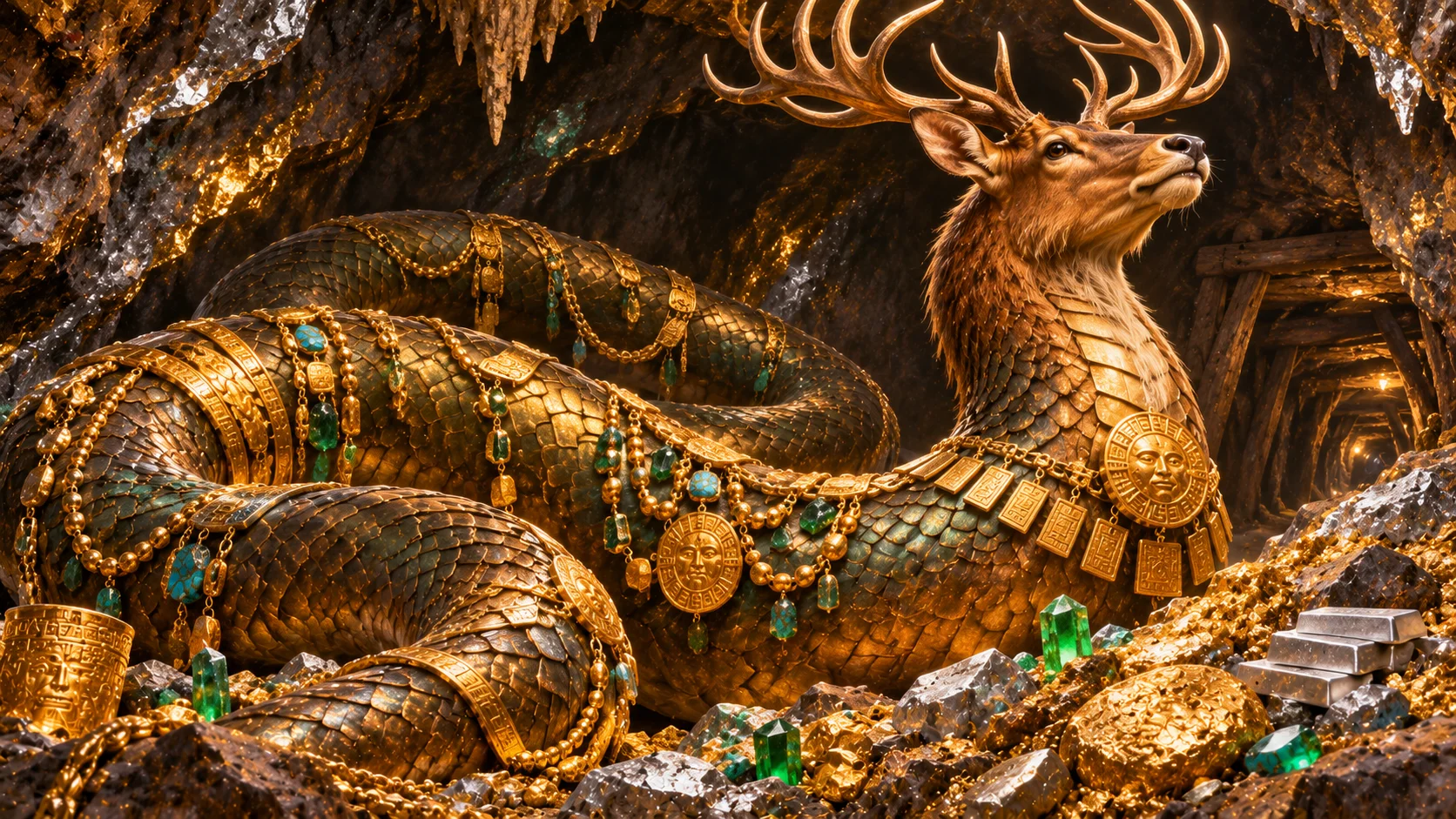
Urcaguary (also spelled Urcaguari, Urkawari or Urcaguay) is a name found in modern lists of Inca gods, where it is given to a deity of metals, jewels and buried treasure, said to live beneath the mountains and to guard the wealth of the earth, and described as a serpent with a deer’s head and with gold chains and precious stones hanging from its tail. These descriptions are not traced to any source here. What it does not do, so far as the early sources consulted show, is turn up in the Spanish chroniclers or in the Huarochirí manuscript. The thinness of the evidence is the first fact about Urcaguary, and an honest account has to begin there. What can be written with confidence is the context: how the Incas and their Andean neighbours treated mines, metals and the serpents of the underground, what the colonial writers actually reported, and which neighbouring figures should not be confused with him.
What the Modern Lists Say
The descriptions of Urcaguary are consistent with one another and almost identical in wording. He is the deity of metals, jewels and other valuable things under the ground. He is said to dwell beneath mountains and to protect metals and jewels from people who would steal them. His body is that of a snake and his head that of a taruka, the Andean deer, and gold chains and precious stones are attached to his tail. A related entry, Hurkaway, a guardian snake, is said to be Urcaguary under another name. A Spanish-language list places him among the minor or regional deities and calls him the chthonic divinity of metals.
None of these entries carries a footnote. Popular web pages that elaborate on him add attendants, offerings and priests, and they too give no source. One of them says that he is drawn from “ancient texts and oral traditions,” and names none. The repetition across sites is evidence that the pages copy one another, not evidence of an early source.
Looking for the Name in the Early Sources
The most complete Spanish description of Inca religion is Bernabé Cobo’s Historia del Nuevo Mundo, completed in 1653 and first printed in the nineteenth century. Its book on the religion of the Andean peoples lists sacrifices, shrines and many named huacas, in Cuzco and across the empire. In the printed edition consulted the name Urcaguary, and variants of it, do not occur; the nearest name is Urcuchillay, a star, discussed below.
The same absence holds for the other major sources examined. The report of Cristobal de Molina on the fables and rites of the Incas, the report of Polo de Ondegardo, the Spanish report of Francisco de Ávila on the religion of Huarochirí, and the account of Santa Cruz Pachacuti Yamqui, all in Clements Markham’s English volume of 1873, do not name him. Nor does the Quechua Huarochirí manuscript in its Salomon and Urioste translation. Two early twentieth-century handbooks of American mythology, Lewis Spence’s of 1913 and Hartley Alexander’s of 1920, do not include him either.
This kind of negative result has limits. A scanned text can be misread, the spelling of Quechua names in Spanish varied widely, and there are inventories of huacas not examined here, such as the one compiled by the extirpator Cristóbal de Albornoz in the 1580s. It is possible that a passage exists under a different spelling. But it is also a fair statement that if Urcaguary was a well-attested Inca god, he would be expected in Cobo, who is the most complete source on exactly this subject, and he is not there. Until a primary source is produced, Urcaguary should be described as a name of modern compilations whose origin is unknown, and not as a documented Inca deity.
The name itself gives little help. The first part resembles the Quechua word urqu, which means a mountain and also a male animal, and a mountain-dwelling being would suit the description, but no early source or dictionary entry located establishes an etymology, and a plausible resemblance is not evidence.
What the Colonial Writers Did Say About Mines
If the god is missing, the cult of mines and metals is not. In his chapter on the objects of worship of the Andean peoples, Cobo reports that those who went to mines revered the hills in which the mines lay and the mines themselves, which he says they called coya, asking them to give them of their metal; to obtain what they asked they kept vigil at night, drinking and dancing in reverence for the hills. They revered also the metals, which he says they called mama, and the stones of the metals, called corpas, which they kissed and used in other ceremonies; the metal called soroche; silver itself; the guairas, the portable furnaces in which ore was smelted; the nuggets and grains of gold and the gold dust; and the red mineral pigment, llimpi, which was highly valued for ritual. Anything in nature that struck them as notable or different, he adds, they revered as the seat of some particular divinity, even small shining, coloured pebbles that they kept polished and prized.
Three points stand out. The word for the ore is mother, mama, the same word that names the goddess earth; what is below is a generative source. The word coya that Cobo gives for the mine is the same as the modern Quechua word for a vein and for a queen. And what is worshipped is a family of substances and tools, not a single lord. Cobo explained this as the work of the devil, but his catalogue is the best contemporary evidence for the actual practice, and in it there is no named master of metals and no serpent.
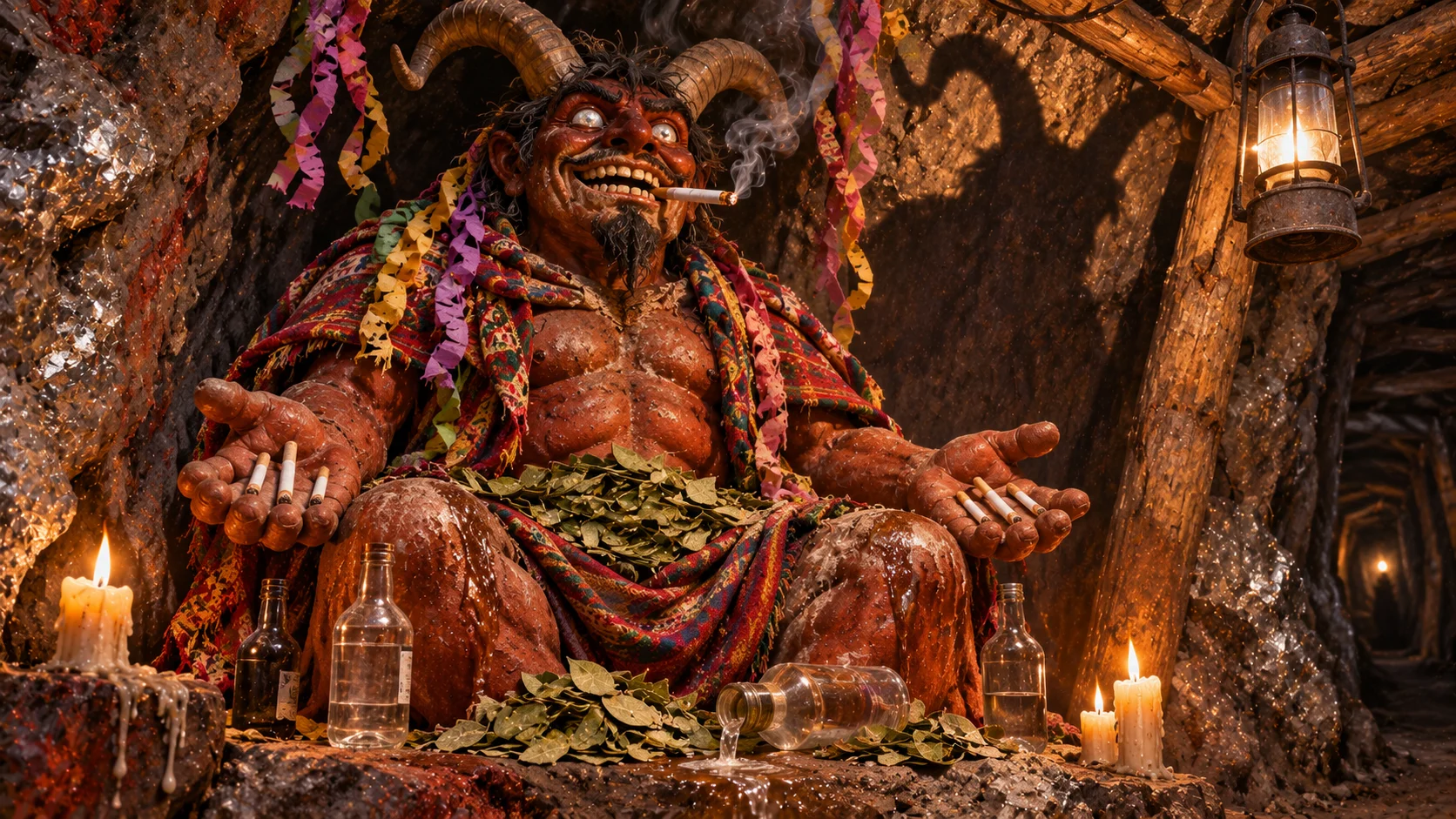
Cobo also listed the figures that the people made. Among the idols of silver, gold, wood, stone and clay, some had human form and others the shapes of animals, fish, birds and plants; the animals included llamas, snakes, toads and macaws, and ears of maize. He observed that the animal and plant images were usually better made than the human ones, and that the human ones had such ugly, deformed faces that they showed themselves to be portraits of the one in whose honour they were made, whom he took to be the devil. Snakes and toads appear on his list, a point of interest because both appear as companions of El Tío in the mines of Potosí today. It is an echo, not a proof of continuity.
The Mountain That Belonged to Others
The most informative colonial stories about metals are about Potosí. A legend, set down by Arzáns de Orsúa y Vela in the eighteenth century and paralleled in Capoche’s account of 1585, says that when the Inca Huayna Capac sent workers up the Cerro Rico they heard a voice telling them not to take the silver, because it was for other owners; they fled, and the name Potosí was said to come from the roar they heard. The historian Carmen Salazar-Soler observes that the Cerro Rico was a huaca, and that huacas were often associated with hidden treasure. The tale makes the metal belong to the mountain and the mountain to a power with its own intentions, which is the idea the modern lists express in a more picturesque form. It gives no name and no shape.
Mining under the Inca was real. The neighbouring mine of Porco was worked for the Inca, and Pascale Absi writes that the silver of the Cerro was probably worked on a small scale in open workings before the Spanish arrived. The chroniclers describe gold in the Qorikancha, the principal temple at Cuzco, as closely tied to the sun; but the Spaniards seized and melted most of the great objects, so that little survives and such descriptions rest on the chroniclers.
Serpents of the Underground
Serpents are, however, part of the picture. The amaru is the great mythic snake of Andean thought, associated with water, disorder and transition. In the Huarochirí manuscript Huallallo Caruincho looses a two-headed amaru on the god Pariacaca, who stabs it with a golden staff and turns it to stone, and the text says that the petrified serpent is still to be seen, and that people strike it and carry off the chips as medicine. Here, in an indigenous text, a serpent becomes rock and the rock is put to use. It is as near as the early literature I consulted comes to a link between the serpent and the stuff of the earth, and it concerns stone, not treasure.
Cobo also reports that the royal insignia of the Inca lineage were the rainbow and two serpents laid parallel to the royal fringe, and colonial writers tell of Atahualpa claiming, after an escape from custody, that the Sun had turned him into a snake. The snake is a sign of power and transformation in Inca royal symbolism, but these are royal and celestial snakes and not guardians of treasure.
Modern miners give the picture its most vivid content. In Absi’s account the mountain is a pregnant womb in which minerals grow and ripen; she cites, from the Julcani mines in Peru, a myth that the minerals were born of a pair of mythical serpents, and she reports a belief in Potosí that the Pachamama, as an old woman, spins the metal veins inside the mountain on the orders of the Tío. A serpent, said to stand for greed, accompanies the Tío’s image. These living beliefs show that the association of snakes and ore is real in the Andes. It does not show that a god called Urcaguary was part of it.
Urcuchillay, a Different Being
The name that resembles Urcaguary, and the one most often confused with it, is Urcuchillay, and the difference should be kept clear. Cobo describes how the herders respected and made sacrifices to the star group that the astrologers call Lyra, which they named Urcuchillay; they said that it was a many-coloured ram, in the Spanish of his time carnero, the usual word for the llama, and that it was in charge of the preservation of the flocks. Two small stars below it, in the shape of a T, were said to be its feet and its head. Nearby, a star they called Catachillay and a smaller one were a llama with her young, said to have come from Urcuchillay. Cobo adds that those who lived in the forested lowlands sacrificed to another star, Chuquichinchay, a jaguar, asking that wild beasts should do them no harm.
Urcuchillay is, therefore, a documented sky-llama, a patron of herders and flocks, with a recorded identification and an attested cult. He has no connection to metals. Later ethnography in the Cuzco region, notably that of Gary Urton, describes a llama formed of dark clouds in the Milky Way, a different kind of sky-figure, so that more than one sky-llama is described in the literature, and identifications of the star Urcuchillay itself are not agreed in every source. None of this touches the underground.
Other Names Not to Confuse
Several other figures are sometimes met in the same lists, and they belong elsewhere. Urpay Huachac is described in María Rostworowski’s work as a goddess of fish and sea birds, a coastal figure and not a mountain one. Pachamama is the earth, and Supay a word for a shade or spirit that Christian translators bent into “devil.” Amaru is the serpent of water and the underworld, not a lord of treasure. Mama Allpa, a name from the same sort of lists, is similarly thin in its sources. A reader looking for an early Andean figure who rules over metals will find, in the documents, the mountain, the mine, the ore and the metals themselves treated as animate, and in the twentieth-century field accounts a living figure, El Tío. For that figure there is rich ethnography.
El Tío and the Guardian of the Treasure
Modern writers sometimes present Urcaguary as the pre-Hispanic ancestor of El Tío, the lord of the veins in the mines of Bolivia. The idea is attractive, since both are owners of underground wealth and both are linked with snakes. It is not supported by a document. El Tío as ethnographers describe him is shaped by the colonial mine, by the Spanish word for the devil and by the miners’ own history of the mita; the stories he generates, of a fallen angel or a buried mountain-guardian or the dead mitayos, are told by the miners themselves, and none of them names Urcaguary. A serpent guarding treasure is also a motif found in many traditions of the world, so the image could easily have been supplied by a compiler without any Andean source behind it.
How to Use the Name
The responsible form of a sentence on this subject is brief: Urcaguary is a name found in modern lists of Inca deities for a god of metals and underground treasure, depicted as a serpent with a deer’s head; no sixteenth- or seventeenth-century source consulted names him, and the details of his form and cult cannot be verified. What can be said firmly is that the Andean peoples revered mines, ores and the underground, that they spoke of ore as mama, that serpents and mineral veins are tied together in the Huarochirí narratives, and that the mountains of metal were regarded as owned by powers other than the people who dug them.
This matters for respect as well as accuracy. The living Andean mining tradition has its own figures and its own rites, and it is better served by being described as it is documented than by being given a missing ancestor.
Sources & traditions
- TraditionIncan texts, oral tradition and village tellings (Andes)
Myths change from area to area and from time to time. This chronicle follows the most widely told versions; tellings in other villages, regions and eras may differ.