Suttungr was the Norse jötunn who came to hold the Mead of Poetry — the drink brewed from a slain wise being's blood that grants the gift of verse and learning — and who lost it forever to the cunning of Odin. Snorri Sturluson tells his story at length in the Prose Edda's Skáldskaparmál, within the frame-narrative Bragarœður, and the Poetic Edda's Hávamál lets Odin himself recall the theft in his own words, an older and independent witness to the same tale.
Blood, Honey, and a Debt Not Yet His
The mead did not begin with Suttungr at all. It began with Kvasir, a being of surpassing wisdom, whom two dwarves named Fjalar and Galar killed and drained. They mixed his blood with honey, and what resulted was a mead so potent that whoever drank it became a poet or a scholar. The dwarves kept this treasure for themselves — until their taste for killing reached further than it should have.
Last updated .
A Father Drowned, a Mother Crushed
Fjalar and Galar next turned on Suttungr's own family. His father, the giant Gillingr, was drowned by the dwarves; his mother was killed when the dwarves dropped a millstone on her. Suttungr did not let this pass. He seized the two dwarves and hauled them out to a skerry that the tide would soon cover, and there, with the rising water as his argument, he gave them a choice. Their lives, in exchange for the mead. Faced with drowning, Fjalar and Galar surrendered the whole of Kvasir's mead to him as weregild — the formal compensation owed for a killing — for his father and his mother both.
What Weregild Meant on That Skerry
Weregild was, in the world this story assumes, a settled and recognizable idea: a killing created a debt, and that debt could be answered with payment rather than with further killing, if the wronged party accepted it. Suttungr did not invent this exchange; he simply held the tide as leverage until the dwarves agreed to pay it in the only currency they had that was worth two lives — the mead itself. The story does not describe him negotiating a price. It shows him choosing the drowning skerry, waiting for the water to rise, and taking payment in full once the dwarves saw no other way off the rock. In that sense the mead changed hands twice before it ever reached a mountain: first as murder's plunder, taken by dwarves from a slain being's blood, and second as weregild, taken by a grieving son from his parents' killers.
The Mountain of Hnitbjörg
What Suttungr won on that skerry he did not spend or share. He carried the mead home and hid it deep inside a mountain called Hnitbjörg, sealing it away from gods, giants, and men alike. To stand watch over it he set his own daughter, Gunnlöð, inside the mountain — the mead's sole guardian, alone with the one thing every seeker of wisdom in the nine worlds would eventually come looking for. For a time, it worked. The mead sat beyond reach, and Suttungr held, without quite realizing it, the most contested prize in the Norse cosmos.
A Wanderer Named Bölverkr
Odin wanted the mead, and Odin did not ask for things twice. He traveled into the giants' realm under a false name, Bölverkr — "evil-doer" — a name that told the truth about his intentions to anyone who might have listened closely enough to notice. He found Suttungr's brother, the giant Baugi, and by trickery and false labor won his help. Together they set about boring a hole clean through the rock of Hnitbjörg, using an auger called Rati, until the mountain that Suttungr trusted to keep his treasure safe had a passage running straight into its heart.
The Serpent in the Stone
Through the hole Rati had cut, no giant or man could have passed. Odin was neither, when he chose to be. He turned himself into a serpent and slid through the narrow bore Baugi had helped make, emerging inside the mountain in the very chamber where Gunnlöð kept her long, solitary watch. What Suttungr had built to be uncrackable had a single flaw: it had been dug from the inside by his own brother's hands, and guarded by his daughter alone.
Three Nights, Three Vessels, One Draught Each
Inside Hnitbjörg, Odin turned from serpent back to guest, and spent three nights with Gunnlöð. In exchange, she granted him three drinks of the mead — a bargain that sounds modest and was anything but. The mead was kept in three vessels, Óðrerir, Boðn, and Són, and Odin's three drinks were three vessels entire. In three gulps, he emptied the whole of what Suttungr had won at the skerry and hidden inside the mountain — everything Gunnlöð had been set to guard, gone from her keeping in a single night's reckoning.
Two Eagles Over the Mountains
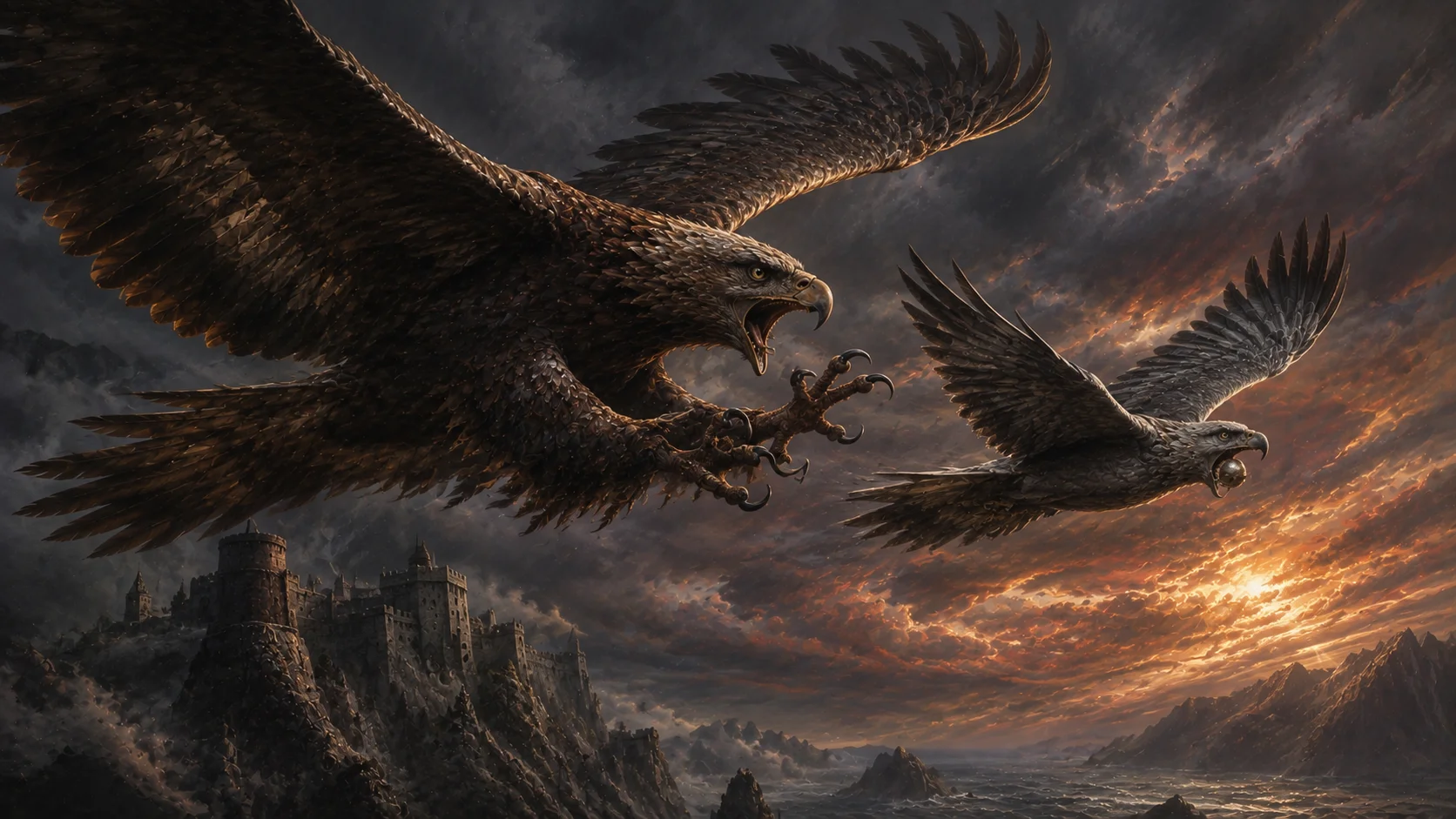
Mead inside him, Odin shed his human shape a second time and took the form of an eagle, beating for the sky and for Asgard, carrying the whole of the world's poetry inside his own body. Suttungr discovered the theft — his daughter's trust spent, his father and mother's weregild gone from the mountain in a single night — and gave chase in the only way that could hope to catch a fleeing eagle. He became an eagle himself, and the sky above the giants' land filled with two great birds, one flying for its life and its prize, the other flying to reclaim what should never have left his mountain at all.
Over the Walls of Asgard
Suttungr closed the distance. He was near enough, as Odin neared the safety of Asgard's walls, that the chase itself nearly ended the theft before it was complete. The Æsir, seeing Odin's eagle-shape bearing down on home ground with Suttungr close behind, set out vessels along the wall to catch what was coming. Odin cleared the wall and spat the mead out above the waiting containers, and the greater part of Kvasir's gift — brewed from his blood, avenged in a father and mother's deaths, guarded by a daughter, stolen by a god — came to rest at last among the Æsir.
The Portion Given to No One in Particular
Not all of it arrived clean. In the desperate last stretch of the chase, with Suttungr all but on him, some of the mead was expelled from Odin the other way — voided in haste and fear rather than delivered with any care or aim. This portion the Æsir did not prize or guard; it is said to have been given out to anyone who wanted it, with no condition attached and no honor in the having of it. Snorri's telling makes this the origin of the "rhymester's share" — the explanation offered for why some verse in the world is fine and some is not: the good mead went over the wall with intention, and the rest went to whoever would take it.
A Chase the Story Leaves Unfinished
Suttungr does not catch Odin. That much the myth is clear about. What became of Suttungr afterward, the myth itself does not say — his pursuit ends at the walls of Asgard, and the text simply moves on to what the mead became rather than what its keeper became once it was gone. Later giant-conflict traditions are sometimes read as counting him among giants who met their end at the hands of the gods, but that fate is not narrated within the mead story itself, and it belongs to a wider and more uncertain body of tradition rather than to this telling. Scholars who raise the point tend to do so cautiously, precisely because the silence is total: no death scene, no final reckoning, no line stating that the debt of the eagle-chase was ever settled one way or the other.
Odin's Own Account, in Hávamál
The theft is not Snorri's telling alone. In the Hávamál, in the stanzas belonging to its Rúnatal section — numbered roughly 104 to 110 — Odin himself looks back on the episode and recounts tricking Suttungr, a first-person corroboration, in verse likely older than Snorri's prose retelling, that the mountain, the guarding daughter, and the theft of the mead were already fixed points of the tradition well before the Prose Edda set them down in full. That two separate texts, composed in different forms and very likely different centuries, agree on the shape of what happened at Hnitbjörg is part of why the episode is treated as one of the more securely attested pieces of Norse myth, rather than as Snorri's invention alone.
A Name Weighed Down by What He Kept
Suttungr's name is often read as carrying a sense of "heavy with drink," a gloss that scholars debate rather than settle, but one that sits naturally against the shape of his story regardless of its precise root — a giant defined, in every surviving account of him, by the drink he held, guarded, and ultimately could not keep.
What the Mountain Cost Him
Suttungr's place in the myth is fixed by loss rather than by conquest: a father drowned, a mother crushed, a debt collected in mead at the edge of a drowning tide, a mountain built to keep that mead safe forever, a daughter set to guard it, and then a serpent through a hole his own brother helped bore, three nights he could not prevent, and two eagles racing for a wall he did not clear in time. Every step Suttungr took to secure the mead — vengeance, concealment, kinship, guardianship — became, in turn, the exact thing Odin turned against him. What passed from dwarves to giant to god did not pass through cunning alone; it passed through a debt of blood that Suttungr collected rightly, and a treasure he then could not hold.