Gunnlod was the giantess who guarded the Mead of Poetry deep within a mountain — the daughter of Suttungr, who was seduced (or won over) by Odin in his quest to steal the precious mead, and who let the disguised god drink it all in three great draughts. Her tender, ambiguous part in the theft of poetry is one of the most poignant threads in that famous myth.
A Daughter Set to Watch Over Wonder
Gunnlod (Old Norse Gunnlöð) was a jötunn, one of the race of giants who stood, more often than not, in tension with the gods of Asgard. She is remembered for a single episode, but it is an episode that sits at the very root of poetic inspiration itself, and no other independent story about her survives. She appears in the Prose Edda, in the section called Skáldskaparmál ("the language of poetry"), and she is referred to again, more intimately, in the Poetic Edda's Hávamál, where Odin himself speaks of her in his own voice, looking back. Nothing else of her lineage is recorded beyond her father's name — no mother, no siblings, no household besides the mountain she was set to keep.
Last updated .
The Mead That Was Born of a Killing
To understand what Gunnlod guarded, the story must first go back to her father. Suttungr was a giant whose parents, Gilling and his wife, were killed by the dwarves Fjalar and Galar. Suttungr took his vengeance and forced from the dwarves, as compensation for the killing, the treasure they had brewed: the Mead of Poetry, made from the blood of the wise being Kvasir. Whoever tasted this mead — called Óðrerir after one of the three vessels that held it — gained the gift of poetry and wisdom. It was, in the mythic imagination of the skalds, the very source of verse: to drink it was to become a poet. Gunnlod's story cannot be separated from this frame narrative; she enters the myth only because her father chose to hide the compensation he had extracted rather than let it circulate among gods or men.
Hnitbjörg, the Mountain of the Mead
Suttungr did not trust so precious a thing to open air. He carried the mead deep inside a mountain called Hnitbjörg and set his own daughter Gunnlod to guard it there, in the rock, in the dark, at the very heart of the mountain. She held the mead in three vessels — Óðrerir, Boðn, and Són — and kept watch over them on her father's orders, the sole keeper of the source of all poetry, sealed away from gods and men alike. The task fell to her, not to some hired guard or monstrous ward; whatever else the myth grants her, it grants her father's trust in that one respect.
A God in Search of What He Should Not Have
Odin, who hungered for wisdom and power above nearly everything else, set his mind on the mead. He would not ask for it, and Suttungr would not have given it. So Odin went by guile instead — he made his way to the mountain, and where the rock itself stood between him and the mead, he took up the auger called Rati and bored a hole straight through the stone. Every step of the approach, from the borrowed auger to the shape he would next assume, was deception aimed squarely at the one obstacle left between him and Hnitbjörg's chamber: Gunnlod herself.
The Serpent in the Stone
Once the hole was bored, Odin changed his shape. He became a serpent and slid through the narrow passage he had carved, down into the darkness of Hnitbjörg, until he came out inside the very chamber where Gunnlod sat guarding the mead. There was no other way in; the mountain had been sealed against every ordinary approach, and it took a god willing to become something other than a god to reach her. Whatever greeting passed between a giantess accustomed to solitary vigil and a serpent that arrived through solid rock, the sources do not preserve — only that he stood before her, and that what came next was neither violence nor immediate flight.
Three Nights in the Heart of the Mountain
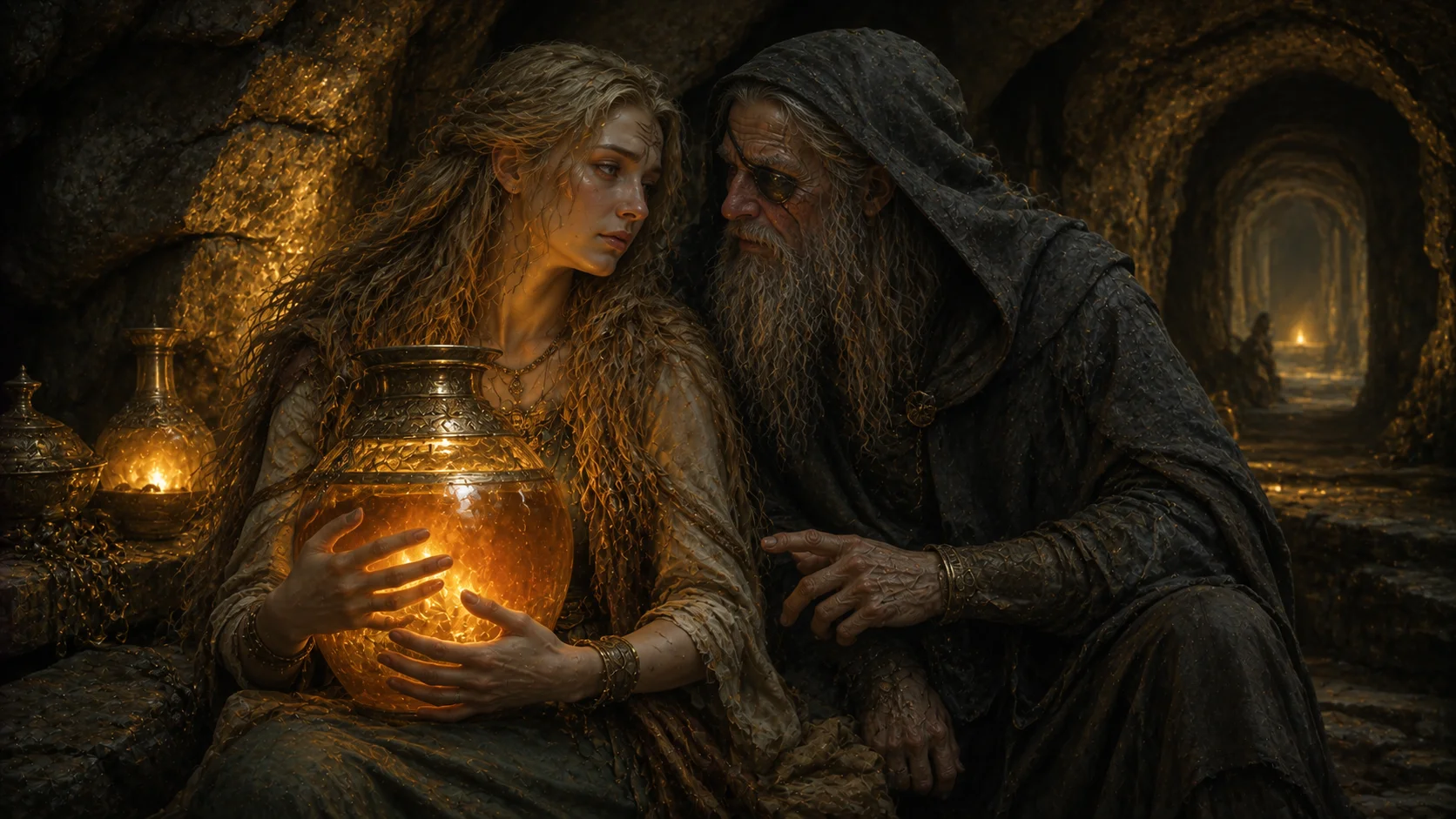
What followed, the sources tell with unusual tenderness for a myth so often given over to conquest and cunning. Odin remained with Gunnlod for three nights, sharing her bed in the chamber where she kept her watch. In return — whether for the nights themselves, or for whatever else passed between them in that time — she agreed to grant him three drinks of the mead she guarded, one draught from each vessel. It is worth naming plainly what the sources do and do not say: they record the nights, the bed, and the bargain of three drinks, and nothing further about affection, persuasion, or her state of mind at the time — that comes only afterward, and only in Odin's own retrospective words.
What Hávamál Remembers
It is in the Hávamál, stanzas 105 and 108 through 110, that the episode is given its most human weight. There Odin speaks of Gunnlod as "the good woman" whom he took in his arms, and the verses recall that she wept in sorrow when he departed. It is a rare moment in the mythic corpus — one of the very few places where a poem built almost entirely around Odin's own cunning turns, if only briefly, to name what the deception cost the woman on the other side of it. The sympathy is Odin's own admission, spoken in hindsight, not a judgment laid on him by some outside voice. No other figure in the surviving corpus is granted quite this treatment: a betrayer's own poem, pausing mid-boast to record the grief of the one he betrayed.
Three Gulps, Not Three Drinks
Gunnlod had promised Odin three drinks. He took her at her word only in the letter of it. In three vast gulps he drained each vessel entire — Óðrerir, Boðn, and Són — until nothing of the Mead of Poetry remained inside the mountain at all. What had been offered as three modest draughts became, in Odin's mouth, the whole of Suttungr's treasure, taken down to the last drop. The scale of the mismatch is the point of the episode as the skalds told it: a bargain kept in wording and broken in every sense that mattered to the one who made it.
The Eagle's Flight from Hnitbjörg
With the mead entirely inside him, Odin shed the shape he had worn to reach her. He became an eagle and took to the air, flying hard for Asgard with Suttungr's mead — and Gunnlod's trust — carried off inside him. He left her behind in the mountain chamber where she had kept her long watch, the vessels empty, the bargain broken the moment it no longer served him. Suttungr himself gave chase in eagle form once the theft was discovered, but that pursuit belongs to Odin's flight and to her father's loss, not to any further part played by Gunnlod, who is not recorded as having any further role in the episode's end.
A Question Left Unsettled
A later strand of tradition, referenced only obliquely and treated by those who study the sources as uncertain rather than established, holds that Gunnlod may have borne Odin a son from those three nights. The core Eddic sources do not state this plainly, and it survives as a disputed, minor thread rather than settled myth — worth naming, but not worth building into more than the sources themselves will bear. No name, no later deeds, and no independent account of such a child appear anywhere in the primary material; the claim exists at the edge of the tradition, not within it.
Her Name Pressed into the Language of Poets
Long after the episode itself, Gunnlod's name lived on in the diction of the skalds. In skaldic verse, poetry itself was sometimes spoken of through kennings tied to her — formulations invoking "Gunnlod's gift" or the like, reaching back to the mead she once held sealed inside Hnitbjörg. Every poet who reached for such a kenning was, in effect, naming her as the last guardian the mead had before it left the world of giants for the world of gods — a small but durable form of remembrance, carried in language rather than in narrative.
A Giantess Who Was Deceived, Not Defeated
Gunnlod belongs to the broader race of jötnar, who stood generally opposed to the Æsir, yet her own place in the myths is not one of battle or open conflict. She was not overcome by force; she was deceived by a god who came to her in disguise, stayed three nights, and left with everything he had promised to take only a portion of. No husband and no other children beyond the disputed son-tradition are attested for her — her entire remembered life is these three nights and their aftermath. Unlike giants who appear across several tales as recurring adversaries of the gods, her presence in the tradition begins and ends inside Hnitbjörg.
Read Again in Later Hands
In modern retellings, Gunnlod surfaces almost entirely within versions of the mead-of-poetry myth itself, rather than in any story of her own invention. Feminist and revisionist readings of Norse mythology have increasingly turned to her not as a footnote to Odin's triumph but as its counterweight — emphasizing the betrayal she suffered rather than treating the episode purely as another clever conquest by the god who wanted wisdom more than he wanted to keep his word. That later attention has not added new events to her story; it has simply asked readers to weigh the three nights, the bargain, and the weeping recorded in Hávamál on their own terms rather than as mere prelude to Odin's victory.
She guarded the source of all poetry in the heart of her mountain and gave it, for love or trust, to a disguised god — who drank it dry in three gulps and flew away, leaving her with empty vessels, a father's broken treasure, and a grief the poems themselves did not forget to name.