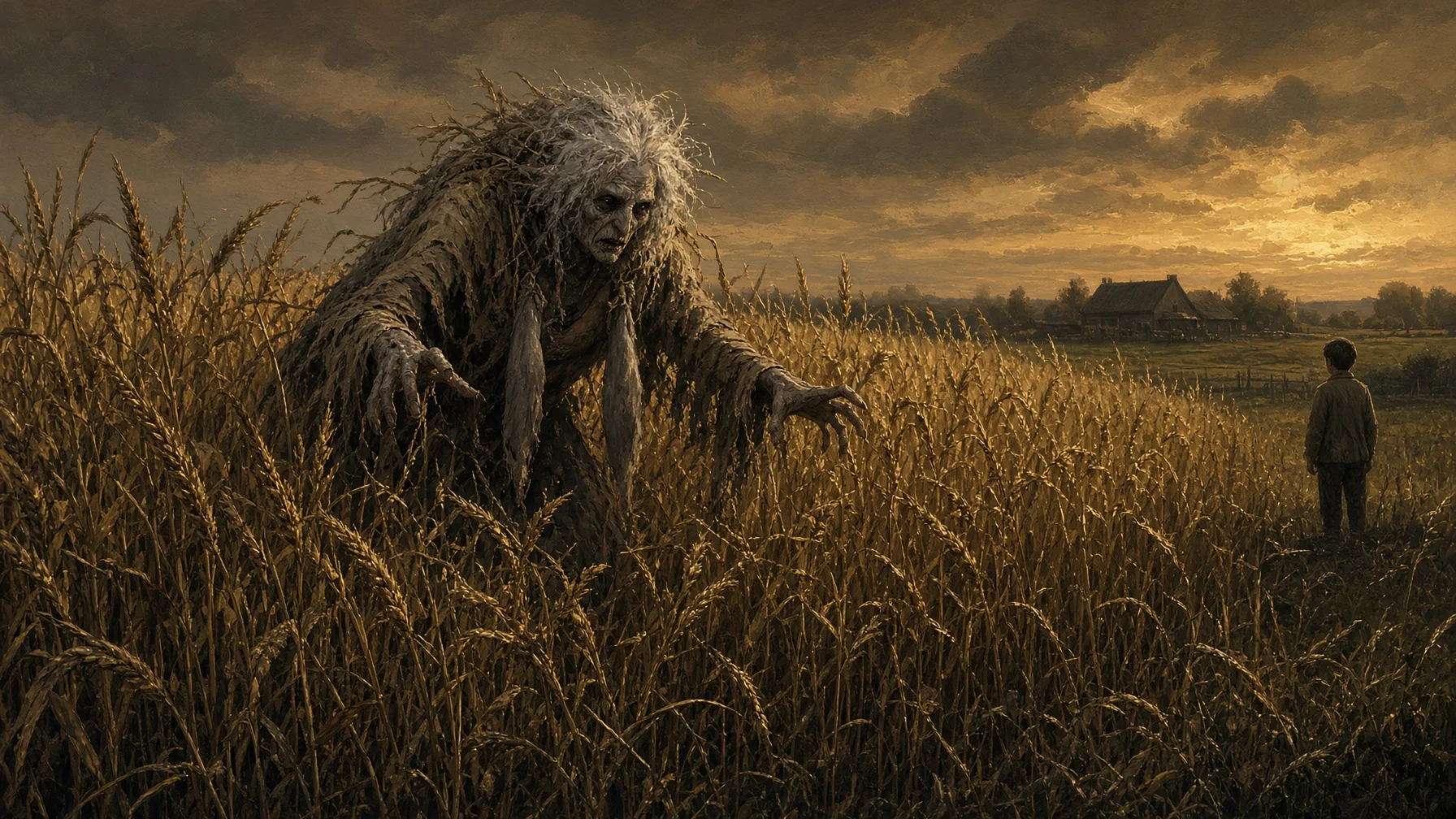
Gerd was a giantess of such radiant beauty that her loveliness lit the sky and sea — the reluctant bride won for the god Frey, whose courtship cost the god his magical sword and so, in the end, his life at Ragnarök. Her story, told in the eddic poem Skírnismál and retold by Snorri Sturluson, is the great Norse tale of love-longing, of beauty so dazzling it drove a god to sickness, and of the high price desire exacts.
The Daughter of Gymir
Gerd — Old Norse Gerðr — was a jötunn, a giantess, born to the giant Gymir. Snorri's account names her mother too: Aurboða, herself called a giantess, of the frost-born peoples who dwelt beyond the reach of the gods in Jötunheimar. Gerd is named plainly and repeatedly in the sources as jötunn and gýgr — there is no softening of her lineage, no hidden divine blood smoothing her into something more palatable to Asgard. She was, in the reckoning of the myth, wholly of giant-kind, and that fact is what makes what follows remarkable: her marriage to a god of the Vanir was not the usual adversarial clash of Æsir and jötnar but a formal, sanctioned union, one of the clearest such alliances in the surviving Norse corpus.
Last updated .
A Beauty That Lit the Sea
Of Gerd's beauty, the sources are almost extravagant. When she raised her arms, it is said, the light that came from them illuminated the sky and the sea both — air and water alike catching her radiance. It was this beauty, and nothing else recorded of her, that set the entire myth in motion. Scholars have long read Gerd's shining arms and her name — thought to derive from an Old Norse root meaning "enclosure" or "fenced field" — as pointing toward a symbolic identity bound up with cultivated land: the gleaming, fertile earth itself, complementing Frey's own domain as a god of harvest and increase. That reading remains interpretive rather than something the text states outright, but it has proven durable, because so little else about Gerd as a person survives to argue against it.
The Seat That Sees All Worlds
The tale begins with Odin's high seat, Hliðskjálf, which commanded a view over the whole of the nine worlds. Frey sat there and turned his gaze toward Jötunheimar, the land of giants, and his eye fell on Gerd. The sight of her undid him utterly.
The Sickness of Longing
What overtook Frey was not simple infatuation but a wasting lovesickness, described with real severity. He could not eat. He could not sleep. He could not speak of what ailed him, and for a time he would say nothing at all — consumed by longing for a giantess he had glimpsed once, from a great distance. A god of fertility and plenty, brought low by hunger of a kind his own gifts could not satisfy — the irony sits at the center of the myth and was surely not lost on those who first told it.
Skirnir Sent in the God's Place
Too stricken to act on his own behalf, Frey turned to his servant Skirnir and asked him to ride into Jötunheimar and win Gerd for him. Skirnir agreed — but the price of the errand was steep, and it was Frey who paid it. He gave Skirnir his own horse, and beside it his sword: a blade that could fight battles on its own, needing no hand to guide it once drawn. Frey surrendered the one weapon that would have armed him at the world's ending, and did so for a courtship he was too sick with longing to carry out himself.
Gold and a Ring Refused
Skirnir came before Gerd in Gymir's hall and made his case for Frey plainly, backing it with treasure. He offered eleven golden apples, a fortune by any measure of the mythic economy. He offered the ring Draupnir, too — one of the most storied objects in the Norse imagination. Gerd refused both without hesitation. Whatever she wanted, it was not gold, and Skirnir's gifts, however dazzling, could not move her.
The Turn to Threat
Rebuffed, Skirnir did not withdraw. He turned instead to violence, threatening Gerd with the edge of a sword — the implication is beheading — if she continued to refuse Frey's suit. When even that did not sway her, he escalated further, into an extended curse, delivered across a long sequence of verses that forms the dark center of Skírnismál. He invoked runes against her. He called upon beings of misery and cold, among them one named Hrímgrímnir, to enact a fate of total isolation — exile to the edge of the worlds, a monstrous marriage forced upon her, and unrelenting madness, should she persist in her refusal. It is a passage scholars have found genuinely unsettling: a wooing errand that curdles, verse by verse, into something closer to a curse-laden threat against a woman's sanity and body.
Consent Under the Shadow of the Curse
It was only then, under that weight, that Gerd yielded. She agreed to meet Frey nine nights later in a grove named Barri, and there the marriage was to be consummated. The text offers no window into what Gerd felt in that moment — no relief, no resignation, no anger recorded in her own words beyond her final assent. What the sources hand down is the bargain itself: a bride secured not by love returned but by threat pressed until refusal became untenable. Scholars have long debated the scene as a hieros gamos, a sacred marriage pairing sky or divine will with earth, a ritual pattern with parallels across other mythologies — but the coercion at its center has never been easy to read past, and modern commentary tends to name it plainly rather than dissolve it into symbolism.
A Meeting in the Grove of Barri
Whatever passed between Gerd and Frey when the nine nights ended and they met at Barri, the sources are silent on the particulars, recording only that the union was completed. No further episode of courtship, of grievance, or of reconciliation survives to fill that silence. The wooing narrative in Skírnismál, together with a brief genealogical notice that follows it, is the entirety of what the medieval corpus preserves of Gerd — no other independent story about her is attested anywhere in the surviving material.
A Line That Reaches Into Sweden
From the marriage came a son, Fjölnir, and here Gerd's myth reaches beyond the private drama of a god's longing into the genealogical claims of real dynasties. Fjölnir appears in the Yngling tradition, recorded by Snorri and in the Ynglinga saga, as an early legendary king of Sweden — a founding figure of the Yngling line said to descend, in myth, from the Vanir gods themselves. Gerd, the giantess won by threat in a distant hall, becomes by this thread the mother of a royal house, her story quietly folded into the origin legends a medieval Swedish dynasty told about its own beginning.
The Sword Frey Would Not Have Again
The cost of the courtship did not end with the wedding. Because Frey had given his self-fighting sword to Skirnir to make the journey to Gerd possible, he would face the final battle of the world unarmed in the way that mattered most. At Ragnarök, Frey is fated to meet the fire-giant Surtr without the blade that could have fought at his side, and he is said to fall there for want of it — a single act of longing, generations earlier, closing the distance between a god's wedding and a god's death.
What the Sources Leave Unsaid
Gerd endures in what survives as a figure defined almost entirely from the outside: by her beauty as Frey perceived it, by her father's name, by her refusals and her eventual yielding, by the son she is credited with bearing. Nothing of her own voice beyond her verses of resistance and her final consent reaches the modern reader. That absence has not stopped the tale from drawing sustained attention — as a possible fragment of ritual drama, as an origin story for a royal line, as one of Norse myth's starkest depictions of courtship won by coercion rather than affection — and it continues to surface, often loosely, in modern retellings and media inspired by Norse mythology, though those adaptations stand apart from what the medieval texts themselves record.
Her beauty lit the sky and sea and struck a god with lovesickness — and to win her, Frey gave away the sword that would have saved his life at the end of the world.