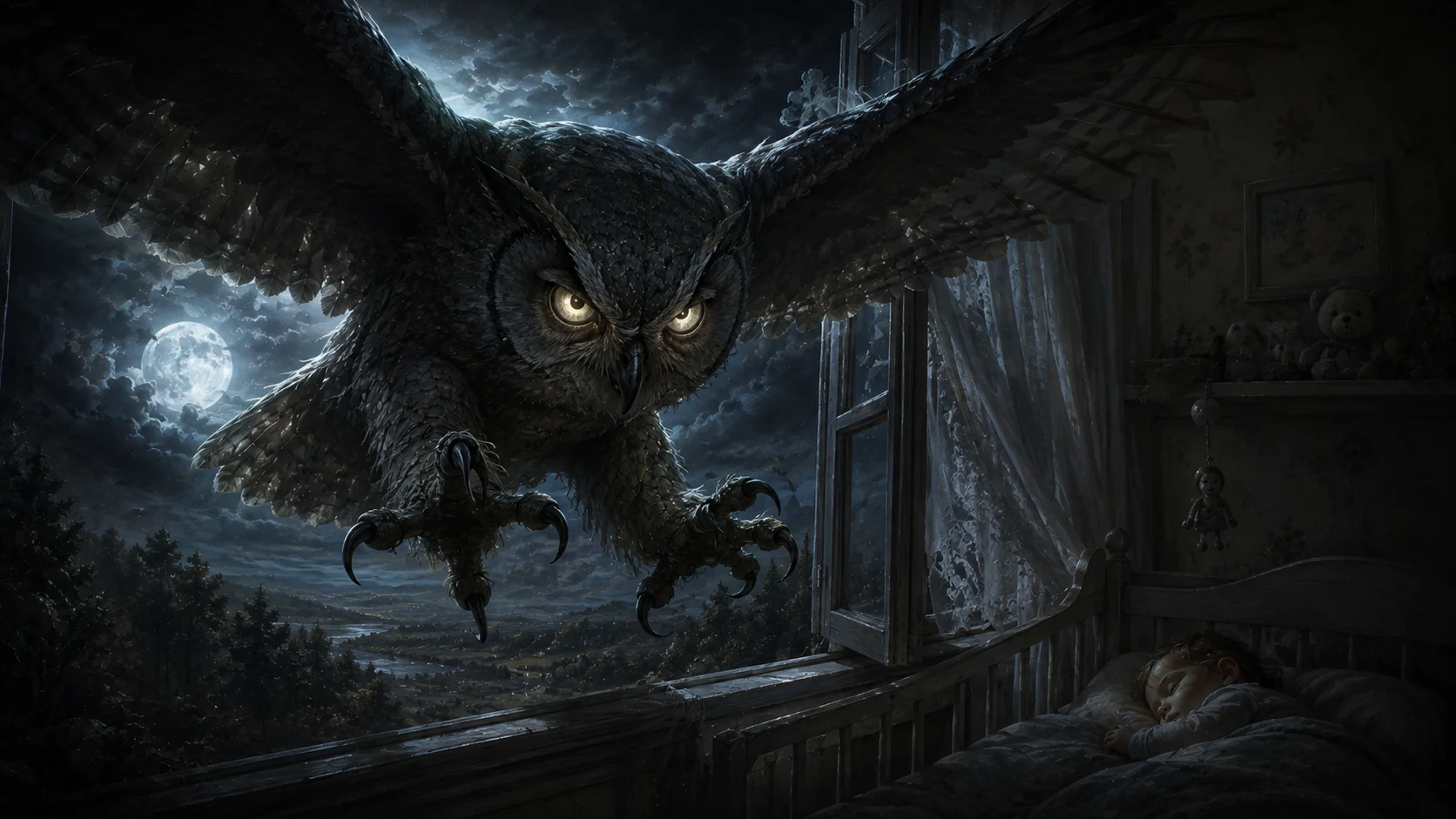
The Strix was an ominous bird of ill omen — a screech-owl or vampiric night-bird that fed on the blood and flesh of the young, swooping into nurseries by night to prey on infants in their cradles. Known to the Greeks and, more fully, to the Romans, it is one of the most ancient ancestors of the vampire and the witch, and its name echoes through European languages of the supernatural to this day.
A Word That Means Owl, and Something Worse
The Greek word strix (στρίξ) literally denoted a species of owl — a bird already bound up with night, with death, and with omen in Greek folk belief. But the strix of legend was never simply an owl watched from a distance. Over time the word came to name something that blurred the line between a natural, if unlucky, bird and a supernatural predator: a monstrous extension of the same creature, sharing its name, its silhouette, and its hours, but not its appetite. Ordinary owls were unsettling to encounter. The strix was something to bar the shutters against.
The Cry in the Dark Hours
To the Greeks, and especially to the Romans who inherited and elaborated the figure, the strix was a nocturnal bird whose cry carried the weight of catastrophe. Its call in the darkness was not mere noise but a warning — a sound that meant something terrible was already in motion, or about to be. This is the oldest and simplest layer of the belief: before the strix became a named horror with talons and appetite, it was already a bird no one wanted to hear outside their window at night.
The Shape It Was Given
The fullest surviving description comes from the Roman poet Ovid, writing in the Fasti. His striges are birds with large heads, staring eyes, hooked beaks, and grayish-white feathers — a shape built for finding what it hunted in the dark and for tearing into it once found. This portrait belongs specifically to Roman literary reception of the figure rather than to a single fixed classical Greek account; the strix was a tradition shared across Greek and Roman folk belief long before, and after, Ovid put it into verse, and Greek-language sources describing the fully monstrous version are comparatively thin next to the Latin material.
What Came for the Cradle
The strix's defining and most consistently attested trait, across the sources that mention it at all, was its hunger for the newborn. It was believed to fly by night into houses where infants lay unguarded and to suck their blood or entrails through the mouth or the navel, leaving the child pale and failing. Ovid's version has the striges tearing at the babies' flesh with their hooked beaks and grasping talons — a bird stealing life from a body too small and too helpless to resist it. There is no gentler telling of this belief in the record. It was, plainly, a fear about the most vulnerable member of the household and the hours when no one was watching over them.
Carna's Charge Against the Bird
Ovid's account does not leave the infant undefended. He credits the Roman goddess Carna with the power to protect cradles from the striges, and describes the kinds of wards households turned to — branches of whitethorn set at the window, offerings made to Carna herself — as a defense against the bird's approach. This detail belongs to Roman religious practice bound to Ovid's telling specifically, rather than to a Greek cult or myth of its own; it is the clearest surviving picture of how the fear of the strix was answered, ritually, in the home. A charm at the sill, a name invoked at the threshold — small, deliberate acts against a threat that came when the house was otherwise defenseless.
No Single Bird, No Single Story
Unlike the Sphinx or any one of the named Sirens, there is no individual strix with a fixed genealogy, a mother, a mountain, or a single mythic episode that belongs to it alone. The strix is a category — a species of ominous, vampiric bird-monster that could appear again and again, in any house, on any night, rather than a personality with one story to tell. This is part of what made it so persistently frightening in folk belief: it was not a monster that had been defeated once in some distant age. It was a kind of danger that remained, in principle, always possible.
Bird of Nature, or Woman Transformed
Ancient sources themselves disagreed about what a strix actually was. Some treated it as a literal, if uncanny, species of bird — a matter for folk natural history rather than sorcery, the framing taken up skeptically by Pliny the Elder when he discusses the strix among the lore of birds in his Natural History. Others held that the strix was a witch or sorceress who had taken bird form, so that the creature seen at the window might once have been a woman known by daylight. Both readings appear across the ancient record, and neither displaces the other. The ambiguity was not a gap to be filled in — it was itself a settled and recognized feature of how the strix was understood.
Two Owls, Two Very Different Reputations
It is worth holding apart two owl traditions that existed side by side in Greek belief and are easily run together. One is civic and religious: the owl sacred to Athena, a mark of wisdom and of the goddess's own city. The other is the folk tradition behind the strix, where owls and owl-like night birds carried associations of death and misfortune rather than favor. The strix belongs entirely to the second tradition. The same wingbeat that might, on the Acropolis, gesture toward the goddess's watchfulness meant something closer to dread when it passed a window after dark in the world of common superstition.
A Name With No Court, No Consorts
No epithets of the kind given to gods and heroes attach to the strix, and it is not a named individual deity or hero with a genealogy to record. What it has instead is remarkable durability as a fixed classificatory label — a word that meant the same dangerous thing across both Greek and Latin sources for as long as the tradition was current. It required no family tree because its threat did not depend on who it was related to. It depended only on what it did when the household was asleep.
The Root Beneath Later Words
The strix's afterlife is written directly into language. Its Latin form is the linguistic root of later European words for witch and vampiric being: the Italian strega, the Romanian strigoi, and related terms across Romance and neighboring traditions all descend from the same word. This lineage is well documented and unambiguous at the level of etymology. What should not be assumed is that the later witch-and-revenant folklore built around strega and strigoi is simply the ancient strix under a new name; those beliefs developed later, and separately, drawing on the word and something of its shape without being identical to the Greco-Roman tradition that first carried it.
An Ancestor of the Vampire
Taken together — the night flight, the blood drawn from the sleeping and the helpless, the uncertain boundary between beast and transformed human, and the name's survival into the vocabulary of witches and revenants across later Europe — the strix stands as one of the direct ancient antecedents of the vampire archetype that would take clearer shape centuries later. It did not hand down a finished monster. It handed down a set of fears and a word, and those proved durable enough to outlast the empire that gave the fullest account of the bird itself.
What the Bird Was Standing In For
Beneath the talons and the borrowed etymology, the strix answers to something plainer: the anxiety of a world in which infants died easily and the night offered no light to watch by. It belongs to a broader Mediterranean category of ill-omened nocturnal birds, and its horror is domestic in scale — not a monster guarding a distant labyrinth, but one imagined to be capable of reaching the cradle in the very next room. That is why the ward at the window mattered as much as the description of the bird. The strix named a fear precise enough that people built specific defenses against it, one household at a time, one whitethorn branch at a time, for as long as the belief held.
It came by night for the children in their cradles — and its name lives on, hidden, inside our every word for witch and vampire.
Sources & traditions
- EncyclopediaWikipedia — Strix (mythology)
- TraditionGreek texts, inscriptions and later retellings (Greece)
Myths change from area to area and from time to time. This chronicle follows the most widely told versions; tellings in other villages, regions and eras may differ.