Empusa was a shape-shifting demon of the night — a seductive, monstrous servant of the goddess Hecate who took the form of a beautiful woman to lure young men to their doom, then revealed her true, hideous nature and devoured them. She is one of the earliest ancestors of the seductive blood-drinking demon — the beautiful stranger who is not at all what she seems.
The Servant of Hecate
Empusa belonged to the dark retinue of Hecate, goddess of witchcraft and the crossroads, and was sometimes counted among the phasmata — the frightening spectres Hecate sent against travellers by night. She haunted lonely roads and was especially dangerous in the dark hours, a creature of the threshold between waking and nightmare.
The Shape-Shifter
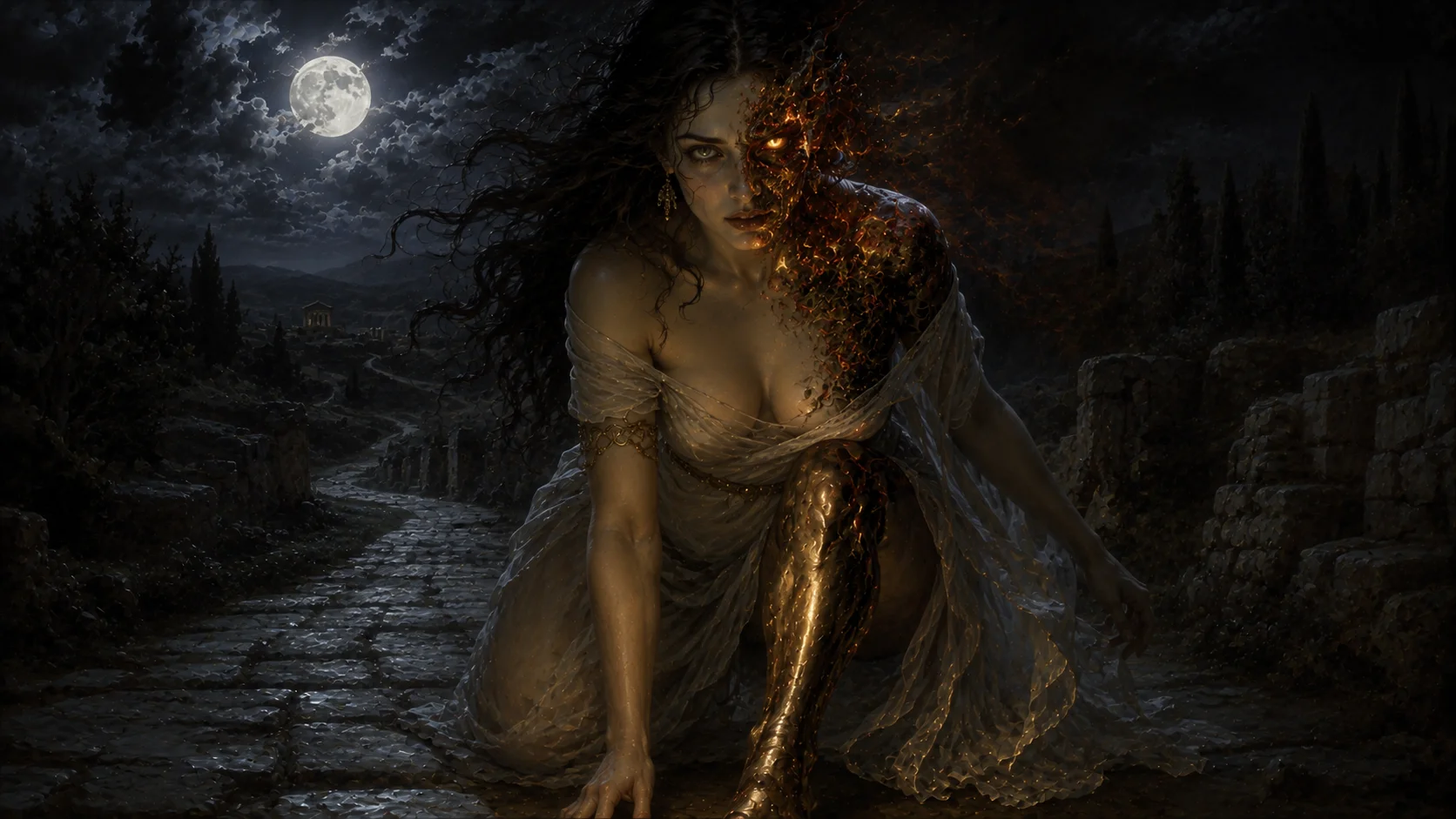
Her defining trait was transformation. Empusa could take the form of a stunningly beautiful young woman to approach and seduce her male victims — but her true shape was monstrous: she was said to have one leg of bronze and one of a donkey (or a single flaming-bronze leg), and a face that could blaze with fire. Once she had a man in her grip, she dropped the disguise and fed on his blood and flesh as he slept or made love to her.
Driven Off by Insults
The Greeks preserved a strangely comic defence against her. Empusa, for all her terror, could supposedly be driven away by insults and abuse — hurl mockery and curses at her, and she would shriek and flee. The playwright Aristophanes plays on this: confronted by the shape-shifting horror, the characters simply jeer at her until she runs off. Even a demon of the night, it seems, could not bear to be laughed at.
Mother of the Seductive Demon
Empusa, alongside Lamia, stands at the head of a long line of seductive, predatory female monsters — the lamiae, the later succubi, and ultimately the seductive vampire. The fear she embodies is ancient and enduring: the beautiful stranger in the dark whose true face is death.
The most dangerous thing on the night road wore the loveliest face — and fled only from laughter.
What Her Name Really Meant
The ancient lexicographers who catalogued Greece’s monsters derived Empousa from the Greek for "one foot" — a thing that moved on a single leg. It is an odd way to name a demon, until you notice what the sources keep circling back to: whatever face she borrowed, the leg gave her away. And they cannot agree on what the leg was. Aristophanes gives her two mismatched ones, a leg of bronze and a leg of cow-dung; later writers make the second a donkey’s; the lexicographers say she hopped along on one. What survives every version is the mismatch itself — something wrong below the hem of a stolen beauty. Empusa is the rare Greek monster named not for what she does to you, but for the detail she could never successfully disguise.
A Fuller Catalogue of Shapes
The beautiful-woman disguise is the one modern readers remember, but Aristophanes’ Frogs preserves a stranger inventory. On the road down to the underworld — and it matters that it happens on that road, at the seam between the living world and Hades — the slave Xanthias reports that the thing ahead of them will not hold still: now a cow, now a mule, now a ravishing woman, now a dog, blazing with fire, with that bronze leg under all of it. Part of the joke is that Xanthias may be inventing the whole parade to terrify his master, which is exactly why the list works. A god or a hero in Greek myth changes shape in order to accomplish something. Empusa changes shape so that nobody can ever say what they are looking at. Her shapelessness is what makes the boundary she haunts feel dangerous: you cannot watch for a fixed enemy when the enemy might currently be a mule.
The Bride Who Vanished at Corinth
The most elaborate Empusa story does not happen at a crossroads at all, but at a wedding feast. Philostratus, writing in the third century, gives a passage of his Life of Apollonius of Tyana to a young Lycian named Menippus who was studying philosophy at Corinth. On the road he met a beautiful foreign woman, wealthy and eager, who declared her love and brought him home to a house full of gold and silver and attentive servants. The sage Apollonius took one look at the engagement and told the young man flatly that the creature he was cherishing was a serpent. Menippus married her anyway. Apollonius arrived at the banquet uninvited and began working through the room: the gold and silver plate had no weight in it, and the cup-bearers, the cooks and the whole household staff thinned away into nothing under his questioning. Cornered, the bride wept, begged not to be made to say what she was — and then said it. She was an empousa, one of the creatures most people lump together as lamiai and bogeys, and she had been fattening Menippus on pleasure because she fed on young and beautiful bodies, whose blood was pure and strong.
It is worth pausing on why this version unsettled readers more than any monster on a dark road ever could. The Corinth Empusa does not ambush a traveller in the wild. She moves into respectable society, produces a household, and comes within one banquet of becoming somebody’s wife. The danger is not that she looks human. It is that she can pass an audit — property, servants, witnesses, a wedding — and still not be one.
From Corinth to Keats
That episode had a long afterlife of its own. Robert Burton retold it in The Anatomy of Melancholy in 1621, among his examples of love-melancholy, and from Burton it reached John Keats, who printed Burton’s paragraph as a note to his 1820 poem Lamia. The poem keeps the skeleton intact: the serpent-woman, the young man of Corinth, the wedding feast, the old philosopher whose stare dissolves the bride — and, in Keats, takes the bridegroom with her. Keats gave the tale its most famous telling in English, but the plot underneath had come to him more or less unaltered from a Roman-era biography of a wandering philosopher.
The figure has proved just as durable in far less literary company. Rick Riordan’s Percy Jackson novels bring the empousai back with their defining anatomy untouched — monstrous servants of Hecate, glamorous in disguise, betrayed by one leg of bronze and one of a donkey, hunting the blood of admiring young men. A monster first written down for an Athenian comic audience in the fifth century BC now turns up on middle-school reading lists with the same mismatched legs.
One Name, Many Empousai
The sources are not consistent about whether Empusa is a single demon or an entire species of them, and the inconsistency is itself informative. Some texts treat her as an individual spectre with a name. Others use empousai in the plural, for a class of phantoms Hecate could send out against travellers at will. Philostratus himself hedges: his Corinth bride never says "I am Empusa" — she says she is one of the things people call by that name, as though the word were a folk category rather than an identity. That ambiguity is a large part of why the figure travelled so well. A single named demon can be killed by one hero and be finished with. A class of spirits in a goddess’s service can turn up on any road, at any wedding, in any century, wearing whatever face happens to be convenient.
She was never one danger. She was a shape the road could put on whenever it needed to be feared.
Sources & traditions
- EncyclopediaWikipedia — Empusa
- TraditionGreek texts, inscriptions and later retellings (Greece)
Myths change from area to area and from time to time. This chronicle follows the most widely told versions; tellings in other villages, regions and eras may differ.