Lamia was the child-devouring monster the Greeks used to frighten children into obedience: a once-beautiful queen transformed by grief and a goddess's jealousy into a horror that hunted the young. Her story is myth at its darkest, a tale of how unbearable loss can curdle into the monstrous, and a victim remade into a bogeyman.
A Queen Born of the Sea and the Sand
Most ancient sources, chief among them Diodorus Siculus in his Bibliotheca Historica, place Lamia's beginnings not in monstrosity but in royalty. She was a queen of Libya, and her lineage tied her directly to the sea: she was said to be the daughter of Poseidon and Libya, the nymph for whom the North African region itself was named. That made Lamia a granddaughter of Poseidon twice over in spirit, if not in strict genealogy, a figure with divine blood running through a mortal throne. Diodorus's account is often described as euhemerized, a rationalized retelling that treats Lamia as a historical woman whose story was later exaggerated into myth, rather than a monster born fully formed. In this reading, everything that follows, the grief, the rage, the transformation, happens to a woman who began as someone rulers might have envied.
The Love That Drew a Goddess's Wrath
Lamia's undoing began when Zeus took her as a lover. It is a familiar shape in Greek myth, the king of the gods drawn to a mortal woman of exceptional beauty, and it is a shape that reliably ends in suffering for the woman rather than the god. Hera, Zeus's wife, turned her jealousy not on her husband but on Lamia, as she so often did with the mortal women Zeus pursued. The core of the myth is not really about Zeus at all; it is about Hera's vengeance, patient and merciless, aimed at a queen who had done nothing but be loved by the wrong god.
The Death of Her Children
Hera's punishment fell on the one place certain to wound most deeply: Lamia's children. Accounts vary on how many children Lamia had and on the exact mechanism of their deaths. In some versions Hera killed them outright, herself. In others, more horrifying still, Hera compelled Lamia to destroy her own children, forcing the mother's hands to do what the goddess would not do directly. Either way, the result was the same: a queen who had children became a queen who had none, and the loss was not an accident of fate but a deliberate act of divine cruelty.
The Grief That Became a Monster
It was this loss, and nothing else, that transformed Lamia. She did not begin as a monster and later commit monstrous acts; she was broken into monstrosity by grief so total it reshaped her. Some later sources add a further cruelty to Hera's punishment: that the goddess robbed Lamia of the ability to close her eyes, so that she could never look away from the vision of her dead children, forced to see them, endlessly, whether she was awake or trying to sleep. Zeus, in whatever pity he retained for the woman he had once loved, was said to have granted her one mercy in compensation: the power to remove her eyes at will, so that she might have some small respite from the sight that haunted her.
A Predator of Other Mothers' Children
Transformed and unable to reclaim what she had lost, Lamia turned her grief outward. In her monstrous form she was said to prey on the children of others, stealing into homes to take what she herself no longer had. It is a psychologically brutal shape for a myth to take: the bereaved mother who cannot bear that other children live while hers do not, and who acts on that unbearable asymmetry by making other mothers grieve as she grieves. The myth offers no redemption in this stage of her story, only the terrible logic of a wound that keeps consuming.
The Name That Frightened Children
Lamia's monstrous reputation outlived any single telling of her tragedy and calcified into something simpler and more durable: a nursery bogey. Greek parents invoked her name to frighten children into good behavior, a tradition attested as early as Aristophanic-era comedy and preserved later by Byzantine lexicographers such as the Suda, which records the threat plainly, that Lamia would come and eat misbehaving children. By this point the queen of Libya and her particular grief had receded almost entirely; what remained was a name that functioned the way "the bogeyman" functions in other traditions, a shorthand terror invoked at bedtime, detached from the sorrow that had originally created her.
Proverbial by the Time of Rome
Lamia's fame was not confined to nursery talk. By the Augustan era she had become proverbial enough that Horace could reference her in the Ars Poetica, using her as a byword in a literary-critical aside about implausible monsters, the kind of creature a poet should not carelessly conjure. That a Roman poet could drop her name and expect readers to grasp the allusion without explanation shows how thoroughly Lamia had entered the general vocabulary of monstrousness across the Greek and Roman world, no longer just a regional folk terror but a recognizable type.
When One Queen Became Many Demons
By the Hellenistic and Roman periods, the singular grieving queen had multiplied into a plural class of beings, the lamiae. These were seductive female demons, monsters who lured young men rather than stealing infants, and who consumed their blood and flesh in a manner that anticipates later vampiric folklore. This plural, folkloric Lamia is a distinct and later development from the original queen myth, closer in kind to the empusa than to Diodorus's Libyan ruler. Where the singular Lamia's horror is rooted in maternal loss, the lamiae's horror is rooted in seduction and predation of a different sort entirely, and the two strands, queen and demon-class, should be understood as related but separate elaborations of the same name rather than one continuous story.
A Serpent's Tail That Came Later
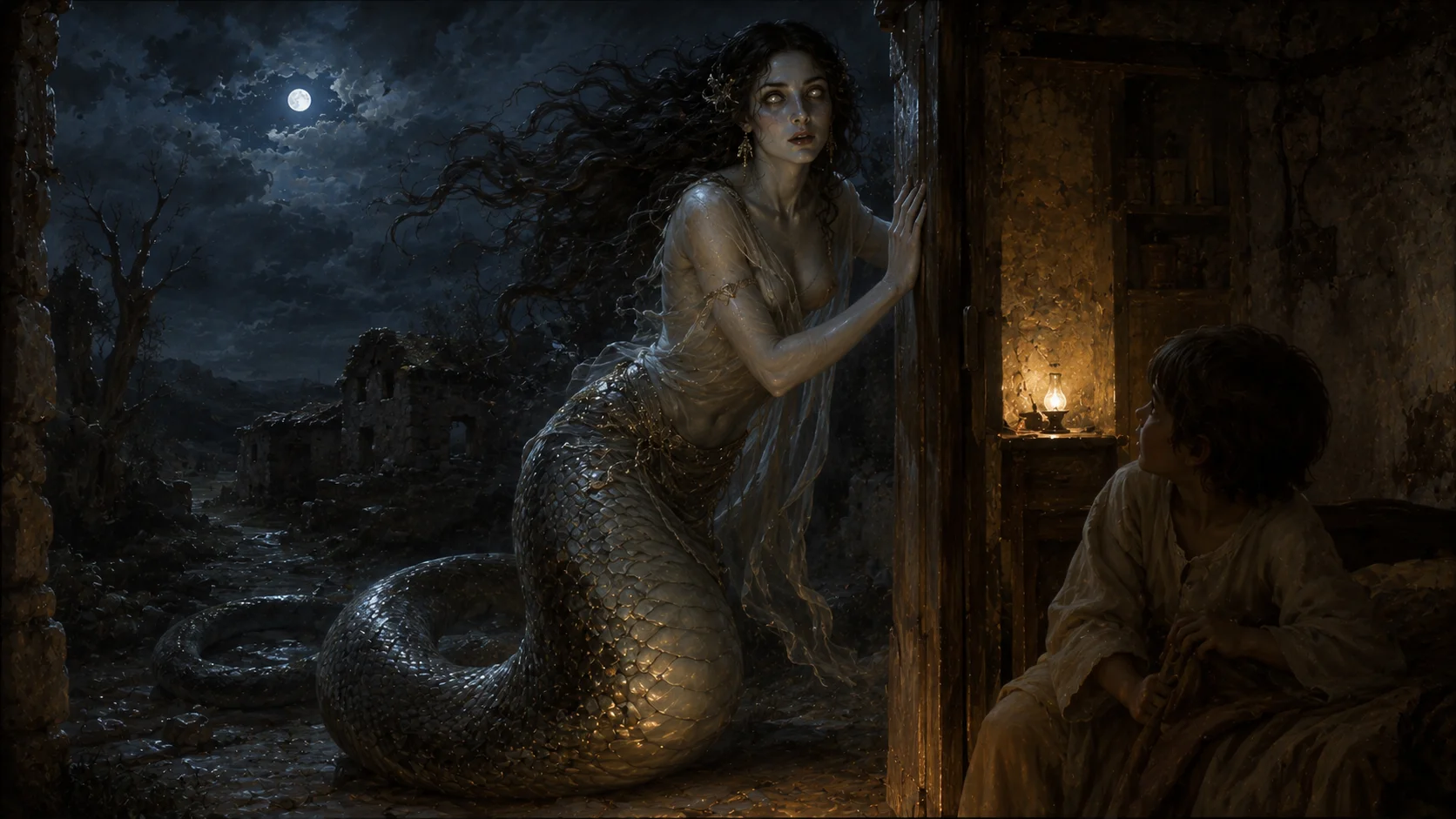
Modern popular imagination often pictures Lamia as serpentine from the waist down, a woman's torso fused to a snake's coiling body. That image, while vivid, is largely a later accretion to the myth, gaining ground from the Hellenistic period onward and becoming especially entrenched in early modern and Romantic retellings. The earliest strand of the myth, Diodorus's account of the grieving Libyan queen, does not describe her this way at all. The serpent iconography should be treated as a detail of uncertain and late attestation, a visual shorthand that later centuries attached to a figure whose oldest core was a human queen undone by loss, not a hybrid creature to begin with.
No Altar, No Priesthood, Only Story
Unlike deities who governed a domain of the cosmos and received cult worship at temples and shrines, Lamia has no widely attested cult of her own. She holds no cosmological office in the way a god of the sea or the harvest might; she is not petitioned or honored with ritual. The evidence for her is thin in exactly this respect, and largely literary and lexicographic: poets, historians, comic playwrights, and lexicon compilers preserved her, rather than priests or temple inscriptions. She functions as a mythic and folkloric figure, a cautionary tale given a name, rather than a worshipped power, and that absence of cult is itself telling about what kind of figure the Greeks understood her to be.
Philostratus, Keats, and a Serpent-Woman's Love
Lamia's afterlife extended well past antiquity. In 1820 the English poet John Keats published a narrative poem titled simply Lamia, drawing on a tale preserved in Philostratus's Life of Apollonius and transmitted to Keats through Robert Burton's Anatomy of Melancholy. Keats's version reimagines Lamia as a serpent-woman who takes human shape to love a mortal man, a romantic and tragic figure quite unlike the child-devouring bogey of the nursery tradition or the grief-shattered queen of Diodorus. This is a post-antique literary elaboration, built centuries after the ancient sources, and it belongs to the poem's own imaginative territory rather than to the canonical ancient myth, even though it borrows the name and something of the serpent imagery that had by then attached itself to the figure.
The Monster Made, Not Born
What makes Lamia endure across so many retellings, the euhemerized queen, the nursery terror, the plural seducing demons, the Romantic serpent-lover, is the psychological wound at the center of all of them: a mother destroyed by grief and by a goddess's jealousy until she became the very thing every parent fears. She was not created evil. She was made monstrous by loss, robbed of her children and then, in the crueler versions, robbed even of the mercy of closed eyes. The Greeks who whispered her name to frighten their children were, whether they knew it or not, keeping alive the memory of a queen whose deepest love had been broken until it became, in her, the deepest horror imaginable.
Sources & traditions
- EncyclopediaWikipedia — Lamia
- TraditionGreek texts, inscriptions and later retellings (Greece)
Myths change from area to area and from time to time. This chronicle follows the most widely told versions; tellings in other villages, regions and eras may differ.