Proteus was the shape-shifting old god of the sea — the “Old Man of the Sea,” a prophetic deity who knew all things past, present and future, but who would answer no question unless a mortal could first hold him fast through every shape he could become. From his name comes the word “protean” — endlessly changeable — and he remains the very image of the truth that must be wrestled into the open.
The Old Man of the Sea
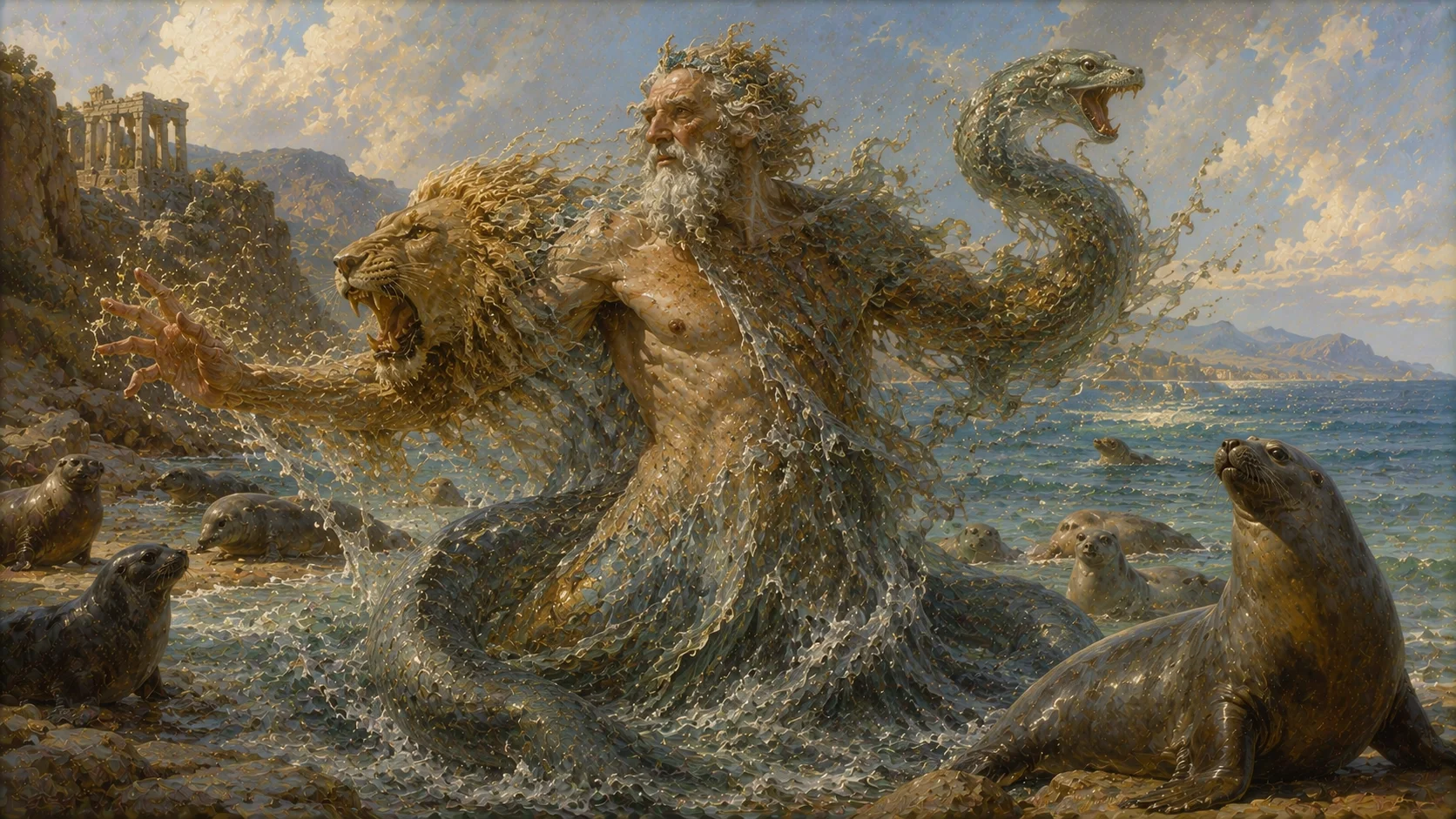
Proteus was an early sea-god, in some accounts a son of Poseidon and the herdsman of his seals, who dwelt on an island (often Pharos, near Egypt) and rose each day from the waves to count his flock of sea-creatures and bask in the sun. He possessed the gift of prophecy and knew the answer to every question — but he hated to share his knowledge, and so he was given the power to change his shape at will, becoming lion, serpent, leopard, boar, running water, a leafy tree, or roaring fire, anything to escape a questioner's grasp.
The Wrestling for Truth
To win a prophecy from Proteus, a mortal had to creep up on him as he slept among his seals at noon, seize him, and hold on through every terrifying transformation without ever letting go. Only when the god had run through all his shapes and found he could not break free would he return to his true form and answer truthfully. Menelaus, stranded in Egypt on his way home from Troy, did exactly this on the advice of Proteus's own daughter, and learned from the old god the way home and the fates of his fellow heroes. The shepherd Aristaeus, in another tale, wrestled Proteus to learn why his bees had died.
The Meaning of the Protean God
Proteus is one of mythology's richest symbols. He stands for the elusive, ever-shifting nature of truth and of the sea itself — never the same shape twice, slipping away from any who would pin it down. To get an answer from him is to refuse to be frightened off by appearances, to hold fast to the thing itself until it stops disguising and speaks plainly. He is the prophet who will only reward persistence.
The Ever-Changing Sea
Proteus endures in our very language — “protean” means versatile, mutable, endlessly able to change — and as the archetype of the shape-shifting prophet. He embodies the wisdom that the deepest truths do not come easily, that they twist and transform and try to escape, and that only the one who holds on through every change will hear them at last.
Hold the old god through fire and flood and fang, and at the end of all his shapes he will tell you the truth.
The Daughter Who Betrayed Him
The only reason anyone ever caught Proteus is that his own daughter turned against him. In Homer’s Odyssey, the sea-nymph Eidothea finds Menelaus marooned on Pharos, twenty days stalled for want of a favouring wind and running out of food, and takes pity on the Greek king — not on her father. She tells him exactly how the trap must be laid. At dawn she brings up four seals from the sea, flays them, hollows out beds in the sand for Menelaus and three chosen men, and covers each one in a fresh skin. Under every man’s nose she sets a dab of ambrosia, because nothing mortal could bear the reek of newly flayed seal for long. At noon Proteus rises from the surf, counts his herd — the disguised men included, tallied in among the animals — and lies down to sleep in the sun. Only then do they spring up and seize him.
What follows is the one wrestling match the god cannot win. He goes through lion, serpent, leopard and boar, then stops being an animal at all and becomes running water, then a tree in full leaf, each shape held only as long as it takes the men’s grip to fail — and it never does. Beaten back into his own form, Proteus answers fully and without evasion, and the answers are mostly bad news. Menelaus must sail back to the Nile and offer proper sacrifice before the gods will release him for home at all. Ajax son of Oileus was pulled alive from his wrecked ship by Poseidon, then boasted that he had escaped the sea in spite of the gods; Poseidon struck the rock he was sitting on with his trident, split it, and let him drown. Agamemnon, greatest of the returning kings, reached home only to be cut down at a welcome feast by Aegisthus, his wife’s lover. And Odysseus, alone of them all, is still alive: weeping on a distant island, held fast by the nymph Calypso, with neither ship nor crew to carry him off it. That last report is what Menelaus, years afterwards, passes on to a young man who has come to his hall asking after a missing father — and it is the first solid word Telemachus has ever had that Odysseus is not dead.
A God Demoted to a King
Not every ancient Greek believed Proteus was a god at all. Herodotus, gathering material in Egypt in the fifth century BC, was told by priests at Memphis of a mortal king named Proteus who had once ruled there. In their account, Paris and Helen were blown off course on their flight from Sparta and landed in Egypt, where Proteus — outraged that a guest had repaid his host by carrying off the man’s wife and property — impounded Helen and the treasure both and sent Paris on to Troy with nothing. Helen sat out the entire ten-year war in Egypt. The army that burned a city for her sake was dying over a woman who was never inside it. Herodotus repeats the story with evident satisfaction, because it answered something that had always bothered him about the Trojans: no city, he reasoned, would let itself be destroyed street by street rather than hand back one woman it could simply have produced.
Euripides built a tragedy on the same premise. In his Helen, staged in 412 BC, the real Helen has been in Egypt the whole time and the thing fought over at Troy was a phantom made in her likeness. King Proteus, who sheltered her, has since died, leaving Egypt to his son Theoclymenus, who intends to force her into marriage, and his daughter Theonoe, a prophetess who alone can decide whether to give away where Helen is hiding. Menelaus is shipwrecked on that same shore on his way back from a war he believes he has already won, and walks in to find the wife he thinks he dragged out of Troy standing alive in front of him. Nobody seems to have found it strange that an Egyptian king and a Greek sea-god should share a name and a coastline — Homer had already anchored his shape-shifter off Pharos, within sight of the Nile delta, and later writers simply reached for the name that was lying there.
The Bees, the Bride and the Truth Aristaeus Did Not Want
Virgil gives the fullest surviving account of a Proteus-wrestling, and it ends somewhere the god never intended. In the fourth book of the Georgics, the beekeeper Aristaeus has lost his entire swarm and does not know why. His mother, the water-nymph Cyrene, tells him that only Proteus can say — Virgil moves him out of Homer’s Egypt to the Carpathian sea, a prophet of Pallene — and that he must be bound while he sleeps out the noon heat among his seals, then held through everything he becomes, because force is the only argument he answers. Aristaeus does exactly this, and Proteus works through the repertoire Cyrene warned him about: a bristling boar, a scaly serpent, a tawny lioness, the crackle of fire, and at last water slipping away through his captor’s arms. None of it works.
The truth is worse than Aristaeus expected. His bees did not simply sicken; they were taken from him as a punishment, because Aristaeus himself once chased the nymph Eurydice headlong along a riverbank, and in her flight from him she trod on a serpent hidden in the deep grass and died of the bite. That single afternoon is the reason Orpheus went down into the underworld to argue for her back, and the reason he lost her a second time by turning to look before she had reached the daylight. Proteus tells Aristaeus the whole of it — the grief, the ruin, the severed head still calling her name as it floats down the river — then plunges into the sea without another word, leaving Cyrene to supply the remedy her son actually needs. It is the strangest recipe in ancient farming literature: bugonia, described earlier in the same book, in which a bullock is killed and shut inside a close-walled chamber strewn with thyme, and out of the putrefying carcass a new swarm of bees is said to be born. Forced to speak, Proteus hands over not an answer but a debt — and it is left to somebody else to explain how it can be paid.
The Lost Fourth Play
Proteus once stood at the end of the single greatest surviving day of Athenian theatre, and almost nothing of him is left. When Aeschylus staged his Oresteia in 458 BC — Agamemnon, The Libation-Bearers, The Eumenides — the competition required a fourth play, a satyr-drama, to send an audience home laughing after three tragedies of murder and blood-guilt. Aeschylus called his Proteus. Only a handful of fragments survive, and the subject has to be reconstructed from the title and from the thread the trilogy leaves hanging: the storm-scattered fleet, and Menelaus lost somewhere off Egypt while his brother walks into the axe at home. Whatever the satyrs were doing among the seals is gone — one more reminder that the Proteus who reaches us through Homer and Virgil is a fraction of the god the fifth century knew.
A Face That Would Not Sit Still
Painters had an obvious problem with Proteus: how do you draw a god whose entire nature is refusing to hold one shape? The Greeks largely did not try. Proteus himself is close to invisible in surviving Greek art, and the scene a modern reader pictures belongs on the vases to his fellow shape-shifters of the sea — Herakles hauling down the old sea-god Nereus, and Peleus locking his arms around Thetis as she turns under him. Those painters found the only solution that works: refuse to choose. A lion’s foreparts, a snake, a tongue of flame break out of a human torso all at once, mid-change, so that the figure reads simultaneously as a person and as a struggle against being one. The image is never the shape-shifter at rest. It is always the shape-shifter losing, because a god defined by escape is only worth drawing at the one moment he cannot.
The Word Outlived the God
By the Renaissance the character had largely given way to the adjective. Edmund Spenser put him back on the page in The Faerie Queene, where Proteus pulls the maiden Florimell out of the sea, rescues her from a lecherous fisherman, and then, when she will not have him, shuts her in his cave beneath the waves and courts her in one form after another — knight, king, giant, horror — the shape-shifter recast as a predator rather than a source of wisdom. Shakespeare went further and simply named a character after the trait: in The Two Gentlemen of Verona, Proteus is the friend who breaks his oath, his loyalty and his engagement for a woman who belongs to somebody else, and an audience raised on Ovid would have known roughly what a man called Proteus was going to do before he did it.
Science eventually took the name outright. In 1885 the bacteriologist Gustav Hauser gave the name Proteus to a genus of gut and soil bacteria — among them Proteus mirabilis, a common cause of urinary tract infections — because the organisms change form readily and swarm across a culture plate in restless advancing waves. Proteus syndrome, a rare overgrowth disorder in which skin and bone enlarge asymmetrically and unpredictably, was named on the same logic in 1983: no two cases look alike. It is the condition most often proposed, since a paper of 1986, to explain the body of Joseph Merrick, the man exhibited in Victorian London as the “Elephant Man” — a diagnosis argued over ever since and never firmly settled. And when Voyager 2 found Neptune’s second-largest moon in 1989, it too was called Proteus: a shape-shifter locked in permanent orbit around the god of the sea.
Sources & traditions
- EncyclopediaWikipedia — Proteus
- TraditionGreek texts, inscriptions and later retellings (Greece)
Myths change from area to area and from time to time. This chronicle follows the most widely told versions; tellings in other villages, regions and eras may differ.