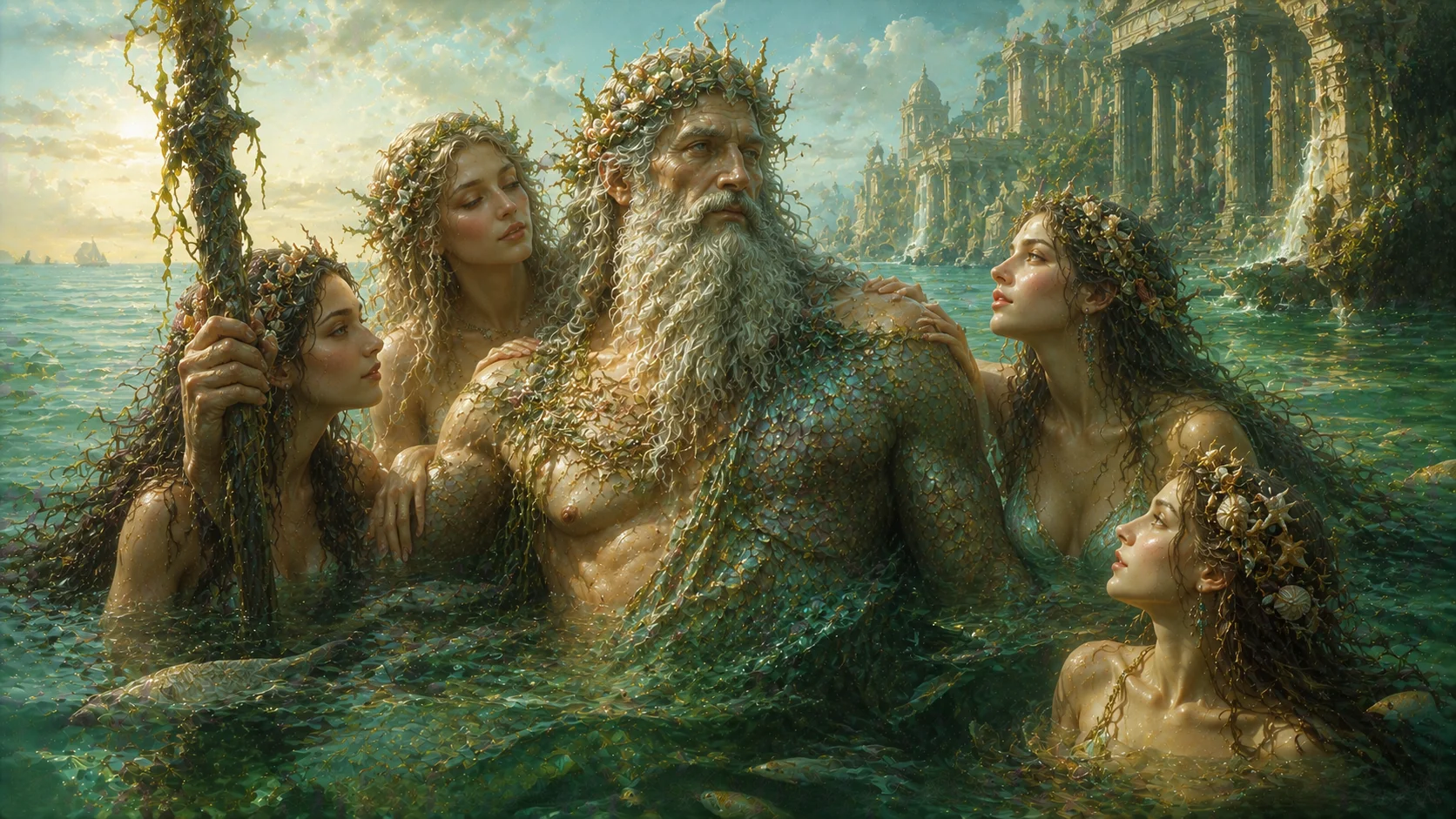
Nereus was the Old Man of the Sea — a gentle, ancient, and supremely truthful sea-god who knew all the secrets of the deep and the future, and who would reveal them only to one who could hold him fast through all his shape-shifting. Older than Poseidon and free of the storms of passion, he is the kindly, wise face of the primordial ocean.
The Truthful Elder of the Deep
The eldest son of Pontus (the primordial Sea) and Gaia (Earth), Nereus was a sea-god of the older generation, predating the Olympian Poseidon. The Greeks praised him above all for his truthfulness and gentleness: Hesiod calls him “trusty and gentle, who never lies, mild and kindly, who never forgets what is right.” In a mythology full of capricious and deceitful gods, Nereus was a rare being of pure honesty and wisdom.
Father of the Nereids
With the Oceanid Doris, Nereus fathered the fifty (or more) Nereids — the beautiful sea-nymphs who personify the gentle and bountiful aspects of the ocean, including Thetis (mother of Achilles) and Amphitrite (queen of Poseidon). Through his daughters, Nereus is the grandfather of much of the sea's benevolent divinity.
The Shape-Shifter Who Must Tell the Truth
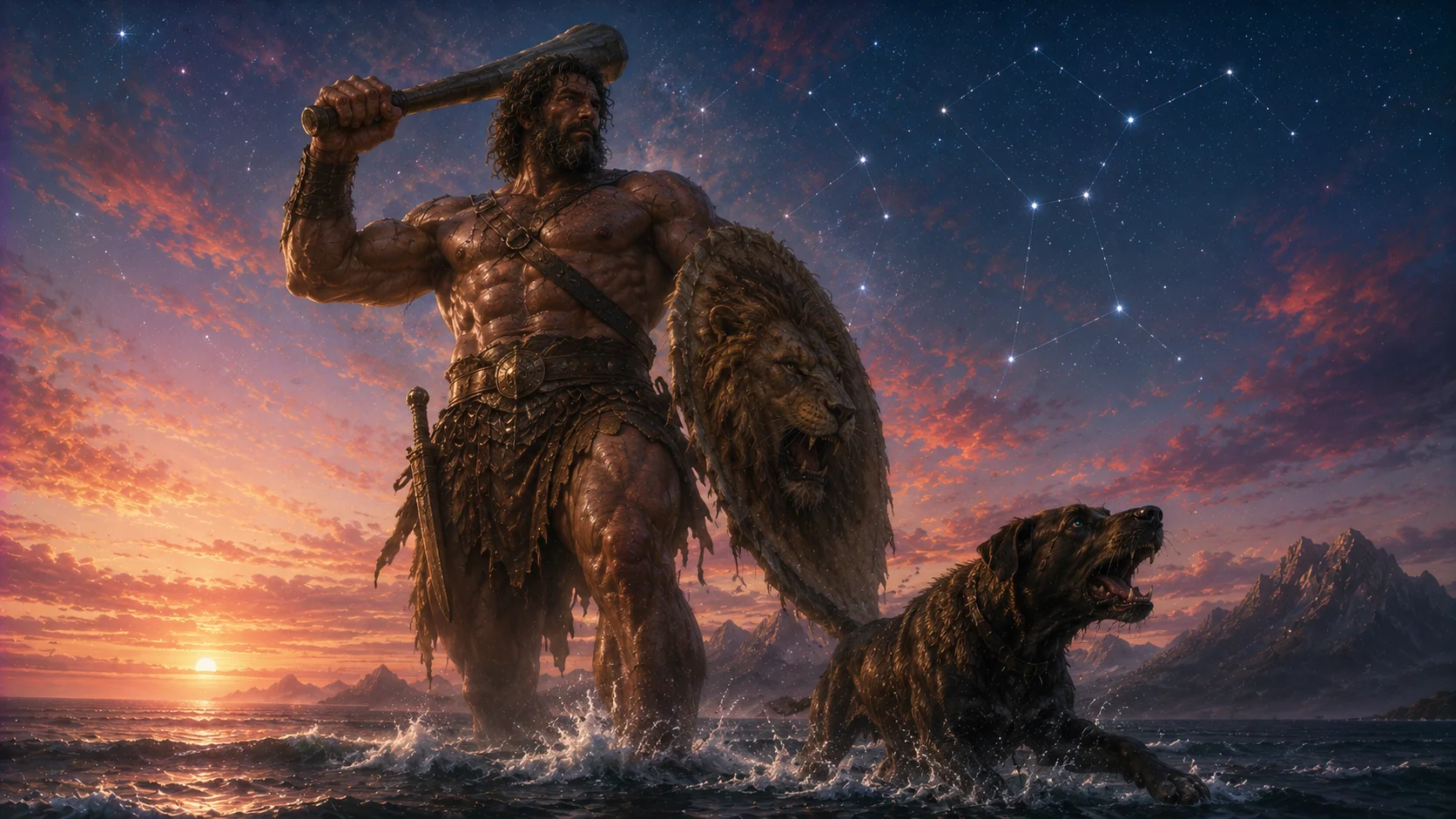
Nereus possessed the gift of prophecy and knew the answers to questions even the gods could not solve — but he did not give them freely. Like other old sea-gods, he could change his shape at will (into water, fire, beasts) to escape questioners. The hero Heracles, needing to learn the way to the garden of the Hesperides, sought out Nereus and seized him, holding on grimly as the god transformed into form after form, until at last Nereus, unable to break free, returned to his own shape and truthfully told the hero what he needed to know. It is a recurring motif: that wisdom must be wrestled from the deep and held onto, no matter how it tries to slip away.
The Gentle Sea
Nereus endures as the embodiment of the sea's calmer, kindlier, wiser nature — the deep that gives rather than takes, that holds ancient truth in its depths for those patient and strong enough to draw it out. He is the grandfather of the sea-nymphs and the gentle elder beneath the waves that Poseidon rules above.
Hold fast to the changing sea long enough, the old story says, and at last it will tell you the truth.
The Silver Cave Beneath the Waves
Homer never lingers on Nereus by name, but he shows us exactly where the old god lives. In Book 18 of the Iliad, when Achilles' scream of grief for the dead Patroclus rolls out across the ships, it carries all the way down to the sea floor, where Thetis sits beside her aged father in the depths. She cries out in answer, and every one of her sisters hears it and gathers to her until they fill the silver cave — Homer's own phrase for the hall they share. He names more than thirty of them in a single breathless catalogue: Glauce, Cymodoce, Speio, Actaea, Doto, Proto, Dynamene, Panope, Galatea, and on, and on, a household instantly and enormously peopled. They rise together through the grey water, break the surface as one body, and come up onto the beach where the Myrmidon ships are drawn up, to grieve beside their sister. It is one of the oldest surviving glimpses of Nereus's world: not a throne room, but a crowded, close, grieving family — proof that behind every one of the sea's famous daughters stood the same quiet old father, keeping house at the bottom of the water.
A Title Shared With Rivals
“Old Man of the Sea” was never Nereus's alone. The Greeks gave the same epithet — halios gerōn — to more than one ancient sea-god, and the myths attached to it repeat the same shape. In the Odyssey, it is not Nereus but Proteus whom Menelaus must corner on the beach at Pharos and pin down with his own hands, holding on through lion, serpent, leopard, boar, running water, and a tree in full leaf, before the god will surrender the sailing directions home. Homer hands the title to Phorcys as well, and names a harbour in Ithaca after him. The wrestle-a-shapeshifter-for-the-truth pattern is plainly older than any single god it is attached to — and the Archaic vase-painters who loved the scene were no more careful than the poets: the fish-tailed elder Heracles grapples on their pots is named Nereus on some vessels and Triton on others, and wherever the painter left no inscription, the figure has been argued over ever since. The confusion is not a modern failure to keep the myths straight; it is inherited directly from a tradition that never fully separated its old sea-gods from one another.
The Family He Was Measured Against
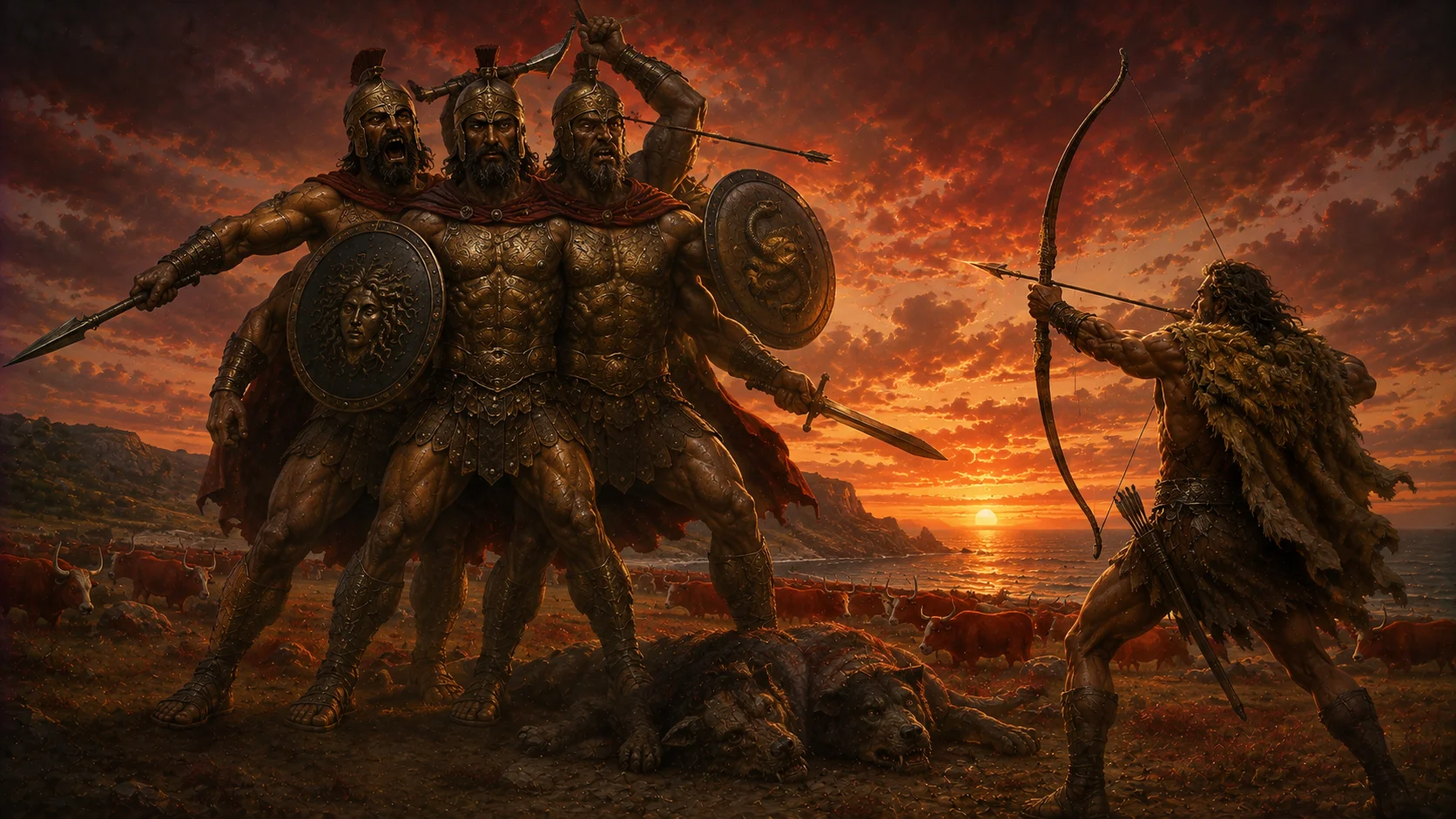
Hesiod introduces Nereus in the company of his siblings, and the company is unflattering. Pontus and Gaia had five children together: Nereus first, and then Thaumas, Phorcys, Ceto, and Eurybia. Where Nereus is gentle and, famously, incapable of lying, his brother Phorcys and his sister Ceto became, as a pair, the parents of most of what Greek myth found monstrous in the sea: the Graeae, grey-haired from birth, who in later tellings pass a single eye between them; the Gorgons, one of whom was Medusa; and the serpent that lies coiled at the edge of the world guarding the golden apples — which makes that guardian the nephew of the very god Heracles went to the sea floor to interrogate about where the apples were. Their brother Thaumas married the Oceanid Electra and fathered Iris the rainbow-messenger and, by the same union, the storm-winged Harpies. Set against that family tree, Nereus's reputation for calm and honesty reads less like an isolated personality trait and more like a contrast the old poets were deliberately drawing: the primordial sea could produce horror from one branch of its oldest family and wisdom from another, and there was never any way to know in advance which you were going to get.
Nereus's Warning to Paris
The Roman poet Horace gave Nereus one of his most vivid later appearances, and it is a warning, not a riddle wrung out of him by force. In one of his Odes, as the shepherd-prince Paris carries the stolen Helen across the sea toward Troy, Nereus stills the winds — an unwelcome calm, Horace calls it, imposed not to speed the voyage but so that the prophecy will carry clearly over the water. Unprompted and unasked, he tells Paris exactly what the abduction is going to cost: a Greece sworn together to take her back with a great army, years of war visited on his own people, and, after a fixed number of winters, Achaean fire burning the houses of the city he is sailing home to. It is the same incurably honest god as ever, but here the truth is not extracted from him — it is volunteered. Where the Heracles story shows Nereus's honesty as something that has to be physically wrestled out of him, Horace shows the opposite face of the same trait: a god so constitutionally unable to withhold the truth that he becalms an entire sea to interrupt a honeymoon voyage with a doom nobody asked to hear.
Daughters Carved in Stone
Nereus himself never had a temple network of his own to rival Poseidon's coastal sanctuaries, but his daughters kept turning up on tombs for centuries after the myths about their father had stopped being freshly told. Roman sarcophagi of the second and third centuries AD carried a recurring image: the soul of the deceased borne across open water by Nereids riding dolphins, sea-horses, and horned sea-monsters — a crossing widely read as the passage to the Isles of the Blessed. In Lycia, a monumental tomb from Xanthos, now reconstructed in the British Museum and known simply as the Nereid Monument, is ringed with wind-blown female figures traditionally identified as Nereids, striding and swimming between the columns of a building shaped like a Greek temple, though it commemorated a local dynast rather than a god. Scholars still debate whether those particular figures are Nereus's daughters or a related order of sea- and wind-spirits, but the instinct behind the identification was sound: by the time these tombs were carved, “a Nereid” had become artistic shorthand for any escort that could be trusted to carry the dead safely across dangerous water — the same benevolence Nereus himself was known for, inherited by his children and outliving almost every other memory of him.
A God Made of Character, Not Power
Greek myth is, on the whole, a study in gods with something to gain from ambiguity. Zeus sends a lying dream to Agamemnon to lure him into a battle he has been promised he cannot lose; Hermes is a practised cattle-thief before he can properly walk; Apollo's oracle tells Croesus that if he marches he will destroy a great empire, and lets him discover only afterwards which empire was meant. Against that backdrop, a deity whose defining trait is that he is constitutionally unable to lie is a strange and telling invention — and the strangeness runs deeper than temperament. Read Hesiod's few lines on Nereus closely and notice what is absent: no weapon, no kingdom, no throne, not a single act of power. The eldest child of the sea is introduced almost entirely in terms of character — trustworthy, gentle, mindful of what is right. Whatever else the Greeks wanted from water that swallowed ships without explanation and hid its floor and its true distances from everyone who crossed it, they wanted one thing inside it that could be relied upon. And when they finally imagined that thing, they gave it no strength at all. They gave it only the inability to deceive.
Sources & traditions
- EncyclopediaWikipedia — Nereus
- TraditionGreek texts, inscriptions and later retellings (Greece)
Myths change from area to area and from time to time. This chronicle follows the most widely told versions; tellings in other villages, regions and eras may differ.