Glaucus was the fisherman who became a god — a mortal transformed by a magical herb into an immortal, prophetic sea-deity, fated to spend eternity in the deep, and doomed in love. His bittersweet story is one of myth's gentler transformations, and it set in motion the creation of one of its most famous monsters.
The Fisherman and the Magic Herb
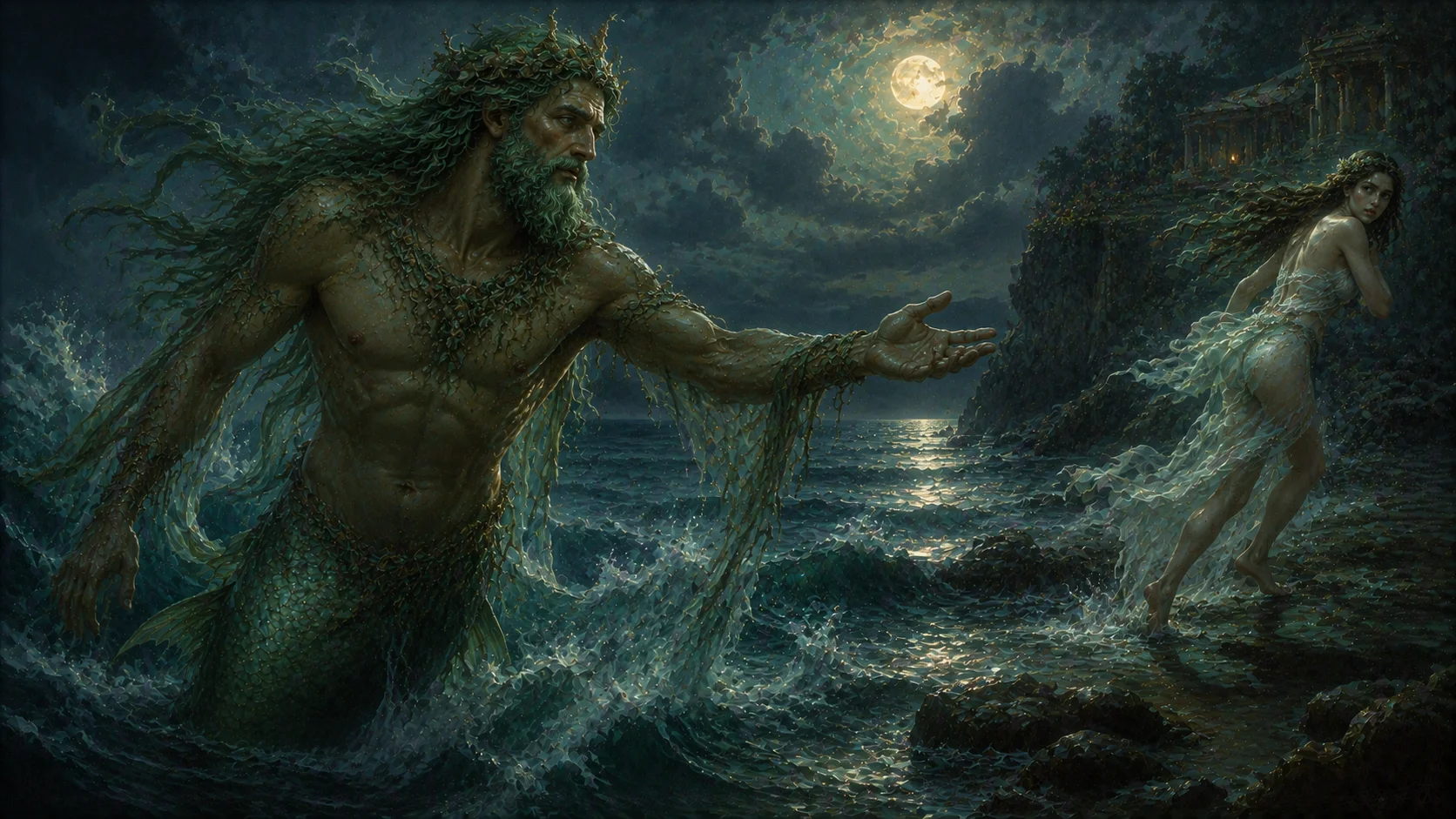
Glaucus began life as an ordinary mortal — a fisherman of Boeotia. One day, laying his catch on the grass of a certain meadow, he noticed that the dead fish, touching a particular herb, sprang back to life and leapt into the sea. Astonished, Glaucus tasted the magical herb himself — and was seized by an overwhelming longing for the water. He plunged into the sea, and the ocean gods Oceanus and Tethys washed away his mortal nature and transformed him into a sea-god: his legs became a fish's tail, his hair and beard grew green and sea-stained, and he became immortal.
The Prophet of the Sea
As a sea-god, Glaucus gained the gift of prophecy and became a benevolent deity, a friend to fishermen and sailors whom he would warn of coming storms. He was counted among the prophetic sea-gods like Nereus and Proteus, and even the Argonauts encountered him, rising from the waves to reassure them. He had gained immortality and divine power — but at the cost of his human life, forever bound to the deep, neither fully man nor fully at home among the great gods.
The Love That Made a Monster
His story took a dark turn in love. Glaucus fell hopelessly for the beautiful nymph Scylla, who fled from his strange merman form. Desperate, Glaucus went to the sorceress Circe for a love potion — but Circe fell in love with Glaucus herself, and when he rejected her, declaring he would love only Scylla, the jealous witch took her revenge not on Glaucus but on her rival. Circe poisoned the pool where Scylla bathed, transforming the lovely nymph into the six-headed, dog-girdled sea-monster of the deadly strait. Glaucus's love had, tragically, created a monster — and lost him his beloved forever.
The God Who Was a Man
Glaucus endures as a poignant figure of transformation and longing — the mortal who gained eternity but lost his humanity and his love, the gentle sea-god with a fisherman's heart, forever swimming the deep and warning sailors of the storms he can foresee but, in his own life, could never avoid.
He ate the herb that made him immortal — and spent his eternity grieving the love his new form had cost him.
A Name the Colour of the Sea
Before he is a story, Glaucus is a colour. Glaukos in Greek is the shifting blue-grey-green that has no clean English equivalent — the sheen on an olive leaf, the pale flash in a wolf's eye, the surface of open water on an overcast morning. It is the same root that gives Athena her standing epithet glaukopis, usually rendered "grey-eyed", and the same root behind the owl, the glaux, whose stare it describes. English still carries it: glaucous for that dusty blue-green bloom on a plum or a cabbage leaf, and glaucoma, named for the grey-green clouding of a failing eye.
So the fisherman of Anthedon is called, quite literally, Sea-Colour. That is worth pausing over, because it hints that the name may be older than the biography. A great many Greek myths work backwards from a name that already existed — a god called Sea-Colour needs no explanation until someone asks why, and then a story arrives to supply one. The herb, the leap, the green beard: all of it is, in a sense, an answer to the question of how a man came to be named after the colour of the water he vanished into.
Anthedon: The Town That Kept Him
Glaucus is not a god of the great panhellenic sanctuaries. He belongs to one small place: Anthedon, a fishing town on the Boeotian shore of the Euboean Gulf, a working harbour remembered in antiquity as a town of fishermen, ferrymen and net-makers with barely a farmer among them. Travellers to Anthedon were shown the spot on the coast called the Leap of Glaucus — the place where he went in.
What the story withholds matters as much as what it tells. In the fullest surviving account the plant is simply a grass: it grows on a meadow no animal has ever cropped, it works once, and nobody goes back for more. That reticence is not a gap in the record; it is the shape of the story. The herb is the thing that happened once, to one man, and cannot be repeated — which is exactly what a fishing town needs to believe about one of its own who never came back.
His cult, so far as we can reconstruct it, was not a matter of temples and priesthoods but of sea-lore: the working faith of men who go out in small boats. Sailors held that Glaucus made a circuit of every coast and island once a year, attended by a train of sea-creatures, calling out prophecies as he went. Fishermen swapped accounts of his warnings the way sailors everywhere swap weather signs. From that local telling the tale reached the Athenian stage: Aeschylus wrote a play called Glaucus of the Sea, now lost apart from scraps, and later poets and antiquarians kept circling back to Anthedon for the details.
What Kind of God He Is
Greek myth has a whole guild of what it calls the halios geron, the Old Man of the Sea: Nereus, Proteus, Phorcys. They share a job description. They are older than the Olympians, they know everything, they will not tell you, and they change shape into fire and lion and serpent in your hands until you are strong enough to hold on. Menelaus, becalmed off Egypt, has to pin Proteus down through every transformation before the god will answer a single question. Prophecy from the sea is something you take by force.
Glaucus breaks that pattern, and it is the most interesting thing about him. He is not ambushed on a beach at noon. He surfaces on his own initiative, unasked, and speaks — no wrestling match, no bargain, no price. Whatever else the Anthedonians made of him, they made him approachable: a god still carrying his human habits, who cannot help warning people because he used to be one of the people being warned.
He also belongs to a second, smaller class: the mortals who became sea-deities. Ino leapt from a cliff with her son and surfaced as the goddess Leucothea, and it is she who lends Odysseus her veil when his raft breaks up; Homer says plainly that she once spoke with a human voice and now holds a share of honour in the depths. Her son Melicertes became Palaemon, honoured at the Isthmus. These are gods you can be promoted into. For anyone whose livelihood is drowning-shaped, that is not a footnote — it is the entire consolation.
The Three Times He Rose
Glaucus surfaces in surviving literature at three moments, and the pattern they make is bleak.
In the Argonautica, the crew is tearing itself apart on the Mysian shore: Heracles and Hylas are missing, Telamon has accused Jason of abandoning the strongest man aboard, and the expedition is one insult from collapse. Glaucus comes up out of the swell and takes hold of the ship's stern. Heracles, he tells them, is not coming, because his fate lies elsewhere; and Hylas will not be found, because a spring-nymph has taken him for her husband. The quarrel dies. Nothing is fixed. They have simply been told what has already happened.
In Euripides' Orestes, Menelaus, sailing home, describes the sea-prophet rising beside his ship to tell him that his brother Agamemnon lies dead. Again: unasked, unavoidable, and far too late to act on.
In Ovid, at last, the prophet's subject is himself — and he is the one thing he cannot see clearly. It is a genuinely cruel joke, and the Greeks liked that kind of joke. Glaucus's gift is not the power to change outcomes. It is the power to know, sooner than everyone else, that an outcome is fixed. He is the god of the news that arrives after the fact.
The Scene Ovid Built
The version most readers inherit comes from the Metamorphoses, and Ovid's real innovation is not the plot but the staging. He has Glaucus tell his own transformation aloud, from the water, to Scylla — who is on the rocks above him, still a girl, still entirely human, listening to a stranger explain how a body can be changed against its will.
The details Ovid lingers on are the small ones. The meadow was untouched: no cattle had ever grazed it, no sheep, no goats. The fish stirred on the grass, then flopped, then made off across dry land for the water. When Glaucus tasted the herb his heart shook and something in him wanted a different element altogether. Oceanus and Tethys washed the mortal out of him with the waters of a hundred rivers, and his mind went out; when he came round he was changed in thought as much as in body, and had no memory of the moment it happened. Then he swims off, the poem moves on to Circe, and the girl on the rocks who has just heard all this is the one it happens to next.
Whose Fault Was Scylla?
The love-triangle is not the oldest answer. In the Odyssey, Scylla has no backstory at all: she is a thing with twelve dangling feet and six long necks in a cliff-face, her mother is Crataeis, and she was never anything else. Homer's monster is simply part of the furniture of the world, a hazard like a reef.
Later Greek and Roman tellers found that intolerable and kept trying to explain her, and the explanations disagree. Ovid's Circe is the famous version. Another strand blames Amphitrite, jealous over Poseidon, spoiling the same bathing-pool for the same reason. What the variants share is the shape: a beautiful woman, a rival's jealousy, a tainted bathing-place, and a body that turns on itself.
That shift matters more than it looks. Once Scylla has a childhood, the strait stops being a hazard and becomes a crime scene. The sailors she eats are still eaten, but the horror has been relocated — from the sea, which is nobody's fault, to a quarrel between two immortals over a man who was neither of theirs. Glaucus's part in it is the most modern-feeling thing in the whole myth: he does nothing malicious, asks for help in good faith, and destroys her.
The Other Glaucuses
Ancient readers were already confusing them, so it is worth separating them out. At least three other significant figures carry the name.
- Glaucus son of Minos drowned as a small boy in a storage jar of honey. The seer Polyidus found the body, was sealed in the tomb with it, and watched a snake revive a dead snake with a particular herb — then used the same herb on the child, who sat up alive.
- Glaucus of Potniae, son of Sisyphus, was killed by his own mares at the funeral games held for Pelias, and was said afterwards to haunt the Isthmian racecourse as the Taraxippos, the horse-frightener that panics teams at the turn.
- Glaucus the Lycian, grandson of Bellerophon, meets Diomedes between the lines at Troy, discovers their grandfathers were guest-friends, and swaps armour with him rather than fight — gold for bronze, which the poet notes was a spectacularly bad trade.
Note what recurs. Two of these stories turn on an unnamed plant that brings the dead back: the boy in the honey jar, and the fish on the Boeotian meadow. Whether the fisherman borrowed the motif or lent it, the pairing tells you something real about the Greek imagination — the resurrection-herb is a fixed idea, and in both tellings it goes unnamed. Nobody is ever sent back to pick it.
The Afterlife of a Minor God
For a deity with no major temple, Glaucus has had a remarkable second career — because he supplies literature with a scarce and useful image: the exact instant a human being stops being human without dying.
Dante reaches for it at the very start of the Paradiso. Trying to describe what happens to him as he begins the ascent, he says he became within himself as Glaucus did on tasting the herb that made him a companion of the other gods in the sea — and then admits the experience cannot be put into words, coining a verb for it, trasumanar, to pass beyond the human. Of every transformation in classical myth, the one Dante chose to stand for the soul's approach to God is the Boeotian fisherman's. It is an extraordinary compliment to a small local legend.
Keats went further and gave him the ending the Greeks refused. In Book III of Endymion, Glaucus appears as a wrecked old man in a blue cloak, cursed by Circe not with monstrosity but with a thousand years of decrepitude, keeping Scylla's body preserved beside him and waiting for the youth prophesied to release him. When the release comes, Scylla and the whole drowned population of lovers are restored to life together. It is the only telling in which Glaucus wins, and it required a Romantic to write it.
He survives, too, in the naming of the natural world. Glaucus atlanticus, the blue sea slug that floats upside-down on the surface film of the open ocean, eating Portuguese man o' war and hoarding their stings for its own use, carries his name — a small, sea-coloured thing that lives its whole life on the boundary between air and water, which is precisely where Glaucus lives too.
Why the Fisherman Still Swims
Strip the ornament away and the myth is doing one job. Fishing communities lose people to the water, and the water gives nothing back — no body, no grave, no last word. Anthedon's answer was to tell a story in which the sea did not take a man, it recruited him: he went in willingly, he is not dead, he is out there now, he still knows the weather, and if you listen he will still try to warn you. That is not a fairy tale. It is a way of standing on a beach at dusk and not going mad.
What keeps the story alive for readers who have never hauled a net is the second half of the bargain. Glaucus gets everything the human race says it wants — deathlessness, foreknowledge, the freedom of the whole ocean — and it makes him unreachable. He cannot go home. He cannot be looked at without flinching. The one person he wants is destroyed by the very power he acquired. Long before any modern writer worked the theme, this obscure Boeotian fisherman was already the proof that immortality is a form of exile, and that the transformation you choose is still a transformation you cannot undo.
The herb was never identified with any plant a reader could go and find. That is the honest end of the story: something on that meadow changed a man for good, and no one has ever been able to say what it was.
Sources & traditions
- EncyclopediaWikipedia — Glaucus
- TraditionGreek texts, inscriptions and later retellings (Greece)
Myths change from area to area and from time to time. This chronicle follows the most widely told versions; tellings in other villages, regions and eras may differ.