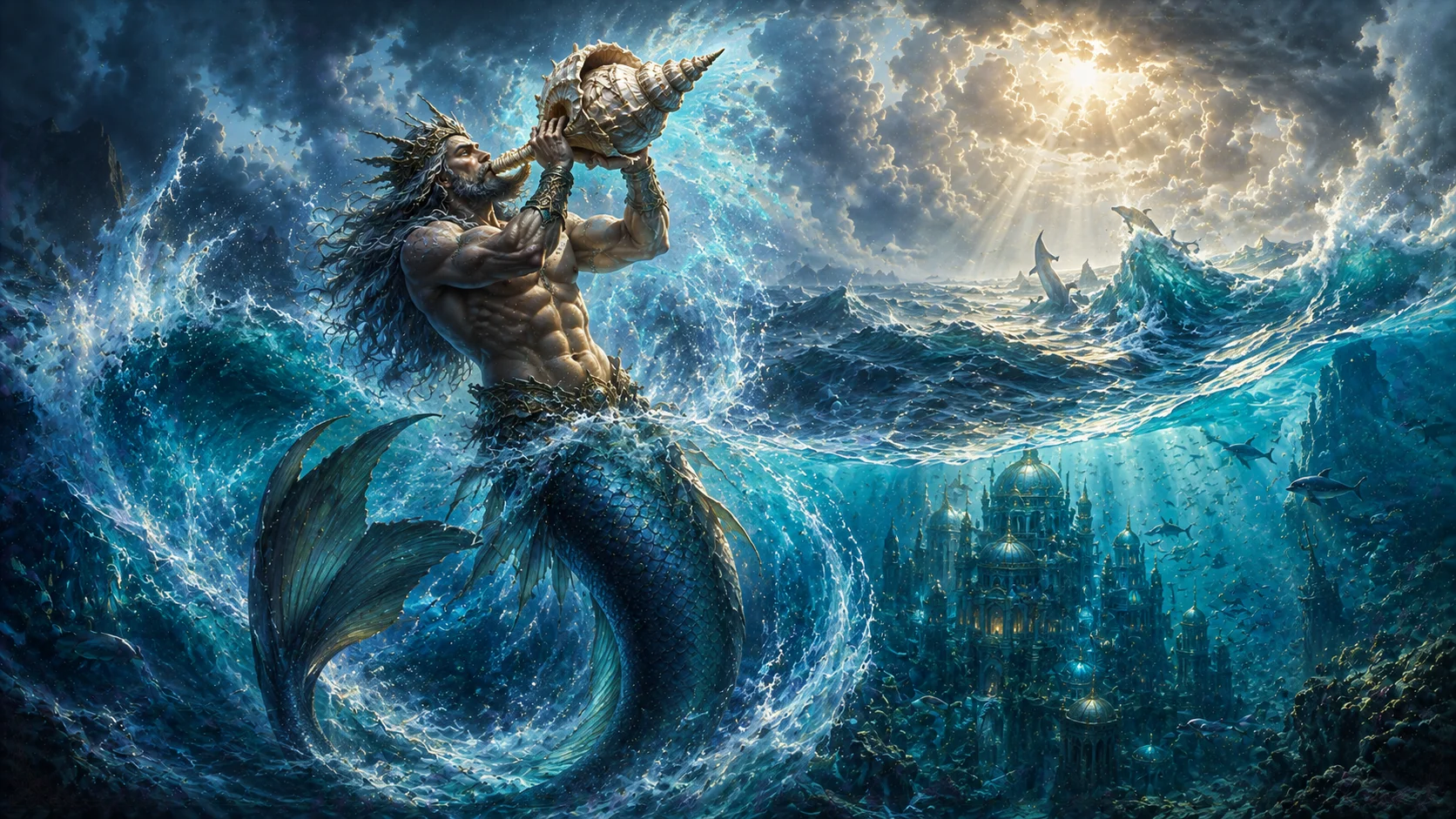
Triton was the great merman of Greek myth — the son and herald of Poseidon, a god from the waist up and a fish below, who calmed or raised the seas by blowing on his great conch-shell trumpet. Hesiod names him first, in the Theogony, and later storytellers built outward from that single figure into a whole undersea retinue that still bears his name.
Born Beneath the Waves
Triton's parentage is the oldest and most settled fact about him: Hesiod's Theogony names him son of Poseidon, lord of the sea, and Amphitrite, the sea-queen who ruled at his side. Hesiod places the family together in a golden palace beneath the sea, and it is there, among the currents and the coral halls of his father's court, that Triton is first imagined — not as an independent wanderer but as a son raised inside the sea-god's own house, closest of all beings to Poseidon's throne. This is the earliest surviving reference to him in Greek literature, and it fixes his identity for everything that follows: whatever later writers add to his story, they add to a figure who was, from the very first mention, defined by his household rather than by any conquest or deed of his own.
Kin of the Nereids
Through his mother, Triton belonged to a wider family of the deep. Amphitrite herself was reckoned among the fifty Nereids, the sea-nymph daughters of Nereus, so Triton grew up with his mother's sisters as his aunts — a household where the whole extended family was the sea itself, personified in every wave and current. He stood, by blood, at the center of the Greek imagination of the ocean: son of its king, nephew to its nymphs, and heir to no title but service. Where the Nereids were scattered across countless local cults up and down the Greek coastline, each attached to her own stretch of water, Triton remained singular in the earliest tradition — one son, one voice, standing apart from the crowd of aunts who filled the sea around him.
A Man Above, a Fish Below
Greek artists gave Triton a body unlike any other god's: a human torso, arms, and face joined at the waist to the long, muscular, scaled tail of a great fish — sometimes rendered with two tails coiling outward instead of one. This hybrid form was not shared by any other major Olympian or sea-spirit of his generation; it was Triton's alone, and it became so recognizable that it gave the Greek visual tradition its lasting template for a merman. Every fish-tailed man in later art and legend, right down to the word itself, traces its shape back to this one figure. Vase painters and sculptors returned to the same basic composition again and again — human strength above, sea-creature power below — precisely because the image did double duty: it showed a being who could stand among the gods and yet never leave the water that made him.
The Shell That Speaks for the Sea
Triton's signature possession was a great twisted conch shell, carried and sounded like a trumpet. This is his best-attested mythic function: blowing the shell to command the waves, calming the water when he sounded it gently and rousing it into roaring surf when he blew it hard and rough. The image fixed him permanently in the Greek mind as the sound of the sea made audible — not the sea's ruler, that was his father's role, but its voice, the herald whose trumpet carried Poseidon's will out across the water so that ships and shorelines alike could hear it coming. No other attribute of his survives so consistently across the sources: whatever else changes between one telling of Triton and another, the shell and its twin powers, to still the water or to summon a storm, remain constant.
Poseidon's Herald
That role — herald and trumpeter to the sea king — is the clearest description of what Triton actually did among the gods. Where Poseidon commanded, Triton announced; where the god's intent needed to travel across open water, the conch carried it. He was not a rival power in the sea's hierarchy but an instrument of his father's authority, standing in the same relation to Poseidon that a herald stood to any Greek king: present at the center of power, but defined by the message he carried rather than a throne of his own. It is a modest role by the standards of Greek divine biography, where so many figures are defined by conquest, rivalry, or transformation — Triton's whole identity rests instead on faithful service and a single unmistakable sound.
Guide Out of the Landlocked Lake
The fullest surviving story of Triton in action comes not from Hesiod but from Apollonius of Rhodes' Argonautica. There, a Triton — identified with a local Libyan sea-deity sometimes called Eurypylus — appears to the Argonauts after their ship becomes trapped in Lake Tritonis, an inland body of water in Libya with no clear outlet to the open sea. He guides their vessel through the lake and out to the sea beyond, and as a parting token he gives the crew a clod of earth, a small and strange gift that later tradition treated as significant, tying the hero Euphemus's line to Libyan soil. It is the one episode in which Triton steps fully into a narrative of his own, acting directly rather than simply sounding his shell in the background of someone else's story — a rare moment where the herald becomes, briefly, a guide and a giver of gifts in his own right.
The Lake and River That Bear His Name
Ancient writers linked Triton by name to real geography: Lake Tritonis and the Triton River in Libya were both connected etymologically to him in local tradition, with some accounts treating the lake as the very place of his birth or origin. This is one of the more unusual features of his myth — a Panhellenic sea-god whose name was, in at least one regional strand of legend, pinned to a specific inland lake and river far from the golden palace beneath the open sea that Hesiod describes. The two traditions, the cosmic herald of Poseidon's court and the local Libyan water-spirit of the Argonautica, sit side by side in the ancient sources rather than being fully merged into one clean biography, a reminder that Greek myth rarely settled a figure into a single, tidy account.
Father of Pallas, Foster-Guardian of Athena
Later mythography, chiefly Apollodorus's Bibliotheca, attaches Triton to one of the more striking stories involving Athena's youth. In one attested tradition, Triton fathered a daughter named Pallas; in a sparring contest between the two girls, Athena accidentally killed her, and out of grief and honor took the name Pallas Athena as an epithet in her memory. Apollodorus's account also holds that Triton served as foster-parent or guardian to the young Athena herself — placing the sea-god's household, briefly, at the center of one of the most important goddesses' own origin story, as the place where she was raised alongside a companion whose loss she carried in her name ever after. It is a striking pairing: the quiet herald of the waves, entrusted for a time with the upbringing of one of the greatest of the Olympians.
One Voice Becomes Many
Later Hellenistic and Roman mythographers took the singular, Hesiodic Triton and multiplied him into a whole class of minor sea-spirits — a plural race of Tritons, merman attendants who escorted Poseidon and Neptune through the waves, sounding their own conches in his wake. This was a distinct and later development from the original figure: where Hesiod knew one Triton, son and herald, the developed tradition populated the sea with many, a retinue of fish-tailed heralds rather than a single named son. The two layers — one Triton, many Tritons — coexist in the ancient sources without either erasing the other, and it is this later, plural sense that fed most directly into the decorative and artistic Triton familiar from later centuries.
Fountains, Moons, and a Nucleus
Triton's afterlife outlasted the myths that produced him. Roman and Renaissance artists made him a favorite ornament for fountains and public water-works — most famously in Bernini's Triton Fountain in Rome, where a muscular merman kneels on a shell and raises a conch to his lips in stone, the same gesture Hesiod's readers would have recognized. His name was later given to Neptune's largest moon, fittingly attached to the planet named for the Roman sea-god his father had become, and to the physics term triton, the nucleus of hydrogen-3 — a name chosen, like the moon's, simply because it belonged to the sea already. Across sculpture, astronomy, and physics, the borrowing follows the same logic each time: whenever something needed a name evoking the sea's voice or its depths, Triton's was the one already waiting.
When the sea suddenly calms or suddenly rages, the old Greeks heard it: the merman's conch, sounding the will of the deep.
Sources & traditions
- EncyclopediaWikipedia — Triton (mythology)
- TraditionGreek texts, inscriptions and later retellings (Greece)
Myths change from area to area and from time to time. This chronicle follows the most widely told versions; tellings in other villages, regions and eras may differ.